What Is SEPA Transfer? Timings, Costs and UK Rules
Published
A SEPA transfer is a euro credit transfer sent between banks in the Single Euro Payments Area under common scheme rules, and UK banks can still send and receive them. The scheme sets the route, while each bank sets the speed and price.
That split is where most confusion starts. If the UK is still connected, why can one euro payment arrive tomorrow, another take longer, and a third cost more than expected? The answer isn't hidden in the word SEPA itself. It's in the difference between a shared payment standard and the service your own provider offers.
Table of Contents
- What a SEPA Transfer Is in Plain Terms
- Which Countries and Currencies a SEPA Transfer Covers
- SEPA Transfers Compared with Other UK Payment Routes and Rules
- How a SEPA Transfer Moves Money, Step by Step
- How Long a SEPA Transfer Takes in Practice
- What a SEPA Transfer Costs and Where Fees Hide
- Check These Details Before Your First Euro Payment
What a SEPA Transfer Is in Plain Terms
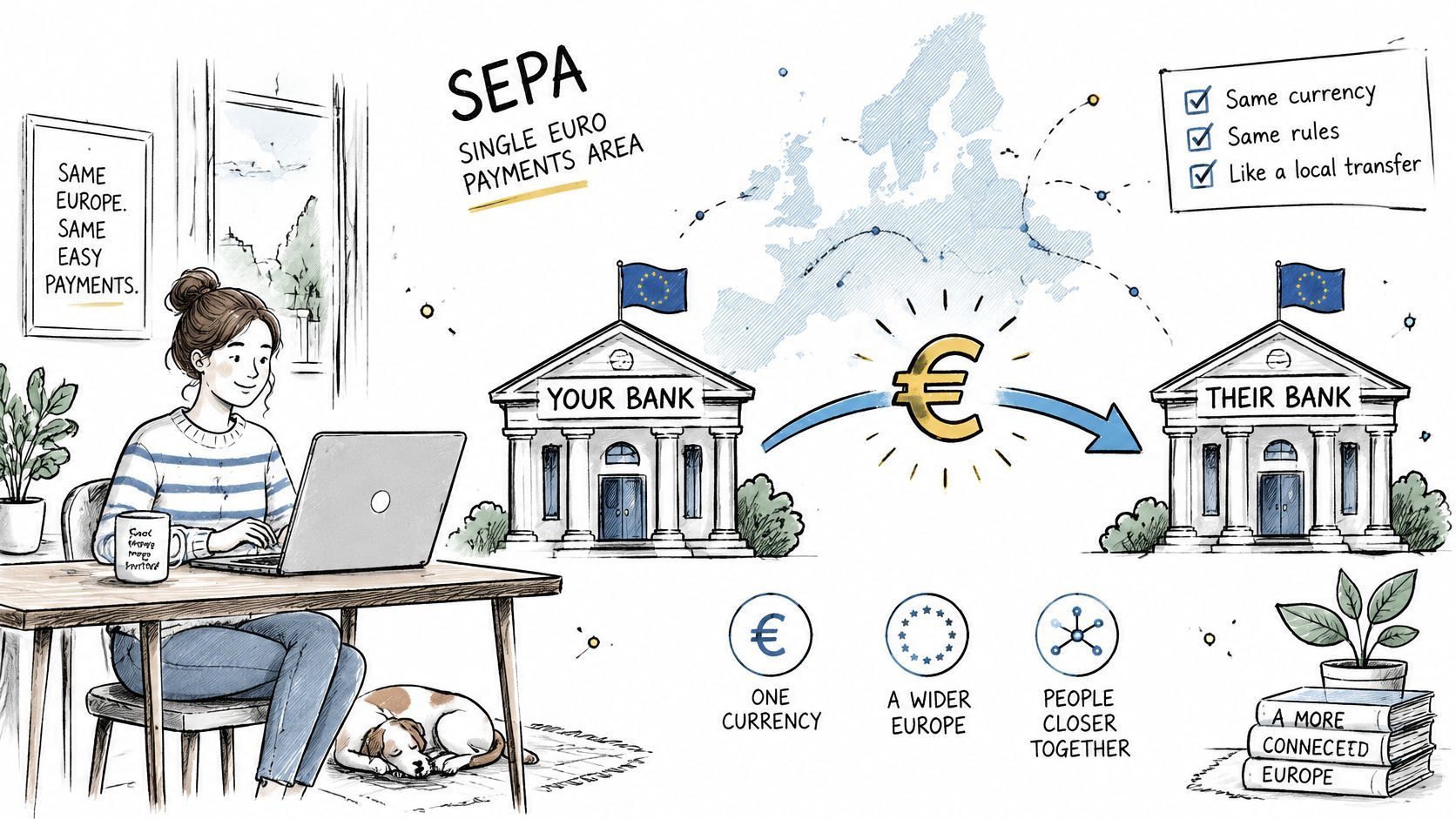
A SEPA transfer is a euro credit transfer made within the Single Euro Payments Area, using standardised schemes so euro payments between participating countries can operate similarly to domestic bank transfers. That's the plain definition of What Is SEPA Transfer in practice. It's a route for moving euros, not a special account and not a promise that every payment is instant or free.
Think of railway track width. If trains from different countries run on the same gauge, they can cross borders without changing wheels. SEPA does something similar for banks. They use one shared payment format, so a payment instruction built in one country can be read and processed in another.
Who Pushes the Money
A credit transfer means the payer starts the movement. The payer tells the institution holding its account to move funds to a beneficiary. The money may pass through intermediary institutions and payment systems before it reaches the beneficiary's provider.
Say a Manchester design studio owes a supplier in Lisbon €4,200. The studio enters the supplier's IBAN and the euro amount. Its provider sends the instruction through the SEPA route, and the supplier's provider credits the account named by that IBAN.
The UK Position After Brexit
The UK remains connected to SEPA schemes for euro payments after leaving the EU. A UK account can potentially send or receive SEPA euro payments even though the UK is outside the euro area and no longer an EU member. The Bank of England 2020 UK to EU checklist stated that UK payment service providers, including banks, used SEPA schemes for lower-value euro payments such as business-to-business transfers, mortgage payments and salary payments.
That same checklist warned that UK to EU payments could require additional information, including payer addresses, after the Brexit transition period. So the route stayed open, but the data checks around it changed.
Practical rule: Keep three things separate. The currency is euro, the route is the SEPA scheme, and the speed and price are set by each bank.
Don't merge those three ideas when you're planning a payment. A sterling transfer to Leeds uses UK domestic rails such as Faster Payments or Bacs. A euro transfer to Lisbon can use SEPA, provided both providers support that route for the payment in question.
Which Countries and Currencies a SEPA Transfer Covers
Start with the currency test. A SEPA transfer is always a euro payment. If you're paying in Swedish kronor or Polish zloty, you're not making a SEPA transfer, even if the supplier sits inside the EU.
That sounds obvious, yet it's a common mistake in accounts payable. Teams often check the country first and the currency second. Reverse that order. Ask whether the invoice is denominated in euros, then ask whether the destination falls inside the scheme.
Apply the Geography Test Second
SEPA covers the euro area plus further European countries that participate in the scheme. Don't rely on a remembered list from an old supplier form. Check the European Payments Council's current list of participating countries, because participation can change and your payment file should reflect the current position.
- Inside the test: A Glasgow printer pays a supplier in Porto in euros. The currency fits, and the destination is a participating country.
- Outside the test: The same printer pays a supplier in Stockholm in kronor. The currency doesn't fit, so the payment follows a different route.
- Needs checking: The invoice is in euros, but you're unsure whether the receiving institution participates. Confirm that point before you promise a delivery date.
What UK Access Does and Does Not Bring
A UK sterling account can still send euros to a SEPA beneficiary. Your provider converts sterling to euro first, then sends the euro payment. That conversion is part of your bank's service, not something the scheme does for free.
The UK is also outside the euro area, so EU-law provisions such as equal charges don't automatically apply to UK firms. Scheme compatibility tells you a payment can be routed. Your provider's tariff, foreign exchange spread, cut-off and compliance checks decide what it costs and when it arrives.
Don't assume an EU pricing protection travels with a UK payment just because the payment uses a European scheme.
If you're choosing accounts for regular euro revenue and supplier payments, it's worth taking time to compare international banking options for founders against three practical questions. Does the provider offer a euro account or convert funds into sterling on receipt? What fee model applies? Have you tested payments in both directions before you rely on the route for payroll or supplier settlement?
Whether a payment qualifies comes down to its currency, the locations of the two providers and the receiving institution's participation.
SEPA Transfers Compared with Other UK Payment Routes and Rules
Use the table to narrow the route before you open online banking. Read across for currency, timing, reach and the main limit.
| Route | Currency | Typical timing | Where it works | Main limit |
|---|---|---|---|---|
| SEPA Credit Transfer (SCT) | Euro | Next business day at the latest | SEPA countries | Not instant; bank cut-off times apply |
| SEPA Instant (SCT Inst) | Euro | Within seconds, 24/7 where offered | Participating SEPA banks | Needs both banks to offer it |
| Faster Payments | Sterling | Usually within seconds, 24/7 | UK | Not for euro payments |
| CHAPS | Sterling | Same day, during banking hours | UK | Mainly suited to high-value sterling payments |
| SWIFT international transfer | Any currency | Often one to several business days | Worldwide | Intermediary fees and less predictable timing |
Three Filters Pick the Route
First, check the currency. Second, check whether the receiving bank sits inside SEPA. Third, decide how fast the money must arrive. Those three answers usually leave you with one sensible route.
The second filter has a UK legal shape. Under the retained SEPA framework on legislation.gov.uk, a qualifying-area transaction exists where both the payer's and payee's providers are in the UK, where one provider is in the UK and the other is in another qualifying state, or where the sole provider involved is located in the UK. The framework also requires interoperability, so the rules for UK credit transfers must be the same as those for cross-border credit transfers within the qualifying area, with the same principle for direct debits.
That scope isn't endless. For transfers between two UK providers in a currency other than sterling or euro, the UK amount and execution-time rules apply only to the UK parts of the transaction. Classify by currency, provider location and route before you quote a statutory deadline.
Two Worked Choices
A £12,000 invoice to a supplier in Leeds is sterling and domestic, so it goes by Faster Payments. A €12,000 invoice to a supplier in Munich goes by SEPA Credit Transfer when next-business-day arrival is acceptable. It goes by SEPA Instant only when it must arrive in seconds and both banks support that service.
Our guide to how Faster Payments works in the UK helps if you're weighing the sterling side of that choice. If you're also sorting account details on invoices, this explainer on banking identifiers for international invoice payments sets out how the identifiers differ.
The timing column describes what the scheme allows. It isn't a promise from your bank for a specific payment.
SWIFT is the fallback outside the scheme, not the default inside it. A euro payment to a SEPA bank starts with SEPA, a sterling payment uses UK domestic rails, and you should record each classification in your compliance review before quoting a deadline.
How a SEPA Transfer Moves Money, Step by Step
Follow one payment from keyboard to credit. Each step exists for a reason, and most delays happen because a step can't complete cleanly.
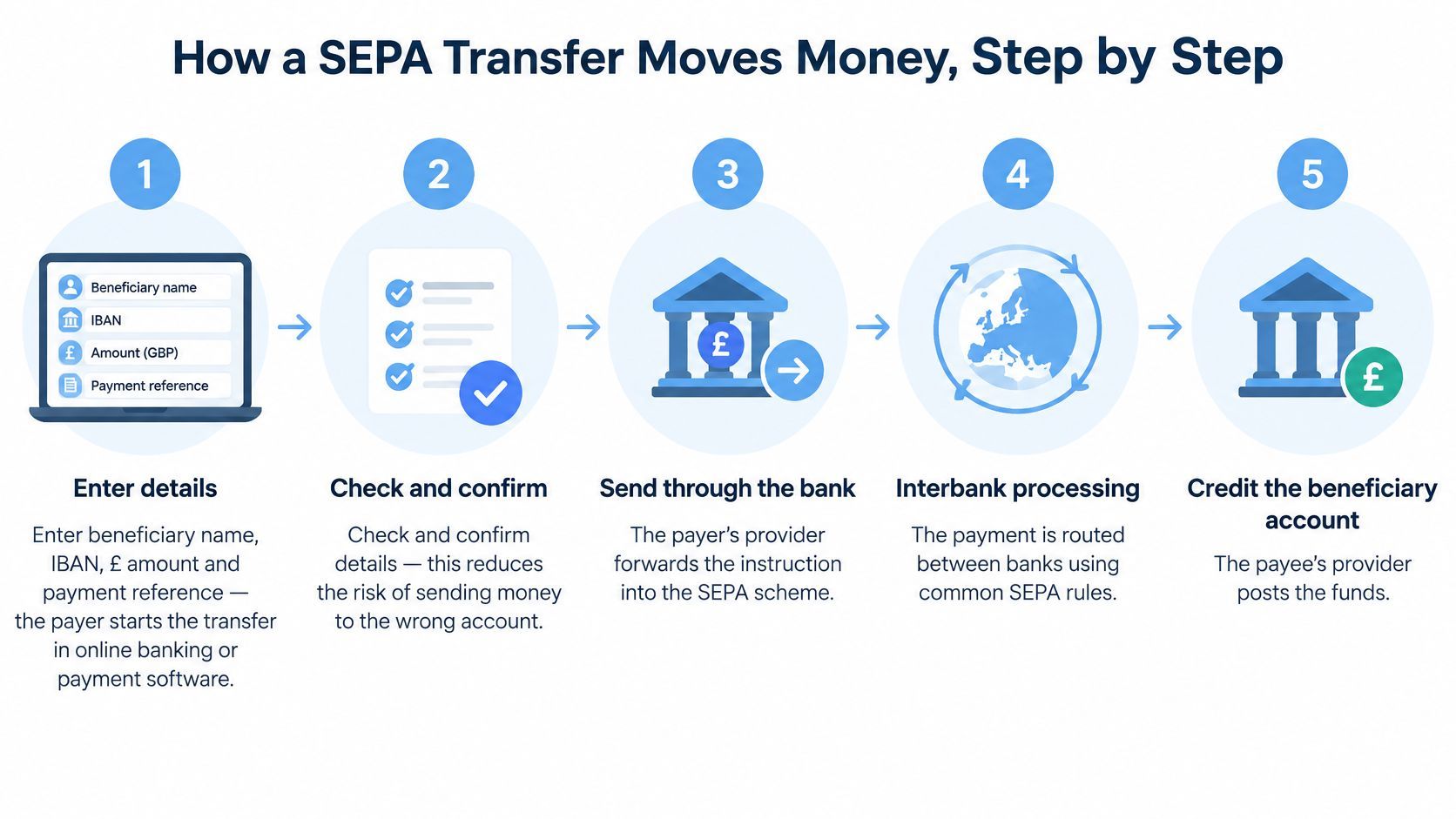
Think of a parcel. You write the label, each carrier reads it and passes the parcel on, and the final carrier delivers it. The IBAN and reference are the label. If the label is wrong or incomplete, the parcel doesn't move faster because you chose a good network.
The Six Steps
- Enter the payment details: The payer adds the beneficiary name, IBAN, euro amount and payment reference in online banking or payment software. The reference matters because it's how the supplier matches money to an invoice.
- Check before release: The payer's provider checks the IBAN format and available funds, then runs sanctions screening. Your own team should also validate the beneficiary name, currency and purpose-of-payment controls at this point.
- Derive the BIC from the IBAN: You don't normally supply the beneficiary bank's BIC separately. Since October 2016, UK SEPA payments have used the IBAN-only approach, with the sending or receiving provider deriving the relevant BIC from the IBAN, as Pay.UK's SEPA IBAN-only directory service explains.
- Send the structured instruction: The instruction travels through the payment system to the beneficiary's provider, possibly via intermediaries. UK implementation uses ISO 20022 XML messaging, so providers exchange structured payment data consistently rather than retyping free-text details.
- Credit the beneficiary: The beneficiary's provider screens the payment, applies its own rules and credits the account identified by the IBAN. This step sits outside your control, which is why arrival and availability aren't always the same moment.
- Reconcile both sides: Your team matches the debit to the invoice or payroll file. The supplier matches the credit to the reference you sent. A vague reference creates manual work at both ends.
What the IBAN Proves and What It Doesn't
A correct IBAN is necessary for routing. It tells the system which account to credit. It doesn't prove that account belongs to the named supplier, and it doesn't remove fraud, compliance or account-ownership risk.
A correct IBAN sends money to the right account number. Your name checks and approval controls decide whether that account is the right supplier.
That's why a finance team shouldn't treat a supplier's new IBAN on an emailed invoice as self-verifying. Call a known contact on a number you already hold. Confirm the change outside the email thread that delivered it. Then release the payment.
The account you hold also shapes this process. If you're deciding between a traditional bank account and an electronic money account for euro payments, check whether the provider gives you your own IBAN, supports SEPA in both directions, and shows screening holds clearly in its platform.
SEPA standardises payment connectivity between providers. It doesn't standardise the commercial relationship between you and your supplier, and it doesn't replace your fraud controls.
How Long a SEPA Transfer Takes in Practice
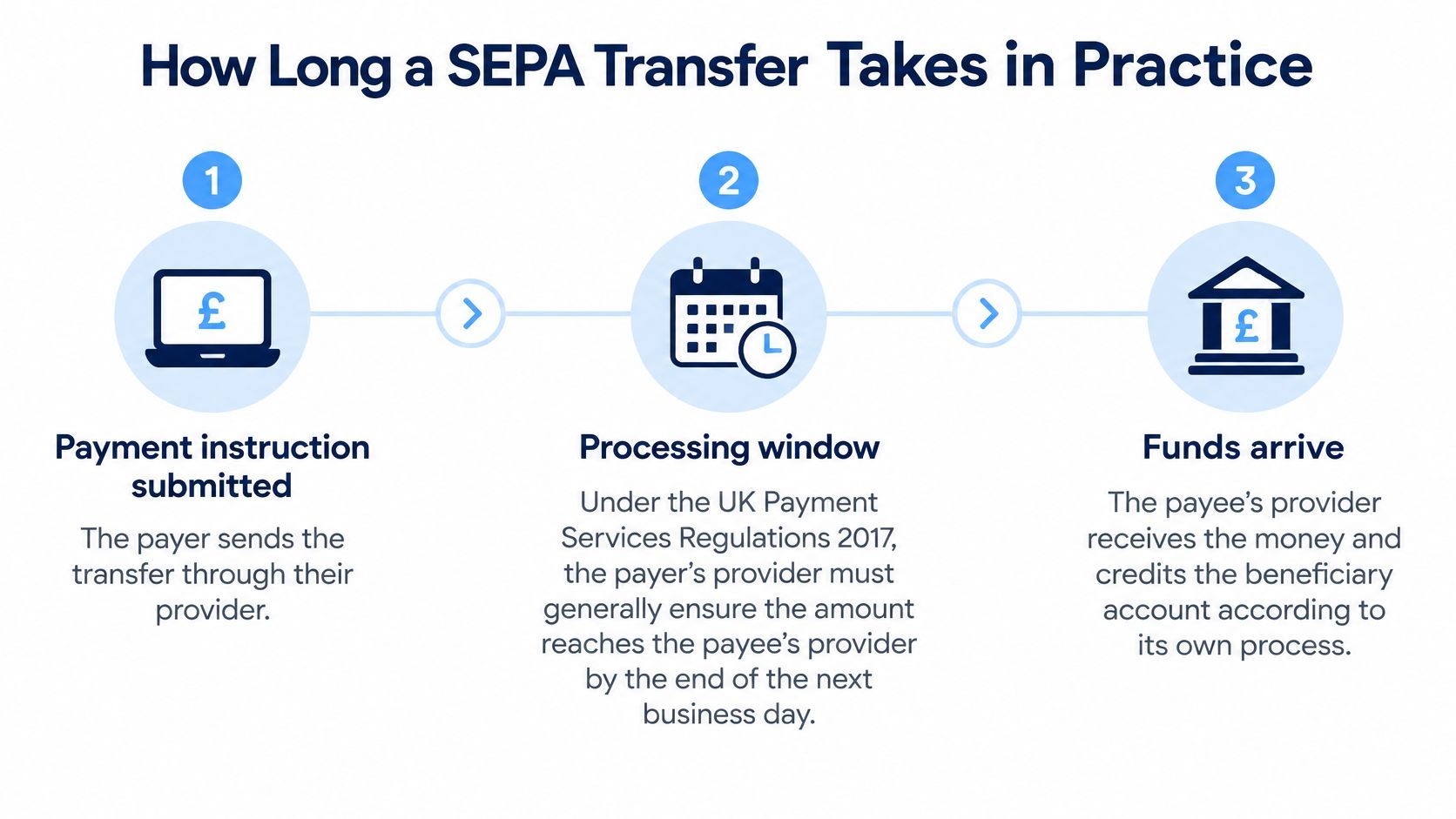
Timing becomes predictable once you know the legal starting point. For transactions within scope, the UK Payment Services Regulations 2017 generally require the payer's provider to ensure the amount reaches the payee's provider by the end of the business day following receipt of the payment order.
Read that sentence slowly. It sets a deadline for money reaching the payee's provider. It doesn't say the beneficiary can spend the money at that exact minute.
| Moment | When it happens | Who controls it |
|---|---|---|
| Order received | Accepted before the provider's cut-off on a business day | Your own bank's cut-off times |
| Funds reach payee's provider | By the end of the business day after receipt under the PSRs 2017 | The payer's provider |
| Funds usable by beneficiary | After the payee's bank credits the account and completes its screening | The payee's bank |
| SEPA Instant | Usually within seconds, where both banks offer it | Both banks' service and enrolment |
Why a Payment Slips a Day
Three moments get merged in everyday conversation. There's the moment your order counts as received, the moment money reaches the beneficiary's bank, and the moment the customer can use the funds. Cut-offs sit between the first two. Weekends, bank holidays, batch processing and screening holds stretch the rest.
Say your bank's cut-off is 16:00 and you send a payroll file at 16:40 on a Friday. Your order is treated as received on Monday, the next business day. Staff shouldn't expect euros on Friday, even though you pressed send on Friday afternoon.
On a normal timeline, Day 0 is submission before cut-off. Day 1 is when funds reach the payee's provider. Day 1 or Day 2 is when the credit appears and the account is updated. Your supplier cares about the last moment, so quote that one cautiously.
SEPA Instant is the exception, usually arriving within seconds. But it only works where both banks offer it, and UK providers aren't automatically subject to EU instant-payment deadlines just because the UK remains within SEPA's geographical scope. Confirm availability per route instead of assuming it.
What a SEPA Transfer Costs and Where Fees Hide
SEPA doesn't set your price. Your bank does. That single point explains why two firms can send the same euro amount on the same day and pay different totals.
| Cost driver | Who usually charges it | What to check |
|---|---|---|
| Sending bank fee | The payer's bank | Tariff for outgoing euro payments, and whether it is per transfer or bundled |
| Receiving bank fee | The beneficiary's bank | Whether it is deducted before crediting the payee, and whether the deduction is disclosed |
| Currency conversion margin | The payer's provider, when converting sterling to euro | Spread over the mid-market rate, shown in the quote rather than as a fee |
| Shared charges (SHA) | Each bank, for its own part | Confirm the order is set to shared charges and does not force the payee to bear the full cost |
| Instant payment surcharge | The payer's bank | Whether SEPA Instant costs more than standard SEPA Credit Transfer on your tariff |
| Intermediary fees | Banks on legs outside SEPA | Whether the route leaves SEPA and which intermediary deducts a fee |
Shared Charges and the Full Amount
The standard SEPA approach is shared charges, often shown as SHA. You pay your own bank, the payee pays its own bank, and charges aren't deducted from the amount in transit. That protects the invoice amount as it travels.
There's a disclosed exception. A payee and its provider can agree that the provider's charge is deducted before crediting the payee, but the payment amount and the charge must be clearly disclosed. An unexplained shortfall isn't the same thing. If your supplier reports receiving less, ask which provider deducted what, and under which agreement.
The Cost You Can't See on a Fee Line
The currency conversion margin is the cost most readers miss. When a sterling account pays euros, your provider builds its margin into the exchange rate you're quoted. It won't appear as a separate fee, and on a larger payment it can outweigh the transfer fee itself.
Check two smaller items too. Ask whether SEPA Instant carries a surcharge over standard SEPA Credit Transfer on your tariff, and whether any leg of the route leaves SEPA and attracts intermediary fees. EU equal-charges protections don't automatically apply to UK firms, so read your provider's own tariff rather than relying on a general European rule.
If you're comparing how payment charges are presented to customers, this breakdown of checkout costs for services and products shows why a single headline fee rarely tells the whole story. The same habit applies when you review UK online payment systems and their charges for domestic receipts.
Run a test before you argue about tariffs. Send €10,000, compare the amount received with the amount sent, and calculate the total cost as a percentage.
That percentage is the number to compare across providers. A low transfer fee with a wide exchange-rate margin can cost you more than a higher fee with a tight margin.
Check These Details Before Your First Euro Payment
Run this as a pre-flight routine before your first live euro payment, not after a supplier complains. Work down the list in order, because later checks assume the earlier ones are settled.
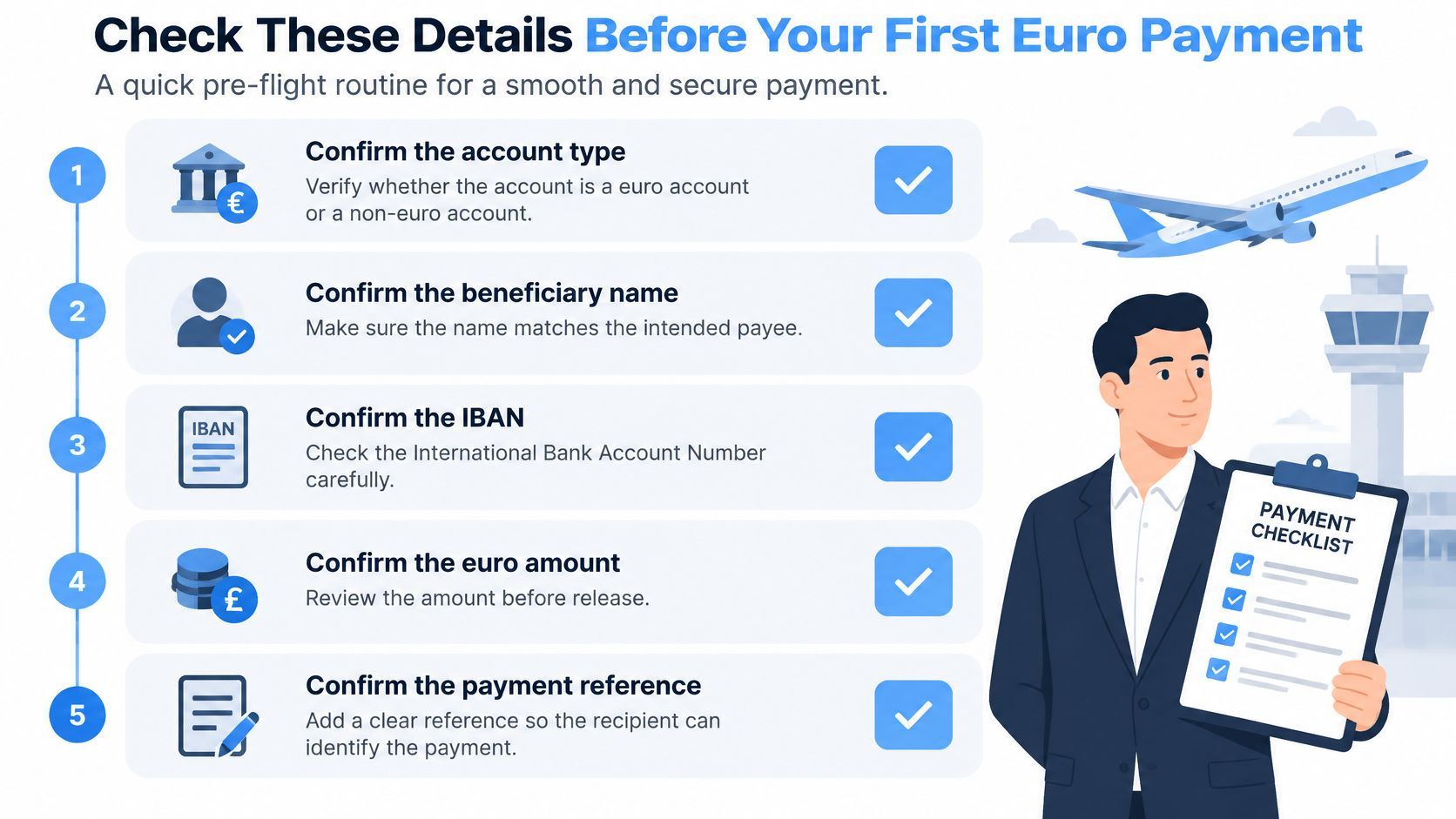
- Confirm the account type: Establish whether you're paying from a euro account or a sterling account that converts. If it converts, read the margin in the quote, not just the fee.
- Confirm instant availability: Check that SEPA Instant is enabled at both banks before you promise arrival within seconds. One-sided support means a standard timeline.
- Confirm the payer data: UK to EU payments may require a full address, an official identification number, a customer-identification number, or date and place of birth. Missing information can cause rejection or delay.
- Agree shared charges: Set each order to SHA and check the order instructions show it. Tell the supplier what to expect before the first payment lands.
- Record your cut-offs: Write your provider's cut-off times into payroll and supplier calendars. The Friday payroll case, sent after cut-off and treated as received on Monday, is the one to design around.
- Check IBAN acceptance: Confirm your provider and counterparties accept valid GB IBANs. Refusing a valid IBAN can breach SEPA rules, but you'll still need a named escalation contact when it happens.
- Send test payments: Send a small payment in each direction and run the cost test. Confirm the reference arrives intact and your team can reconcile it without manual detective work.
- Confirm your controls: Check that name checks, sanctions screening and purpose-of-payment controls are in place, and match every payment to an invoice or payroll line.
Our guide to opening and using a SEPA bank account goes deeper on the account side of items one and seven. Use it when you're comparing providers, not after you've already committed payroll to an untested route.
If your euro payments form part of a wider authorisation project, we start by examining your planned activities, jurisdiction, existing material and open questions, then agreeing the work, deliverables and responsibilities. That first step stops payment assumptions, such as instant settlement or a particular IBAN arrangement, from being written into an application before anyone has tested them.
If you're building euro payment flows into a regulated business plan, Glentorion helps you test your assumptions about accounts, providers and controls before they reach a regulator. We scope the work around your planned activities and jurisdiction, then prepare and review the application material with you. Visit Glentorion to discuss your route and what evidence you'll need.
- SEPA transfer
- euro payments
- SEPA credit transfer
- UK business payments
- IBAN transfers