SEPA Bank Account Guide: How It Works for UK Businesses
Published
If your UK business already has a current account, do you really need a separate SEPA bank account, or do you just need a bank that can reach the right euro payment rails? That distinction matters more than the label attached to the account.
After Brexit, UK businesses can still send and receive euro payments through SEPA, but support varies by bank and provider. The practical questions concern IBAN and BIC handling, transfer types, settlement timing, foreign exchange, fees, direct debit protections, and operational controls. Choose the wrong provider and a supposedly simple euro payment process can create failed collections, unexpected conversion costs, and avoidable reconciliation work.
Table of Contents
- The SEPA Account Myth UK Businesses Should Drop
- How SEPA Works and Why the UK Still Participates
- Eligibility and Requirements for UK Business SEPA Payments
- SEPA Direct Debit Schemes Compared - Core vs B2B
- Payment Flows and Settlement Realities for UK Firms
- How to Choose a UK Bank for Reliable SEPA Operations
- Next Steps for UK Businesses Moving to SEPA Payments
The SEPA Account Myth UK Businesses Should Drop
You don't need a special account called a “SEPA bank account” just because your business needs to send or receive euros. SEPA is a payment scheme, not a bank account type, and a standard UK business account may support SEPA payments if the bank has enabled the relevant services. The FCA's consumer explanation of SEPA makes the distinction clear: SEPA concerns euro payments across participating countries, not a separate category of bank account.
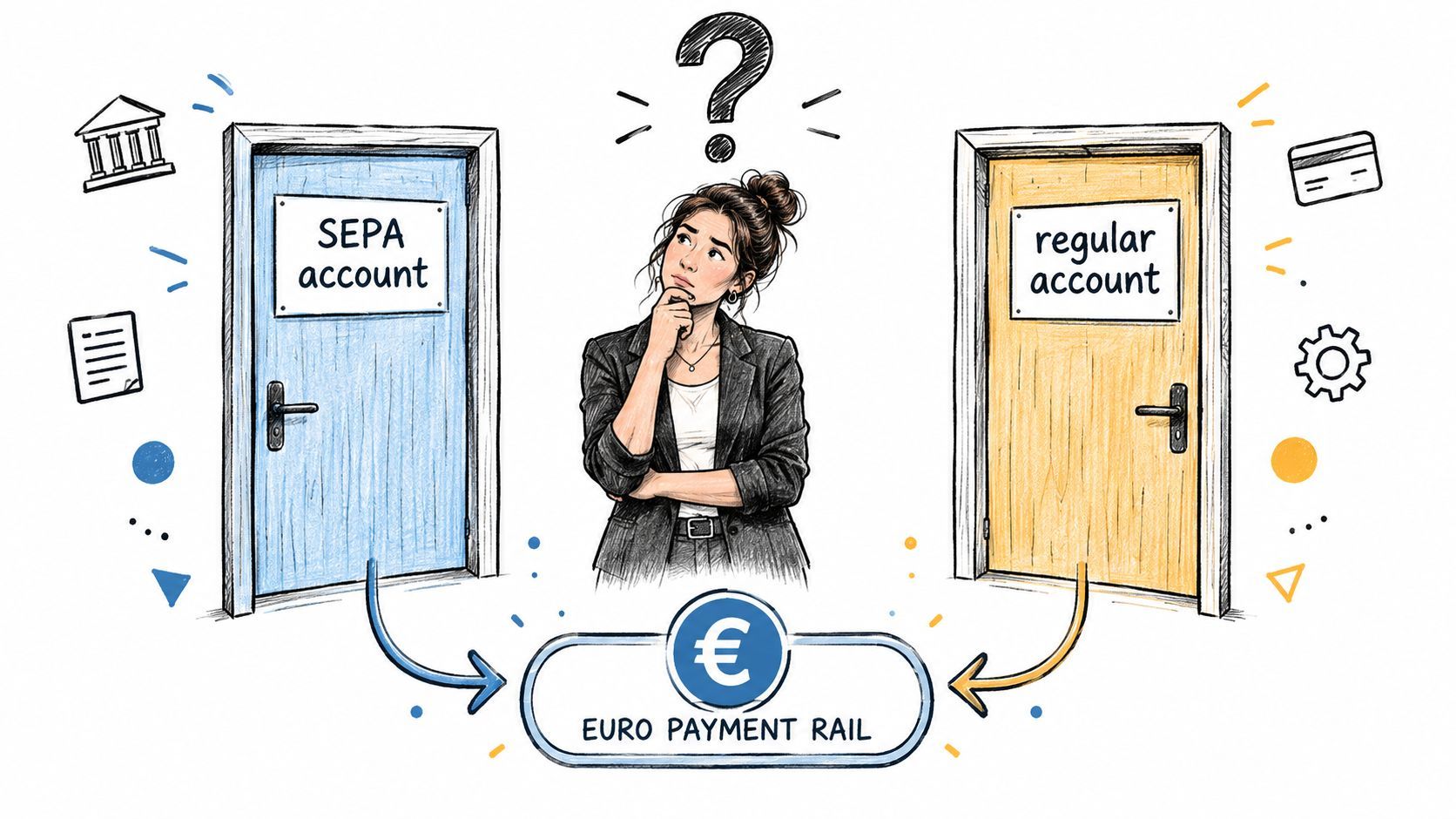
The mistake is treating account branding as proof of payment capability. A bank might offer a sterling current account that can send euro credit transfers, a dedicated euro balance, SEPA Direct Debit collection, or only some of these services. Those are different capabilities with different pricing and onboarding requirements.
Ask the bank the operational questions
Before assuming your existing account is suitable, ask:
- Outgoing payments: Can the account send standard SEPA Credit Transfers in euros?
- Incoming payments: Can customers and suppliers pay the account using the expected IBAN?
- Direct debit: Can the business collect SEPA Direct Debits, and under which scheme?
- Identifiers: How does the bank handle IBAN and BIC validation?
- Pricing: What fees apply to transfers, account maintenance, rejected payments, and currency conversion?
- Controls: What approval, cut-off, screening, and beneficiary-verification processes apply?
The right conclusion isn't “every UK account works” or “every business needs a euro account”. It's that bank reachability and service configuration matter more than the account name. A dedicated euro account can be useful for reducing unnecessary conversions and separating euro cash flows, but it doesn't automatically provide SEPA Direct Debit or instant payment functionality.
Practical rule: Treat “SEPA account” as a search term, not a product specification. Verify the exact payment services in writing.
How SEPA Works and Why the UK Still Participates
Why does SEPA still matter to UK businesses after Brexit? Because the UK left the EU, not the SEPA payment schemes. SEPA launched in 2008, introducing euro credit transfers that year and direct debits in 2009. It became fully operational across eurozone countries in 2014, establishing shared rules and formats for cross-border euro payments. The European Payments Council background records the UK's continued participation after Brexit.
The European Payments Council approved the UK's retention in SEPA in 2019. By 1 January 2021, the UK had left the EU but remained involved in SEPA schemes as a non-EEA member. Brexit changed the UK's political and legal relationship with the EU. It did not remove UK banks from the SEPA payment infrastructure.
What the scheme covers
SEPA supports three main euro payment instruments:
- SEPA Credit Transfer, initiated by the payer.
- SEPA Direct Debit, initiated by the payee under a valid mandate.
- SEPA Instant Credit Transfer, intended for near-immediate euro transfers where the banks and services involved support it.
SEPA is a payment framework, not a UK banking product. It does not convert a sterling account into a euro account. Instead, it standardises how participating institutions process euro payments. Each bank still sets its own service scope, charges, onboarding requirements, cut-off times, and settlement arrangements. That distinction matters when comparing UK providers.
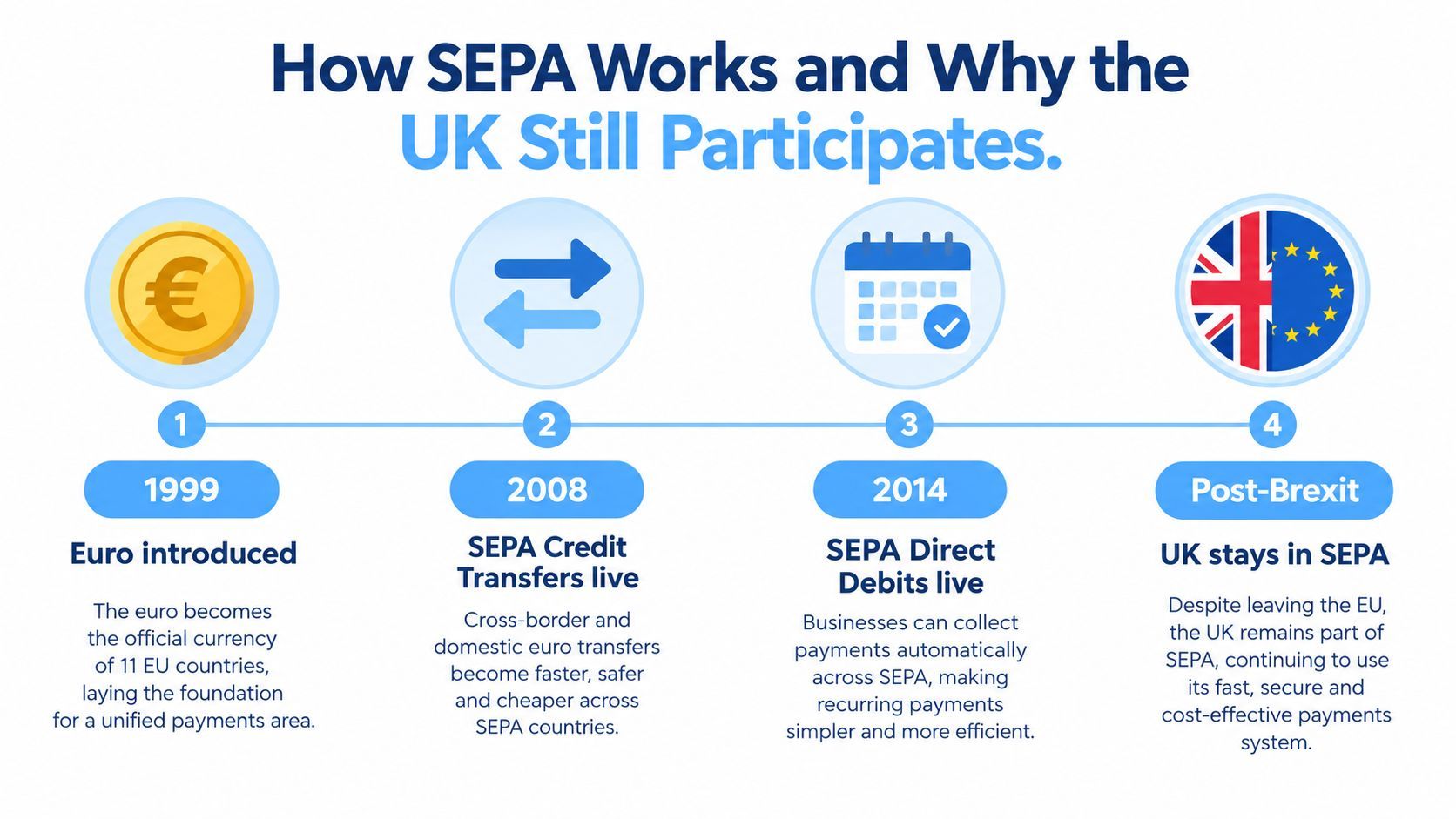
For UK firms, participation means a UK bank can remain reachable for euro SEPA payments even though the UK is outside the EU and SEPA is not a domestic UK account system. The scheme currently spans 36 countries across Europe, including non-EU participants such as the UK, according to the European Payments Council. For a practical explanation of SEPA payment types and UK usage, see Wise's UK guide to SEPA payments.
Participation does not guarantee identical service between providers. One bank may support standard credit transfers but not direct debit collections. Another may process euro payments while applying less favourable foreign exchange terms. SEPA supplies the common framework. Your provider determines how usable that framework is for your business.
Eligibility and Requirements for UK Business SEPA Payments
A UK business will usually need an eligible business account with a bank or payment provider that supports the relevant SEPA service. For an ordinary euro credit transfer, the essential information is the beneficiary's IBAN, with BIC used where required for routing and account identification.
The IBAN identifies the recipient's account in an internationally standardised format. The BIC identifies the bank. UK payment journeys should not force the payer to enter a BIC as a condition of initiating a euro payment, because the FCA's SEPA requirements for firms state that firms must not make BIC provision mandatory for initiation.
What the FCA rule means in practice
For a UK payment journey, the customer or finance user should provide the IBAN. UK Finance and SWIFT operate a SEPA IBAN-only directory that can derive the relevant BIC from a GB IBAN when the receiving bank requires it. This removes an unnecessary user-input dependency while preserving routing accuracy.
That doesn't mean finance teams can ignore BIC data. Banks still use both IBAN and BIC in operational processing, and RBS business guidance explains the practical role of these identifiers. The correct approach is to collect reliable beneficiary data, validate it, and let the payment system apply the relevant routing rules.
Build the control around the beneficiary
At onboarding, capture the beneficiary's legal name, IBAN, bank country, currency, payment purpose where relevant, and any required BIC data. Your payment system should validate the IBAN before release and flag changes to beneficiary details for independent verification.
SEPA Credit Transfers from the UK are EUR-only. They aren't a substitute for sterling Faster Payments, and they aren't the right rail for every international currency or urgent payment. HSBC Innovation Banking's SEPA guidance describes the rail as suitable for standard euro transfers, typically clearing within one working day.
Direct debit introduces a different control model. The payer gives consent through a mandate, the payee initiates the collection, and the business must manage mandate records, collection timing, returns, and refund exposure. Don't approve a provider on the basis of outgoing euro transfers if your business model depends on recurring collections.
SEPA Direct Debit Schemes Compared - Core vs B2B
Choosing between SEPA Direct Debit Core and SEPA Direct Debit Business-to-Business is a customer and risk decision, not merely a technical setting. The Core scheme is intended for consumers, SMEs, and corporates, including micro-enterprises. The B2B scheme is for business customers who are non-consumers and aren't classified in the UK as micro-enterprises, as set out in Paytia's explanation of the direct debit schemes.
The refund position is the major commercial difference. Under Core, the payer has 8 weeks to request a refund without providing a reason, and an unauthorised Core mandate may be challenged within 13 months. Under B2B, there are no refund rights under the scheme.
| Feature | Core Scheme | Business-to-Business Scheme |
|---|---|---|
| Intended users | Consumers, SMEs, corporates and micro-enterprises | Business customers that are not consumers or UK micro-enterprises |
| Mandate model | Suitable for consumer and broader business collections | Designed for business-to-business collections |
| Refund without giving a reason | Available within 8 weeks | No refund right |
| Unauthorised collection | May be challenged within 13 months where the Core mandate wasn't authorised | No equivalent scheme refund right |
| Best fit | Subscriptions, memberships, utilities and broad customer bases | Controlled B2B billing with agreed mandate verification |
| Risk profile for the payee | Greater payer protection and collection reversal exposure | Lower refund exposure, but narrower eligibility and stronger process expectations |
A sterling account can be used for SEPA Direct Debit collection, but the bank will convert the collected euro amount through foreign exchange and apply fees. RBS's SEPA Direct Debit guidance confirms that non-euro accounts can be used, while warning that conversion and charges apply.
Choose Core when your customer base includes consumers, smaller businesses, or micro-enterprises. Choose B2B only when your customers qualify and your mandate process can support the scheme's stricter business-to-business design. A provider that offers both should explain how it verifies mandates, handles returns, and reports collection status before you go live.
Payment Flows and Settlement Realities for UK Firms
What happens after a UK business submits a euro payment through its bank? A standard SEPA Credit Transfer follows four stages: the business sends the instruction, the bank validates it, the payment travels through the relevant SEPA clearing route, and the beneficiary's bank settles the euro funds. The payment is EUR-only, and standard transfers typically clear within one working day, subject to cut-off times, validation checks, and compliance controls.
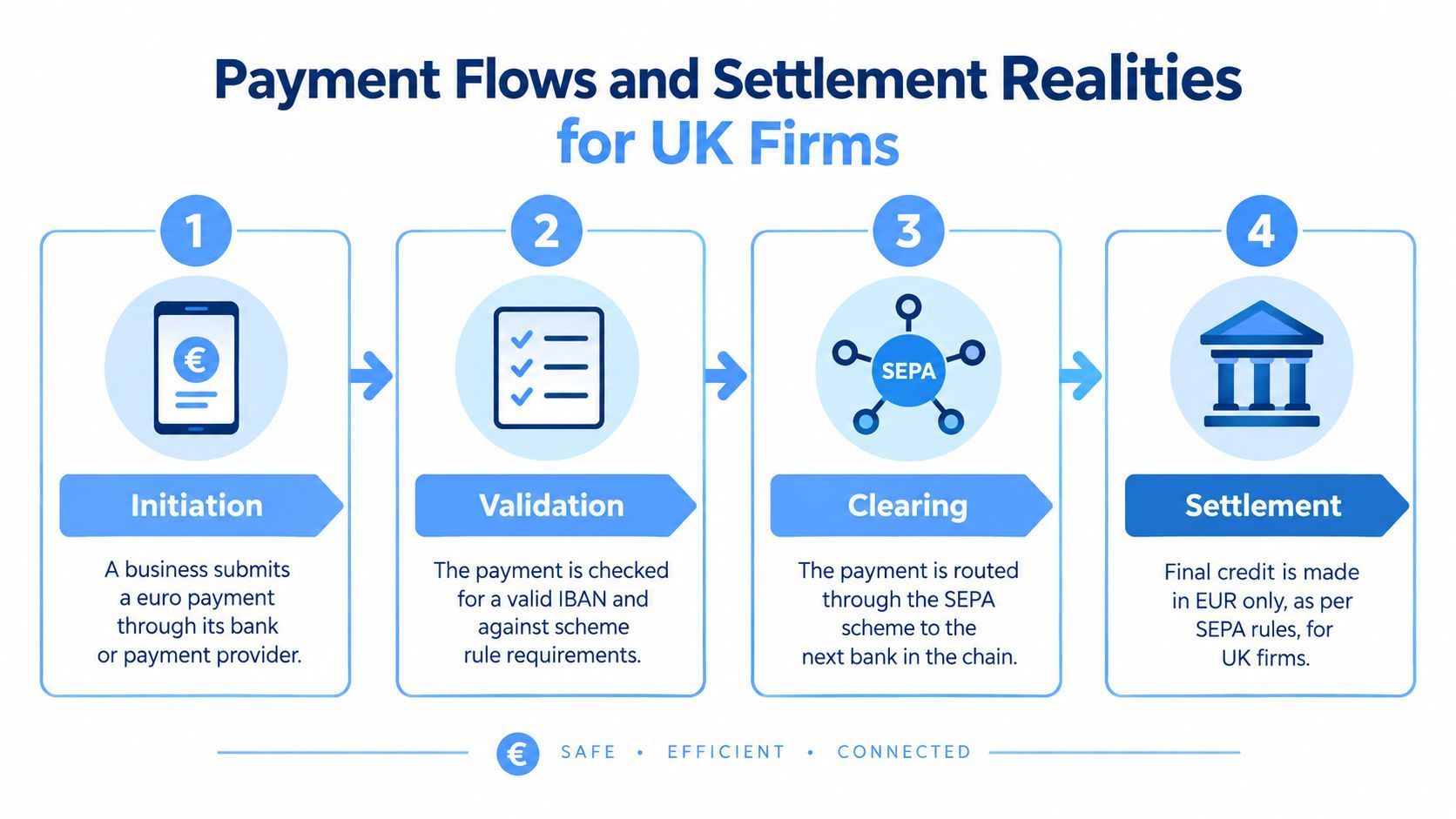
Submission and settlement are different events. An instruction entered after the bank's cut-off may wait until the next working day. An incorrect IBAN, screening hold, unavailable beneficiary bank, or insufficient euro balance can add further delay. UK firms should therefore assess the provider's operating process, not rely only on its claim to support SEPA.
Instant payments change the control requirement
SEPA Instant Credit Transfer has been available since 2017. The 2024 Instant Payment Regulation requires banks to receive instant payments by 9 January 2025 and send them by 9 October 2025, as set out in the EU regulation on instant credit transfers.
Those deadlines do not confirm that every UK business account offers the same service. Ask whether instant payments are enabled for your account, whether inbound and outbound transactions are supported, how beneficiary verification works, and whether your approval process can operate at instant-payment speed.
An instant rail does not compensate for weak payment controls. A wrong beneficiary or rushed approval reaches its destination faster.
Collections create a separate cost and control question. If euros arrive in a sterling account, the provider converts the funds and applies its foreign exchange process and fees. A euro balance or dedicated euro account can reduce unnecessary conversions, but it does not resolve mandate management, scheme eligibility, or reconciliation.
Map each payment flow before selecting a provider:
- Supplier payments: Check euro balance requirements, cut-off times, approval controls, and rejected-payment handling.
- Customer receipts: Confirm the receiving IBAN, account currency, reconciliation references, and return process.
- Recurring collections: Confirm Core or B2B eligibility, mandate storage, refund handling, and collection reporting.
- Urgent payments: Confirm instant-payment availability. Standard SEPA support does not make every transfer immediate.
This flow-by-flow review exposes the practical difference between a UK account that can process euro transfers and a service configured for dependable SEPA operations.
How to Choose a UK Bank for Reliable SEPA Operations
Bank selection matters more than the phrase “SEPA bank account”. UK providers differ in the breadth of their SEPA support, the transfer types they offer, their fee schedules, their foreign exchange process, and the controls they place around euro payments. Industry guidance also warns that not every UK bank supports SEPA payments in the same way.
Start with a capability matrix, not a headline price. Ask each shortlisted provider to confirm the following in writing:
- Rail access: Standard SEPA Credit Transfer, SEPA Instant Credit Transfer, and SEPA Direct Debit are separate capabilities.
- Account structure: Determine whether the service uses a sterling account, a euro balance, or multiple accounts.
- Identifier handling: Ask how the provider validates IBANs and resolves BIC data from UK IBANs.
- Fees and FX: Request the full schedule for sending, receiving, converting, rejecting, returning, and amending payments.
- Operating model: Check cut-off times, approval levels, payment file support, reconciliation data, and service escalation.
- Customer eligibility: Confirm whether the bank supports your sector, transaction profile, counterparties, and expected payment volumes.
Don't accept “we support SEPA” as a complete answer. A provider might support incoming payments but not direct debit collection, or standard transfers but not instant payments. It may also advertise low transfer fees while recovering margin through currency conversion or charging for failed instructions.
Test the journey before migration
Run a controlled test with a real beneficiary, subject to your normal compliance and approval requirements. Verify the payment instruction, beneficiary display, value date, account statement, reconciliation reference, fee entry, and receiving-side arrival. For direct debit, test mandate setup, collection status, return reporting, and refund workflows before onboarding a material customer base.
If the business is also preparing a regulated payments, financial, or crypto proposition, Glentorion provides regulatory authorisation consultancy covering application preparation and review, submission under an agreed mandate, and regulator interview preparation. That work is separate from choosing a bank, but the operating model, payment flows, responsibilities, and evidence should remain consistent across both decisions.
The best provider is the one that matches your actual flow and gives finance staff dependable controls. A cheaper account with weak reconciliation or limited scheme access can cost more than a clearly priced provider that supports the whole process.
Next Steps for UK Businesses Moving to SEPA Payments
Treat your move to euro payments as an operating-model decision. The account is only one component. Your bank must support the required SEPA rails, your payment system must validate beneficiary data, and your finance team must understand when funds will settle and how fees or conversions will appear.
Use this implementation sequence:
- Document the flows. Separate supplier payments, customer receipts, recurring collections, and urgent transfers. Record the currency, direction, frequency, approval path, and reconciliation requirement for each.
- Verify the provider. Ask your current bank whether it supports standard SEPA Credit Transfer, SEPA Instant Credit Transfer, and the relevant direct debit scheme. Get fees, cut-offs, account requirements, and service limitations in writing.
- Prepare identifier controls. Capture and validate IBAN data at onboarding. Don't make the payer enter a BIC where the FCA rules say it must not be mandatory, but retain the data and routing controls your bank requires.
- Choose the direct debit scheme deliberately. Core provides broad eligibility and stronger payer refund rights. B2B may suit qualifying business customers, but it has no scheme refund rights and requires a more controlled mandate process.
- Test reconciliation. Confirm that incoming and outgoing entries include usable references, fee details, currency information, and return codes. Test the process before moving live customer or supplier flows.
- Prepare for instant payments. Check whether your provider can receive and send instant payments under the applicable implementation timetable, then align user permissions and fraud controls with the faster rail.
Don't open a new account just because someone calls it a SEPA account. Choose a bank that can support your required euro flows, explain its costs, process the right identifiers, and provide evidence that its service works in practice.
Glentorion helps financial and crypto businesses prepare regulatory applications, align operating arrangements and evidence, and prepare management teams for regulator interviews. Visit Glentorion to discuss how your payment model and regulatory route should fit together.
- SEPA bank account
- UK business payments
- cross-border Euro
- payment rail guide
- business banking