How to Submit Application to the FCA: A Practical Guide
Published
Of 395 UK cryptoasset applications the FCA had determined, 266 were withdrawn, about 67%, on the FCA's cumulative cryptoasset table covering cases since 10 January 2020. That share is not a forecast for your firm. It shows that filing is the start of a controlled evidence process, not the end of a form.
I would give a readiness test and a single answer log the same weight as the application itself. A thick set of policies that describe a future firm creates questions. A shorter pack that shows what exists, what will exist, who owns each control and how any gap will close is the one that moves. The notes below are how to submit an application without spending the review repairing contradictions you could have caught before receipt.
Table of Contents
- Timelines and Routes That Set Your Filing Clock
- How to Submit an Application in Five Gated Steps
- Readiness Tests and Your Go or No-Go Check
- Application Outcomes and What Drives Them
- Handling Regulator Questions After Filing
Timelines and Routes That Set Your Filing Clock
Two clocks govern a new UK authorisation, and they are not the same kind of promise.
For a new firm applying for Part 4A permission under the Financial Services and Markets Act, the FCA's 2025/26 operating metrics state that a complete application must be determined within 6 months of receipt, and an incomplete one within 12 months. Applications for new schemes carry the same pair of limits. Time spent waiting for missing information sits inside that window. An incomplete package can double the statutory determination period.
A statutory deadline is the outer legal period. A service aim is what the FCA tries to achieve on complete files. Missing a service aim is not the same event as running past the statute, so do not plan a launch date off the shorter figure unless your route and your file quality sit on that clock.
| Application type | Period | What changes the clock |
|---|---|---|
| Complete FSMA Part 4A application | Up to 6 months from receipt | Statutory deadline for a complete file |
| Incomplete FSMA Part 4A application | Up to 12 months | Time waiting for missing information counts |
| Payment services and e-money, complete | 98% within 3 months (FCA aim) | Incomplete files may take up to 12 months |
| Cryptoasset AML registration, 2024/25 | 86.7% determined within 3 months | Completeness and responsiveness of the file |
The 98% within 3 months aim for complete payment-services and electronic-money applications, with incomplete files allowed up to 12 months, is in those same operating metrics. The cryptoasset row is a recorded result, not a promise. In 2024/25, 86.7% of UK cryptoasset cases received and determined were determined within 3 months of receipt or completion of the application, on the FCA's 2024/25 operating metrics.
Practical rule: Name the route before you draft a policy. The route picks the clock, the threshold conditions and the evidence the file must carry.
How to Submit an Application in Five Gated Steps
Treat submission as five gates. Each gate has a purpose, a piece of evidence and a slip that regularly adds months. The diagram sets the sequence before the detail.
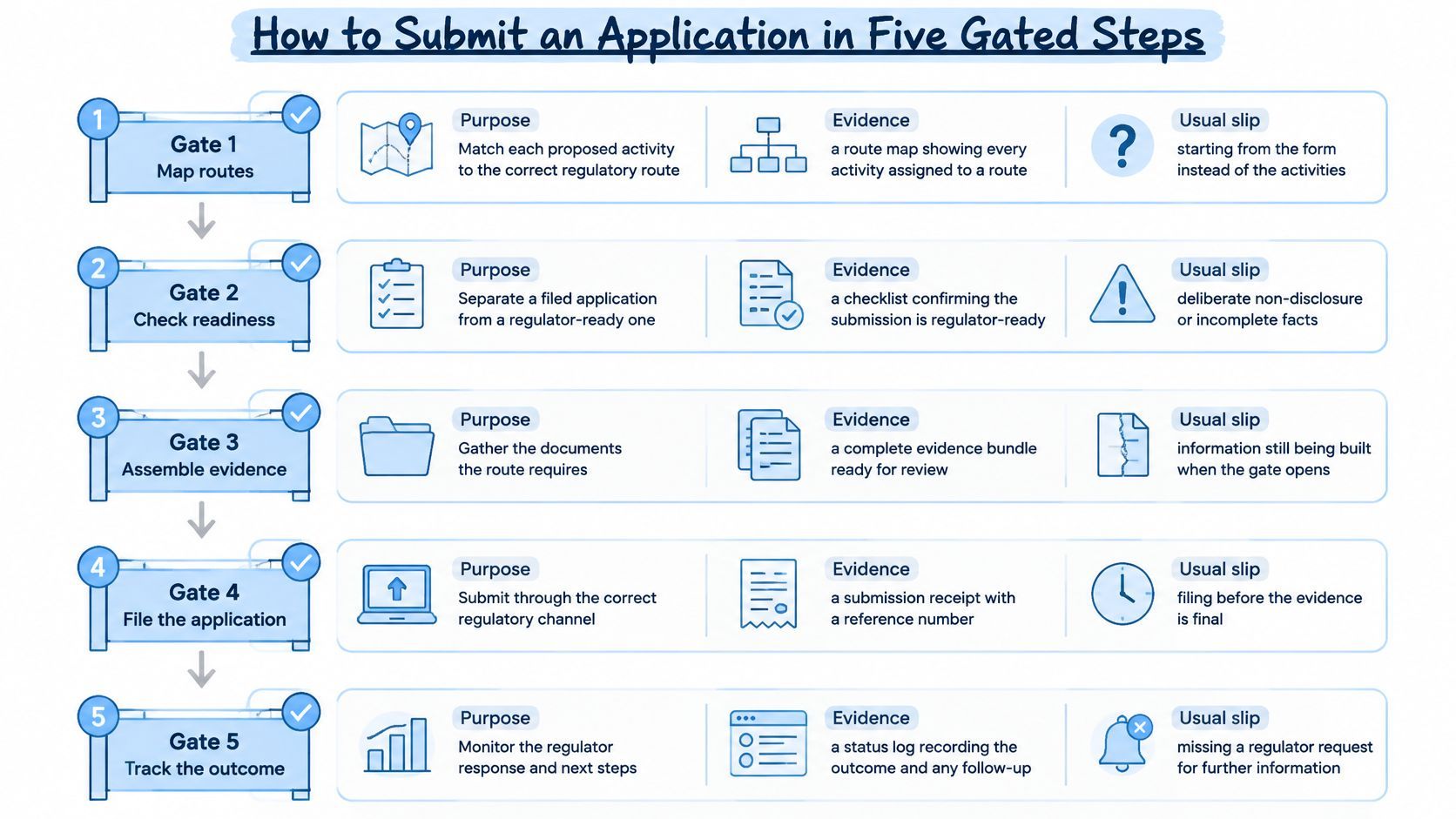
1. Map each activity to a route. Start from what the firm will do in practice, which legal entity does it, and how responsibilities split. On an authorisation engagement, our first step is to examine planned activities, jurisdiction, existing material and open questions, then agree the work, deliverables and responsibilities. The evidence is a route map with every activity assigned. The usual slip is drafting generic policies before the route is known.
2. Test the model against the threshold conditions. Governance, controllers, financial resources, systems and controls have to meet the conditions for that route. Projections that do not match the operating model are the slip that triggers the first round of questions. Say the plan shows 12 staff in month six while the governance map names three. Fix that before anyone sees the form.
3. Assemble one document set. The form, business plan, financial projections, policies, supporting evidence and responsible-person details should read as one case. We bring the business plan, financial information, policies and application answers together, review the documents, resolve findings and revisit affected material when facts change. A regulatory business plan for an FCA application has to describe the same customers and flows as the policies. The usual slip is a policy written for a target model while operations are still being built.
4. Run a completeness and consistency review. Check each figure, legal name and control owner against every other document. The slip is a change made in the projections and left stale in the form.
5. Sign off, then file. Protected files need access details, and every required signature has to be present, before you use the regulator's online portal. Missing items are the most common cause of the file being treated as incomplete. Record the date of receipt. The statutory clock runs from receipt, and complete or incomplete status decides which limit applies.
What you should have at the point of filing
- Cover note: One page stating the route, the legal entity and what is live versus planned.
- Document index: Each answer linked to an approved source, owner, version and implementation status.
- Sign-off record: A named approval for each gate, including senior-manager approval of the final pack.
Readiness Tests and Your Go or No-Go Check
A filed application and a regulator-ready application are different things. FCA guidance on cryptoasset application registration says applications must be complete and include all supporting documents, and warns that deliberate non-disclosure or incomplete facts can affect the outcome. Applications that are complete and thorough are more likely to be determined within target timeframes.
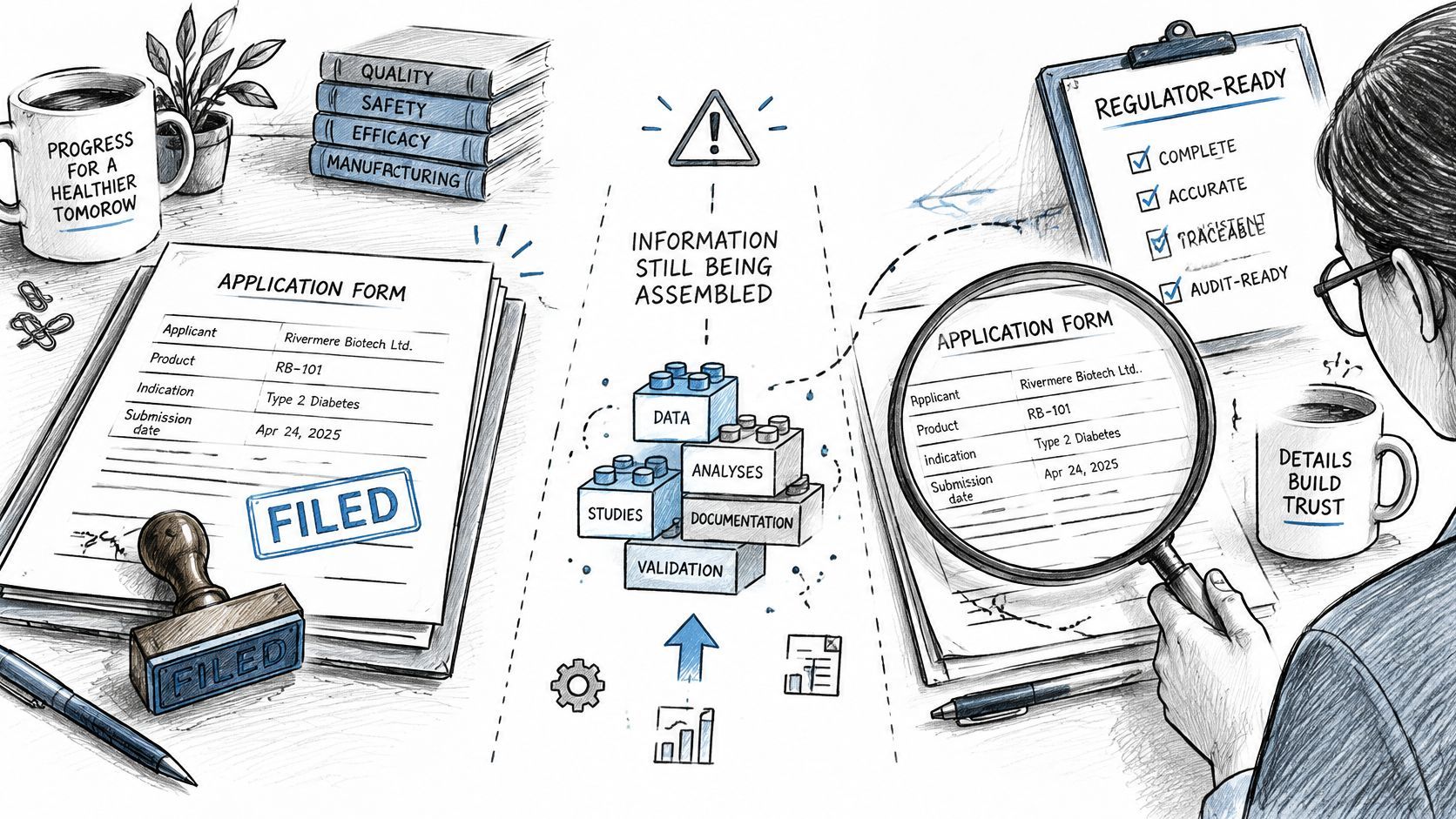
Information that is still being built has to be labelled as such. Outsourced controls, planned compliance hires, technology that is not live, and policies written for a target operating model are commitments, not current operations. State the owner, the date and the dependency. Hiding the gap is worse than disclosing it.
More documents are not automatically better. Unsupported or inconsistent detail invites clarification questions. The better objective is a coherent narrative of what exists, what will exist, who is accountable and how the gap closes. The same split between ambition and evidence is what Ekipa's AI readiness assessment guide asks of a technology programme. A payments or crypto file needs it too.
Six tests before anyone signs
| Test area | What the file must show | Ready when |
|---|---|---|
| Ownership | A named accountable senior manager for each activity | Name, role and sign-off recorded in the governance map |
| Implementation dates | Current controls separated from post-authorisation arrangements | Each control tagged live or planned, with a date |
| Dependencies | Outsourced providers, technology and planned hires | Contract or plan referenced and status confirmed |
| Evidence status | Each answer linked to an approved source document | Owner, version and approval date recorded |
| Open issues | Known gaps disclosed rather than hidden | Gap listed with owner and closure date |
| Cross-document consistency | Business model, policies and projections agree | Changes tracked across every affected document |
Use a requirements-to-evidence matrix as the working tool, and test the file against the FCA threshold conditions for the route you chose. Then run a simulated challenge with someone who did not write the file. We check consistency across the application documents, address findings and prepare the identified package for internal and client approval. The scope of that work, and any authority to submit on a client's behalf, is set out in the engagement agreement. After our internal approval and the client's sign-off, the agreed application is submitted on the client's behalf under the required mandate and access arrangements.
The go or no-go questions
Before sign-off, confirm five things.
- Route: Each activity has a named regulatory route.
- Owner: Each control has an accountable senior manager.
- Status: Every arrangement is marked live or planned.
- Gaps: Open issues have an owner and a closure date.
- Voice: A named person can explain each control in interview without reading the file.
A file that cannot answer those five is not ready, however complete it looks. The first action this week is the route map. Every later decision hangs off it.
Application Outcomes and What Drives Them
Filing is not registration. UK cryptoasset businesses that provide certain in-scope services must register with the FCA under the Money Laundering, Terrorist Financing and Transfer of Funds Regulations 2017 before starting those services where they are carried on by way of business in the UK. Since the FCA became supervisor on 10 January 2020, the FCA's cryptoasset AML/CTF figures show 428 applications received and 395 determined as at 1 November 2026.
| Outcome | Applications | Share of determined |
|---|---|---|
| Registered | 68 | 17% |
| Rejected | 47 | 12% |
| Refused | 14 | 4% |
| Withdrawn | 266 | 67% |
| Total determined | 395 | 100% |
Withdrawal is the largest outcome category. It can mean an applicant paused or exited. It often also signals an unclear route, weak evidence or policies the firm could not stand behind. Over the preceding 12 months, 25 applications were determined: 12 registered, 3 rejected and 10 withdrawn. These figures are historical indicators of how demanding the screening has been. They are not a success probability for any one firm.
Three lessons from the outcome mix
Resolve open questions before you file. Perimeter doubts, controller gaps and half-built monitoring do not improve once the clock is running. A withdrawal decided early, with a plan to return, is a planning point, not a dead end.
Evidence the financial-crime framework rather than describe it. Customer due diligence, sanctions screening, transaction monitoring, suspicious-activity escalation and outsourcing oversight need owners and worked examples. How you explain the evidence behind a control matters more than the policy title.
Keep the business description accurate through the review. A drift between the form and the operating model is a common reason firms step back rather than finish.
Handling Regulator Questions After Filing
The clock does not stop while the regulator waits. FCA authorisation metrics measure the process from receipt to determination, and the Q3 2025/26 authorisations operating service metrics state that elapsed time for an incomplete notification includes periods spent seeking or waiting for missing information. In Q3 2025/26, 97% of applications across the reported metric areas were determined within the applicable deadlines. The FCA still stresses that complete applications are more likely to meet targets. Speed matters, but a fast wrong answer is worse than a short, sourced one.
The test on every question is simple. Is this an explanation of a fact already in the file, or does the answer change a fact?
| Response type | What it changes | What to update |
|---|---|---|
| Explanation of an existing answer | Nothing in the facts | Answer log only |
| Clarification of wording | Presentation rather than substance | Affected form answer and its version |
| New fact about the business | Business model or activity scope | Business plan, governance map and projections |
| Change in controllers or senior managers | Responsibilities and fitness checks | Governance map, responsible-person details and interview preparation |
| Revised financial assumption | Resource and capital projections | Financial projections and every dependent figure |
Keep one source of truth
- Answer log: One log, one accountable owner per question, and the final wording recorded before it is sent.
- Version control: Every revised policy gets a new version, not a silent overwrite.
- Impact map: Each response is checked against the business plan, the governance map and the financial projections.
Do not answer in one document while another still describes the old position. Disclose a material change promptly rather than leaving the case officer to find it. Greater transparency on end-to-end timings, including lower-quartile, median and upper-quartile determination periods, only helps if your own log is equally clear.
The people who will be interviewed should know the answers in that log. Follow-up discussions test whether controls are explained the same way twice. Preparation before a regulator interview fails when the room has not read the log.
Glentorion prepares, reviews and submits FCA and crypto authorisation packages, and readies the people who will explain the controls. If you are about to file, or you are already in questions, start with a route map and a consistency check rather than another draft policy. Visit Glentorion to scope the work, the deliverables and who signs what.
- submit application
- FCA authorisation
- regulatory authorisation
- FSMA Part 4A
- crypto registration