Electronic Money Account Explained for UK Businesses
Published
You're paying suppliers from an app, checking incoming customer payments and keeping a balance for next week's bills. The account looks familiar, but the provider isn't a bank. Before you put more business cash into it, you need to know what that balance represents and what happens if the provider stops operating.
Table of Contents
- Why Electronic Money Accounts Matter Now
- Defining an Electronic Money Account in Plain Terms
- How an Electronic Money Account Differs from a Bank Account
- What an Electronic Money Account Can and Cannot Do
- How Safeguarding Protects Customer Funds in Practice
- Consumer Protections When a Provider Fails
- Capital Requirements and What They Mean for Businesses
- Choosing the Right Route and Taking the Next Step
Why Electronic Money Accounts Matter Now
An electronic money account can look like an ordinary business current account on a screen. That resemblance makes it easy to choose a provider by fees, payment features and convenience without examining the legal arrangement behind the balance.
For a founder, the distinction matters in both directions. You might be choosing somewhere to hold operating cash, or designing an account product for your own customers. Either way, the useful questions concern who owes the money, how it's protected and how customers can recover it.
Payment adoption isn't the same as primary banking
The FCA reported that consumer use of electronic-money accounts increased from 1% in 2017 to 4% in 2020 and 7% in 2022. Regulatory returns for 2022 and 2023 indicated approximately 58 million accounts, although customers frequently held more than one, with about £17.9 billion outstanding and approximately £1 trillion in annual payments across 6.3 billion transactions, according to the FCA's safeguarding consultation.
Those figures describe a substantial payment market, not an equivalent number of individual customers. For a business assessing demand, account numbers alone therefore aren't enough.
- For finance teams: Test whether the account suits supplier payments, working-capital needs and contingency arrangements.
- For founders: Decide what customers will legally hold before choosing the interface or account branding.
- For compliance staff: Connect customer disclosures to the actual movement and protection of funds.
Cross-border research also needs careful boundaries. Sambapay's guide to accepting digital wallets in Singapore offers a useful merchant-acceptance perspective, but payment acceptance in another market doesn't establish the legal protection attached to a UK account.
Practical rule: Start with the customer's claim and the provider's responsibilities, not the appearance of the app.
Defining an Electronic Money Account in Plain Terms
A customer pays into a supplier-payment wallet, sees a balance, then uses it to pay a supplier. For your product, the key question is what that balance represents in law. An electronic money account records value issued by a provider after it receives funds. The balance is a claim against the issuer, not a bank deposit held by the customer.
The interface does not decide the answer. Calling a product a wallet, or displaying a balance, does not by itself determine whether it is electronic money or place it outside the rules.
Test the underlying arrangement
The legal definition covers monetary value stored electronically or magnetically that represents a claim on its issuer. The issuer must provide it on receipt of funds for payment transactions, and someone other than the issuer must accept it, subject to statutory exclusions.
The Electronic Money Regulations' definitions and prohibition on unauthorised issuance focus on these features. A business cannot issue electronic money in the UK, or claim to do so, unless it is within the permitted issuer framework.
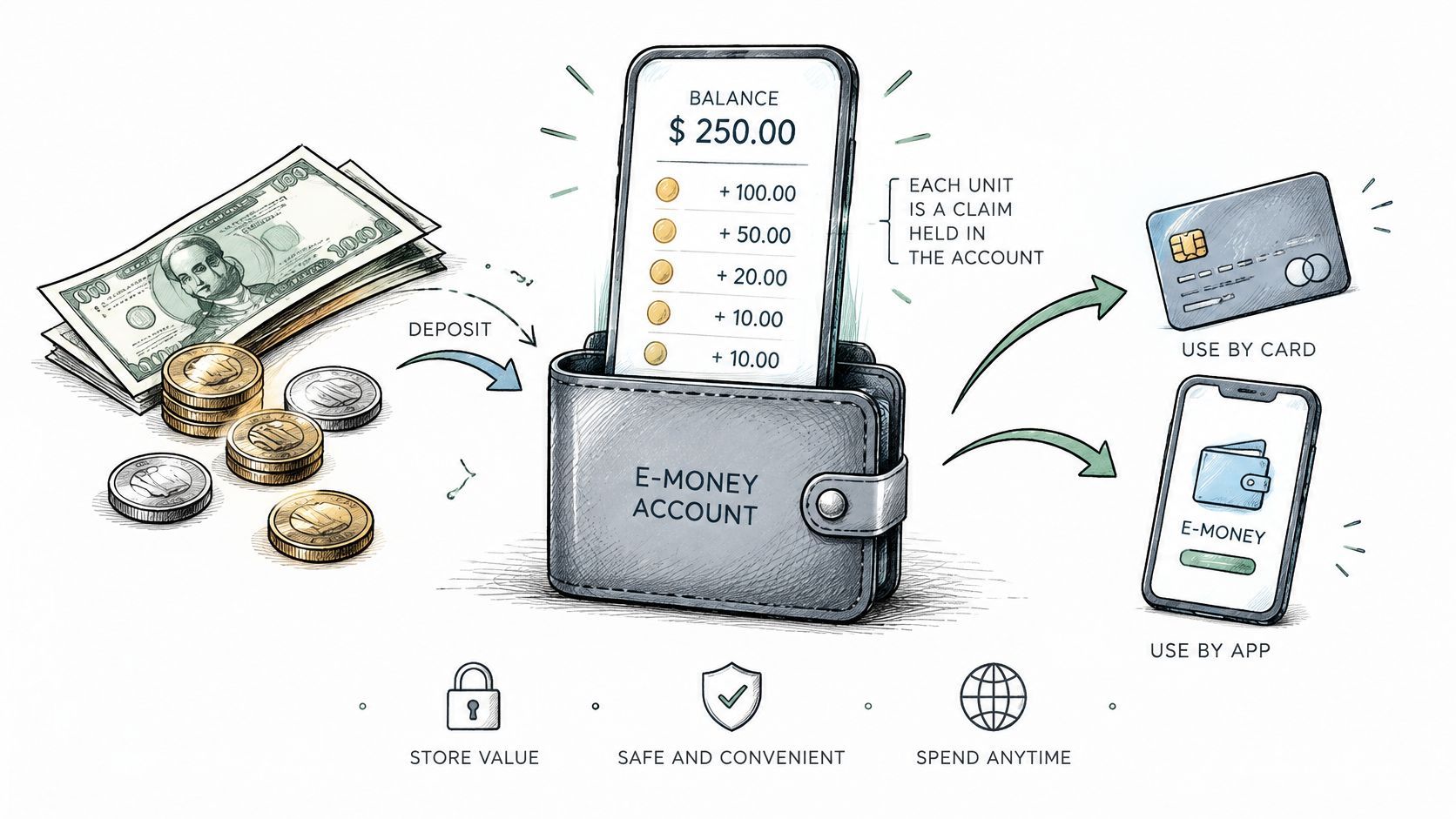
For the proposed wallet, trace the customer's money through four questions:
- Receipt of funds: Does the customer pay in before making payments?
- Stored value: What does the balance legally represent?
- Third-party acceptance: Can the customer pay someone other than the issuer?
- Issuer identity: Which legal entity owes the customer that recorded value?
These questions also help clarify who must manage the funds as the product operates. A displayed balance is a record, not proof that the customer can recover the full amount immediately if the provider fails.
Understand the regulatory foundation
The Electronic Money Regulations 2011 came into force on 1 May 2011, with transitional arrangements from that date. They replaced the earlier regime implementing Electronic Money Directive 2000/46/EC and established frameworks for authorised and small electronic-money institutions, as set out in the Electronic Money Regulations.
The regulations prohibit issuers from paying interest on outstanding electronic-money balances. For a founder, that rule affects product design and customer terms. Safeguarding also needs to be treated as an ongoing operational control: identify the relevant funds, apply the required arrangements, and avoid implying that protection guarantees instant access or full recovery in every failure scenario.
How an Electronic Money Account Differs from a Bank Account
The most important comparison isn't between app features. It's between the obligations attached to the balance.
An electronic-money issuer and a bank may offer payment experiences that feel similar. But similar interfaces don't make their customer-protection arrangements interchangeable, and the word regulated doesn't identify which protection applies.
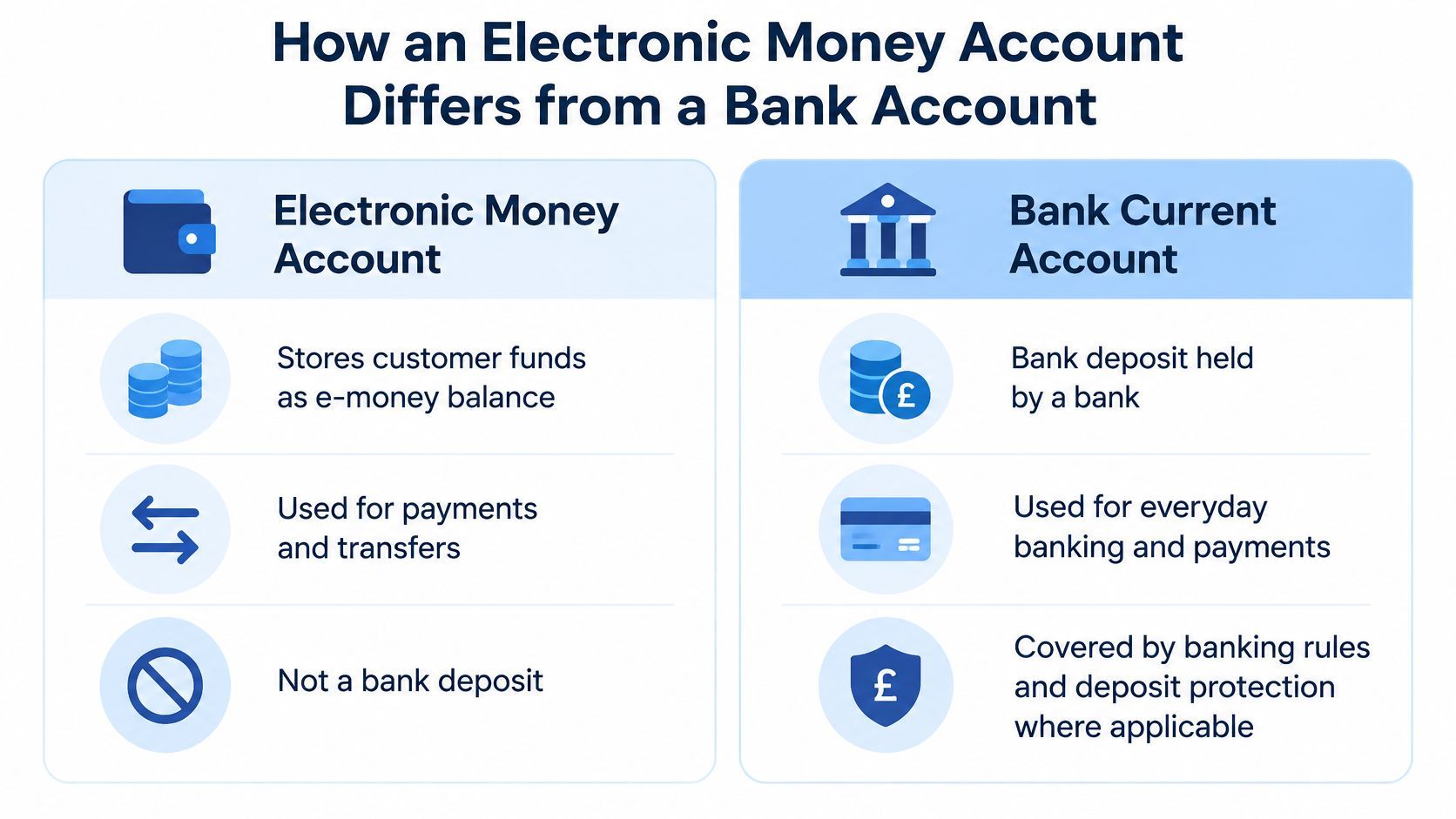
Compare legal status before features
| Question | Electronic money account | Bank current account |
|---|---|---|
| What does the customer hold? | The issuer claim described above | A bank deposit |
| What status should you examine? | The issuer's electronic-money regulatory status | The provider's banking status |
| What protection should you investigate? | Safeguarding arrangements | Applicable deposit-protection arrangements |
| How should returns be assessed? | Apply the prohibition on interest explained above | Examine the particular bank product's terms |
| What should closure terms explain? | Redemption rights and conditions | Withdrawal and account-closure arrangements |
The FCA expressly distinguishes these arrangements: electronic-money accounts aren't covered by the Financial Services Compensation Scheme, even though their issuers must safeguard customer funds. Its guidance on using payment service providers also warns that recovery after failure can take time and may be reduced by insolvency costs.
For a business buyer, that's a reason to examine the contract and legal entity, not to assume every non-bank account is unsuitable. The right choice depends on what you need the account to do and how you'll manage interrupted access.
Separate account protection from payment costs
Commercial comparisons still matter. Zaro's discussion of FX transparency across banks and fintechs is a useful companion when examining currency-conversion pricing, provided you assess legal protection separately.
Likewise, questions about a SEPA bank account concern payment functionality and account suitability. They shouldn't replace the underlying issuer-status check.
A convenient payment account and an appropriate place for essential operating reserves aren't automatically the same decision.
Ask the provider to identify the contracting entity, explain the applicable regulatory status and describe protection in language your finance team can use. Don't settle for a group brand name or an unexplained regulatory badge.
What an Electronic Money Account Can and Cannot Do
A proposed account might let customers receive value, retain it for later payments and request its return. Those functions need contractual and operational rules, not just buttons labelled “add money”, “pay” and “withdraw”.
For founders, redemption deserves particular attention. It concerns returning the monetary value represented by e-money, rather than merely moving a number between internal screens.
Build redemption into the product
Under the statutory issuance and redemption rules, issuers must issue e-money without delay on receipt of funds and issue and redeem it at par value. Holders may request redemption at any time, with full or partial redemption available before termination.
The same rules require clear, prominent contractual disclosure of redemption conditions and fees before the customer is bound. Fees are permitted only in specified circumstances, including redemption before termination, early termination of a fixed-term contract or requests more than one year after termination; total value must be redeemed on termination or within one year afterwards, while no redemption obligation remains for requests made more than six years after termination, under those statutory provisions.
That means your closure workflow needs to distinguish an active account from a terminated contract with a later redemption request.
- Ledger design: Preserve the information needed to calculate the value owed.
- Customer terms: Explain conditions and permitted fees clearly.
- Operations: Assign responsibility for requests that arrive after account closure.
Don't mistake a narrow exclusion for general permission
Consider a hypothetical balance usable only with its issuer. Adding acceptance by independent merchants could change the perimeter analysis, so reassess the arrangement before enabling that feature.
The limited-use exclusions include qualifying telecom-billed transactions capped at £40 per payment and £240 per subscriber per month. Separately, limited-network or limited-purpose issuance exceeding €1 million in transactions during a 12-month period triggers FCA notification.
These aren't general low-value safe harbours. Nor does selecting a payment rail settle classification: assess a Faster Payment service separately from the legal nature of the customer balance.
How Safeguarding Protects Customer Funds in Practice
Safeguarding is a live operational control. A policy saying customer money is protected won't explain an unmatched receipt, an incorrect ledger entry or a shortfall between records and protected funds.
The protection begins when the institution receives the relevant funds. The permitted approaches are segregation or protection through an appropriate insurance or comparable guarantee arrangement.
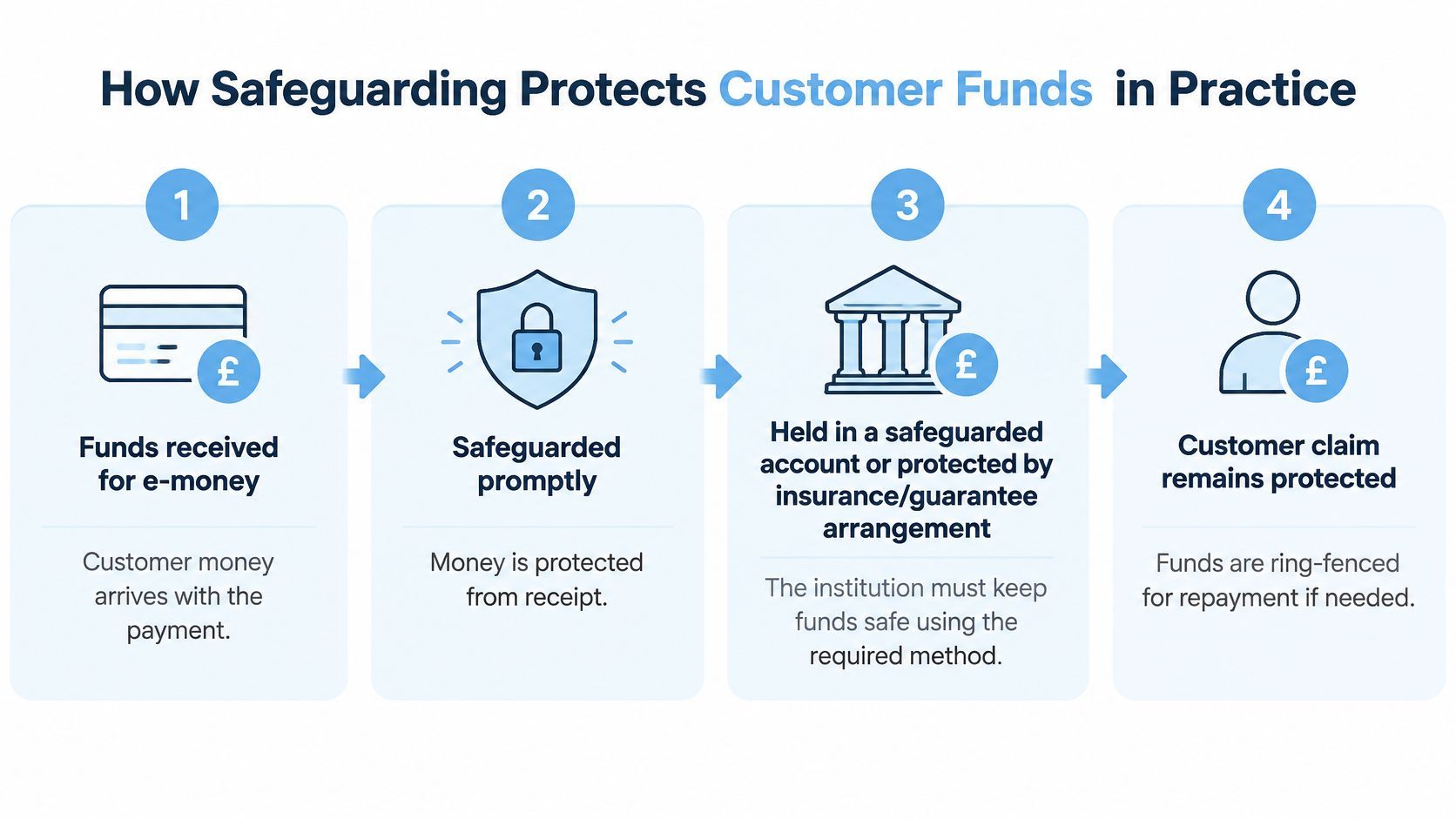
Follow a receipt through segregation
Take a hypothetical customer funding payment. Operations should be able to trace it from receipt to the customer ledger and then to the safeguarding records.
- Identify the money: Establish which funds were received in exchange for issued e-money and when.
- Keep it separate: Prevent the business from treating those funds as its own operating cash.
- Place continuing holdings correctly: Under the statutory safeguarding provisions, funds still held at the end of the following business day must be placed in the required separate account with an authorised credit institution or the Bank of England, or invested in secure, liquid, low-risk assets held with an authorised custodian.
- Investigate differences: Define who resolves discrepancies between receipts, outstanding value, settlements and protected holdings.
The account must be designated for safeguarding and used only for the relevant funds or assets. The rules also restrict third-party interests, subject to their limited exceptions.
Keep evidence of the control working
The FCA requires authorised EMIs and small EMIs that safeguard funds to report safeguarding arrangements and relevant funds monthly, within 15 business days after each calendar month, alongside the framework described in the safeguarding requirements.
For implementation, document daily reconciliation, settlement cut-offs, exception escalation and reporting evidence. These are practical control-design priorities: a firm should be able to explain not only its chosen method, but how staff detect and correct a failure.
The distinction from an authorised payment institution also belongs in route assessment. Don't copy another firm's policy without checking whether its activities and fund flows match yours.
Control test: Ask operations to demonstrate an unresolved reconciliation exception and explain who can authorise its correction.
Consumer Protections When a Provider Fails
Safeguarded doesn't mean instantly or fully recoverable. The FCA warning already discussed matters most when a business needs money for payroll or a supplier deadline and can't access its account.
Keep the terms separate. Regulated describes the provider's regulatory position; safeguarded describes the required protection arrangements; FSCS-protected refers to a different compensation framework. None should be used as shorthand for the others.
Test the failure scenario, not just the label
As the FCA consumer guidance explains, administrators or liquidators may deduct costs and repayment may take time. Don't turn the existence of segregated money into a promise about the amount or timing of recovery.
The difficult questions concern the account's actual state when the provider fails. A static closing balance may not answer every issue involving transactions in progress.
- Pending card transactions: Ask how the firm identifies authorised but unsettled payments and any related balance restrictions.
- Chargebacks and disputes: Establish who handles open claims if normal customer support stops.
- Foreign-currency balances: Request an explanation of how currency holdings and associated customer entitlements are recorded.
- Pooled accounts: Ask how the firm can identify your entitlement within combined safeguarded holdings.
- Intermediaries: Identify the issuer and the responsibilities of any platform between you and that issuer.
These are due-diligence questions, not predictions that every failure will produce the same result. The answer depends on the arrangement and the records available.
Request evidence you can use
Before relying on an account, request the provider's authorisation status, safeguarding method, insolvency arrangements, complaint route and expected access timeline. If it can't give a firm timeline, ask it to explain the dependencies rather than provide reassurance without support.
For a founder launching the product, use those same questions to test customer disclosures. Give customers a meaningful explanation of who holds the relevant records, how claims would be identified and what remains uncertain.
For a business customer, consider a contingency payment route. That's a treasury decision about maintaining operations during interrupted access, not a substitute for examining the provider's protections.
Capital Requirements and What They Mean for Businesses
An EMI's regulatory capital isn't the same thing as safeguarded customer money. Founders should model them separately, then check that the business plan explains how both requirements will be met.
The initial-capital threshold concerns entry into the authorised regime. Continuing own funds concern the resources the institution must maintain as its business develops.
Electronic Money Institution Capital Thresholds
| Threshold | Requirement |
|---|---|
| Authorised EMI initial capital | At least €350,000, under the capital requirements |
| Authorised EMI continuing own funds | At least €350,000 or the applicable calculated requirement, whichever is higher, under those provisions |
| E-money issuance calculation | Generally 2% of average outstanding electronic money, under the same provisions |
| Small EMI threshold | Where average outstanding e-money reaches €500,000 or more, required initial capital is at least 2% of that average, under those provisions |
For the authorised-EMI example in those capital rules, €10 million of average outstanding e-money produces a €200,000 issuance component. The €350,000 floor therefore still applies before other activities or supervisory adjustments are considered.
That example illustrates why applying a percentage to forecast balances isn't enough. The team must also identify the applicable floor, other activities and assumptions that could change the calculation.
Forecast the operating model alongside capital
A founder might forecast payment revenue while a treasury colleague forecasts balances and an engineer designs settlement. Those workstreams need a shared model.
- Customer behaviour: Explain how receipts, spending and redemptions affect outstanding value.
- Treasury arrangements: Identify where funds move, who controls those movements and what happens during disruption.
- Operational capacity: Show that staff and systems can reconcile the volumes assumed in the financial plan.
- Wind-down planning: Make the funding assumptions and responsible decision-makers explicit.
Average balances matter for the calculation, but they shouldn't be the only balances you examine. Consider peaks where operational risk warrants it, particularly when customer funding and outgoing settlement don't occur together.
For the application, reconcile the financial projections with the business plan and operating procedures. A reviewer shouldn't have to infer why the balance forecast, capital model and safeguarding design describe different businesses.
Choosing the Right Route and Taking the Next Step
Choose the regulatory route from the activity you intend to perform, not from the licence name you prefer. Start with a fund-flow diagram showing who receives money, who issues value, who owes the customer and who handles redemption.
Then test that diagram against your launch product and planned changes. A route that fits a restricted initial service may need reconsideration when you add stored value, additional merchants or another jurisdiction.
Compare the broad options
Build your own issuance capability. Assess whether your business can support the applicable authorisation, capital, safeguarding and governance arrangements. Authorisation planning should account for preparation, unresolved design decisions and management readiness, without assuming a guaranteed completion date.
Work with an existing authorised EMI. Examine the allocation of responsibilities rather than treating the partnership label as the answer. Identify the issuer, customer contracting arrangements, access to records, reconciliation responsibilities and procedures if either party exits.
Keep e-money features out of the product. Test whether a different design meets the commercial need. Removing stored-value features doesn't automatically remove every other regulatory question.
Rally's resource to compare business account options can support the commercial side of that assessment. Keep account selection separate from determining whether your own business will conduct regulated activities.
Prepare a decision-ready scope
Bring a product description, target jurisdictions, customer types, expected balances, redemption flows and proposed partner responsibilities to the assessment. Mark arrangements as established, proposed or unresolved, so nobody mistakes a future control for a working one.
A UK online payment systems overview can help frame infrastructure choices. The route decision still needs to connect those choices to legal responsibilities and evidence.
Depending on your internal capabilities, use in-house specialists, legal advisers or a regulatory authorisation consultancy. The useful deliverable is a defined route with responsibilities, missing evidence and decisions made explicit before you commit to development.
Glentorion supports electronic-money business-model scoping, application preparation and review, submission under an agreed mandate, and management preparation for regulator interviews. Visit Glentorion to arrange a scoping conversation and test your proposed account's fund flows, safeguarding responsibilities and authorisation route before committing to a build.
- electronic money account
- e-money accounts
- UK e-money regulation
- safeguarding funds
- EMI authorisation