
Faster Payments UK: How the Scheme Works and Why It Matters
Published
Faster Payments carried nearly £1.3 trillion in Q3 2025, with payment values rising 11.9% year on year while volumes rose about 7%, according to Pay.UK's quarterly statistical report. The important development isn't that customers can move money quickly. Businesses and households are using the infrastructure for increasingly significant transfers, which changes the consequences of weak controls.
For founders, boards and compliance teams researching Faster Payments UK, the useful question is therefore broader than how quickly a transfer arrives. It's whether the firm can govern payment initiation, beneficiary verification, exceptions and customer recovery as a connected operating model.
Table of Contents
- What the Faster Payments Scheme Actually Does
- How Faster Payments Grew from Launch to a 24/7, £1 Million Service
- How a Faster Payment Actually Moves
- Who Participates in Faster Payments and Why Their Roles Differ
- Reading the £1 Million Limit as a Product and Risk Decision
- Fraud Control, Confirmation of Payee and APP Reimbursement
- When Faster Payments Go Wrong and What the Reimbursement Rules Actually Cover
- Implications for Regulated Firms and the Business Case for Treating Faster Payments as Infrastructure
What the Faster Payments Scheme Actually Does
The scale of value moving through Faster Payments makes it transaction infrastructure, not merely a convenient bank-app feature. Its defining customer proposition combines rapid account-to-account transfers with availability outside conventional banking hours. Firms should distinguish that proposition from a guarantee that every instruction will be accepted or every recipient credited immediately.
Pay.UK operates the service, while the Payment Systems Regulator's interventions include beneficiary-name checking and APP-scam reimbursement requirements. Those responsibilities are different: operating a payment system isn't the same as setting regulatory protections around its use.
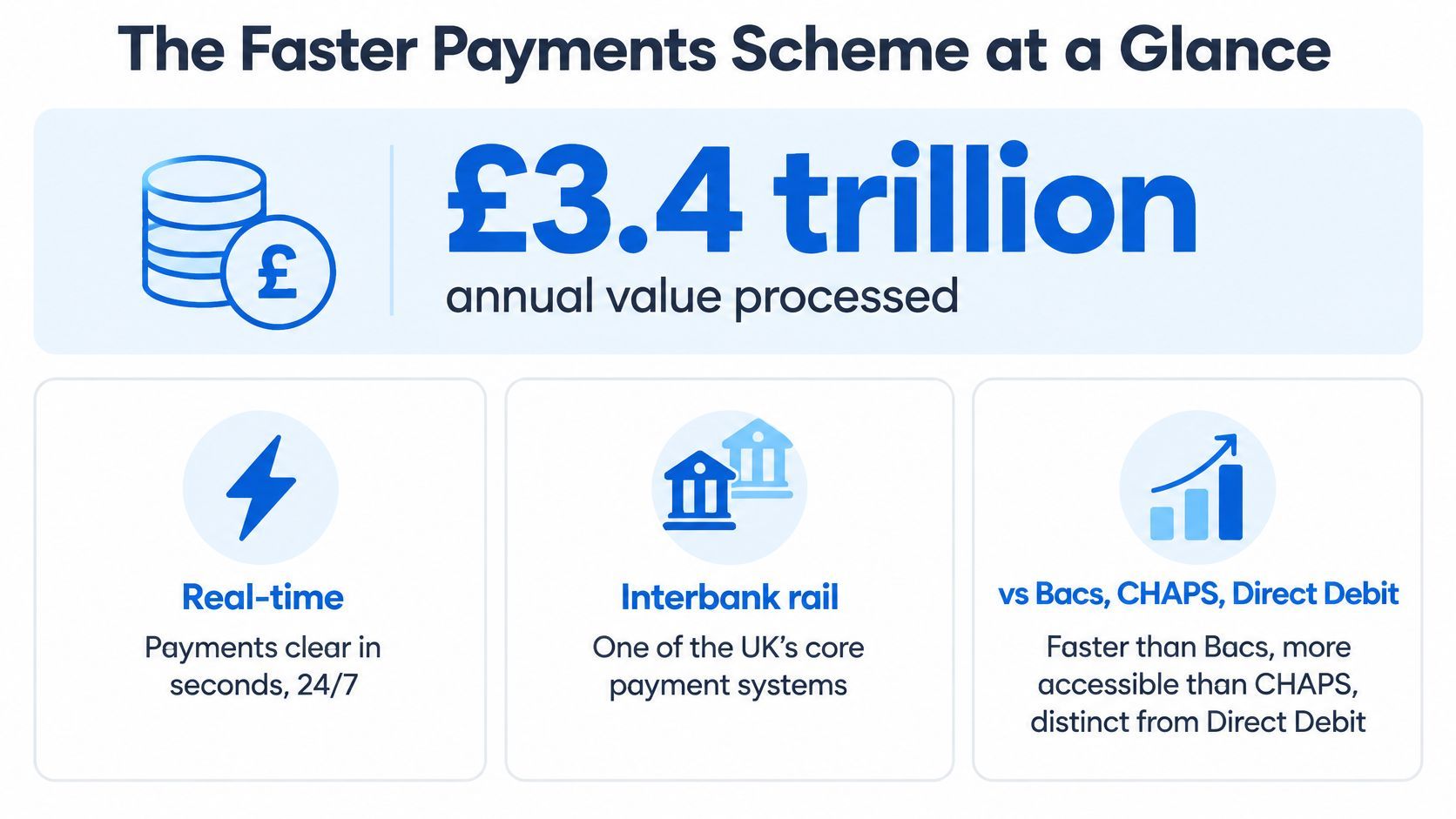
Treat the graphic as an orientation aid rather than a current statistical statement. Its annual-value headline has no identified reporting period, so the dated quarterly evidence above is the appropriate basis for assessing scale.
Start with the payment requirement
For a business choosing among payment arrangements, the right starting point is the instruction it needs to execute:
- Customer availability: Does the recipient need access to the money promptly, including outside office hours?
- Instruction type: Is the business sending an account-to-account payment, arranging a scheduled instruction or collecting money under a different mechanism?
- Control requirement: Can the provider support the necessary beneficiary checks, approval workflow and exception handling?
Don't treat Bacs, CHAPS, Direct Debit and Faster Payments as interchangeable labels. A useful overview of UK online payment systems can support the initial routing discussion, but the implementation decision should turn on the actual service terms and operating arrangements.
The key distinction is between customer-facing availability and formal processing mechanics. A firm that promises immediate receipt without recognising acceptance outcomes, provider restrictions or settlement arrangements creates avoidable complaints and operational ambiguity.
Practical rule: Describe what your provider can deliver, not merely what the underlying rail can support.
How Faster Payments Grew from Launch to a 24/7, £1 Million Service
Faster Payments didn't begin with its present capabilities. It launched on 27 May 2008, introducing a new interbank payment service after more than 20 years without one. Its original purpose was to let customers send low-value electronic payments and receive them rapidly, including outside conventional banking hours.
The initial transaction ceiling was £10,000, subsequently increasing to £100,000 during the service's early development. The ceiling later rose to £1 million in February 2022. Alongside those increases, the service expanded beyond one-off transfers to standing orders, forward-dated payments and Direct Corporate Access, and developed into a 24-hour, seven-day service for relevant payment types, as documented in Pay.UK's historical and annual statistics.
Capability expansion changes the control problem
These milestones represent different operating challenges, not just a longer feature list. A larger permitted transfer changes the potential exposure from an incorrect beneficiary or compromised approval. Scheduled instructions require controls that remain effective between creation and execution.
Direct Corporate Access also raises a different design question from an individual customer pressing send. A firm evaluating corporate payment functionality should examine who can create instructions, approve them, amend beneficiary records and investigate failures.
| Capability expansion | Management question |
|---|---|
| Higher transaction ceiling | Does approval authority match potential exposure? |
| Scheduled payments | What happens if customer circumstances or beneficiary details change before execution? |
| Corporate access | Can the firm trace instructions to authorised people and processes? |
| Continuous operation | Who acts when an exception occurs outside normal staffing hours? |
The operational conclusion is that product permission and control readiness must advance together. A provider may technically support a capability before a customer-facing business has established the governance to use it safely.
For example, a firm introducing time-critical supplier payments should assess its authorisation workflow and incident coverage before widening access. That's a design recommendation, not evidence that any particular customer segment caused the scheme's expansion.
History matters because legacy assumptions persist. A control framework built around modest transfers and office-hours intervention shouldn't be accepted unchanged merely because the payment connection still works.
How a Faster Payment Actually Moves
A Faster Payment has distinct instruction, response, customer-crediting and settlement stages. Keeping them separate prevents a familiar mistake: interpreting a successful customer notification as proof that every interbank obligation has already settled.
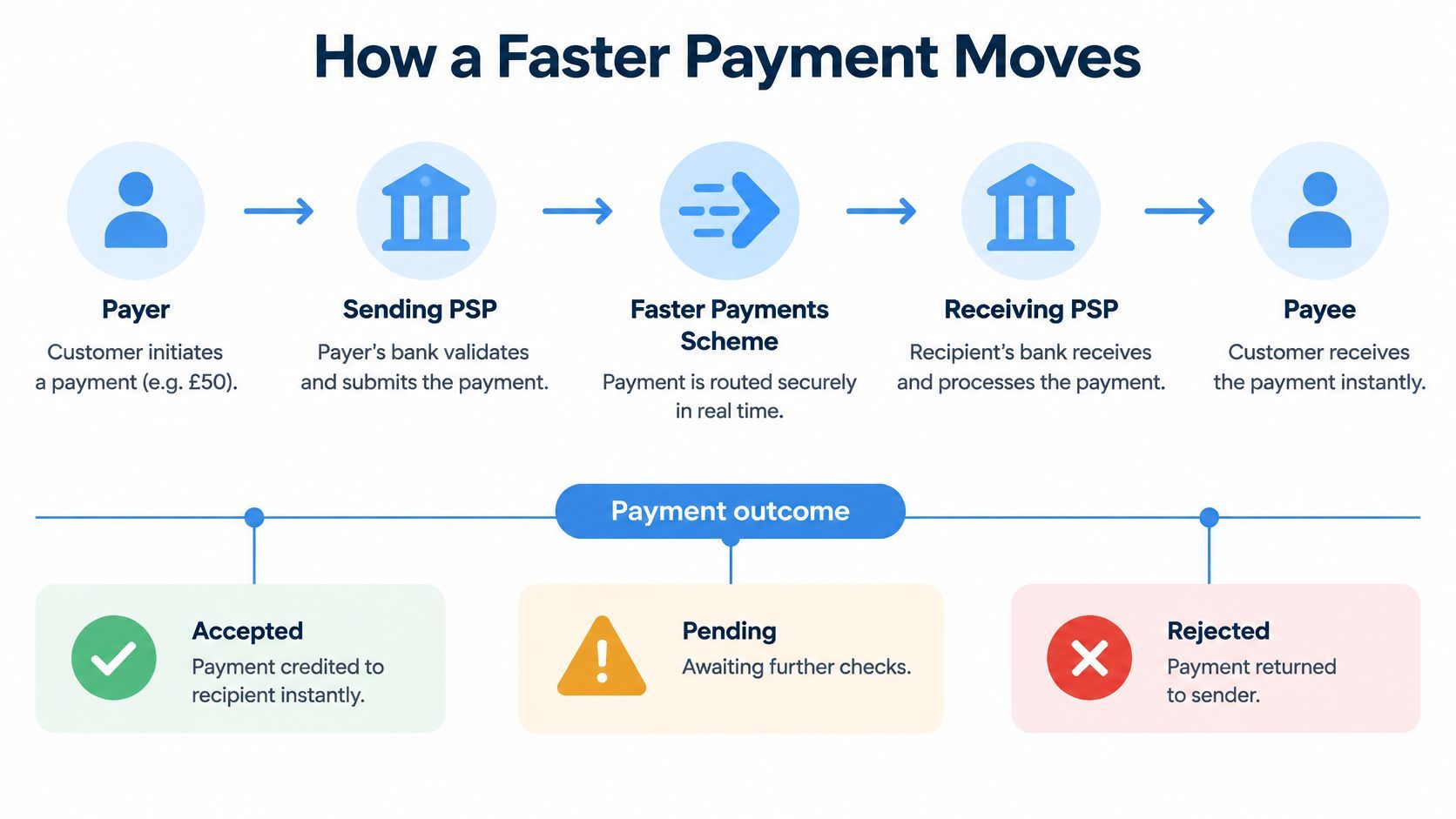
The diagram simplifies the journey. Its accepted, pending and rejected labels shouldn't replace the scheme's formal response categories or be read as unconditional promises about crediting and returns.
Follow the instruction and response
- Initiation: The payer submits an instruction to the sending payment service provider. The provider applies its own account, channel and risk controls before submission.
- Receiving response: The receiving participant responds within a few seconds with unqualified acceptance, qualified acceptance with a qualifier code, or rejection with a rejection code.
- Beneficiary availability: Unqualified acceptance indicates that funds should be available in near real time, although application within the relevant availability window may occasionally take longer.
These response mechanics, together with the requirement for participants to receive and respond to payment types continuously, are set out in Pay.UK's Faster Payments Service Principles.
The practical requirement is to retain the actual response and its meaning. A customer-service screen that displays only sent may leave staff unable to explain whether the receiving participant accepted the payment, qualified its acceptance or rejected it.
Separate crediting from settlement
Interbank settlement follows a different timetable. The Bank of England states that Faster Payments net settlement takes place three times on each business day in its Real-Time Gross Settlement system. Participants can exchange customer instructions while RTGS is closed, with obligations settled later through deferred net settlement, according to the Bank of England's payment-settlement explanation.
Near-real-time access to money and completed interbank settlement are different events.
That distinction should shape reconciliation, liquidity oversight and incident investigation. Records need to connect the customer instruction, participant response and settlement position without collapsing them into a single status.
It also matters when evaluating a broader transfer journey. Africhange's resource for readers who want to compare money transfer providers offers a comparison starting point, but firms should separately establish which part of any proposed journey uses Faster Payments and which other processing stages remain.
Who Participates in Faster Payments and Why Their Roles Differ
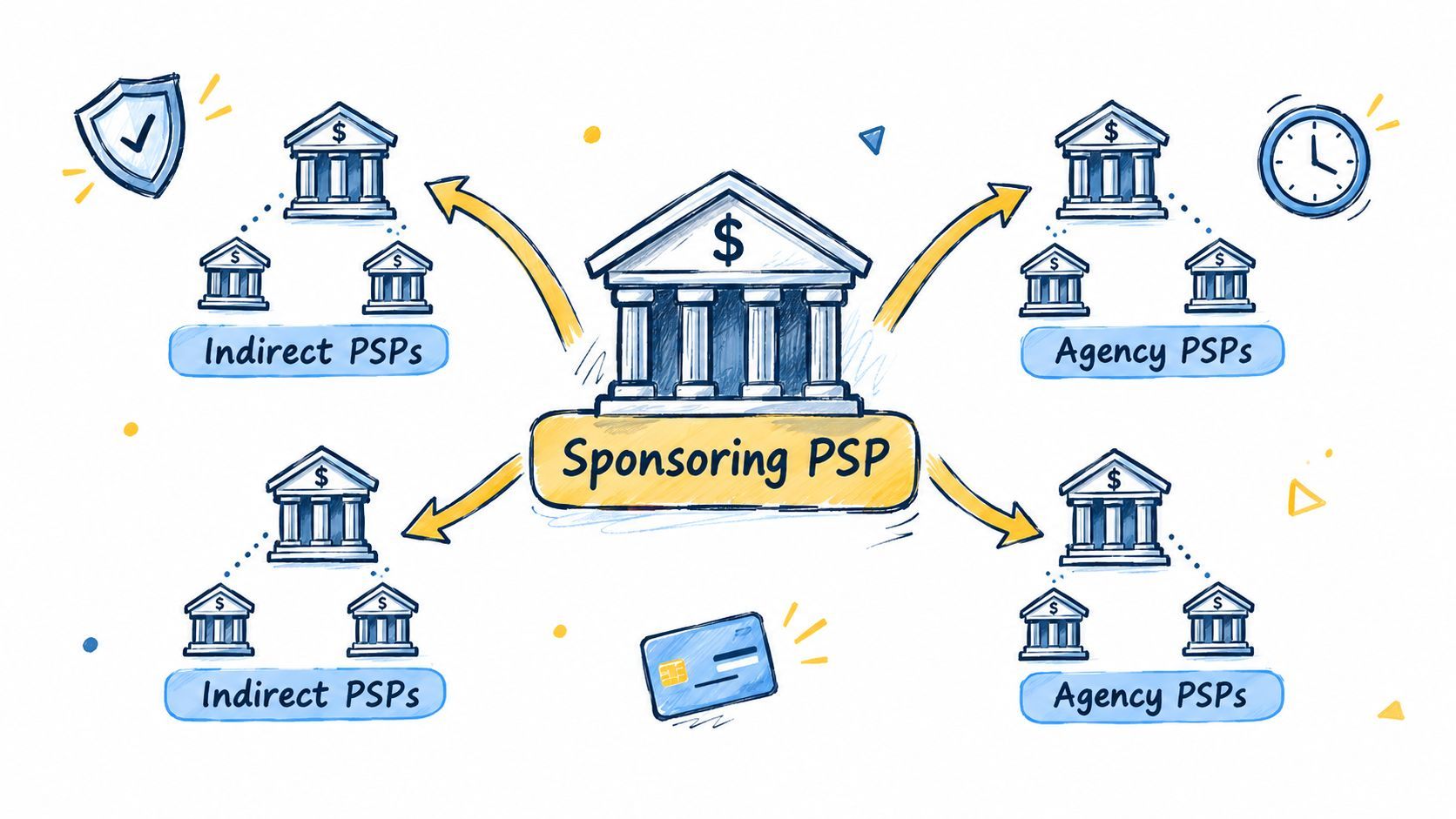
A firm's responsibilities depend on the role it performs, not whether its customers can send a Faster Payment. A sponsoring PSP, an indirectly connected provider and a customer-facing business may all touch the same transaction while controlling different parts of its journey.
The essential governance exercise is to map those boundaries. A connection diagram is useful, but it isn't a substitute for identifying contractual responsibilities, operational ownership and evidence access.
Map control rather than branding
| Role | Question the firm should resolve |
|---|---|
| Sponsoring PSP | Which connectivity, processing and support services does the arrangement provide? |
| Indirect or agency PSP | Which decisions remain with the firm, and which require sponsor action? |
| Customer-facing business | Who owns customer instructions, disclosures and investigation updates? |
| Pay.UK | Which scheme operating requirements apply to the arrangement? |
| Regulatory and settlement authorities | Which regulatory requirements and settlement mechanics affect the model? |
The operator, regulatory and settlement functions described above shouldn't be compressed into a generic payments authority. Each addresses a different question: how the scheme operates, what regulatory protections apply, or how participating institutions settle obligations.
Consider an indirectly connected provider investigating a missing payment. Its staff may need information held by the sponsor before they can give the customer a reliable answer. The recommended control is a documented escalation route that specifies the information required, its owner and how unresolved cases are managed.
The same approach applies to beneficiary data and incident response. Don't accept a statement that the partner handles it without identifying the decision, evidence and accountable person.
For businesses assessing e-money institution operating models, access to a payment rail should therefore sit within a wider responsibility map. The firm should be able to explain which activities it performs itself, which it relies on others to perform and how it monitors that reliance.
Indirect access changes the operating dependency. It doesn't, by itself, establish who owns every customer or compliance obligation. That answer must come from the applicable requirements and the documented arrangement.
Reading the £1 Million Limit as a Product and Risk Decision
The ceiling in the heading is a scheme maximum, not a promise of customer entitlement. Pay.UK permits participating organisations to set lower limits according to payment channel and account type. Providers may also apply daily caps or tighter restrictions for new and infrequently paid beneficiaries.
A payment above the scheme maximum is rejected by the central infrastructure. A payment below it can still be blocked by the sending provider's controls, as Pay.UK's transaction-limit guidance explains.
Layered Limits on Faster Payments
| Limit layer | Who sets it | What it governs | Why it matters |
|---|---|---|---|
| Scheme maximum | Pay.UK | Maximum individual instruction | Establishes the infrastructure ceiling |
| Provider-level cap | Sending provider | Account or daily payment availability | May constrain otherwise eligible instructions |
| Channel-level cap | Provider | Mobile, online, telephone or business access | Produces different customer journeys |
| Beneficiary restriction | Provider | New or infrequently used recipients | Can restrict an otherwise routine payment |
| Proposed internal risk threshold | The firm designing its product | Approval or review before submission | Aligns payment authority with risk appetite |
The last row is a design recommendation, not a separate scheme rule. Firms should distinguish what the infrastructure requires, what their provider imposes and what they choose to add internally.
That separation matters commercially. A product team might advertise the scheme maximum while operations can support only a more restrictive provider configuration. The resulting customer disappointment isn't a payment-system failure. It's a mismatch between the proposition and its implementation.
Design limits around decisions
A defensible limit framework should answer practical questions before launch:
- Authority: Who can approve an increase, and what evidence supports the decision?
- Interaction: How do daily caps, channel restrictions and beneficiary controls combine?
- Capacity: Can staff review exceptions without encouraging customers to bypass safeguards?
- Disclosure: Where will customers see the limit that applies to them?
Design test: A limit is useful only if staff can explain why it applies and what happens when a customer reaches it.
Higher permitted transfers also warrant a review of approval separation and account-change verification. Those are recommended safeguards rather than evidence that every larger payment is suspicious.
The objective isn't to minimise every limit. It's to make the relationship between customer need, provider capability and risk acceptance explicit. Otherwise, the firm may offer flexibility that its control environment can't reliably support.
Fraud Control, Confirmation of Payee and APP Reimbursement
Fraud controls belong in the payment architecture, not in a separate policy document that operations consult after a loss. A name-checking result, a behavioural alert and an escalation decision should affect the payment journey while intervention is still possible.
Confirmation of Payee compares the intended recipient's name with the account number and sort code. Under Specific Direction 17, Group 1 PSPs faced an implementation deadline of 31 October 2023, followed by remaining in-scope Group 2 firms on 31 October 2024. The PSR reported more than 320 organisations, coverage of over 99% of organisations initiating Faster Payments transactions, and more than 2 million daily checks in its Confirmation of Payee compliance report.
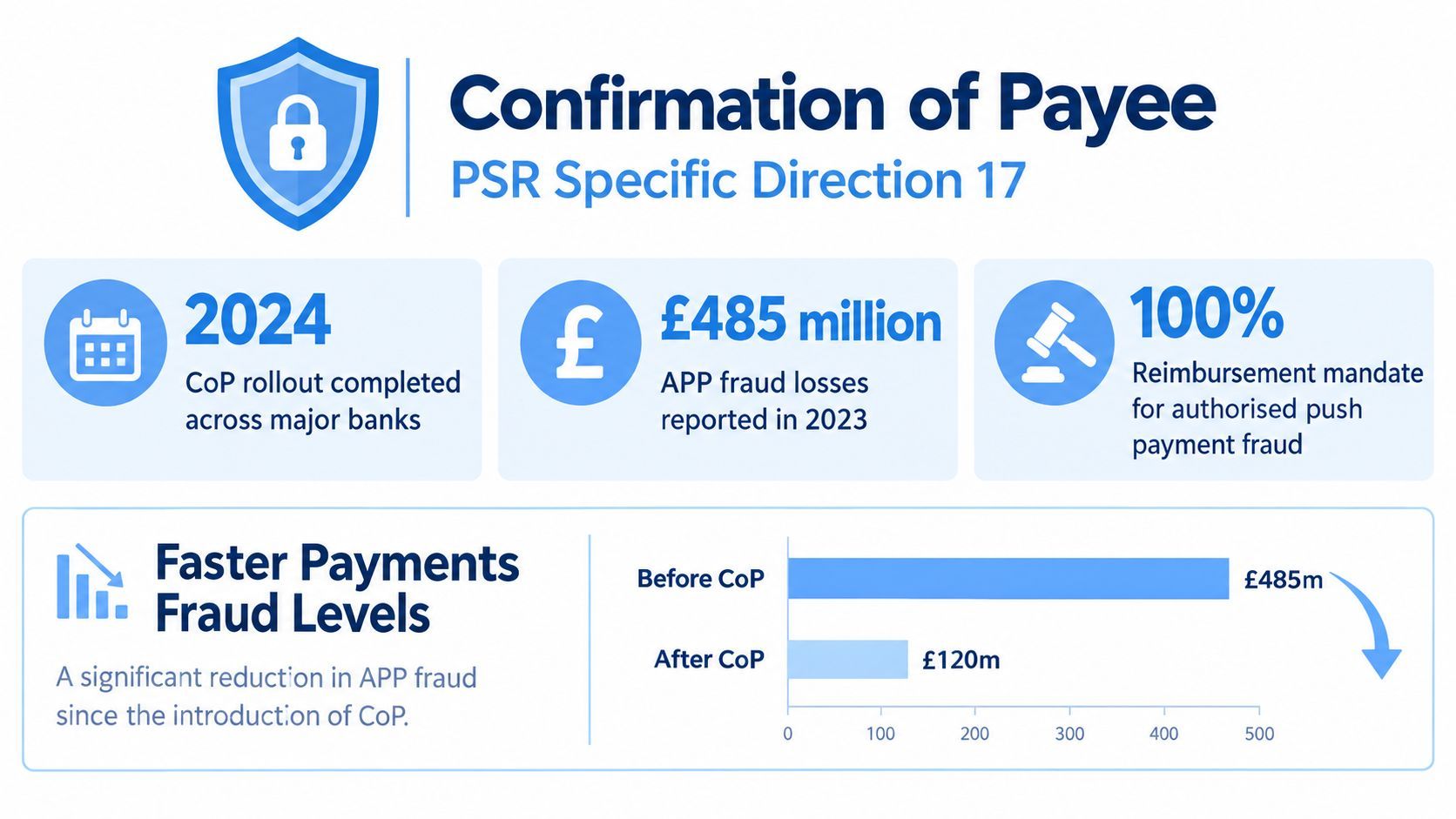
The graphic is conceptual rather than proof of a measured reduction. Its loss figure and blanket reimbursement description shouldn't be relied on as current regulatory evidence: reimbursement is conditional, and a name match doesn't establish that a payment is legitimate.
Scale makes control execution consequential
In Q2 2025, Faster Payments processed almost 1.4 billion payments worth more than £1.2 trillion. Single Immediate Payments grew 10.8% by volume and 15.1% by value, according to Pay.UK's quarterly statistical reporting. The implication is operational: a control that works only through discretionary manual attention is a poor foundation for a high-throughput service.
Historical reimbursement outcomes also differed sharply. The PSR's first APP-scams performance report covered institutions representing 95% of Faster Payments volume and value and reported full reimbursement in 94% of reported cases at TSB, compared with 6% at Monzo, in the relevant reporting period, according to the PSR's first APP-scams performance announcement.
Those figures don't prove that a particular control caused the difference, and they shouldn't be presented as current league-table positions. They demonstrate why firms must examine reimbursement outcomes rather than assume the rail produces uniform customer treatment.
Connect checks to accountable action
A practical design should combine beneficiary confirmation, transaction monitoring, velocity and behavioural limits, escalation queues and auditable warnings. Staff need clear authority to resolve alerts, while investigators need the evidence that informed the original decision.
For merchant-facing teams, Suby's discussion of fraud payment prevention strategies for e-commerce can prompt wider control questions, but it isn't a substitute for scheme-specific analysis. A structured approach to financial risk assessments should connect each identified risk to a control owner, decision record and review process.
When Faster Payments Go Wrong and What the Reimbursement Rules Actually Cover
Instant receipt doesn't mean automatic recovery or compensation. A mistaken beneficiary, an unauthorised instruction, an APP scam and a processing delay require different investigations. Confirmation of Payee is preventative, not a recovery guarantee.
Mandatory reimbursement applies to qualifying APP payments through Faster Payments from 7 October 2024, with claims generally reportable within 13 months. Scope matters, including whether the sending and receiving accounts are held in the UK. The £85,000 cap covers 99% of APP claims by volume and more than 90% by value, according to the PSR's consolidated APP reimbursement policy statement.
Classify the problem before promising a remedy
- Wrong recipient or amount: Contact the sending PSP promptly and request its mistaken-payment investigation route. Don't assume an APP claim applies.
- Payment not authorised: Tell the provider explicitly that authorisation is disputed. Preserve account-access alerts and relevant device information.
- Payment authorised under deception: Identify the suspected scam and request assessment under the applicable APP framework.
- Payment delayed or disputed by the recipient: Request the payment reference, processing status and investigation route rather than treating non-receipt as proof of fraud.
Retain beneficiary details, timestamps, account statements, messages, invoices, warnings displayed and communications with both providers. Ask for a written decision explaining the classification, applicable scope, any exclusion relied upon and the available complaint or escalation route.
Customer communication is a control
The reporting route should be visible where customers need it, not buried in a general policy page. Staff should explain what information to provide and why prompt contact matters without promising an outcome before eligibility has been assessed.
Firms should also distinguish transaction tracing from reimbursement assessment in their case records. A payment can require operational investigation while a separate decision is needed about regulatory protection.
Customer-outcome test: Can a distressed customer identify whom to contact and what evidence to retain without understanding the scheme rules?
Clear communication won't make every loss recoverable. It can prevent avoidable confusion from obstructing a properly evidenced claim.
Implications for Regulated Firms and the Business Case for Treating Faster Payments as Infrastructure
The business case for stronger governance isn't based on speed alone. It rests on the interaction between customer promises, provider dependencies, payment authority and evidence. Treating those matters separately leaves gaps precisely where an incident crosses team boundaries.
Boards should require a coherent operating model rather than a collection of independently approved policies. Work on banking core systems should connect payment statuses, customer records and investigation evidence so responsible staff can explain what happened.
Decisions to take into a governance review
- Participation: Identify the access model, dependencies and accountable owners.
- Control design: Reconcile product promises with actual limits and beneficiary checks.
- Operations: Establish incident coverage, escalation authority and exception ownership.
- Finance: Align reconciliation with the settlement structure rather than the customer interface.
- Customer protection: Document claim classification, evidence retention and decision communication.
- Management assurance: Test whether responsible people can explain the arrangements consistently.
For authorisation preparation, the important distinction is between controls already operating and arrangements still to be established. Application narratives, procedures, contracts and management answers should reflect the same facts.
For an existing business, the equivalent discipline is change control. A new channel, beneficiary journey or provider configuration should trigger an assessment of affected responsibilities and evidence.
The strongest operating model isn't the one with the most ambitious payment promise. It's the one in which management can demonstrate how the promise is supported, where exceptions go and who makes the consequential decisions.
Glentorion combines regulatory consultants with software, systems and AI engineers to help financial and crypto businesses scope authorisation routes, prepare application materials and ready management teams for regulator interviews. Visit Glentorion to discuss a defined engagement covering your Faster Payments operating model, control documentation and unresolved responsibility or evidence gaps.
- faster payments uk
- uk payment rails
- pay uk
- faster payments scheme
- payment system regulator