Money Transfer Business: How It Works and UK Licensing
Published

Approximately 1,000 non-bank money remitters were registered in the UK in 2018, more than four times the combined number registered in France, Germany, Italy, the Netherlands and Spain. A UK government-published review citing Royal United Services Institute research also recorded about 1,500 money-service businesses operating from approximately 31,000 premises.
That scale doesn't tell you which permission you need. The words on the website don't either. A money transfer business is defined by where customer money sits and who moves it. Founders get this wrong when they call the firm a technology provider, a marketplace or an agent network, then find the regulator is looking at the account that received the funds.
Sketch the money before you sketch the licence. Getting the route wrong isn't a tidy-up. Providing payment services without the correct authorisation or registration is an offence.
Table of Contents
- How a Money Transfer Business Earns and Moves Money
- Sizing Demand With Official Transfer Data
- Choosing the Right UK Regulatory Route
- How Safeguarding Keeps Customer Funds Safe
- Fraud Controls That Protect Without Blocking Customers
- Operational Resilience and Complaints Readiness
- Confirm Your Route Before You Apply
How a Money Transfer Business Earns and Moves Money
Say a customer in Birmingham wants £400 to reach a relative in Nairobi by the next morning. The sender pays by bank transfer. The firm receives that money into an account it controls. Checks run. Sterling is converted, the payment is routed, and a payout partner credits a mobile wallet. The firm keeps a transfer fee, a margin inside the exchange rate, or both. While funds sit between receipt and payout, some firms also earn interest on that temporary float. The float is small next to fees and foreign exchange, and it only exists because the firm held the money.
Think of a courier who signs for a parcel. From that signature until the doorstep, the courier is responsible. Regulators focus on the same handover. The interesting step isn't the app screen. It's the moment customer money is in an account the business controls.
Agent and premises networks sit inside that flow, not beside it. Cash taken at a counter, or a branch that releases a payout, is another point where money changes hands and another place oversight has to reach. Training, transaction records and a line back to the principal firm all have to work at that counter. Many UK-origin transfers also start on Faster Payments before they leave the country, so the ledger has to match a near-instant receipt with a slower cross-border payout.
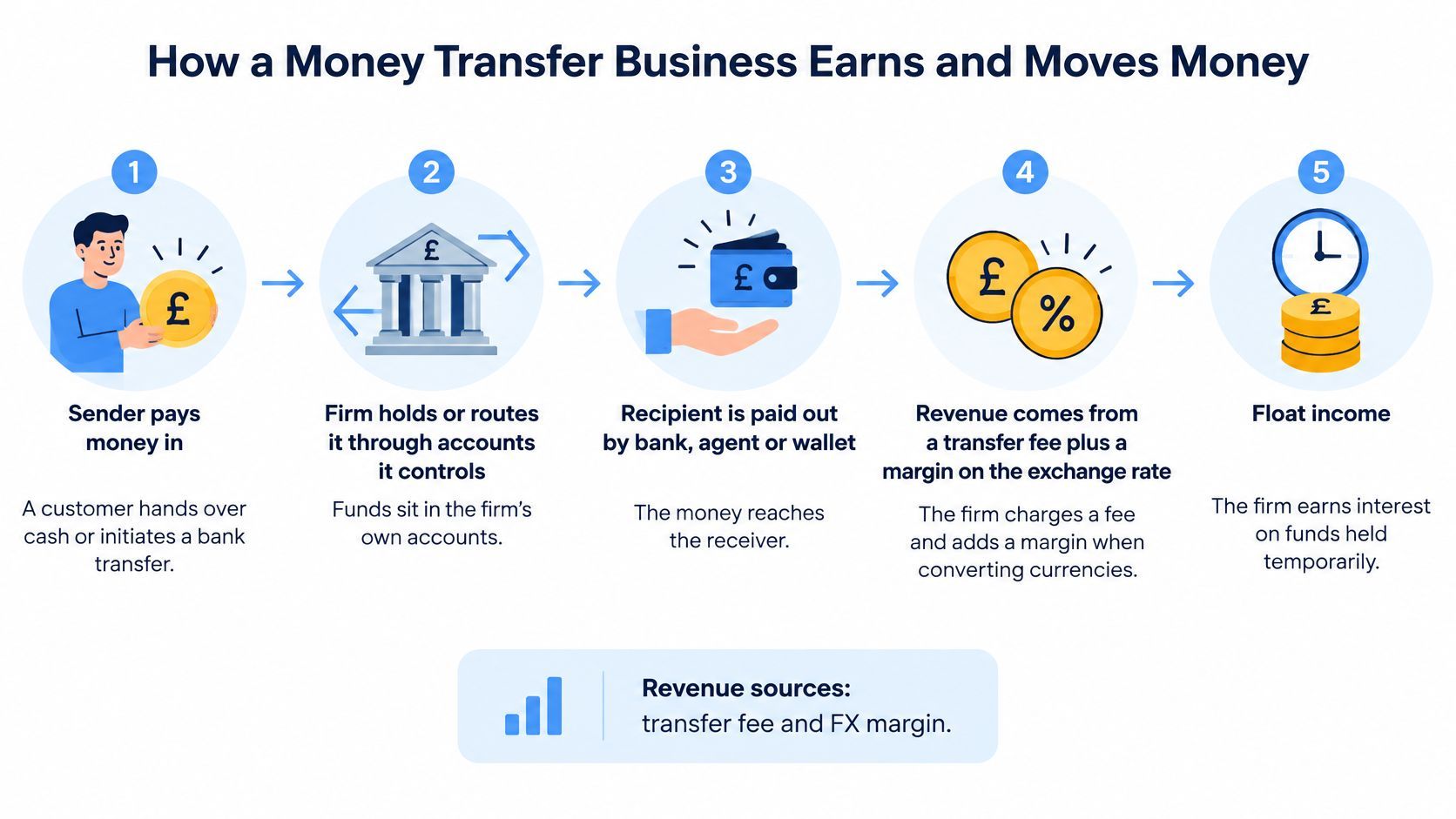
Walk the Birmingham payment in six steps.
- Customer funds the transfer. Cash at an agent, a card payment, or a push from the sender's bank.
- The firm receives funds into an account it controls. This is the step that usually decides the route.
- Compliance checks run. Identity, purpose, and whether the corridor and amount fit that customer.
- FX conversion and routing. The rate, the fee and the payout partner are chosen here.
- Payout by bank, agent or wallet. The recipient is paid in local money.
- Reconciliation and records. The firm's ledger, the safeguarded balance and the payout confirmation agree.
Practical rule: Sketch your own flow on one page and mark the step where customer money is first held. That mark, not your marketing description, is what you take into the route decision.
Sizing Demand With Official Transfer Data
Commercial remittances aren't published as a neat UK total you can drop into a forecast. The closest official series is broader. Office for National Statistics national-accounts data for miscellaneous current transfers recorded outward flows from the UK to the rest of the world of £3.936 billion in 2023, compared with £4.713 billion in 2019 and £3.501 billion in 2008. Treat it as a UK-specific indicator of personal and other current funds that money-transfer firms help move, not as your own revenue pool.
| Year | Recorded outward flow | Movement or context |
|---|---|---|
| 2008 | £3.501 billion | Reference point in the cited series |
| 2019 | £4.713 billion | Highest value among the years cited |
| 2020 | £4.362 billion | Down from the 2019 peak |
| 2021 | £3.550 billion | Trough, about 25% below 2019 |
| 2022 | £3.771 billion | Partial recovery |
| 2023 | £3.936 billion | Still below the 2019 peak |
What the drop is telling you
The pattern is the useful part. Recorded outward flows fell from the 2019 peak through 2020 and reached the 2021 trough, then recovered in 2022 and again in 2023 without getting back to 2019. Volumes move with economic and social conditions. For a money transfer business, the demand behind those flows is migration, family support, international employment and wider cross-border activity. A corridor that looks steady in a good year can shrink when those drivers weaken, and your controls still have to work in the thin year.
Turn the trough into a planning case
Don't forecast one number and call it the plan. Build two cases from the official series, then put your own corridor on top.
- Set a base case from the 2023 level. That's the latest year in the series above, not a peak you hope to revisit.
- Set a downside case from the 2021 trough. If family support and employment flows slow together, this is the stress you should still be able to reconcile.
- Apply your own corridor share. A single destination is a slice of the national series, not the series itself. Write down the share and the reason.
- Test safeguarding and reconciliation in both cases. Staff, breaks and segregated-account capacity have to hold when volume is high and when it falls and exception rates rise.
Place that corridor's average monthly volume against the small-firm cap before you pick a route. A share that looks modest against billions can still cross a monthly threshold once agents are included.
Choosing the Right UK Regulatory Route
The route follows the funds, not the pitch deck. In the United Kingdom, a business that receives money into an account in its own name and transfers it between a payer and a payee may be providing the regulated payment service of money remittance. The FCA's payment services perimeter guidance says this can apply where funds arrive in a bank account, an electronic-money account or a merchant-acquirer account the business controls. Describing yourself as a technology provider, a marketplace, an agent or a remittance platform doesn't change that test. Providing payment services without the correct FCA authorisation or registration is an offence.
How the thresholds split the routes
Read each row as a trigger, then a number, then the thing that knocks you off that row. The small payment institution figures come from the FCA Handbook's payment services perimeter. The electronic-money ceilings come from the FCA's electronic-money application guidance.
| Route | Trigger | Threshold or limit | Key restriction |
|---|---|---|---|
| Small payment institution (registered) | Average monthly payment transactions over the preceding 12 months, including UK agents | Up to €3 million per month, or equivalent | Not available if the firm provides account-information or payment-initiation services |
| Authorised payment institution (full FCA authorisation) | Volume above the small route limit, or a restricted service added | No small-route cap applies | Full authorisation with safeguarding and reporting duties |
| Limited (small) electronic-money institution | Average outstanding e-money, plus monthly payment transactions if payment services are also offered | Up to €5 million outstanding e-money and €3 million monthly payment transactions | Applicants must safeguard e-money holders' funds |
| Authorised electronic-money institution | Outstanding e-money above the limited route, or a broader model | Above €5 million average outstanding e-money, or above the €3 million monthly payment-transaction limit | Full authorisation; scope confirmed in the application |
| New firm with no trading history | No 12-month average exists yet | Use projected average monthly volumes | Re-test the route once actual volumes are known |
Two traps sit in that table. First, the small payment institution average includes transactions executed through UK agents. Growing the agent network can push you over the monthly cap without any new product. Second, account-information services and payment-initiation services take the small route off the table entirely. A wallet or stored balance can also pull you into electronic money, which is a different ceiling from a pure remittance flow.
A firm with no trading history doesn't get to wait for a 12-month average. It uses projected monthly payment volume, then re-tests once real volumes exist. Applicants that haven't operated use projections for the electronic-money test as well.
What the scoping review is actually for
The services, the customers and the operating model are what fire those triggers. Our business and activity assessment covers the services the client intends to provide, its customers and how the business will operate. That review is where you find out whether a "payout partner" is in fact your own account, and whether a planned open-banking feature is a payment-initiation service.
If the same model later moves value across blockchains, settle that design before you freeze the UK flow. Some teams discuss cross-chain swap integration at that point, because an on-chain leg can change which account the firm controls and which route the funds imply.
Re-check the route whenever volumes grow or a restricted service is added. Crossing from registration to full authorisation as an authorised payment institution isn't a relabel. It brings safeguarding and reporting duties you have to be able to evidence, not just describe.
How Safeguarding Keeps Customer Funds Safe
Safeguarding starts with a simple question: where does customer money sit while it is yours to move, and where can it go if the firm fails? For an authorised payment institution or an electronic-money institution, the answer has to be a control that runs every day. The acceptable methods fall into two families: hold relevant funds in a segregated safeguarding account, or protect them through an authorised-insurer policy or a comparable guarantee. Naming one method in a policy is easy. Regulators will look for the repeatable process that would keep customer money away from the firm's creditors.
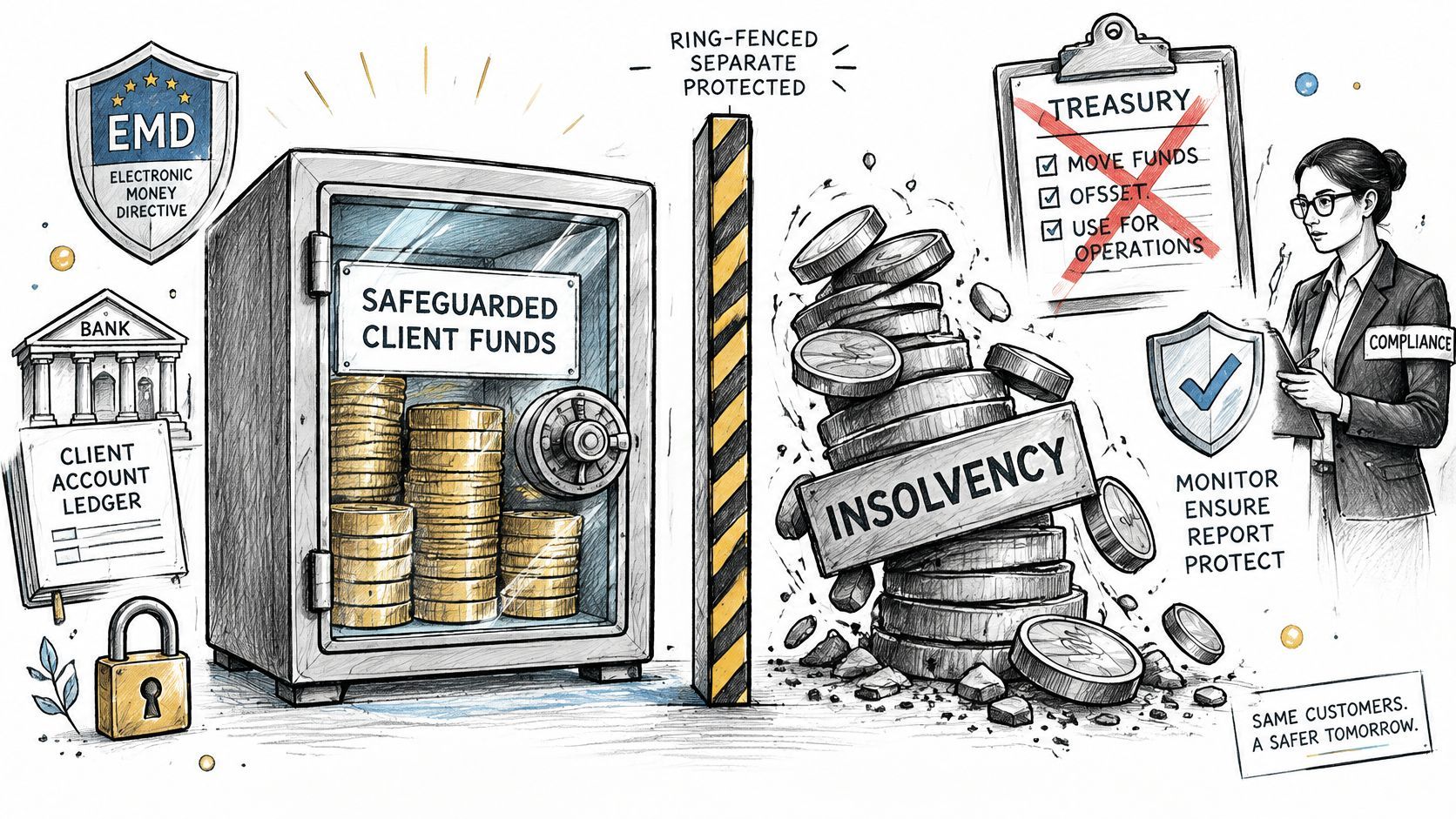
The control loop that has to run every day
Build the loop in this order, and keep each step producing a record.
- A transaction-level ledger. Each customer balance ties to safeguarded funds, rather than a pooled figure rebuilt at month-end.
- Daily internal reconciliation. Compare the ledger with the safeguarding account, or with the insurance or guarantee, on a set timetable.
- Prompt investigation of breaks. A difference is owned the same day, with the cause and the fix written down.
- A complete reconciliation record. Keep the time and date, the actions taken, the calculation outcome and any safeguarding resource used.
Authorised payment institutions, authorised electronic-money institutions and small electronic-money institutions that safeguard file monthly safeguarding reports to the FCA within a short period after each month-end. Treat that cadence as a finance and management-information workload, with inputs from the ledger, the bank statement and the break log. An electronic money account held for customers belongs inside the same loop, because stored value is still customer money.
When volume grows, the loop has to grow with it
A new corridor can triple transaction count before the finance team has revised a single procedure. The safeguarding method may stay valid while the work around it changes: more ledger lines to match, more reconciliations to review, more breaks to clear before reporting. If capacity stays flat, the firm is describing yesterday's control over today's balances. Projected growth in the application should match reconciliation capacity you can staff.
You also need a documented insolvency procedure: who is told, how customer balances are identified, and how safeguarded funds are kept apart from the firm's own creditors. Policies should separate arrangements already in place from those the business still needs to establish. Glentorion prepares policies and operating arrangements on that split, so an application does not present a future control as if it already runs.
Fraud Controls That Protect Without Blocking Customers
Say two transfers land in the same review queue on a Tuesday morning. One is a regular monthly payment to family abroad, flagged because the corridor looks unusual. The other is a freshly opened account pushing small payments through a chain of new beneficiaries. Controls earn their place when they separate those two cases quickly, and when the firm can produce the record showing how it did. Criminals commonly move fraudulent funds through chains of accounts before cashing out, so a clean identity at signup can still be the first hop in that chain.
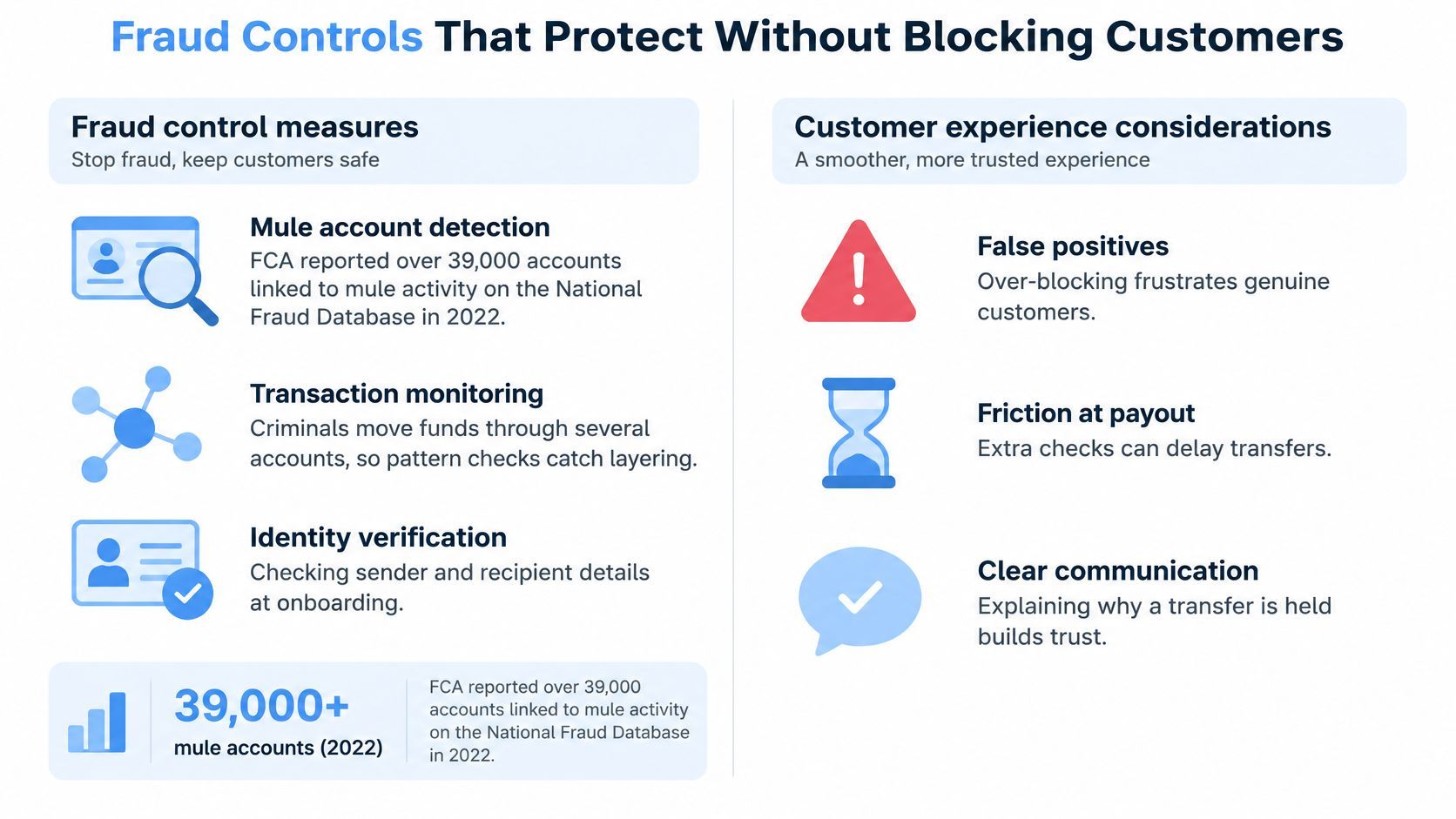
Customers feel both sides of this. Payment Systems Regulator research on the consumer perspective found that 36% of consumers had experienced attempted fraud, 22% had experienced a blocked payment and 39% reported limited payment choice. 41% were worried about fraud, with financially constrained consumers particularly affected. A blanket rule that stops every unusual corridor protects the firm on paper while trapping customer money in limbo, and it hits hardest the people who have few other ways to send funds home.
Signals worth watching, and the metrics that show the balance
Pair onboarding risk scoring with transaction-graph analytics. Watch for rapid pass-through, newly created beneficiaries, unusual account-to-account chains, velocity spikes, device or identity reuse, and transfers that fall outside the customer's expected corridor or purpose. Scripted attacks often start before any of that, so stopping scripted abuse at signup belongs in the same design as the later graph checks.
Friction protects customers only when the firm can explain it.
- Explainable alerts. The reviewer can say why this payment was flagged, in terms a customer could hear back.
- Case escalation. A held transfer has a named owner and a resolution clock.
- Evidence for suspicious-activity reporting. What you saw, what you did and what you decided remains on record after the payment is released or rejected.
- False-positive analysis. If genuine family support keeps getting stopped, the threshold is wrong. That analysis belongs in the same pack as your financial crime risk assessment.
Management information should join the operational view to the regulatory one. Track alert-to-case conversion, confirmed mule rate, intervention time and recovery rate. The FCA expects firms to report payment fraud in a structured way, so those metrics should map onto what you file and onto the board's risk appetite. A firm that tunes controls in one spreadsheet and reports them in another will struggle to show that legitimate transfers still get through. Where customer money sits and moves is, in the end, an evidence question: when a payment is held, released or reported, the record is what proves the control worked.
Operational Resilience and Complaints Readiness
A licence application that can't explain a failed payment won't survive contact with customers. Financial Ombudsman quarterly complaints data show a 49% uphold rate for money-remittance complaints in Q2 2025/26. That figure measures how the dispute was handled: the Ombudsman can uphold a complaint over poor communication even where the payment decision itself was sound. Either way, the message for a founder is the same. Delayed, rejected and disputed payments are routine events in this market, and a generic "how to start a remittance company" plan rarely says what evidence the firm will hold when one lands.
Headline service figures can hide exactly where a firm is weak. A payments market can report that the large majority of customers send and receive money on time while a meaningful minority still hits IT failures, blocked transfers or long waits for a status update. Boards quote the average because it reads well on a slide; complaint handlers and supervisors work through the minority. Where customer money sat during the failure, who controlled it and what the firm recorded at each step are the questions that decide how those cases end.
Can the operating model produce reliable evidence when a payment is delayed, rejected, disputed or investigated? If the answer is a policy title rather than a record, the model isn't ready.
What you should be able to show before you apply
Treat the business plan, the customer journey, outsourced providers, safeguarding, incident response and complaints as one system. Test it as one system.
- Rehearse delayed, rejected and disputed flows before application. Pick one payment in each state and keep the artefacts: status messages, timestamps, who was told, and how the customer was put back to a known balance.
- Write a responsibility matrix. Name the person for safeguarding, financial crime, complaints, incidents and each critical outsourcer. A shared inbox isn't a name.
- List third-party and subcontracted dependencies. Payout partners, safeguarding banks, cloud hosts and identity vendors. For each, write down what happens to customer funds and to service if it stops mid-transfer.
- Document incident response and recovery. Who declares the incident, who talks to customers, and how you restore service or exit a failed provider.
- Feed complaint root-cause analysis back into controls. An upheld pattern about late payouts should change a threshold, a vendor or a script. The final response letter then describes a fix that already happened.
The interview test is simple. Named managers should explain these controls and the assumptions behind the volumes without reading from a pack. If only the consultant can answer, the firm doesn't have the control yet.
Confirm Your Route Before You Apply
Decide the route only after you can evidence it. Work through the points in order, and stop when one of them changes the answer.
- List every service. If account-information or payment-initiation services are in scope, the small payment institution route is unavailable. Say so in the scoping note, not in a footnote after submission.
- Estimate average monthly payment volume. Use the preceding 12 months where you have them, including UK agents. A new firm uses projections. Test that average against the small payment institution cap.
- Check for stored balances. If customers can hold value before payout, test outstanding electronic money and any related payment transactions against the limited electronic-money route. A wallet you described as "just a balance display" still counts if you owe that money.
- Map who controls each account that receives funds. Your name on the account is the remittance trigger, even when a partner runs the app.
- Confirm the safeguarding method and the reconciliation capacity it needs. Daily breaks, the 15-business-day report and the insolvency procedure have to match the volumes in your downside case.
- Run one failed payment from end to end. Use the delayed, rejected and disputed tests, and keep the record a complaints handler could hand to an ombudsman.
Re-check whenever volumes grow or you add a restricted service. Agent growth alone can move the monthly average across the boundary.
Firms that want authorisation support can write to contact@glentorion.com. Rosie Murphy Williams, Head of Market Structure & Regulation, has deep expertise in FCA, MAS and DFSA regulatory frameworks, which matters when the same flow is being tested against more than one regime. Information on the Glentorion website is general and doesn't constitute advice on a particular business or application.
Glentorion helps financial and crypto firms prepare payment-institution and electronic-money applications, from the funds-flow scoping through the evidence a supervisor will ask to see. If you're deciding which UK route a money transfer business fits, and whether the model can prove it, start with a look at how we work at Glentorion. Bring your flow diagram and your volume cases. That's the conversation worth having before you apply.
- money transfer business
- UK money remittance
- FCA payment institution
- safeguarding customer funds
- small payment institution