FCA Authorisation Application Form: A UK Filing Guide
Published
In 2024, UK retail-bank authorisation applications carried a 50% rejection, withdrawal or refusal rate, based on four such outcomes among eight cases, according to FCA freedom of information data. One portfolio in one year proves nothing about your own sector's odds. It does show that the file a firm sends in gets judged, and that a meaningful share of applicants fall short, give up, or are refused.
Founders usually meet the FCA authorisation application form as an online form with sections and upload buttons. Practitioners meet it as a regulatory case file that someone assesses, tests against the financial projections, and asks them to explain at interview. That shift in perspective changes the order of work, because you can't write your way past a business the paperwork doesn't support.
Two rules hold across every route. The filing has to describe a business that could operate, and every document in the pack has to describe the same business. The route, the fee, the statutory clock and the interview all follow from those two.
Table of Contents
- Where to Find the Form and Which Route Applies
- How Cryptoasset Registration Differs From FSMA Authorisation
- Form Sections and the Evidence Each One Needs
- Clock Rules and Decision Timelines Explained
- Pre-Application Support Before You File
- Cross-Document Checks That Make a Form Assessable
- How to File the Application Step by Step
- Common Application Problems and How to Fix Them
Where to Find the Form and Which Route Applies
Most applicants arrive with the wrong first question, which is which form to open. The form depends on the regulated activity the firm will carry on, not on its legal form, its sector label, or what a founder heard from another business. Get the route wrong and every later document is written for an audience that will never read it.
For most firms seeking permission to carry on regulated activity in the UK, the route is Part 4A authorisation under the Financial Services and Markets Act 2000, applied for through the FCA's authorisation pages. Payments and e-money firms start in the same place but are assessed against a shorter usual period. Cryptoasset firms registering under the Money Laundering Regulations start somewhere else entirely, with a different purpose and a different fee rule.
Fees follow permissions, not labels. The FCA's published framework sets out 10 pricing categories, with application fees ranging from £280 for Category 1 to £225,170 for Category 10, and the category depends on the group of permissions included in the application rather than the applicant's legal form or industry, as the FCA application fees page sets out. The fee is payable when you submit, so it belongs inside your submission controls and approval steps, not in a separate finance queue running in parallel.
| Route | Who it covers | Where the application starts | Fee rule |
|---|---|---|---|
| FSMA Part 4A authorisation | Firms seeking UK permission for regulated activity under FSMA 2000 | FCA authorisation pages | Set by the pricing category of the permissions sought, from £280 (Category 1) to £225,170 (Category 10) |
| Payments and e-money authorisation | Payment and e-money firms | FCA authorisation pages | Set by the pricing category of the permissions sought, paid on submission |
| Cryptoasset registration under the Money Laundering Regulations | Cryptoasset firms registering with the FCA | FCA cryptoasset registration pages, checked for the latest version | Category 6, paid in full on or before submission |
Three Questions to Settle Before Drafting
- Which regulated activities will the firm carry on? Name them against the regulator's own activity descriptions, not in your marketing language. "Payments platform" is not an activity. "Payment initiation" is.
- Which permissions does each activity need, and which do you need at launch? Every permission you add changes the fee category and widens the evidence set you have to produce.
- Which legal entity will hold them? In a group with several companies, say exactly which one contracts with customers, which one employs the people doing regulated work, and which one holds the permission.
Check the live FCA page on the day you file. Forms, question wording and guidance move, and a package built against a cached version costs you weeks.
How Cryptoasset Registration Differs From FSMA Authorisation
Registration under the Money Laundering Regulations is not FSMA authorisation, and treating the two as interchangeable is the single most common structural error in crypto paperwork. Registration allows a firm to carry on cryptoasset business while it is supervised for money laundering compliance. It does not grant permission for regulated activity under FSMA.
The fee rule is stricter than most applicants expect. For registration, the application fee must be paid in full on or before submission, and an application received without the prescribed fee is not treated as a valid application under the Regulations. The FCA may contact the applicant, but if the fee is not received the application is returned and no application is considered to have been made, as the FCA cryptoasset registration guidance explains. Registration sits in Category 6 of the pricing categories, and registered firms also pay annual periodic fees, which belong in the budget from day one rather than at renewal time.
Filing rule that catches people out: in cryptoasset registration, the fee is confirmed before you submit, not after. A pack that is complete in every other respect is not an application until the fee has been received.
That single detail reorders the whole filing sequence. In FSMA work, payment can sit near the end of the administrative checklist. In registration, it is a precondition, so the approval that releases payment has to happen while the pack is still moving.
Longer-term plans matter too. The UK crypto regime is moving from registration toward full FSMA authorisation, so firms with a multi-year horizon should confirm which regime their activity will sit under before they build. A registration file and an authorisation file are not the same document, and rebuilding one into the other wastes the work you've already paid for. Our guide to crypto asset regulation covers how the perimeter is shifting.
The evidence principles don't change. The registration file is judged on the same question as any FSMA file: do all the documents describe the same business?
Form Sections and the Evidence Each One Needs
The form arrives as sections, and each section asks about a different part of the business. Read them as a set of claims rather than a set of fields, and the work becomes obvious. Every material answer needs a document behind it, and every document needs an owner.
This is what the exercise looks like once the evidence sits beside the answers.
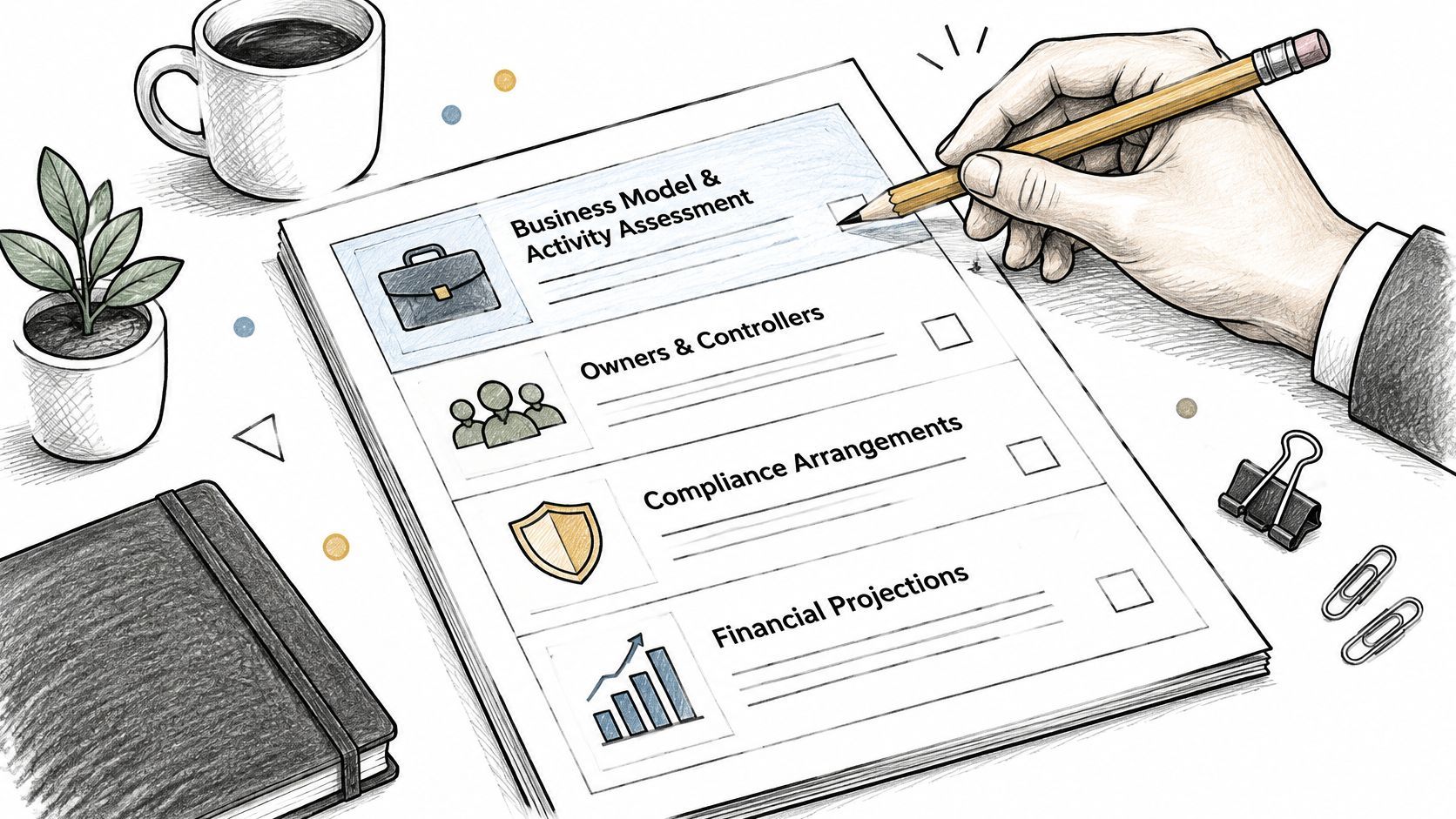
Business model and activity assessment comes first because every later section borrows from it. The business and activity assessment covers the services the client intends to provide, its customers and how the business will operate. If you can't state those three things in two pages of plain prose, no amount of policy drafting rescues the pack.
| Form area | What the FCA needs to see | Evidence to attach |
|---|---|---|
| Business model and activities | Services, customers and how the business will operate | Business plan and activity description |
| Ownership and structure | Controllers, group structure and legal entity | Organisation chart and shareholder register |
| Governance and individuals | Senior roles, responsibilities and time committed | Role descriptions and responsibility map |
| Financial resources | Capital, projections and key assumptions | Historic accounts where they exist, forecasts and funding evidence |
| Systems and controls | IT infrastructure, operational resilience and outsourcing | Systems diagrams and outsourcing agreements |
| Policies and procedures | Arrangements in place now and those still to be established | Policy documents and operating procedures |
| Threshold conditions (FSMA firms) | Minimum standards the firm must meet | Document mapping each condition to its proof |
Two rows get underestimated. Governance and individuals is where the regulator tests whether the people running the firm have the time and authority to do it properly, so role descriptions should say what each person decides, not just what they're called. Financial resources is where projections get read against their assumptions, so a forecast without stated assumptions reads as a guess.
Where the Pack Is Thin
Walk the evidence column and mark every answer that has no document attached. That list is your real gap analysis, and it's usually shorter than the panic suggests. Our note on evidence and authorisation packs works through what a usable document looks like.
Add the threshold conditions for FSMA firms. Map each minimum standard to the specific document that proves it, because a condition with no proof is an open question an assessor will ask in writing.
Clock Rules and Decision Timelines Explained
The statutory clock depends on the application route and whether the application is complete. For a firm seeking Part 4A permission, the FCA generally assesses a complete application within six months. If the application is incomplete, the statutory period can extend to 12 months from receipt, as the FCA's authorisation guidance explains. Payments and e-money firms usually face an assessment period of three months for a complete application. These are statutory timeframes, not promised decision dates.
A separate measure can help put the statutory periods in context. In 2024/25, the FCA's median determination time for new firm authorisations was 112 calendar days, according to its authorisations operating service metrics. A median describes the middle of the cases reported, not an individual applicant's expected wait.
| Scenario | Timeframe | What drives it |
|---|---|---|
| Complete FSMA Part 4A application | Assessed within 6 months | The full application has been received |
| Incomplete FSMA Part 4A application | Up to 12 months from receipt | The application is incomplete |
| Complete payments or e-money application | Usually 3 months | The application is complete |
| Median new-firm determination, 2024/25 | 112 calendar days | FCA operating metric across cases |
What Actually Stops the Clock
The statutory period is longer for an incomplete application. Missing information, unresolved findings or contradictory answers can prompt further questions and delay assessment. Treat the form as one part of a regulatory case file: the answers should match the evidence and the other application documents, so the assessor can understand which account is current.
Missing information is easier to address before filing than after the application is under review.
Turn the Clock into a Plan
- Confirm the route and evidence set before drafting. A late change to the permission sought can affect the questions and documents required.
- Plan around the applicable statutory period. For a complete Part 4A application, that means allowing for the six-month period rather than assuming an earlier decision.
- Leave room for further questions. Even a complete application may prompt requests for clarification, so avoid setting a launch date that depends on a guaranteed decision date.
The regulator makes the decision, and approval and decision dates are not guaranteed. Plan using the applicable timeframe, and keep launch plans conditional on permission being granted. The authorisation process and filing sequence explain how the application moves from preparation to submission.
Pre-Application Support Before You File
This is the step most applicants skip, and it's cheap relative to a rebuild. In 2024/25 the FCA received 88 applications from firms seeking to use its Pre-application Support Service, according to its supporting growth metrics. Those firms used the service to test a route before committing to a filing.
Arrive with four things and the conversation is useful within an hour.
- The planned activities, in regulatory language. Bring your own reading of which activity descriptions apply, including the ones you're unsure about.
- The proposed legal entity and its controllers. Naming the entity and the people behind it early prevents a structure that has to be redrawn.
- A plain-language business model. Two pages, money in and money out, and the customer journey end to end.
- Your open questions on permissions and systems. Write them down. The ones you don't ask are the ones that surface at month four.
The service helps shape the route and the evidence set. It doesn't guarantee an outcome, and it doesn't replace the documents described above.
The Regulatory Sandbox Has a Different Bar
The Sandbox is not a shortcut for early-stage ideas. In its 2025/26 reporting year the FCA received 142 Regulatory Sandbox applications, compared with 52 in 2024/25 and 43 in 2023/24, an increase of 173% from the previous year, according to its digital and innovation metrics. Across the Sandbox, Innovation Pathways and Digital Sandbox, the FCA received 332 applications in 2025/26 against 176 in 2024/25. Priority goes to firms ready to test in a live environment and able to move quickly toward authorisation, including applying within three months.
Test yourself against that bar. If you can show live-testing readiness and a credible path to authorisation within three months, the Sandbox is worth the application. If you can't, prepare for the standard route and stop spending weeks on a pitch you can't yet support.
Cross-Document Checks That Make a Form Assessable
A complete form is not a complete application. Populated fields, attached policies and signed declarations don't make a file assessable. The FCA's own good and poor practice findings on authorisation and registration applications show that completeness depends on whether the whole evidence set is coherent and credible, as set out in its authorisation and registration good practice guidance.
The failures the FCA lists are strikingly consistent. Missing historic accounts. Inaccurate information. Insufficient evidence of financial resources. Unclear ownership structures. Generic policies and inconsistent policies. Unclear IT infrastructure and unrealistic technology plans. Weak explanations of how individuals divide their time between multiple roles. None of those are field-completion errors. They're coherence errors.
Build a Consistency Map
Take every material answer in the form and attach five things to it.
- An owner. One named person who can defend the answer in an interview without checking with someone else.
- A supporting document. The file that proves the answer, with a version and a date.
- A system. The actual platform, register or process the answer refers to, named specifically.
- A key assumption. What has to be true for the answer to hold, stated in numbers where numbers apply.
- An implementation milestone. The date by which the arrangement exists, or a clear statement that it exists today.
Then test the map for contradictions. Say a business plan assumes three staff in year one. The governance section has to list the same three roles, the financial projections have to carry the same three salaries, and the systems budget has to match the tooling those three people will use. If the plan says three and the projections carry five, an assessor asks which figure is true, and answering costs weeks.
Contrarian point: polished, templated documentation raises risk when it hides contradictions between the business plan, governance model, systems design and individual responsibilities. A plain policy that matches the operating model beats a glossy one that doesn't.
Test each policy against what the firm will do. A generic policy that could belong to any firm in the sector is a warning sign, not reassurance, because it tells the reader nobody has thought about this business. Small firms need the most care here, since one person often holds several roles and the FCA specifically highlights weak explanations of divided time.
The discipline resembles document control in any management system: write what you do, do what you write, and keep documents consistent as facts change. ISO Security's documentation guidance from ISO Security explains how versioning, ownership and evidence trails work in practice, and the logic transfers directly to an authorisation pack.
This is also where the work has to be sequenced rather than batched. Our approach brings the business plan, financial information, policies and application answers together as a second step, reviews the documents, resolves findings and revisits affected material whenever a fact changes. We check consistency across the application documents, address findings and prepare the identified package for internal and client approval, which is why the regulatory business plan for FCA applications is written to be read alongside the financials rather than on its own.
How to File the Application Step by Step
The sequence holds whatever the route. What changes is the content of the middle steps, which depends entirely on the activity.
- Confirm the route and the permissions, and name the legal entity that will hold them. This is what makes the form and the fee match the planned activity. The usual slip is drafting before the route is settled.
- Assess the business model, services, customers and operating arrangements. Every later answer borrows from this assessment, so an error here propagates. The usual slip is describing the product instead of the regulated activity.
- Draft the business plan, financial projections, policies and application answers, marking which arrangements are current and which are to be established. Mixing the two without labels reads as a misstatement. The usual slip is writing policies for a firm you plan to be rather than the firm you are.
- Run the consistency review across every document and close each finding. One contradiction can trigger questions that extend the timeline. The usual slip is reviewing sections individually instead of end to end.
- Obtain internal approval and client sign-off on the final package. The version filed should be the version everyone agreed. The usual slip is a late edit that never reaches the approver.
- Pay the application fee at submission. For cryptoasset registration, an application without the prescribed fee is not treated as valid at all. The usual slip is treating payment as post-filing administration.
- Submit under the agreed mandate and access arrangements, then record the filing result and keep the evidence of submission. Your file copy and submission timestamp are the first things you'll want when a question arrives.
The steps below show how that sequence runs in practice.
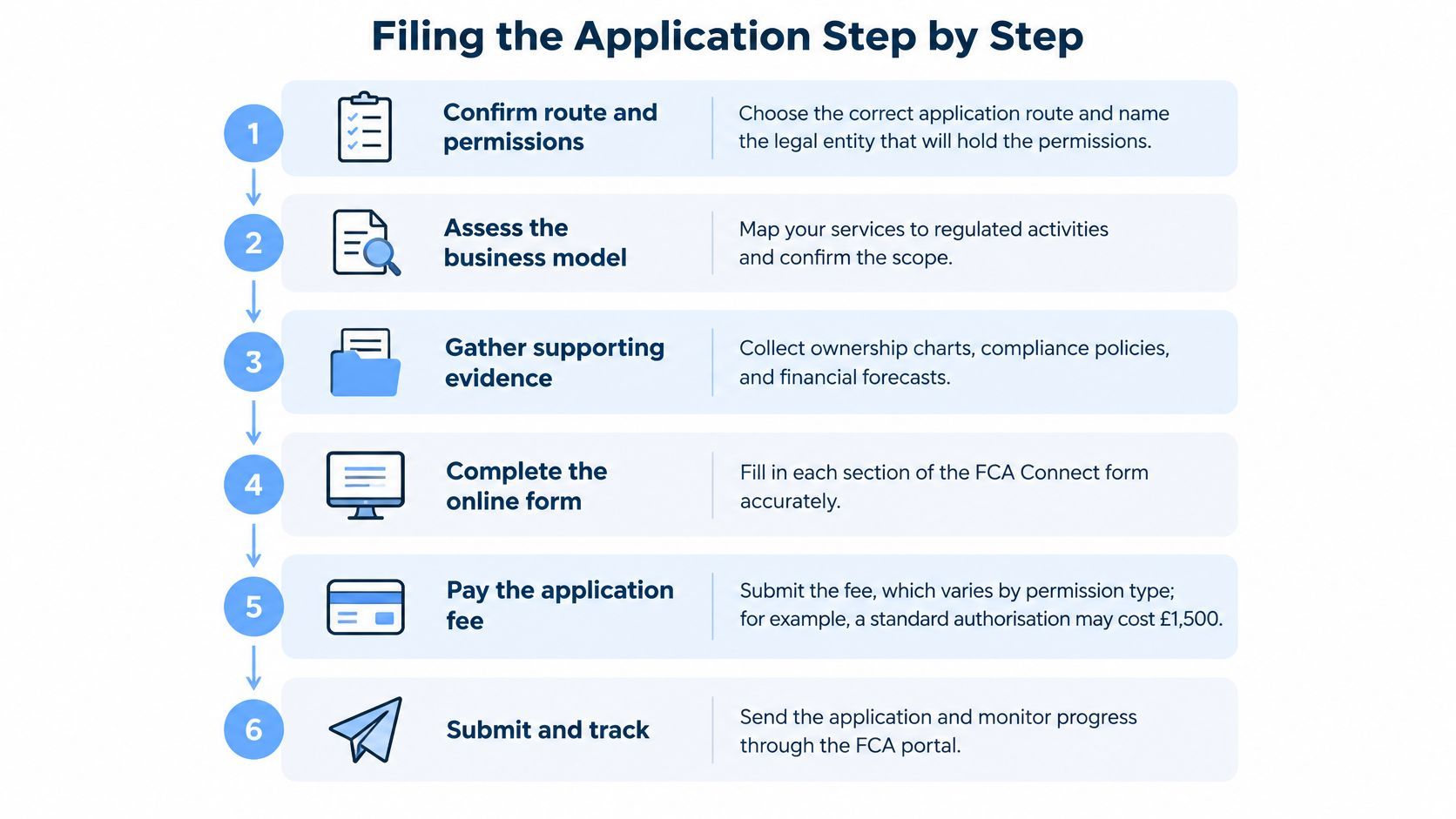
After our internal approval and your sign-off, the agreed application is submitted on your behalf under the required mandate and access arrangements, with the filing result recorded.
What to Do in the First Week
Write down the route and the permissions in one paragraph, in regulatory language. Collect the historic accounts, or write the reason none exist and state what replaces them. Give every known problem an owner and a closing date, and put the fee release into the same approval chain as the pack.
Common Application Problems and How to Fix Them
A completed form is only assessable when its answers match the evidence behind them. In the FCA freedom of information data cited in the article's opening, the rejection, withdrawal or refusal rate for retail-bank new authorisations was 57% in 2020, 64% in 2021, 40% in 2022, 44% in 2023 and 50% in 2024. These figures describe one retail-banking portfolio, not all FCA-regulated sectors. They underline why applicants should check their evidence and explanations before filing.
The FCA reported that 99.1% of applications across its authorisations operating-metric areas were determined within the statutory deadline in the quarter covering January to March 2025, according to its authorisations operating and service metrics. The practical lesson is to make the application assessable when submitted: missing or inconsistent material can create problems even when the regulator meets its deadline.
| Problem | Why it matters | Fix before filing |
|---|---|---|
| Missing historic accounts | The FCA cannot assess the firm's financial resources from incomplete information | Provide the accounts, or explain why none exist and what information supports the assessment |
| Inaccurate information | Figures that conflict across documents make the application harder to assess | Check each figure against its source and correct affected documents |
| Unclear ownership structure | The FCA cannot readily identify who controls the firm | Include a current structure chart that names each controller |
| Generic or inconsistent policies | The documents may not explain how controls will work in the proposed business | Describe the actual activity, the relevant controls and who is responsible |
| Unclear IT infrastructure or unrealistic technology plan | The application may not show how systems support the business and its controls | Map the systems to the business model and check that the plan aligns with the budget |
| Individuals divide time across roles without explanation | The FCA may question whether governance responsibilities can be met | Set out each role, time commitments and cover arrangements |
| Minimum information missing | The FCA may reject the application without assessing it | Check that the minimum information is complete before filing |
A rejection for missing minimum information is not the same as a decision on the merits. The applicant may resubmit and receive a refund of the application fee, but the application process must start again and time has passed.
Use the table as a working checklist. Assign an owner to each issue, set a closing date and identify the document that demonstrates it has been resolved. Then review the evidence against the application answers: a row marked complete without supporting material is still an open finding.
Glentorion prepares and reviews FCA authorisation packages, bringing the business plan, financial information, policies, controls and application answers together so the figures and written account can be checked as one file. After internal approval and client sign-off, the agreed application is submitted on the client's behalf under the required mandate and access arrangements. If you are unsure which route applies to your activities, or want a consistency review of a prepared package, Glentorion provides support scoped to the work required. Start at Glentorion.
- FCA authorisation application
- FSMA Part 4A
- FCA application fees
- UK crypto registration
- FCA application timeline