License for Banking: How Authorisation Works
Published
The most common advice about getting a license for banking is to prepare a business plan, assemble the policies and submit an application. That puts the paperwork ahead of the harder question: can the proposed bank demonstrate that its people, funding, controls and infrastructure will work together?
A banking licence isn't a certificate you collect before starting the build. It's regulatory permission supported by evidence, sometimes with restrictions that leave the management team facing a tightly controlled delivery programme. Permission to take deposits and the practical ability to operate are different milestones.
Table of Contents
- What a Licence for Banking Actually Permits
- How Banking Licence Rules Differ by Place
- Who Must Be Satisfied Before Approval
- UK Timelines Fees and Authorisation Numbers
- Capital Liquidity and the Mobilisation Window
- Where Applications Stall After the Paperwork
- Decide the Route Before You Build the Bank
What a Licence for Banking Actually Permits
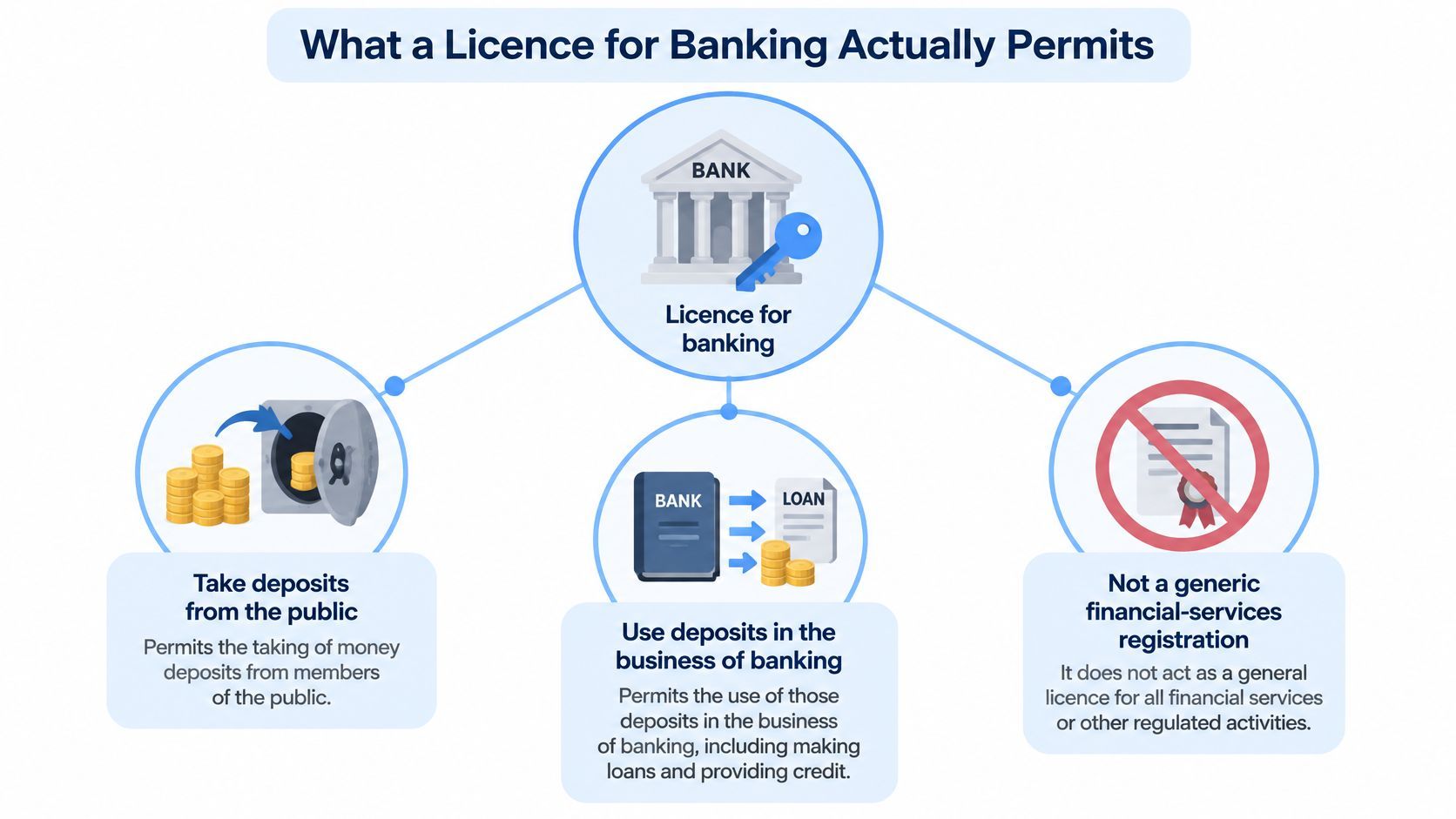
Say a founder wants customers to place their savings with a new business, which will use those funds to make loans. That proposition requires deposit-taking permission, not registration as a financial-services company. The airport analogy helps: the licence is clearance to operate the airport, not a ticket to fly.
The Bank of England's account of UK bank authorisation dates the modern PRA and FCA framework to April 2013, records 46 new banks authorised between then and September 2019, and describes 12 to 24 months of typical pre-application preparation.
Permissions that look similar but aren't
- Electronic money and payments: These permissions allow specified ways of storing or moving value without making the provider a bank. Understanding an electronic money account helps separate a payment balance from a bank deposit.
- Crypto custody: Safeguarding customers' cryptoassets doesn't itself authorise the custodian to accept bank deposits.
- A credit-institution branch: A branch serves a host market as part of its home bank, rather than necessarily being a separately incorporated local bank.
- Deposit insurance: Where applicable, insurance eligibility or approval is a distinct question, not something to infer from a banking brand.
The founder therefore needs more than a convincing product description. Management must explain which legal entity receives customers' money, what that money becomes and how the entity uses it. The numbers, approval tests, mobilisation timetable and jurisdiction must all describe the same proposed business.
How Banking Licence Rules Differ by Place
Where a banking licence is granted and what it does not cover
| Place | Who decides | Core permission | Constraint to plan for |
|---|---|---|---|
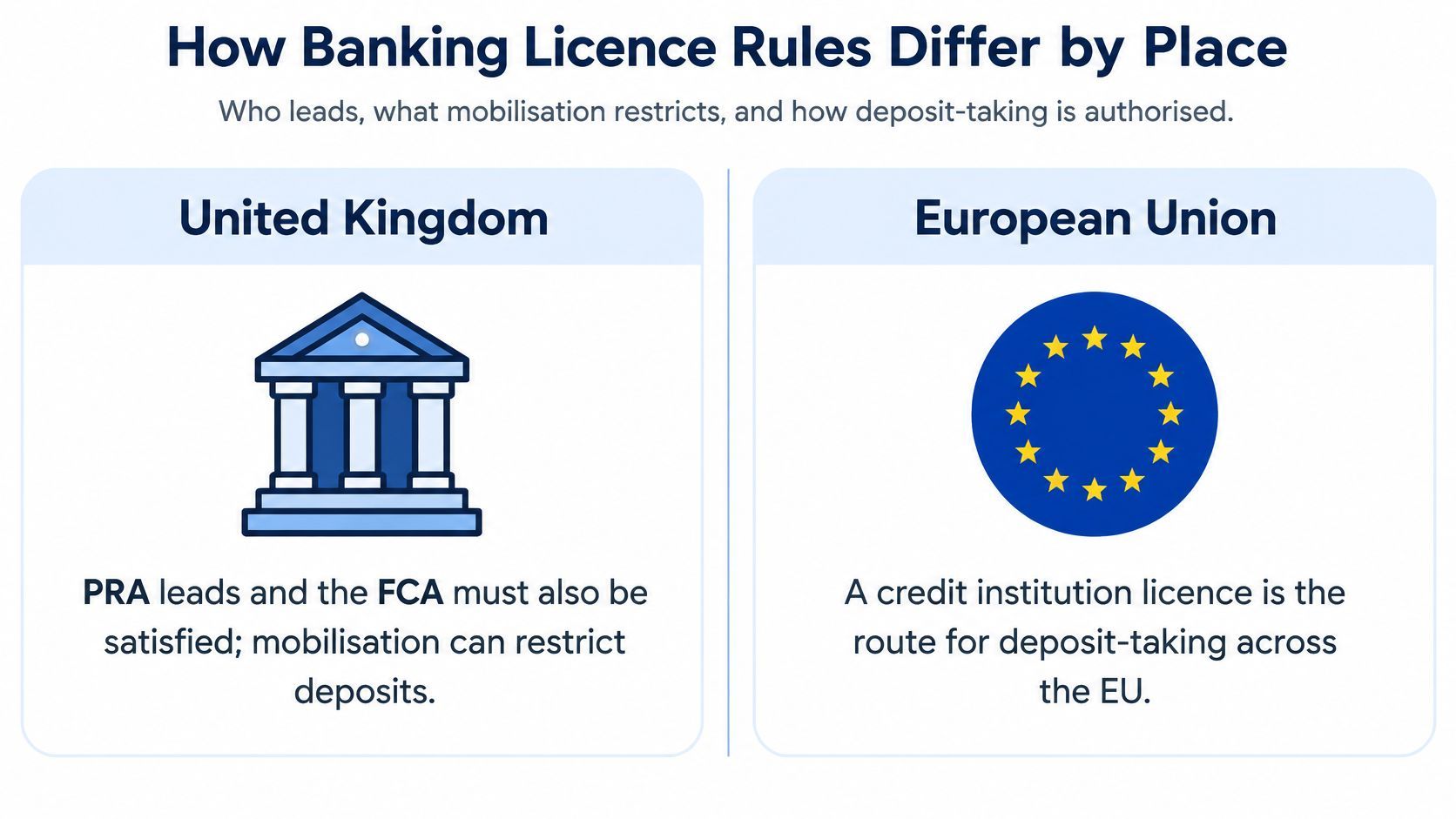
| United Kingdom | PRA, with the FCA also satisfied | Deposit-taking as a bank | Dual approval; mobilisation can restrict deposits |
| European Union | Home national authority under CRD, with ECB involvement where applicable | Credit institution in the home state | CRD VI can require a licensed branch to lend to EU borrowers |
| UAE mainland | UAE Central Bank | Commercial banking in the UAE | Not a DIFC or ADGM permission |
| DIFC | DFSA | Specified financial services inside the DIFC | Not a UAE-wide banking licence |
| ADGM | FSRA | Specified financial services inside ADGM | Not a UAE-wide or DIFC licence |
| United States | OCC or a state chartering authority, with a separate FDIC insurance decision where applicable | National or state bank, plus deposit insurance if granted | Charter and deposit insurance are separate decisions |
The table is a route map, not a finding that every permission permits the same activities. Applicants should identify the entity, services and customers before choosing an authorisation process.
A branch isn't a passport
In the EU, distinguish a locally authorised credit institution from a third-country bank's branch. They don't provide identical market-access rights. A third-country branch isn't an EU-wide passport, and establishing it doesn't replace prudential supervision of the home bank.
The CRD VI analysis by Latham & Watkins explains how the licensed-branch requirement can affect in-scope third-country institutions lending to EU borrowers. This is a legislative framework requiring national implementation, not merely supervisory commentary. Its scope, exemptions and local implementation need assessment before a lender assumes it can continue serving customers entirely across borders.
The UAE requires a different separation. A UAE Central Bank banking licence isn't interchangeable with a DFSA permission in the DIFC or an FSRA permission in ADGM. A group's presence in a financial free zone doesn't establish that it may conduct mainland banking.
A charter isn't deposit insurance
In the United States, the chartering decision and the FDIC insurance decision answer different questions. An applicant planning an ordinary insured retail deposit business must establish both the relevant banking authority and the insurance position. It shouldn't describe a charter alone as proof that the proposed deposit product is ready to launch.
Technology assurance also needs jurisdiction-specific scoping. For teams assessing US security obligations, ThreatExploit AI's financial institution penetration testing guidance is a useful starting point for security-testing questions, not a substitute for determining the applicable charter and supervisory requirements.
Cross-border rule: Never treat a home-country licence as automatic permission to solicit or accept deposits in another country.
Before selecting a filing, name the customers, the place where deposits will be taken and the payment rails the business will use.
Who Must Be Satisfied Before Approval
A UK applicant doesn't prepare independent stories for independent regulators. Under the FCA's bank authorisation guidance, a deposit-taking applicant submits a single application to the PRA, which leads the process, while the FCA assesses conduct and relevant threshold conditions. Authorisation requires both regulators to be satisfied.
Treat this as a combined test of whether the proposed bank can operate prudently and treat customers properly. A favourable capital model won't compensate for an ownership structure the regulators can't understand or controls management can't explain.
Build a consistent evidence pack
The application materials should connect:
- Business model: Customers, products, distribution, pricing and the source of sustainable income.
- Ownership and controllers: The ownership chain, funding sources, controlling interests and relationships that could affect supervision.
- Governance: Board oversight, decision rights, escalation arrangements and challenge.
- Senior-manager responsibilities: Named accountability, relevant competence and enough capacity to perform the role.
- Risk controls: Material risks, monitoring, limits, breaches and corrective action.
- Capital and liquidity strategy: Assumptions, stress testing, funding availability and management actions.
- Operational infrastructure: Systems, suppliers, records, security and continuity arrangements.
The FCA expects applicants to demonstrate prudent management, identify material business and regulatory risks, and explain how they'll monitor and control them. A practical review against the FCA threshold conditions should therefore examine evidence, not just whether policy documents contain the right headings.
A tidy prudential model can still fail on customer treatment, weak governance or poor supervisory access.
Make the written account match the numbers
Suppose the financial model assumes rapid savings-account growth, but the operating plan provides only a small manual onboarding team. Management needs to resolve that mismatch before filing. The answer may involve slower growth, additional staff or tested automation, with corresponding changes throughout the pack.
Ownership evidence deserves similar discipline. Keep beneficial-ownership records, organisational charts and explanations of funding consistent across documents. Inpro's guide to documents for opening a UAE bank account offers a useful comparison for organising corporate and identity records, but account-opening documents aren't a bank-authorisation package.
Senior managers must also be able to explain how their controls work. An outsourced compliance task still needs an accountable person inside the proposed bank who understands its scope, limitations and escalation process.
Completeness is only the starting point. Management must establish whether capital, liquidity and the operational build can withstand a restricted start.
UK Timelines Fees and Authorisation Numbers
UK banking authorisation volumes and clocks
| Measure | Figure | What it means |
|---|---|---|
| New banks, April 2013 to September 2019 | 46 | About seven a year after the dual-regulator framework began |
| Annual average in the four years before April 2013 | About 4.5 | The baseline against which the subsequent rise was measured |
| Banks and credit unions authorised since the PRA was created | 81 | The combined total isn't solely brand-new UK banks |
| Brand-new or de novo UK banks in that total | 40 | A narrower category of genuinely new institutions |
| New banks in 2024/25 | 5 | The prior-year comparison in the PRA annual report |
| New banks in 2025/26 | 1 | An 80 per cent year-on-year fall |
| Typical pre-application preparation | 12 to 24 months | Preparation before formal submission |
| Decision on a complete application | 6 months | Statutory decision period for a complete application |
| Decision on an incomplete application | Up to 12 months | A separate statutory period, not permission to omit evidence |
| Application fee recorded in the 2019 framework | £25,000 | A historical application fee, not the cost of building a bank |
| New-firm cases completed in 2024/25 Q4 | 2, all within standard | Service-standard performance isn't an approval rate |
The historical entry, preparation and fee figures above come from the Bank of England's previously identified authorisation bulletin. The PRA's 2025/26 annual report records 81 banks and credit unions, including 40 de novo UK banks, and one new bank authorised in 2025/26 against five in 2024/25, an 80 per cent reduction; its reported process metrics include two new-firm cases completed in 2024/25 Q4, with 100 per cent meeting the standard, against decision periods of six months for complete applications or up to 12 months for incomplete applications.
Separate preparation from the decision clock
The statutory decision period isn't the total project duration. Before formal submission, founders need to resolve ownership, recruit credible management, develop financial projections and decide how the bank will operate. These are substantive delivery tasks, not administrative waiting time.
A complete application must also remain accurate. If an investor withdraws, a senior manager changes or a supplier arrangement fails, the team must assess which documents and assumptions need updating. Submitting a pack doesn't freeze the underlying business.
Don't use the historical fee as a current quotation. Also, don't confuse an application charge with the financing required for staff, technology, advisers, assurance work and capital.
Read volumes without inventing causes
The fall in annual authorisations doesn't prove that regulation alone caused fewer banks to enter the market. The figures don't explain how many prospective applicants deferred, changed strategy, couldn't secure investment or remained in preparation.
They also don't establish an applicant's probability of success. Annual authorisation totals aren't approval rates, and meeting a service standard measures timeliness rather than willingness to approve.
Budget pre-application preparation as a funded programme with deliverables and accountable owners. Judge readiness by unresolved dependencies and the quality of evidence, not by how long the team has been speaking to regulators.
Capital Liquidity and the Mobilisation Window
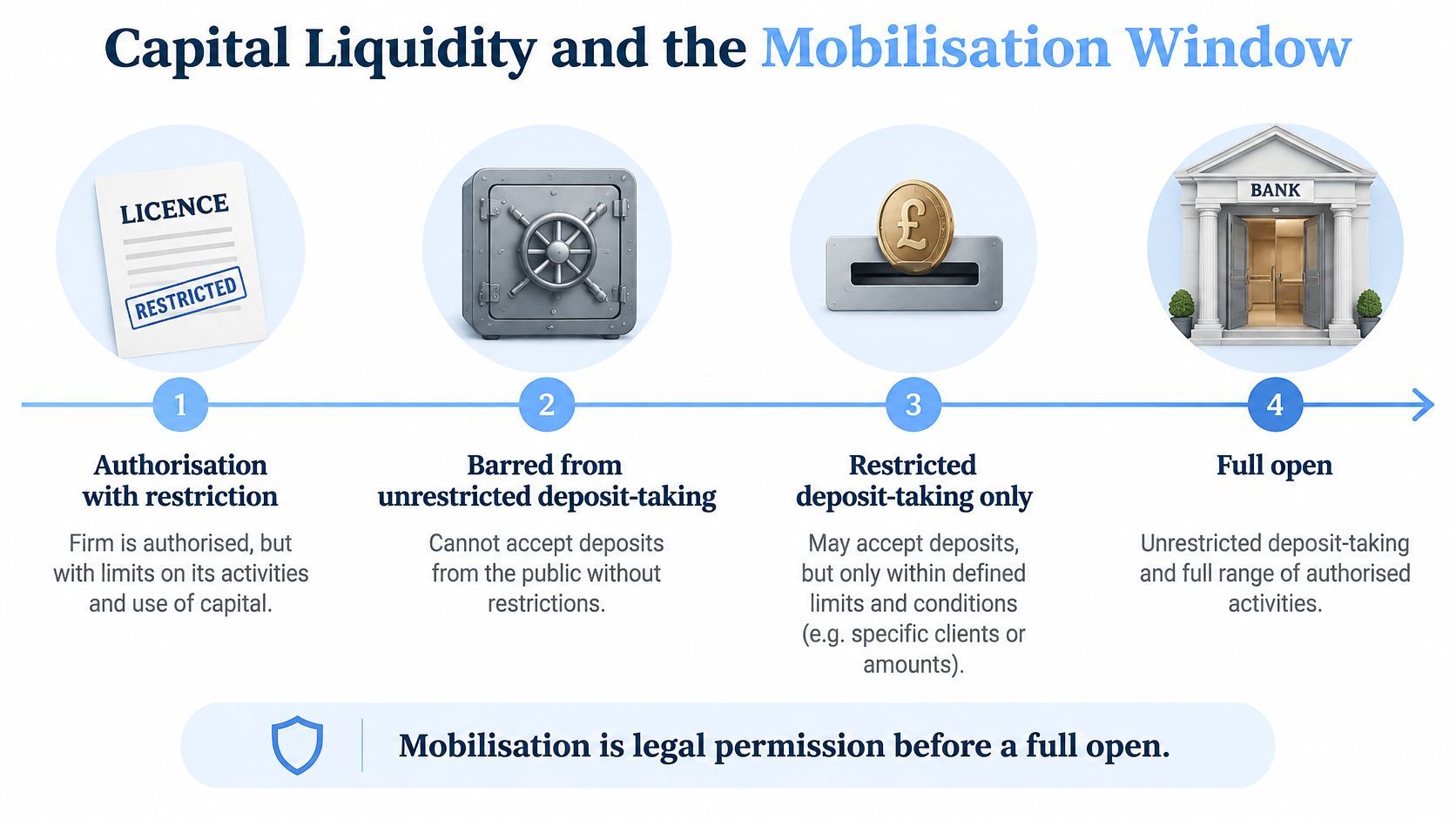
Under the mobilisation route, an authorised bank may accept no more than £50,000 in total deposits and normally has up to 12 months to complete its build, according to the Bank of England's New Bank Start-Up Unit; removing the restriction requires a Variation of Permission, recommended for submission at least three months before that period expires.
That is authorisation with restriction, not an unrestricted commercial launch. The firm must continue meeting applicable Threshold Conditions, including capital and liquidity expectations, while completing the work.
Finish the build rather than begin it
The PRA and FCA applicant journey says mobilisation may take as little as three months, should not exceed 12 months except in agreed exceptional circumstances, and can end in removal or cancellation of restricted authorisation if the required work isn't completed.
Management should enter mobilisation with a controlled delivery programme. That means identified suppliers, credible recruitment plans, defined testing, funding commitments and clear acceptance criteria. A promise to select the core banking platform after authorisation is very different from a contracted implementation awaiting final assurance.
Planning test: Put each unfinished capability against an owner, a dependency, an acceptance test and a decision date. If any is missing, the completion date isn't yet credible.
Capital isn't a flat licence price
The PRA and FCA banking authorisation process document describes an earlier €5 million capital floor and later treatment for certain resolvable, non-systemic new banks with an absolute minimum of £1 million or €1 million, whichever is higher, plus a capital planning buffer; it also describes liquidity against expected net cash outflows under a 30-day stress scenario, with individual guidance and possible risk-specific additions.
These aren't interchangeable prices for buying permission. Applicability must be established for the proposed institution, and the financial plan must reflect its risks and supervisory requirements.
Capital and liquidity also solve different problems. Capital supports the bank's ability to absorb losses. Liquidity addresses its ability to meet cash outflows when they fall due. A bank can face a cash shortage even where management believes its assets have substantial long-term value.
Connect the model to delivery
Build projections that connect customer acquisition, deposit concentration, lending, operating expenditure and stressed withdrawals. Include the cost of delayed recruitment, supplier implementation and additional testing.
Say the launch depends on completing a platform migration. If testing reveals reconciliation errors, management may need to postpone customer onboarding while continuing to pay staff and suppliers. The funding plan should accommodate that outcome without assuming unrestricted deposit growth will finance the delay.
A useful business plan and risk analysis ties these operating assumptions to financial consequences. Separate what must be demonstrably ready before submission from what can credibly finish during mobilisation, then test whether the latter still fits within the restricted business model.
Where Applications Stall After the Paperwork
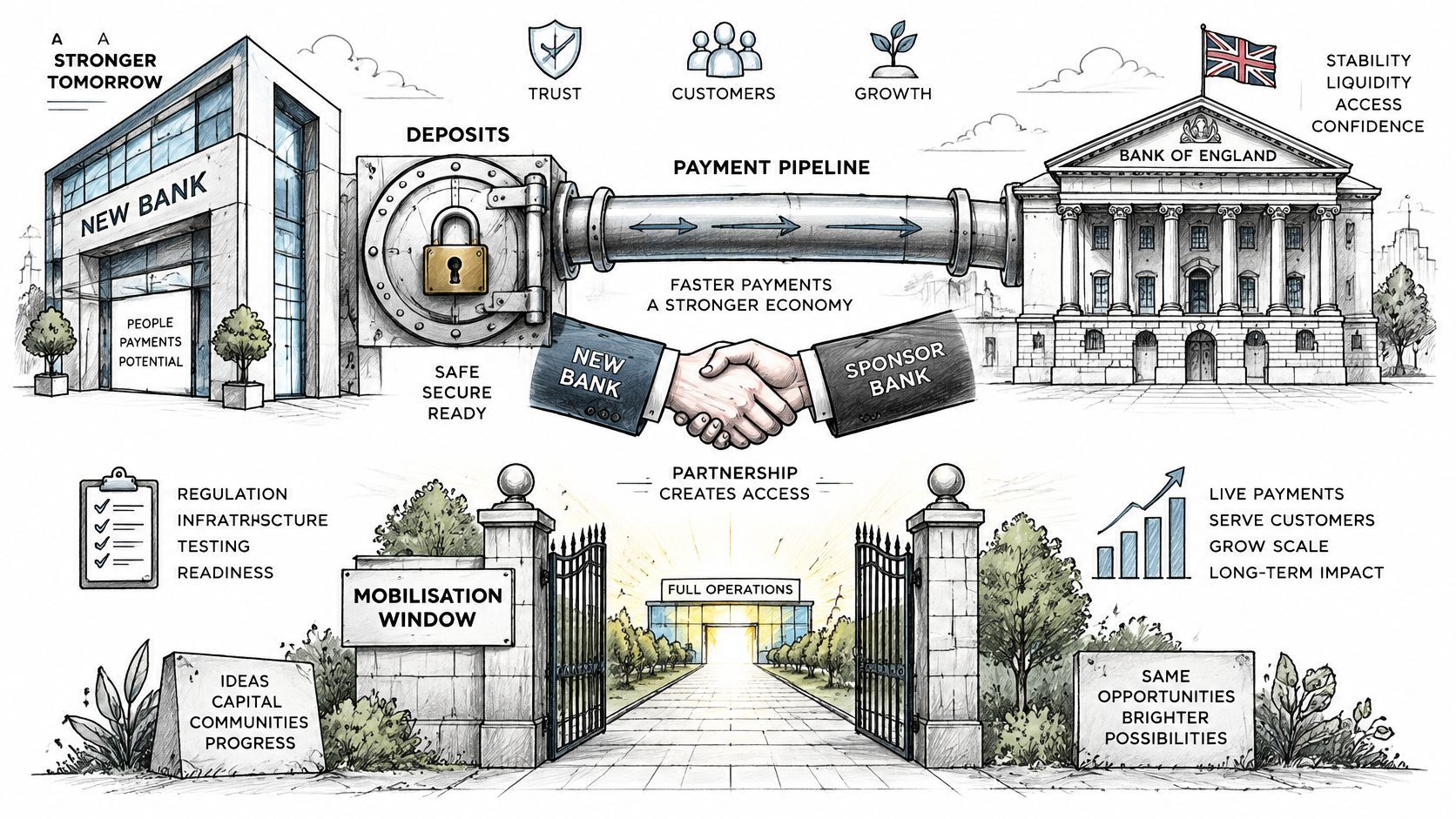
A bank can have a persuasive application and still lack a workable way to transfer customers' money. The Bank of England's guidance on becoming a bank identifies payment systems as critical and says new banks are unlikely to operate without access; it also describes mobilisation as time to secure investment, recruit staff, invest in IT and commit to suppliers.
Payment access therefore belongs in the operating design, not in a launch-week checklist. Direct participation and access through a sponsor create different contractual, technical and operational dependencies.
Test dependencies in delivery order
- Payment-system or sponsor-bank access: Establish eligibility, onboarding requirements, settlement arrangements and what happens if access is delayed or withdrawn.
- Resilient outsourcing with a workable exit: Understand service boundaries, subcontractors, access to records and how the bank would transfer or recover the service.
- Key senior managers in post: Recruitment intentions aren't operating capacity. Ensure responsible managers can approve procedures, supervise implementation and challenge suppliers.
- Technology assurance on the core platform: Test ledger integrity, reconciliation, access controls, recovery and exception handling. A demonstration environment isn't proof of production readiness.
- Funding until restrictions are lifted: Link available resources to remaining work and plausible delays, rather than assuming the preferred launch date.
For technology selection, Grail Computer Labs' examples help teams compare legacy system constraints. Use that comparison to question integration and replacement assumptions, not to conclude that a newer platform automatically creates fewer risks.
Separate authorisability from operability
Authorisability asks whether the proposal meets the regulatory tests. Operability asks whether management can deliver the promised service through actual people, contracts, systems and infrastructure. Review both explicitly.
For each dependency, record the evidence, accountable owner, contractual status and a plain-language explanation suitable for a supervisor interview. Where a contract isn't signed, say so and explain the remaining conditions. Where testing hasn't finished, identify the outstanding tests and who can accept the results.
International expansion adds another permission question. Revolut's further New Zealand banking licence, described in Finovate's account of its local registration, illustrates the distinction between operating a financial-services proposition and obtaining banking permission in another deposit market.
The stronger application doesn't pretend every capability already exists. It distinguishes completed arrangements from planned ones and explains how management will control the transition.
Decide the Route Before You Build the Bank
Write down the answers to these questions before commissioning a library of policies. The answers determine which application is needed and what evidence belongs in it.
- What is the activity? State whether customers will place bank deposits, hold electronic money, use payment services or entrust assets for custody.
- Where will it happen? Name the country where deposits will be taken, the relevant legal entity and the authority that must approve it.
- Can the operating dependencies be evidenced? Establish whether capital and payment access can be delivered within the applicable authorisation and restricted-start arrangements.
Assemble the pack for that route
If an answer remains unknown, scope the customers, deposit-taking location and payment rails before drafting policies. Otherwise, the team may prepare detailed controls for the wrong legal entity or permission.
Once the route is clear, assemble a consistent business, ownership and governance account, a model-linked capital and liquidity case, and a delivery plan with owners and dates. Distinguish arrangements already operating from those still to be established.
At Glentorion, the first working session examines planned activities, jurisdiction, existing material and open questions, then agrees the work, deliverables and responsibilities. After our internal approval and the client's sign-off, an agreed application is submitted on the client's behalf under the required mandate and access arrangements.
Decision boundary: The relevant regulator decides authorisation. An adviser can't guarantee approval or a decision date.
Don't mistake an internal target date for the regulator's decision timetable. The practical choice is whether the activity is banking, whether the jurisdiction is right and whether the proposed operating model can be evidenced. Resolve those questions before committing to a build that the chosen route cannot support.
Glentorion offers banking authorisation route assessment, application preparation and review, submission under an agreed mandate, and management interview preparation. Visit Glentorion to discuss your planned activities, target jurisdiction and existing evidence, and agree a defined scope for the application and operating-readiness work.
- license for banking
- banking licence
- PRA authorisation
- bank mobilisation
- CRD VI