MiCA White Paper Requirements: What UK Firms Need to Know
Published
The most popular advice on MiCA white paper requirements starts too late: download a template, fill in the disclosures and prepare to publish. For a UK business, the first question is which regulatory route applies, not which template looks complete. An EU-compliant document doesn't give a firm permission to conduct regulated activities in the UK.
A useful white paper connects legal obligations to evidence: who makes the offer, what holders receive, how the service works and who approves changes. Treat it as a controlled disclosure document, not a polished version of the pitch deck.
Table of Contents
- Which White Paper Your Business Needs
- What a MiCA White Paper Must Disclose
- Drafting the White Paper in Eight Steps
- Filing, Publishing and Liability Duties
- Keeping the White Paper Consistent After Publication
- How UK Promotions and Authorisation Change the Picture
Which White Paper Your Business Needs
A MiCA white paper is generally required for an in-scope public offer of a crypto-asset in the EU or admission to trading on an EU platform, unless an exemption applies. UK-only activity doesn't automatically trigger MiCA. Token classification and the precise offer or admission route must be checked before applying that general rule.
The practical starting inputs are issuer location, target customers and trading-platform admission. Add token type and marketing activity before deciding who must prepare, notify or maintain the document.
Which white paper applies by situation
| Situation | EU MiCA white paper | UK disclosure document | First check |
|---|---|---|---|
| EU public offer of a crypto-asset | Required for an in-scope offer unless an exemption applies | No UK document solely because an EU offer occurs | Confirm issuer location, token classification and exemptions |
| UK-only offer to UK customers | Not triggered by MiCA alone | Expected for in-scope activity under the future admissions-and-disclosures regime | Map the perimeter and FCA authorisation route |
| Same token offered in the EU and UK | Required for the in-scope EU offer unless exempt | Assess separately under the final UK rules | Keep a controlled version register with jurisdiction-specific documents |
| Trading platform admission or stablecoin issuance | Apply the relevant jurisdiction's admission or token-specific issuance rules | Relevant when the applicable UK requirements commence | Run perimeter analysis first |
| Marketing only, with no offer or admission | No offer or admission trigger, but verify the communication's substance | UK financial-promotion rules may apply | Test each claim against evidence |
The FCA's cryptoasset authorisations webinar Q&A distinguishes the proposed UK public-offer, admission and stablecoin disclosure arrangements from the wider authorisation perimeter. A completed EU paper isn't UK permission, and UK admissions-and-disclosures rules are still being finalised.
Don't treat an exemption as an informal assumption. Record the provision relied on, the facts supporting it and the person responsible for checking whether those facts remain true. Marketing labelled educational can still require assessment if customers can act on the token-specific information it presents.
Record the route before drafting
Prepare a route memo naming the offeror, jurisdictions, intended customers, token classification, responsible owner and relevant filing timetable. Have a senior decision-maker approve it before setting publication dates. The broader crypto-asset regulation framework should inform that analysis, rather than the document's title.
Cross-border operations can create separate banking questions too. RNC Group's guidance on navigating Israeli crypto banking restrictions is a useful jurisdiction-specific resource when Israeli banking arrangements form part of the operating model, not a substitute for EU or UK perimeter analysis.
At Glentorion, we begin by examining planned activities, jurisdiction, existing material and open questions, then agree the work, deliverables and responsibilities. We also check consistency across application documents, address findings and prepare the identified package for internal and client approval.
Start with this test: In which jurisdiction is the offer made, and who is making it?
What a MiCA White Paper Must Disclose
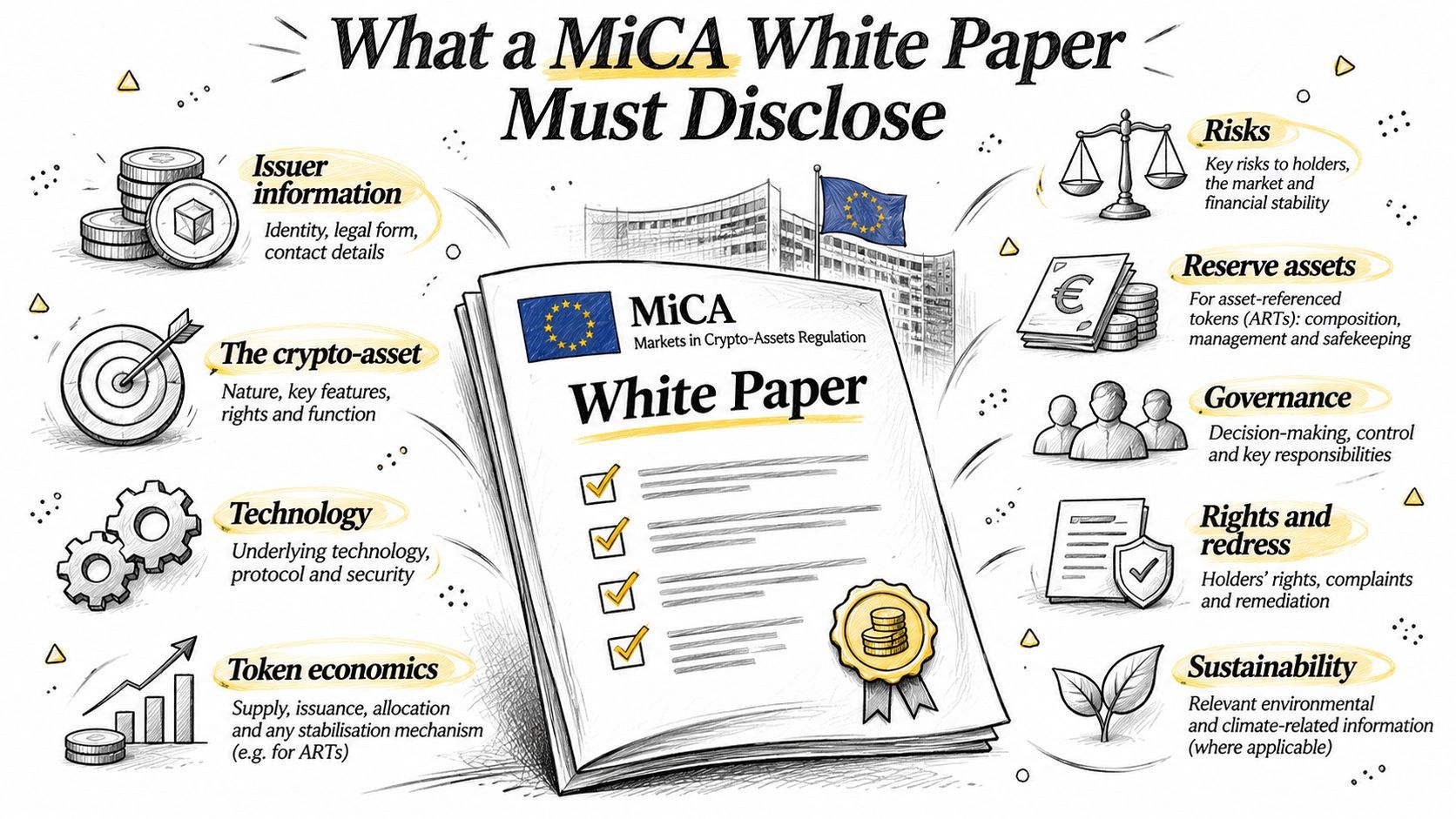
Use the disclosure areas below as a working checklist, then apply the requirements for the token's legal classification. A single generic template won't resolve the differences between project tokens, asset-referenced tokens and e-money tokens. The paper should be dated, internally coherent and supported by identifiable records.
Disclosure content and supporting evidence
| Disclosure area | What the paper must cover | Evidence to keep |
|---|---|---|
| Offeror or person seeking admission | Identity, role, governance and contact details | Corporate records and officer lists |
| Project and offer | Project description, purpose, use of proceeds and offer terms | Business plan and funding model |
| Crypto-asset rights | Attached rights and obligations, including redemption or exit terms | Terms of issue and draft contracts |
| Underlying technology | Protocol, standards, security and key dependencies | Architecture documents and audit reports |
| Risks | Specific risks for holders and the issuer | Risk register with management sign-off |
| Adverse impacts | Principal adverse climate and environmental impacts, including the consensus mechanism | Energy and consensus assessment |
The supporting documents aren't attachments collected for appearances. They let reviewers distinguish an enforceable right from an aspiration and an implemented control from a planned one.
Explain rights and limitations plainly
If a token provides access to a service, explain when that access becomes available, what customers must do and what happens if development stops. Don't describe expected platform adoption as a holder's legal entitlement.
For technology, distinguish the protocol from the issuer's implementation. An audit of a smart contract doesn't prove that custody operations, administrator privileges or every external dependency are secure. State what was reviewed, what remains unresolved and who can change the system.
Stablecoin language needs particular care. Reserve assets, redemption rights and the identity of the party owing the obligation must fit together; UK stablecoin regulation also requires a separate domestic analysis rather than an assumption that EU terminology transfers unchanged.
Test accuracy before approving the summary
Use a short editorial control list:
- Traceability: Every material factual claim points to a named document and relevant passage.
- Financial agreement: Supply, funding and expenditure statements match the financial plan.
- Specific risks: Explain how this token or operating model could cause loss, delay or restricted access.
- Standalone summary: A reader can understand the proposition and its limitations without reconstructing the full paper.
- Marketing alignment: Promotional language doesn't strengthen, simplify away or contradict the underlying disclosure.
Misleading or incomplete information can expose the responsible offeror to liability. Adviser involvement doesn't remove the need for management to understand and approve the content.
The work calls for legal, technical and operational judgement. For staff developing those skills, Blockchain Jobs' guide to advance a Web3 compliance career provides a separate professional-development resource.
The reader's test is practical: can every disclosure row be proved by a named document?
Drafting the White Paper in Eight Steps
Draft from the operating model and evidence, not from promotional copy. The FCA's explanation of the new cryptoasset regime identifies newly regulated activities including qualifying stablecoin issuance, safeguarding, arranging safeguarding, trading-platform operation and dealing as principal or agent. That makes activity mapping a prerequisite for a credible UK-facing document.
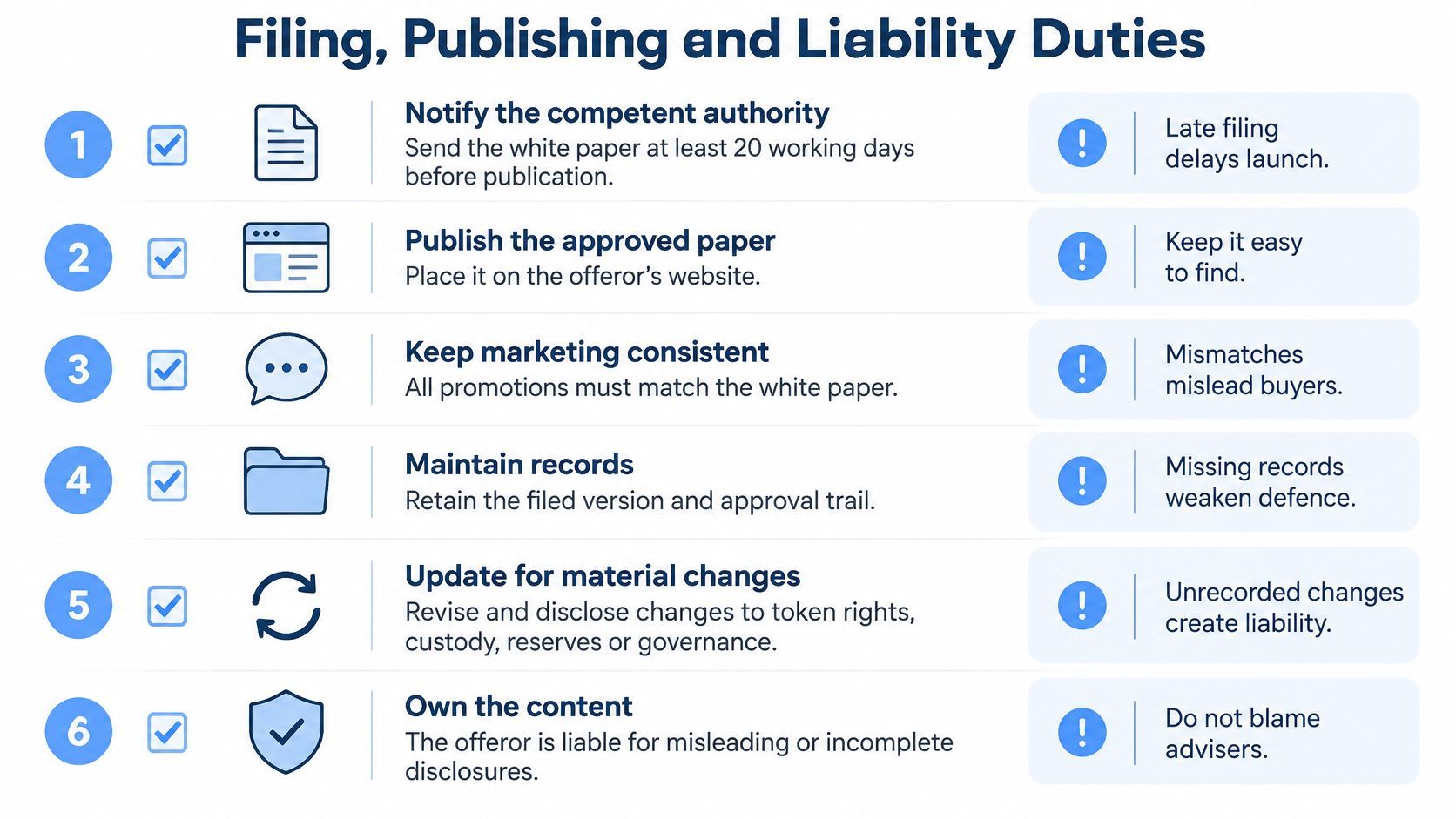
Build the document in a controlled sequence
- Map the route. Identify the offer, admission and service jurisdictions, then record the applicable document obligations. The common slip is choosing an EU template before deciding whether the business also needs UK permission.
- Define the token and service precisely. Describe what the token does today, what remains planned and which entity performs each service. Avoid using utility, custody or settlement as unexplained labels.
- Assign disclosure owners. Record a responsible person for each subject in the version register. Shared responsibility without a named decision-maker leaves unresolved questions circulating between legal, finance and engineering.
- Build the claim-to-evidence matrix before marketing copy. Collect source documents and flag unsupported statements before drafting confident prose. Don't turn a sales assertion into an apparent fact through repetition.
- Draft risks from the risk register. Translate operational scenarios into consequences for holders and the issuer. Generic language copied from another issuer can omit the actual dependency, privileged access or liquidity weakness.
- Reconcile financial and customer materials. Compare the paper with projections, the website, promotions and investor materials. A model using a different token-supply assumption can undermine both the funding explanation and the offer description.
- Obtain technical and legal sign-off. Record reviewer comments, decisions and closure evidence. Read the summary against the final body, not an earlier draft, so it doesn't promise rights that the detailed terms qualify.
- Set change triggers and the review date, then complete the applicable filing. Confirm the jurisdiction-specific procedure and publication sequence. The common slip is treating submission as the end of disclosure ownership.
Make the approval record usable
A reviewer should see the document identifier, jurisdiction, version, status, disclosure owners, evidence references and outstanding issues. Include approval dates, the publication location and the reason for each amendment.
Keep current arrangements separate from controls still to be established. Describing a planned process in the present tense can mislead both customers and application reviewers.
A clean version register should let another reviewer identify exactly what was approved, by whom and against which evidence.
Filing, Publishing and Liability Duties
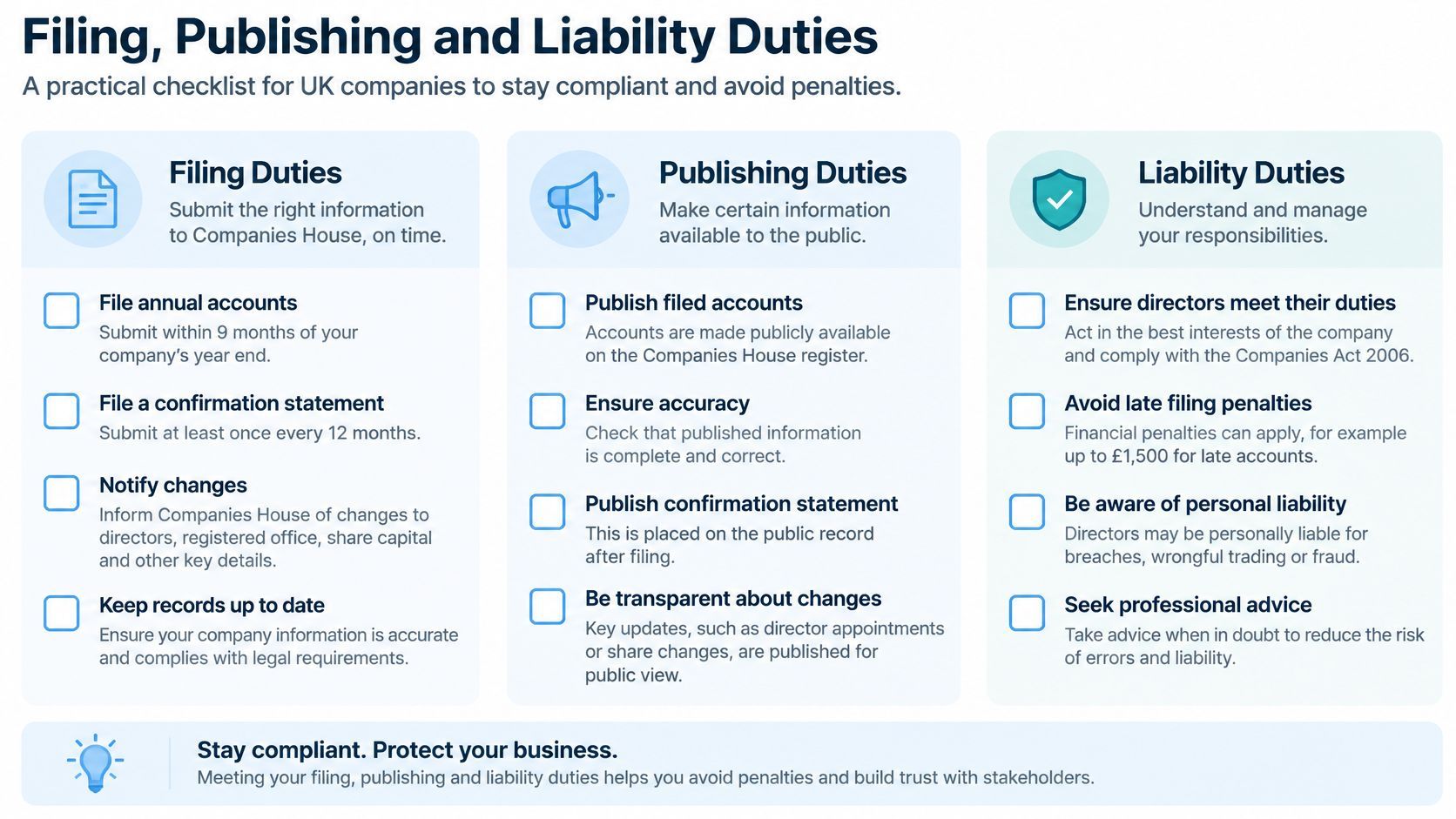
Notification under MiCA is a formal legal process with a statutory lead time. Confirm the competent authority, applicable token category, required format and lead time before committing to a launch date. The notification route for crypto-assets other than asset-referenced or e-money tokens sits apart from token-specific approval and authorisation requirements, so the same document may need only notification in one situation and prior approval in another.
Internal sign-off and regulator approval are different things. Where notification applies rather than prior approval, publishing the paper doesn't mean the authority has endorsed the token or checked the investment proposition. Responsibility for what the paper says stays with the responsible persons either way.
Control the release and the record
- Notify through the correct route: Submit the required paper and accompanying information within the applicable lead time, preserving delivery evidence.
- Publish the authorised release: Place the dated version on the offeror's website in the required form and keep it accessible.
- Retain the history: Preserve the notified document, amendments, reasons for change and approval trail.
- Check communications: Make sure advertisements, social posts and investor presentations don't contradict the released paper.
- Address withdrawal rights: Where retail withdrawal rights apply, explain eligibility, the applicable period and how holders exercise them.
- Accept content responsibility: Misleading, incomplete or inconsistent disclosure can create liability for responsible persons.
Key dates for MiCA and UK white-paper planning
MiCA deadlines are measured from the competent authority's notification lead time, so no single EU calendar date applies to every offer. The UK timetable is fixed differently. The FCA's admissions-and-disclosures discussion paper sets the planned UK application window at 30 September 2026 to 28 February 2027, with the expanded domestic regime scheduled to commence on 25 October 2027.
| Date or period | Regime | Requirement or milestone |
|---|---|---|
| 30 September 2026 to 28 February 2027 | UK | Planned window for FCA cryptoasset applications and supporting evidence |
| 25 October 2027 | UK | Scheduled commencement of the expanded domestic cryptoasset regime |
A notified MiCA paper establishes no UK permission and satisfies no UK obligations. A domestic authorisation submission may require governance evidence, operational policies and financial-resilience information beyond the white paper itself. Plan those workstreams separately, even where they share source documents.
On notification day, the filer should hold a locked release version, classification rationale, exemption analysis where relevant, authority details, accompanying materials and approval evidence. Keep a publication plan and an escalation contact ready in case the authority raises questions.
A structured approach to submitting a regulatory application separates document preparation, internal approval, client sign-off, submission authority and recorded filing results. A file named "final" proves none of those steps.
Keeping the White Paper Consistent After Publication
Say the team changes a token's redemption window. The paper, token terms, website FAQ and investor deck should change under a coordinated approval, with release timing controlled so customers don't receive conflicting descriptions. Updating only the contract leaves other customer-facing claims inaccurate.
Build the claim-to-evidence matrix before marketing copy is written. Maintain it after publication so the owner can identify which source changed, which claims rely on it and which materials require review.
Claim-to-evidence matrix
| Claim | Source document | Owner | Last review date |
|---|---|---|---|
| Redemption window | Token terms and draft contracts | Head of legal | Record the completed legal review date |
| Reserve composition and backing | Reserve policy and custody agreements | CFO | Record the treasury reconciliation date |
| Consensus mechanism and energy use | Energy and consensus assessment | CTO | Record the technical assessment date |
| Use of proceeds | Business plan and funding model | CFO | Record the financial approval date |
| Website FAQ and investor deck wording | Marketing approval log | Head of communications | Record the release review date |
Dates should reflect an actual review, not an automatically refreshed spreadsheet field. Add source-version references and affected-document identifiers in the working register so the team can reconstruct the decision.
The FCA's announcement on cryptoasset rules describes a proposed UK qualifying stablecoin model requiring full backing and redemption at par. That makes reserve evidence and operational ownership central, rather than matters solved by carefully drafted language.

Identify drift before customers encounter it
The main drift points deserve different checks:
- Reserves and backing: Treasury confirms that reserve descriptions match actual arrangements and supporting records.
- Custody and safeguarding: Operations checks account structures, access arrangements and the allocation of responsibilities.
- Technology and outsourcing: Engineering identifies supplier changes, protocol changes and altered dependencies.
- Conflicts and governance: Compliance checks decision rights, connected parties and escalation arrangements.
- Financial assumptions: Finance reconciles projections with supply, costs, proceeds and the operating plan.
What triggers an update? A change that could make a material statement inaccurate, incomplete or misleading triggers assessment, followed by any required notification and publication process. The disclosure owner coordinates that assessment, while the designated legal, technical or management approver authorises the release.
For the redemption-window example, retain the change request, impact assessment, amended files, approval and publication confirmations under the same change identifier. That's how the team proves that every affected document changed consistently.
Change-control rule: Changes to rights, reserves, custody, technology, outsourcing, conflicts, governance or projections require review, named approval and a dated version entry.
How UK Promotions and Authorisation Change the Picture
A MiCA white paper answers an EU disclosure question. It does not grant UK permission, and it does not satisfy UK obligations. Disclosure, promotion and permission are separate questions, and treating them as one is how a compliant-looking document ends up carrying weight it was never designed to bear. When a white paper is used in a UK promotion it functions as evidence supporting the proposition, so its accuracy affects whether that promotion can be approved.
The right test depends on the situation:
| Situation | Role of the white paper | Separate UK question |
|---|---|---|
| Token offered only in the EU | Performs its MiCA disclosure function | UK promotion rules are not engaged |
| White paper used in a UK financial promotion | Becomes part of the due diligence evidence | Who may communicate or approve the promotion |
| Firm issues tokens, safeguards assets or operates a trading platform in the UK | Describes the activity; confers no status | Whether the activity sits inside the regulatory perimeter |
| Firm holds money-laundering registration or e-money permissions | Unchanged | Whether that status covers the intended future FSMA permission |
The FCA's finalised guidance on cryptoasset financial promotions says firms approving or communicating promotions should perform due diligence on the cryptoasset, issuer, developers and key associated individuals, and assess whether the proposition and claims are authentic and accurate. Reviewing the paper and related documents can form part of that evidential basis. A paper that overstates functionality or understates risk therefore creates problems for every promotion that cites it.
Apply the UK decision test
Ask the responsible team three questions.
- Is the paper being used to promote in the UK? Examine distribution, intended recipients and the customer journey; neither a disclaimer nor the issuer's registered address settles this question.
- Does the firm perform an activity within the regulatory perimeter? Assess the actual services and operating responsibilities, including issuance, safeguarding, arranging safeguarding, trading-platform operation and dealing.
- Will the existing regulatory status cover that activity? Money-laundering registration, payment or e-money permissions, and access to a promotions approver do not supply the necessary future FSMA permission.
Each question needs its own answer. A business might have a lawful route to communicate a particular promotion while still needing a different permission for its intended operating model.
The FCA's new-regime overview treats admissions and disclosures alongside other regulatory work, including market-abuse controls. That direction reinforces the need to connect published descriptions with the people, procedures and systems that operate the service.
Make approval evidence specific
Before release, the approver should be able to name the evidence behind each material claim: functionality, rights, technology, governance, risks and use of proceeds. That claim-to-evidence mapping gives every statement an owner and an evidential basis. Performance-related statements need particular scrutiny of their assumptions and limitations.
If engineering cannot substantiate a security claim, remove or qualify it, since legal sign-off cannot warrant a technical fact. If finance changes the funding model, reassess promotional statements about how proceeds will be used.
Legal support also needs the right scope. General resources that help founders compare small business lawyers cover ordinary selection criteria. Cryptoasset classification and cross-border promotions call for relevant specialist competence.
For management, FCA authorisation planning should connect the proposed activities with governance, evidence and accountable owners. Unsupported or inconsistent claims can affect promotion approval, distribution and supervisory scrutiny.
A scoping conversation with Glentorion examines your planned activities, jurisdiction, existing material and open questions, then agrees the work, deliverables and responsibilities.
Glentorion helps financial and crypto businesses scope regulatory routes, prepare application packages and check consistency across supporting documents. Bring your token description, proposed markets and existing materials to a scoping conversation so the white paper and authorisation work follow the same operating facts. Visit Glentorion to discuss the deliverables, evidence gaps and responsibilities for your project.
- MiCA white paper
- MiCA disclosure
- UK crypto regulation
- crypto-asset disclosure