Authorisation Process Explained: Steps and Timelines
Published
You've built the product, hired a compliance lead, and promised the board a launch plan. Then someone asks the question that stalls the room. How long does authorisation take?
The honest answer is that the regulator's clock isn't your main constraint. Whether your file is complete enough to start that clock properly is, and so is whether each activity you plan to run sits inside the permission you're requesting. Get either wrong and you lose months without ever receiving a rejection letter.
What follows is the lifecycle as a consultant walks it with a founder, stage by stage, with the outputs that prove each stage is finished.
Table of Contents
- The Authorisation Process at a Glance
- Scoping the Route Before You Write Anything
- Jurisdictional Routes Compared Across FCA, MAS and DFSA
- UK Cryptoasset Registration and Transitional Routes
- Building a Complete Application Package
- Submission, Review and Planning Timelines
- Interviews and Clarification Questions
- Confirm the Route and Evidence Before You File
The Authorisation Process at a Glance
Authorisation is the permission a regulator grants before a firm may carry on a specified regulated activity. Dealing, arranging, custody, payments, running a trading platform. Without it, that activity isn't a business line you can scale. It's a breach waiting for a supervisor to notice.
The building-permit analogy holds better than most. You don't get a permit because you applied on a Monday. You get it because the drawings match the structure you'll build, the inspections confirm the wiring, and the file is complete enough for an officer to sign. The permit arrives at the end. The drawings decide the date.
Seven stages carry a firm from intention to permission. Each produces a named output you can hold, and each hands a decision to the next.
| Stage | Main activity | Output or decision point | Who leads |
|---|---|---|---|
| Scoping | Confirm activities, legal entity, jurisdiction and route | Go or no-go on the route | Founders and legal adviser |
| Route mapping | Map each activity to the permission it requires | Permission matrix | Compliance lead |
| Preparation | Write business plan, financial projections, policies and controls | Complete, consistent package and evidence register | Management team with compliance |
| Submission | File the application through the regulator's system | Application received and checked for completeness | Authorised signatory |
| Regulator review | Answer questions and provide further information | Clarification log and revised documents | Project lead |
| Interview | Senior managers explain controls and responsibilities | Regulator's view of management readiness | Senior managers |
| Decision | Regulator approves, refuses or the applicant withdraws | Permission granted, with any conditions | Regulator |
Three decision points carry most of the risk. The go or no-go at scoping fixes the route and stops you drafting against the wrong permission. The completeness check at submission decides whether you sit in a shorter queue or a longer one. The final decision belongs to the regulator, and nothing in your preparation moves it to a date of your choosing.
Then there's the loop. A clarification question rarely arrives alone. It sends the team back into preparation, and every document touched by the answer needs updating in the same cycle. Teams that draw the lifecycle as a straight line budget for stages that repeat.
Test for your next team meeting: name the stage you're in, then name the specific output the following stage requires from you. If the second answer is vague, that's where the schedule will slip.
Scoping the Route Before You Write Anything
Most delayed applications don't fail on drafting quality. They fail because the firm asked for the wrong permission or filed through the wrong legal entity, and discovered it only when a reviewer asked a question the business plan couldn't answer. Scoping is where that risk gets retired, before anyone writes a policy.
The five-step scoping routine
1. Describe each service precisely. Name the customer type (retail, professional or institutional), the asset or product involved, and whether the service is delivered from one legal entity or several. Precision here is what makes step two possible; a vague description like "digital asset services" maps to nothing.
2. Map each service to the permission that covers it using the regulator's perimeter guidance rather than your own commercial description. The FCA's operating service metrics make the same point from the other direction: a complete submission maps every proposed regulated activity to the permissions requested, the responsible senior managers, governance, financial forecasts and supporting evidence.
3. Check exemptions and existing permissions, then record their limits. Legacy cover is frequently narrower than the team assumes. Write down exactly what the current permission allows before you rely on it for anything new, and read the FCA threshold conditions as the test any new permission will face.
4. Inventory the starting materials. Business plan, organisation chart, draft policies, financial model, corporate structure chart, anything already filed with another regulator. What exists shapes the work plan more than what's aspirational.
5. Log every open question with a named decision owner and a due date. Unassigned questions become late discoveries, and late discoveries are what turn a six-month file into a twelve-month one.
Say a firm already holds a permission for one activity and wants to add a service that looks adjacent. Scoping has to establish whether that's a variation of permission or a separate application, and that answer determines the drafting, the timetable and the fee. Starting the business plan first means rewriting it later.
The first step in any authorisation engagement we run is exactly this: examine the client's planned activities, jurisdiction, existing material and open questions, then agree the work, deliverables and responsibilities in writing. Nothing gets drafted until that's settled.
Where files go wrong first: a permission matrix that lists permissions and nothing else. Each row should tie a permission to the entity holding it, the customer type it serves and the revenue line that depends on it.
The stage closes with three things: a signed-off scope, a permission matrix, and an explicit go or no-go on the route.
Jurisdictional Routes Compared Across FCA, MAS and DFSA
The three frameworks expect the same quality of package but differ in legal basis, application route and how completeness is measured. Read the table by jurisdiction first.
| Regulator and jurisdiction | Legal basis | Application route | Planning note |
|---|---|---|---|
| FCA, United Kingdom | Financial Services and Markets Act 2000, Part 4A | Application through the FCA's Connect system for Part 4A permission | 6 months for a complete application and 12 months for an incomplete one |
| MAS, Singapore | Securities and Futures Act and Payment Services Act, depending on the activity | Licence application to MAS for each regulated activity | Timing confirmed with MAS during scoping |
| DFSA, Dubai International Financial Centre | DFSA Rulebook, with the legal basis confirmed during scoping | Application for authorisation to carry on financial services in the DIFC | Timing confirmed with the DFSA during scoping |
Reading the table by location and by activity
Location decides the regulator. A firm serving UK customers from a UK entity sits under the FCA. A firm seeking a Singapore licence for a regulated activity applies to MAS, and does so activity by activity rather than once for the whole business. A firm based in the DIFC applies to the DFSA for authorisation to carry on financial services there.
Activity decides the permission list, and that list is longer than most founders expect. One operating model can pull in several permissions across several entities. Each permission is assessed against its own activity list, its own senior manager allocation and its own evidence.
Two honest caveats. First, the table states the statutory position where it's known and tells you where timing must be confirmed with the regulator directly, which is a task for scoping, not an assumption for a board pack. Second, it's a first filter, not a substitute for regulator guidance. Where digital assets are involved, the perimeter questions get sharper, and our overview of crypto-asset regulation covers how the routes differ for tokenised and crypto propositions.
The useful discipline is to hold the comparison beside your revenue model and ask, for each line, which regulator's permission it depends on and whether that permission exists today.
UK Cryptoasset Registration and Transitional Routes
Crypto needs its own route check because the vocabulary hides a trap. Registration under the Money Laundering Regulations is not FSMA authorisation, and the two aren't interchangeable.
Registration is not authorisation
Existing registrations and permissions do not convert automatically where a business conducts newly regulated cryptoasset activities. Firms may need a new FCA authorisation or a variation of permission, unless an exemption, saving provision or transitional run-off route applies, as the FCA's cryptoasset regime policy statement sets out. The proposed framework covers activities including operating qualifying cryptoasset trading platforms, custody, arranging, dealing and staking.
That creates a planning gap generic guides tend to skip. They treat "regulated" as one status instead of mapping each activity, legal entity, customer type and service model to the correct permission. The practical question isn't whether you've filed. It's which activities can continue, which new business can be accepted, and which permissions must exist before launch.
The application content is correspondingly detailed. A Money Laundering Reporting Officer, also called the Nominated Officer, must be appointed before preparation begins, and the FCA's registration guidance requires the application to be complete, up to date, signed and accompanied by the registration fee, with a fully developed anti-money-laundering, counter-terrorist-financing and counter-proliferation-financing framework.
What the 2020 to 2025 record shows
The decision clock for registration is different too. The FCA has 3 months to decide once it has received all the information it needs, per its cryptoasset registration page, so evidential sufficiency rather than the filing date starts the timer.
History explains why preparation quality matters so much here. FCA data on crypto firm registrations shows 195 applications received in 2020, of which only 36 were approved, 147 withdrawn, 9 refused and 3 rejected, with approvals averaging 465 days. By 2022, average approval time had fallen to 321 days; by 2025 it was 217 days across completed approvals. Attrition, not paperwork, shaped those years.
| Item | Value | Planning note |
|---|---|---|
| Minimum application fee, 2026/27 | £2,251 | Paid on or before submission |
| Variable fee | £6.01 per £1,000 or part above £100,000 of income | Added to the minimum fee |
| Decision period for registration | 3 months | Runs from receipt of all information needed |
| Savings application window | 30 September 2026 to 28 February 2027 | Applications in this window are expected to be assessed before the new regime begins |
Those fee figures come from the FCA Fees manual, which also states that an application received without the required payment is not treated as an application made under the Money Laundering Regulations. Where a submission combines a Part 4A application with cryptoasset registration, only one fee generally applies, calculated at the highest applicable tariff.
Then the transitional question, which many summaries get wrong by calling it a blanket safe harbour. The FCA has specified an application window of 30 September 2026 to 28 February 2027 for firms seeking to use the savings arrangements, and firms applying within it may generally continue specified services while awaiting a decision, subject to statutory conditions. Late applicants may face transitional arrangements that restrict new UK customers. Newly established firms can't rely on these arrangements at all, as the FCA's cryptoasset regime publications explain.
Practical rule: build a route check that records, activity by activity, whether it needs MLR registration, FSMA permission or a transitional route, and who signed off that conclusion.
Building a Complete Application Package
A complete application gives the regulator everything it needs to assess the firm. Not everything the firm happens to possess. That distinction sounds trivial until you watch a 200-page pack generate six clarification rounds because the strategy narrative and the financial model describe different businesses.
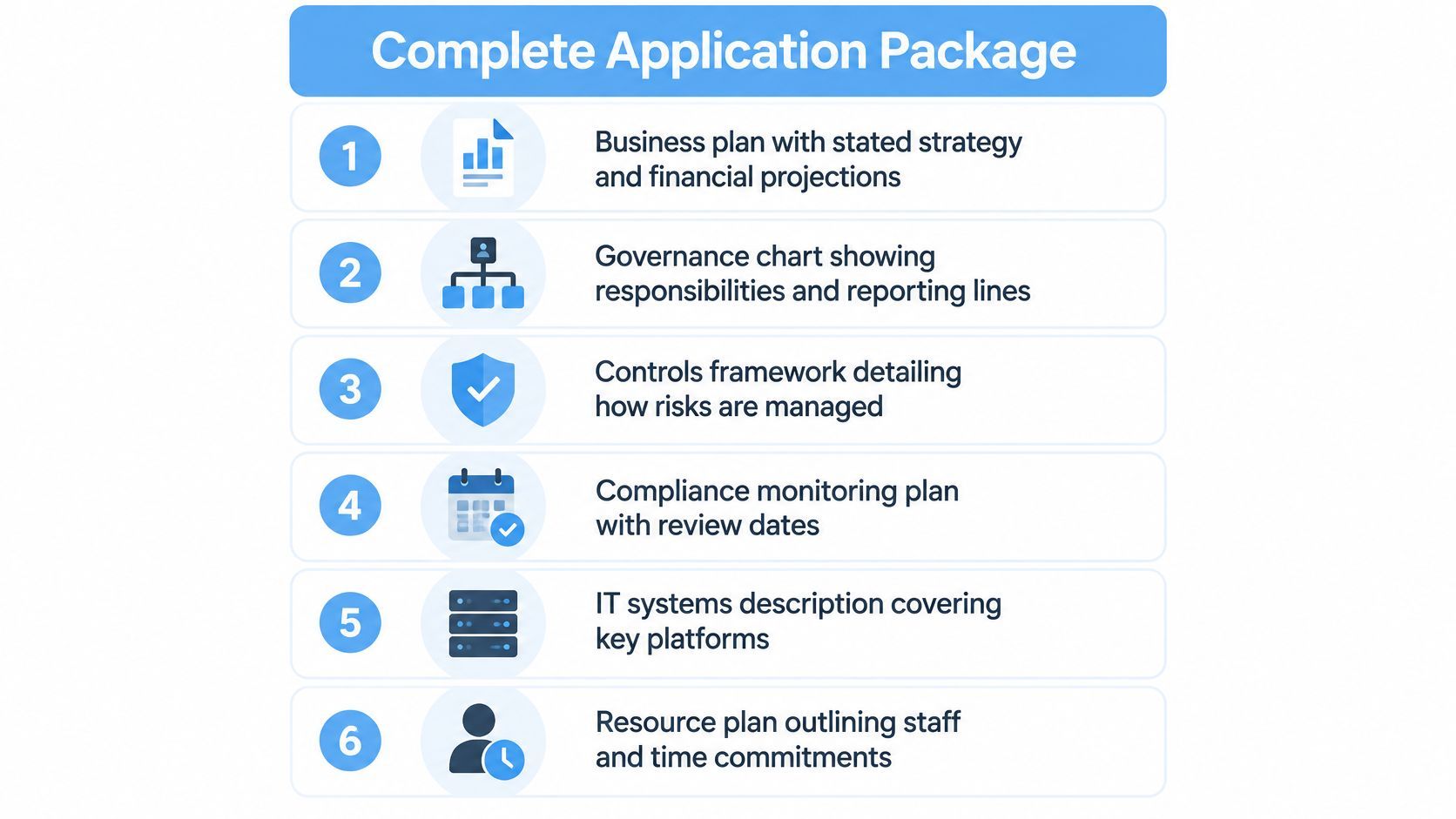
The core components are a business plan with stated assumptions, financial projections linked to those assumptions, governance and a responsibilities map showing which senior managers hold which functions, policies and operating procedures, system and outsourcing descriptions, a financial crime framework, a wind-down plan, and an evidence register. If your product moves money, add a complete end-to-end flow of funds for the fiat and crypto legs.
Six steps that make a package complete
1. Build one fact base. Every document draws on the same set of facts: ownership, controllers, entity structure, headcount, revenue lines, systems, outsourcing. One source of truth kills contradictions before they're written.
2. Assign an owner and a due date to each evidence item. Unowned evidence is uncollected evidence. Track it the way you'd track a regulatory deadline.
3. Draft from the fact base, not from the previous draft. Copying last year's policy carries its assumptions forward. Use our guide to how evidence works in an application to decide what counts as proof rather than assertion.
4. Run a cross-document consistency check comparing numbers, names, dates and descriptions. The second step of our own process sits here: bringing the business plan, financial information, policies and application answers together, reviewing the documents, resolving findings and revisiting affected material when facts change.
5. Label each control as operating today or scheduled before launch. Reviewers accept planned controls. They don't accept ambiguity about which is which.
6. Obtain internal and client sign-off. Two signatures, dated, on the final version.
Corporate evidence is where packages often thin out. Reviewers want to know who can bind the company and on what authority, and Jumpstart Partners' incumbency certificate explainer sets out what that document evidences and when a firm is asked for it.
The output is a package your team can defend line by line, with each claim traceable to a policy, a system record, a board minute or a test result.
Submission, Review and Planning Timelines
Start with what the clock measures. The FCA's application guidance sets a statutory decision period of six months after receiving a complete Part 4A application under the Financial Services and Markets Act 2000, extending to 12 months where the application is incomplete. Applications go through the Connect system, and approval is rarely immediate because questions are a normal part of assessment.
The filing date matters less than founders expect. The statutory clock starts on completeness, so a thin package filed in March does not beat a complete one filed in May.
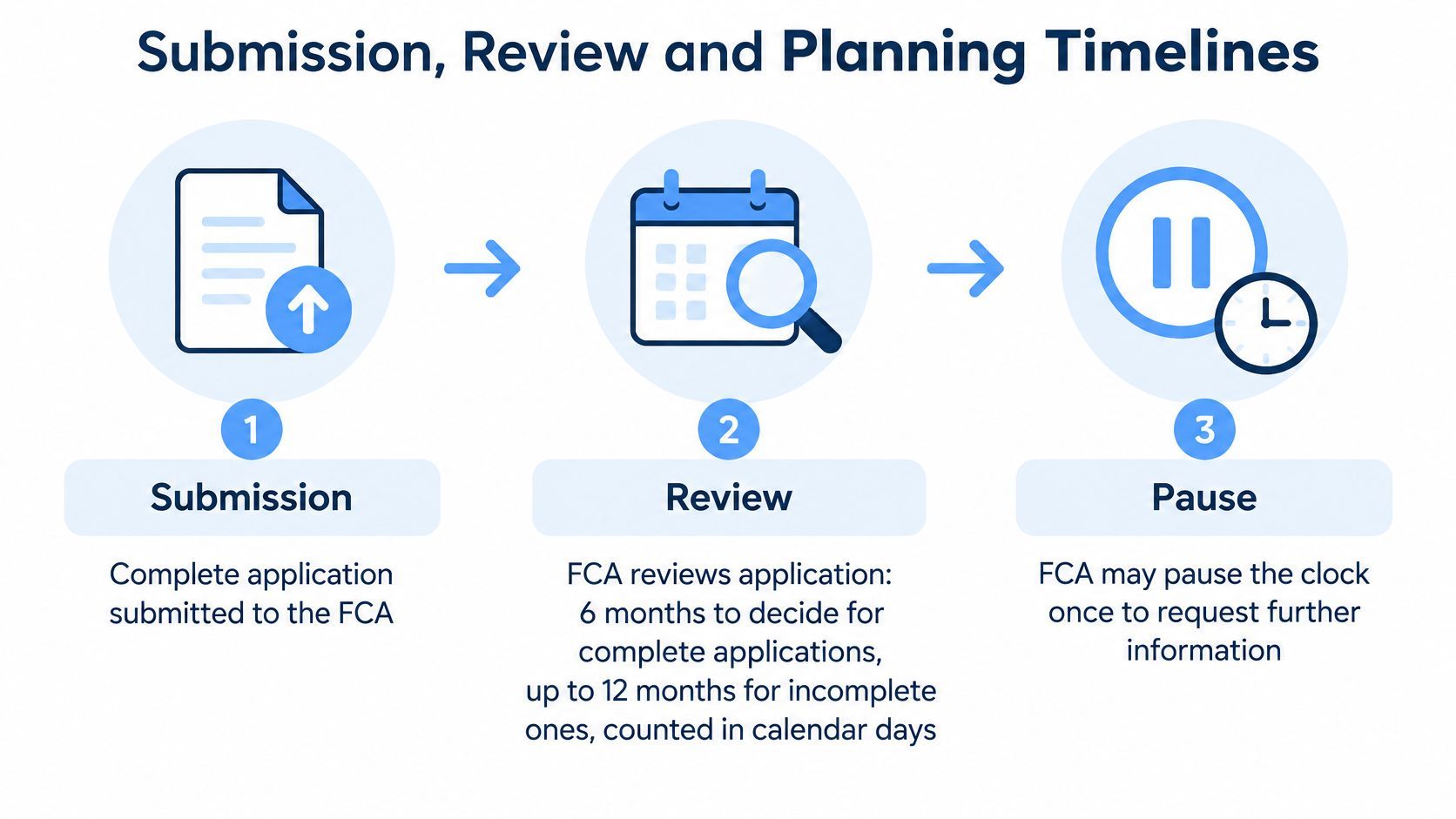
The authorisations operating service metrics for Q2 2024/25 show how that split plays out: 93.9% of complete Part 4A applications were determined within the applicable statutory deadline, against 95.6% of incomplete applications under their own 6- or 12-month framework. The FCA measures those periods in calendar days, not working days, and may pause once for up to 30 days to request further information.
Two routines that protect the date
The filing routine has six items. Check the package against the permission matrix. Confirm the signatory and the submission authority. Submit and record the acknowledgement date. Open a clarification log with an owner and deadline per question. Update every affected document in the same cycle. Escalate any item that stalls.
One item on that list deserves a second look. The permission check is not a formality: an existing registration or permission does not convert automatically to a newly regulated activity, so each activity in the plan needs its own route check. A firm that discovers mid-review that one activity sits outside its permissions has effectively restarted its own clock.
The planning routine is shorter and more often skipped. Estimate scoping and preparation from your activity and entity count. Add the statutory period your completeness will earn. Add a buffer for one clarification pause. Then set a dated plan with decision gates a board can hold you to.
| Scenario | Period | What it means |
|---|---|---|
| Complete application, FCA Part 4A | Up to 6 months from receipt | Statutory decision period measured in calendar days |
| Incomplete application, FCA Part 4A | Up to 12 months | Longer because required information is missing |
| Clarification pause, FCA Part 4A | Once, up to 30 days | Regulator requests further information |
| Scoping and preparation before filing | Set by the firm | Happens before the statutory clock starts |
| Interview and clarification response | Set by the regulator's requests | Depends on question volume and response speed |
Rejection patterns repeat across regulators, and the causes are usually documentary rather than substantive: missing supporting documents, details that do not match between forms and attachments, attestations nobody checked. The pattern extends well beyond financial regulation. A guide to MOHRE errors for SMEs documents comparable submission mistakes in UAE employment and permit filings.
Firms weighing a banking route alongside a payments or crypto route need the same discipline, and our guide to UK bank licences shows how the preparation burden scales with the permission.
Scheduling reality: scoping, preparation and interview readiness all sit before or beside the regulator's clock, and together they usually take longer than the decision period itself.
Submission happens on the client's behalf under the required mandate and access arrangements, after internal approval and client sign-off. The decision stays where it belongs: the regulator decides, and no one can guarantee an approval date.
Interviews and Clarification Questions
A senior manager who recites the transaction monitoring policy word for word but can't say who reviews the alerts, at what threshold, or how often the rule set is tuned, damages the file. The reviewer hears a firm that has documented a process it doesn't run.
Interviews test whether named individuals can explain how controls work in practice. That's a different skill from writing them up, and it needs rehearsal rather than confidence.
Preparing the people, not the paperwork
1. Assign topics to people. Identify which senior managers attend and which subject each owns. Overlap creates contradiction under questioning.
2. Rehearse the five areas that always come up. Governance and reporting lines, financial resources, financial crime controls, outsourcing, and incident response. Twenty minutes each, spoken aloud, no notes.
3. Prepare an evidence reference per answer. Each response points to the policy, system record or board decision behind it. Reviewers accept "see the March board minute" far more readily than "that's how we do it".
4. Run a mock interview and log every question the team couldn't answer. The log is the deliverable. It tells you exactly which paragraphs need rewriting before the session that counts.
5. Close the gaps in the documents first, then re-rehearse. Fixing the answer without fixing the file leaves a contradiction a reviewer will find.
For written clarification requests, answer within the deadline, cite the evidence directly, and where a fact has changed, run an impact review across every affected document. Our interview preparation step does exactly this: it helps the client's team explain the business, its controls and its responsibilities, and uses focused preparation to surface the questions that still need work.
What no consultant can promise: the outcome. Authorisation decisions remain with the relevant regulator, and rehearsing well improves the quality of the file, not the certainty of the result.
Confirm the Route and Evidence Before You File
The whole lifecycle reduces to three moves: decide the route, prove the facts, let the regulator decide. Everything else is execution.
Five questions test readiness before you file.
- Can you name every activity, the permission each needs and the entity that will hold it? If any activity has no row in the matrix, it isn't covered.
- Have you tested whether an existing registration or permission covers a new cryptoasset activity, and identified where it doesn't convert? Prior status reduces familiarity risk, not perimeter risk.
- Is every claim in the evidence register traceable to a document, system or decision? Untraceable claims become questions.
- Who holds the authority to sign and submit, and has the cross-document consistency check been run? Both need a name and a date, not an intention.
- Does your dated plan show the project window, including preparation and interview readiness, rather than only the decision window?
Where professional support is involved, the scope, fees, responsibilities and any authority to submit on your behalf sit in a written engagement agreement. That clarity protects both sides, and it doesn't change the fact that the regulator decides.
The strongest next step is small and concrete: a short scoping session that produces a permission matrix and a dated plan. Until those two documents exist, any launch date you give the board is a guess dressed as a commitment.
Glentorion works with founders and compliance teams on exactly this sequence: route scoping, a permission matrix per activity and entity, application preparation and cross-document review, submission under an agreed mandate, and interview preparation for the senior managers who'll be questioned. If you're planning a new regulated activity, or unsure whether your existing registration covers it, visit Glentorion to scope the route before the drafting starts.
- authorisation process
- FCA authorisation
- regulatory authorisation
- Part 4A permission
- regulatory application