Operating Procedures for UK Regulated Firms: A Guide
Published
You're assembling an authorisation file. The business plan describes the service, compliance has drafted the policies, and operations has a folder of instructions. Then someone asks who can release a delayed payment when the usual approver is unavailable, and which record proves that the replacement approval was valid. The documents don't quite answer.
That's the gap good operating procedures close. For UK founders and compliance teams, the challenge isn't producing more paperwork. It's showing that named people can run the proposed business, recognise when a control is failing and produce evidence that matches the application.
Table of Contents
- What an Operating Procedure Must Contain
- Mapping Services and Setting Measurable Tolerances
- How to Draft a Procedure Step by Step
- Testing Procedures Against Severe but Plausible Scenarios
- How One Withdrawal Procedure Serves Three Rulebooks
- Align Your Procedures Before You File
What an Operating Procedure Must Contain
An operating procedure is the written, owned and tested instruction for how a regulated service runs day to day. It explains who acts, when, with which systems and what evidence they keep. A policy states the firm's position; a procedure tells a trained employee what to do next.
For firms within scope, the FCA's operational-resilience policy statement connects important business services with impact tolerances, dependency mapping and testing. That makes a policy statement alone insufficient evidence of operational readiness. Check which requirements apply to your firm rather than assuming every applicant falls within the same Handbook provisions.
Core elements of an operating procedure
The payments example below is illustrative. Its outage limit is a hypothetical drafting assumption, not a recommended tolerance or regulatory allowance.
| Element | Question it answers | Example |
|---|---|---|
| Accountable owner | Who answers for the outcome when the service fails? | Head of Payments Operations |
| Important business service | Which client-facing service does this procedure protect? | Same-day client payment release |
| Impact tolerance | How much disruption can occur before harm becomes intolerable? | Hypothetical maximum outage of 24 hours, subject to harm assessment |
| Escalation trigger | When does routine handling become a formal crisis response? | Payment queue passes the agreed backlog limit |
| Required inputs | Which data, systems and people must be available? | Payment queue, approved signatory list, core banking access |
| Decision rule | Who may authorise a manual workaround, and under what conditions? | Duty director with dual sign-off |
| Evidence retained | Which record proves the control worked? | Incident log, timestamps, approval records |
| Review trigger | Which change forces an update before the annual review? | New third-party provider or product change |
MakeAutomation's guide to SOP requirements for B2B offers a supplementary starting point for structuring everyday instructions. For a regulated business, add the service-specific control limits, authority boundaries and evidence requirements that make those instructions usable in an authorisation assessment.
Practical rule: A short procedure with an executable decision rule gives more assurance than a long policy library that leaves the decision undocumented.
Document length isn't the quality test. Start with service mapping and tolerance setting, then draft executable instructions, test disruption scenarios, reconcile overlapping obligations, and check the filing package. Each activity should produce something management can inspect, not another document marked approved.
Mapping Services and Setting Measurable Tolerances
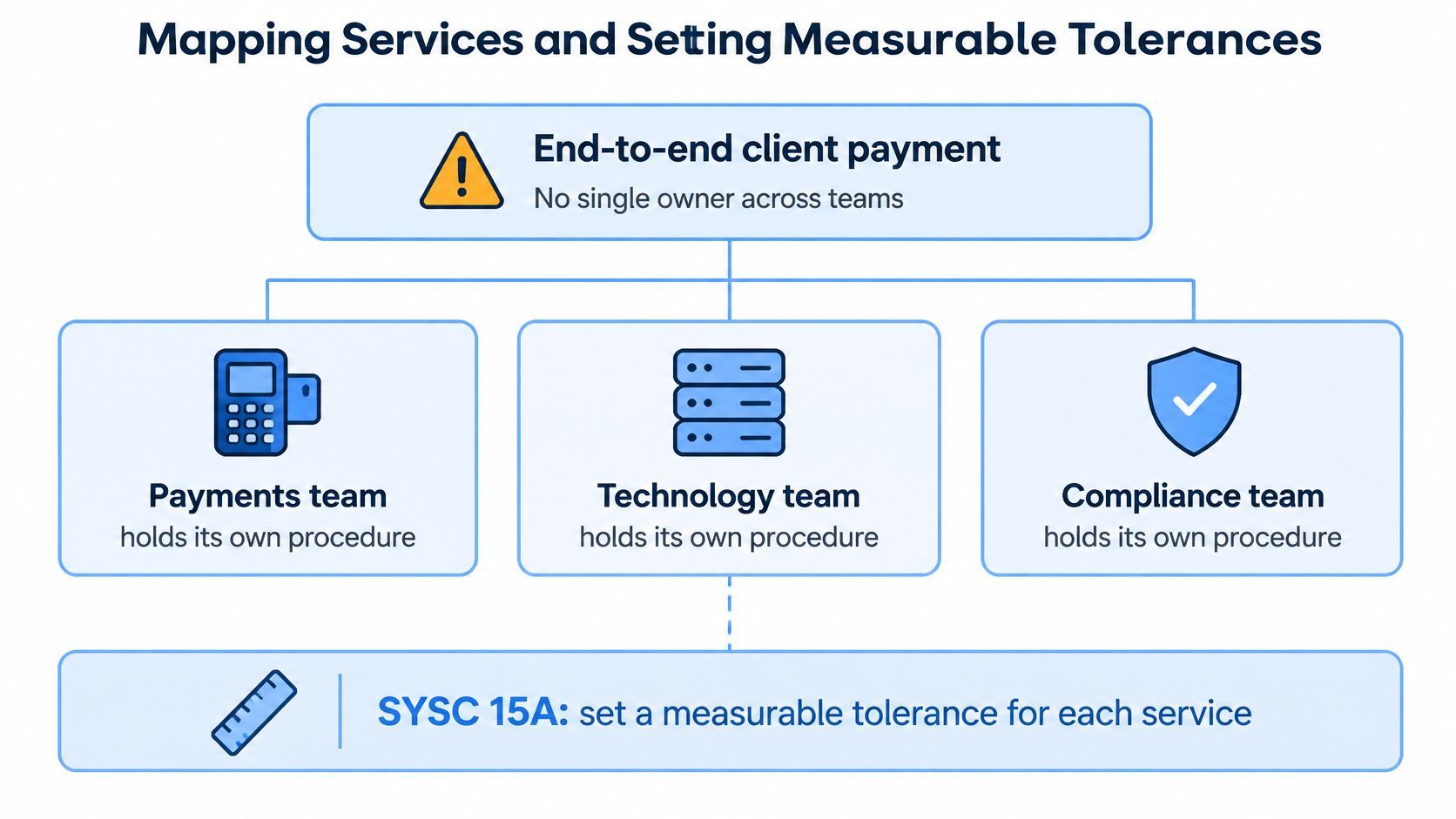
A payments firm has a payments team, a technology team and a compliance team. Each maintains a procedure, but nobody owns the end-to-end client payment. When processing stops, technology reports that the platform is available, compliance waits for an escalation and operations waits for approval.
The client still hasn't been paid.
The FCA's guidance on demonstrating operational resilience in practice focuses on important business services and the resources supporting them, rather than departmental documentation alone. It also expects firms to consider vulnerable customers, peak demand, financial loss and the consequences of reputational damage when assessing disruption.
Build the map around the client outcome
Use a service inventory and a dependency register before writing detailed instructions. A business analysis process model helps distinguish the service customers receive from the internal activities employees perform.
- List the client-facing services. Describe outcomes, such as releasing client payments, rather than internal functions such as payment administration. Assess which qualify as important business services.
- Trace the dependencies. Record people, processes, technology, facilities and information, including third-party providers and group infrastructure. Follow the transaction through hand-offs instead of stopping at the departmental boundary.
- Identify single points of failure. Look for sole approvers, inaccessible credentials, shared infrastructure and suppliers with no workable alternative. Record the consequence of losing each dependency.
- Assign a service owner. Give a named individual responsibility for coordinating the end-to-end outcome. Record the role, its current holder and the deputy arrangement.
- Connect the procedures. Link payment validation, screening, release, reconciliation and incident handling to the service they protect. Keep specialist instructions separate where useful, but make their interfaces explicit.
Mapping too broadly produces an inventory nobody maintains. Mapping too narrowly misses the dependency that stops delivery. Include enough detail to explain how losing a resource affects the client outcome and which response remains available.
Set limits that support decisions
An impact tolerance is the maximum tolerable disruption before harm becomes unacceptable, not a convenient recovery target. The FCA's SYSC 15A framework requires a tolerance for each important business service; its consultation example described a service interruption exceeding 24 hours as potentially causing intolerable harm, not as a universal allowance.
Choose measures that expose the actual harm mechanism. For payments, a modest backlog of urgent transactions may be more consequential than a larger queue of non-urgent instructions. For crypto services, platform availability alone may conceal unsuccessful transactions or delayed confirmations.
Impact tolerance metrics by service type
| Service | Measure |
|---|---|
| Client payments | Elapsed time |
| Client payments | Backlog of unprocessed payments |
| Crypto trading platform | Transaction-success rate |
| Crypto trading platform | Confirmation latency |
| Crypto custody | Critical smart-contract error rate |
| Client onboarding | Customers unable to complete onboarding |
These are candidate measures, not prescribed thresholds. Define the population, measurement period, data source and person responsible for interpreting each measure. Otherwise, teams can report different figures while believing they're monitoring the same service.
Set escalation early enough to allow action before the tolerance is exhausted. The procedure should identify who declares an actual or likely breach, the decision deadline and the record retained. Review the map at least annually and after material change, rather than waiting for an incident to reveal that it no longer describes the business.
How to Draft a Procedure Step by Step
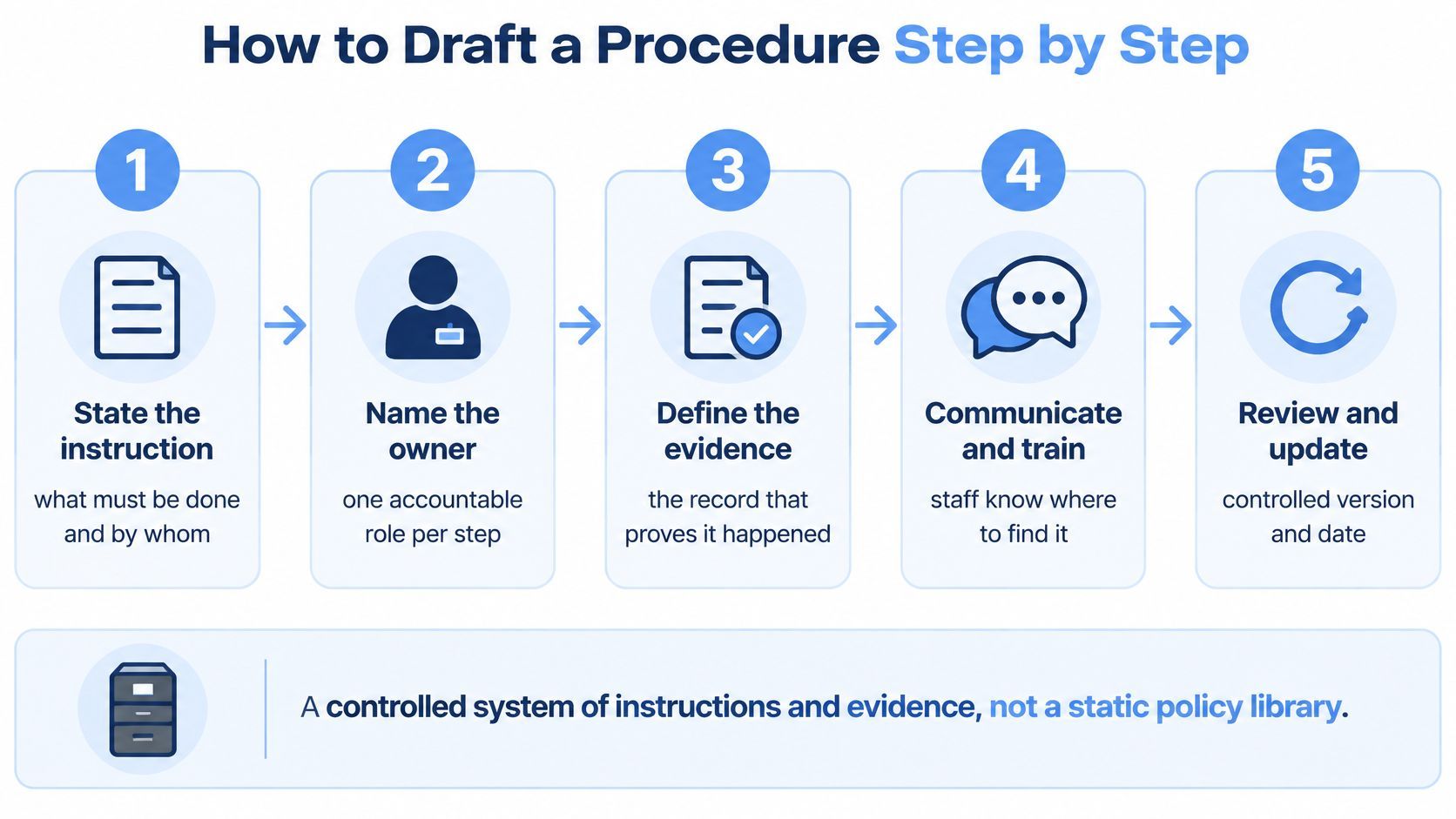
Treat the manual as a controlled system of instructions and evidence, not a static policy library. The FCA's systems-and-controls guidance expects appropriate procedures to be effectively communicated and available to employees, with operational-risk controls addressing relevant failures in internal processes, systems and service providers.
Draft in the order an employee will execute the process. Keep background explanation separate from instructions so the person handling an exception doesn't have to search through policy commentary.
Write for execution rather than interpretation
- Name the risk and control objective. State what could go wrong and what the control must achieve. Avoid objectives such as maintaining compliance, which don't tell the operator what successful execution looks like.
- Allocate accountability and responsibility. Identify the accountable role and the person responsible for performing the task, with current role holders recorded. Naming a team leaves uncertainty when an urgent decision needs an individual.
- Specify inputs, systems and records. List the information required before work starts, the access needed and the output location. A reference to the usual spreadsheet won't help a substitute identify the approved version.
- Write decision rules and exceptions. Define approval conditions, segregation of duties and the route when normal processing fails. Management discretion needs boundaries and a recorded rationale, not an unrestricted override.
- Set review and remediation ownership. Record the review frequency, change triggers and who closes identified weaknesses. Don't confuse approving a revised document with fixing the underlying control.
- Test reproducibility. Ask a trained substitute to execute the instructions and produce the expected records. If they need undocumented explanations from the author, revise the procedure.
A payment-release example
The risk is delayed client payment release beyond the agreed tolerance; the objective is release within the approved time limit. The Head of Payments Operations is accountable, while the payments duty officer performs the control using the payment queue, approved signatory list and core banking access.
Manual release becomes available only after the backlog trigger is reached and dual sign-off is obtained. The duty officer retains the incident log and approval timestamps; the review schedule includes an annual check and an immediate reassessment when a new provider is introduced.
Once the written instruction is stable, Tutorial AI's guidance can help teams turn procedures into video tutorials. Keep training material aligned with the controlled version. Managers should still be able to explain the decision rule, evidence and exception route without relying on a recording.
Testing Procedures Against Severe but Plausible Scenarios
A successful backup restoration doesn't prove that clients can receive their payments. Nor does a supplier's availability report prove that your employees can access the recovered service, approve transactions and reconcile the results. System testing and service testing answer different questions.
The FCA's operational-resilience guidance expects testing plans to demonstrate delivery within impact tolerances under severe but plausible disruption. It also explains that, where extensive testing shows a firm cannot remain within a tolerance, the issue should be reported to the FCA in line with SYSC 15A.2.11G.
Test the outcome and the response
Start with a service-level scenario, then introduce the dependency failure. Use the firm's financial risk assessments to inform assumptions about liquidity, transaction exposure and the consequences of delayed delivery. Don't assume technical recovery automatically restores financial capacity.
Severe but plausible test scenarios and evidence
| Scenario | What to test | Evidence to record |
|---|---|---|
| Critical technology component fails | Recovery within tolerance and manual workaround | Timestamps, workaround approval, retest result |
| Key staff unavailable | Cover from trained substitutes | Rota, training records, completed tasks |
| Information compromised | Data integrity checks and client communications | Incident log, data reconciliation record |
| Supplier failure | Exit or failover to an alternative provider | Escalation record, failover timings |
| Client access restricted | Alternative channels and client communication | Customer notices, complaint volumes |
| Premises unavailable | Remote working and recovery sequence | Continuity records, attendance logs |
For each exercise, record the scenario, assumptions, participants and expected outcome before execution. Afterwards, capture observed failure points, decisions, remediation ownership and retest evidence. Distinguish actions performed from actions participants merely said they could perform.
Include peak-demand conditions and customers whose circumstances make delay especially harmful. Test whether an alternative channel is usable in practice, not merely listed in the continuity plan. A telephone fallback offers little protection if callers can't complete authentication or staff can't access the relevant records.
A test that passes only because the most experienced employee supplies missing instructions hasn't demonstrated a reproducible control.
Turn findings into decisions
Some exercises should be controlled simulations because live execution would create unacceptable client risk. Record that limitation and identify what further evidence is needed. A tabletop discussion can establish whether decision-makers understand their roles, but it won't establish actual failover speed.
Don't close a finding because someone updated the wording. Require evidence that the revised response works and record any remaining limitation for management.
Schedule a scenario test for the most critical service this quarter. Assign an owner to every failure point it reveals, including weaknesses that sit outside the procedure author's department.
How One Withdrawal Procedure Serves Three Rulebooks
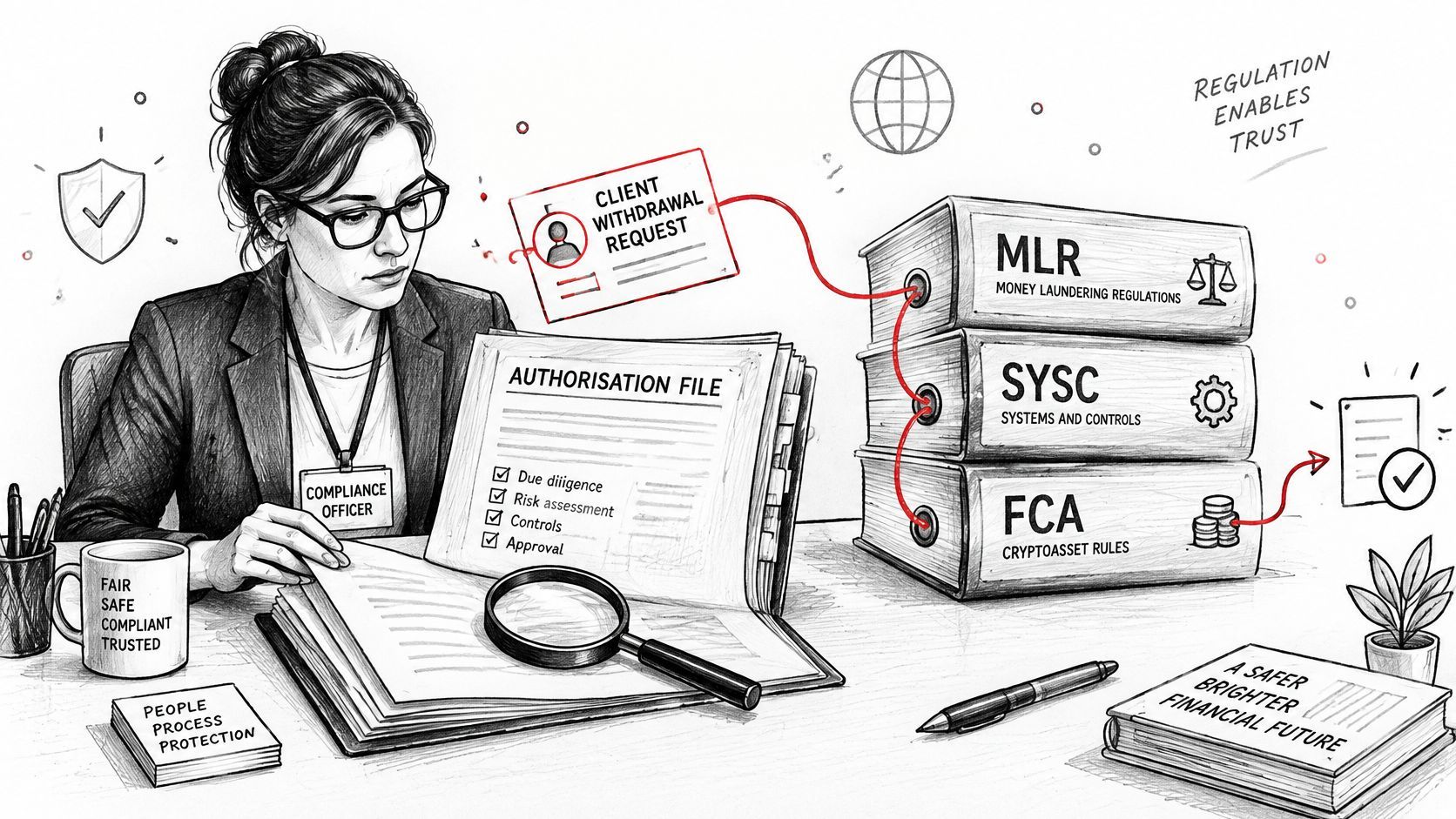
A crypto firm is preparing its authorisation file when a client withdrawal stalls. Financial crime has cleared the customer, custody operations is waiting on reconciliation and customer support has already promised a release time. Each team followed its own document. Nobody can state the withdrawal's overall status.
The FCA's cryptoasset policy statement addresses the interaction between the Money Laundering Regulations framework and the new FSMA regime, and UK crypto businesses have been subject to the Travel Rule since September 2023. These obligations demand coordinated execution; competing approval chains produce exactly the stall described above.
Give the withdrawal a shared workflow
Connect the transaction workflow to the applicable obligations with a control-to-obligation map. The frameworks stay legally distinct; what the map changes is consistency of responsibility and evidence across them.
- Financial-crime hand-off. Record screening outcomes, required transaction information, unresolved alerts and release restrictions.
- Safeguarding hand-off. Confirm the relevant asset and reconciliation position, with a defined response to a discrepancy.
- Customer hand-off. Give an approved status explanation without disclosing information that must remain restricted.
- Complaints hand-off. Route dissatisfaction into the complaints process while retaining the withdrawal's transaction reference.
Run the workflow on a shared transaction identifier and reconciled status records. Specialist checks stay separate, but every employee touching the withdrawal should know which unresolved condition blocks release and who can clear it. Mapping FCA compliance requirements to each check prevents duplicate approvals without weakening any control.
Treat provider changes as application changes
A custody provider change is a defined change trigger. Assess the withdrawal instructions, safeguarding reconciliation, screening interfaces, board disclosure and application answers together; updating only the supplier name leaves the transaction flow untested. Glentorion's second step brings the business plan, financial information, policies and application answers together, reviews the documents, resolves findings and revisits affected material when facts change.
The FCA's cryptoasset preparation guidance sets out a scheduled application window ahead of the new regime's commencement. Build the file against the published timetable and keep tracking it, because both dates and requirements can move.
Read the finished procedure the way a case officer will: it should name the service it protects, state the measurable tolerance it holds and identify the trigger that forces revision. A smaller set of tested, version-controlled procedures with reliable hand-offs gives stronger assurance than separate manuals that contradict each other.
Align Your Procedures Before You File
The final review should establish whether the application describes a coherent business that management can explain. A polished procedure is a liability if it claims a control is operating when recruitment, procurement or implementation hasn't happened.
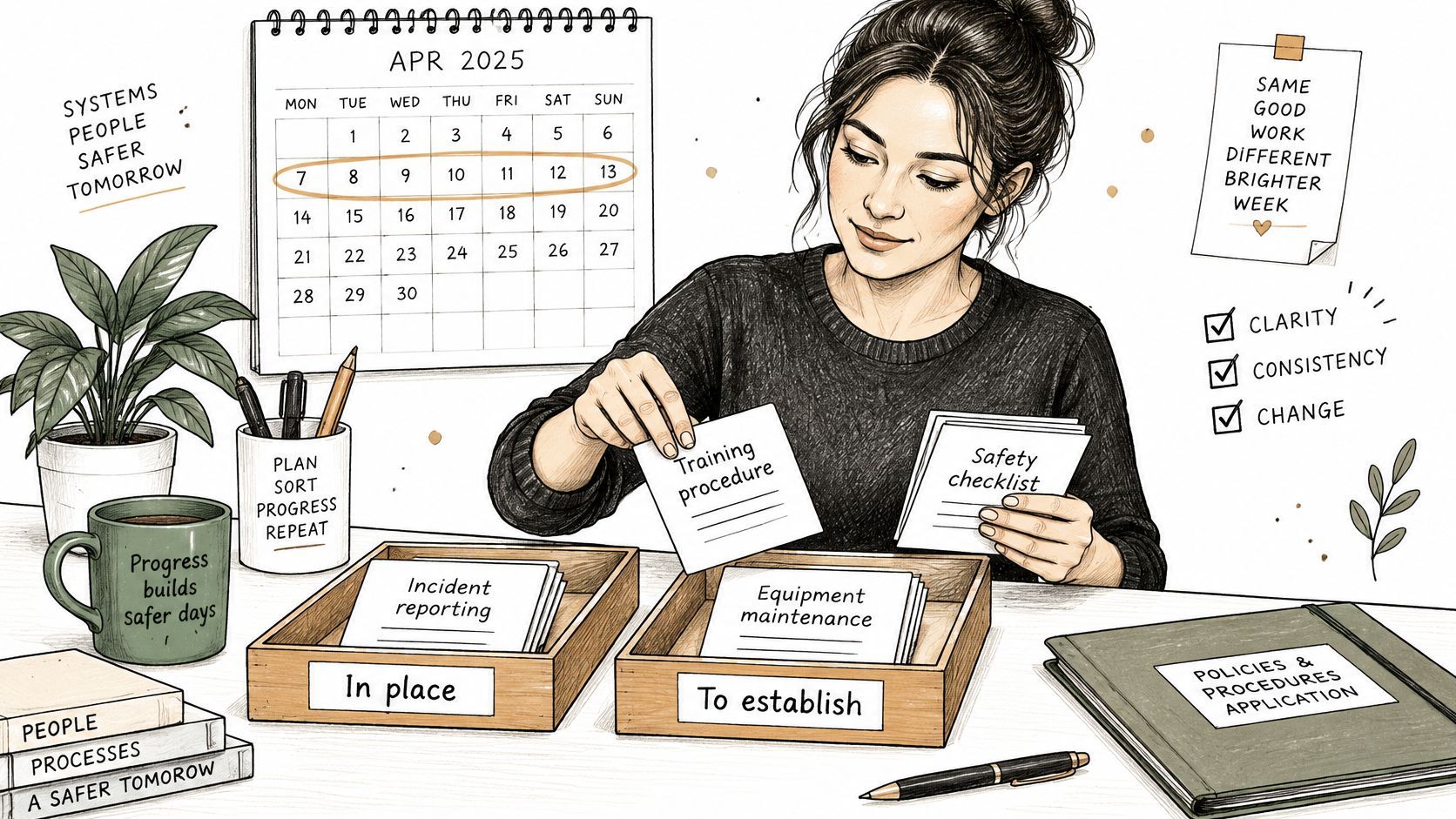
Glentorion prepares policies and operating arrangements that distinguish what's already in place from what the business still needs to establish. Keep that distinction visible throughout the file, including dependencies and unresolved decisions.
Run the pre-filing sequence
- Separate current and planned arrangements. Label controls according to their actual status and retain supporting evidence. For planned arrangements, record the implementation owner, dependencies and completion condition rather than writing in the present tense.
- Check against the business model and service map. Confirm that the procedures cover the proposed activities, customers and transaction flows. For each important business service, check the owner, tolerance and tested scenarios, and explain any remaining implementation gap.
- Reconcile the narrative with financial projections. A procedure requiring additional operational cover must be consistent with staffing assumptions. Supplier costs, implementation expenditure and contingency arrangements should be readable alongside the written operating model.
- Prepare the people who may be interviewed. Ask each owner to explain the control, decision rule, evidence and escalation route in their own words. In our fourth step, we help the client's team explain the business, controls and responsibilities, using focused preparation to identify questions that still need work before an applicable interview.
- Complete the consistency review. Track every finding with an owner and a target date, then check the correction across affected documents. Glentorion checks consistency across application documents, addresses findings and prepares the identified package for internal and client approval.
Make evidence easy to inspect
Use an evidence index that connects each material statement to its supporting record. Distinguish a design document from an execution record: an approved access-control procedure establishes the intended approach, while an access review shows whether someone applied it. This distinction is central to assessing what counts as regulatory evidence.
Filing check: Ask the control owner to find the supporting record without help from the application drafter.
Resolve discrepancies before treating the package as ready for approval. Where a matter remains open, describe it accurately rather than hiding it behind a general assurance.
This week, list the services in scope, name an owner for each and schedule the first scenario test before the application window opens. Give the resulting findings a place in the filing tracker, not just in meeting notes.
Glentorion helps financial and crypto businesses prepare operating procedures, align them with business plans and application answers, and ready responsible teams for applicable regulator interviews. Visit Glentorion to discuss a scoped review of your operating arrangements, evidence gaps and authorisation package.
- operating procedures
- operational resilience
- FCA authorisation
- impact tolerance
- crypto regulation