FCA Limited Permission: What It Covers and How to Apply
Published
Most startup advice treats FCA limited permission as a quick, low-friction shortcut for small businesses that don't want the hassle of full authorisation. Founders get told to tick the narrower box, pay a lower fee, upload a few templates, and move on to commercial growth.
That advice breaks down when a regulator inspects how the business operates. Limited permission isn't a lighter copy of full authorisation, and it isn't a one-off hurdle you clear before launch. Eligibility depends strictly on your commercial model, your sales channels, and your revenue mix.
Change one part of that model after launch, and your permission can stop fitting overnight. A new finance product, a shift to in-home sales, an outsourced collections partner, or a change in ownership can push an authorised firm outside its permitted boundary. Treating FCA limited permission as a continuing change-management discipline, rather than a cheap starter licence, is the only way to stay on the right side of the UK consumer-credit perimeter.
Table of Contents
- What Limited Permission Covers and How It Differs
- Which Activities Qualify and the Tests They Must Pass
- How to Prepare a Limited Permission Application
- How Long Assessment Takes and What Slows It Down
- When Limited Permission Needs Rethinking After Launch
- Confirm Your Permission Route Before You Apply
What Limited Permission Covers and How It Differs
In the UK, FCA limited permission is a defined statutory route within the consumer-credit authorisation regime, not an exemption from regulation. It remains a Part 4A permission under the Financial Services and Markets Act framework, which means the Financial Conduct Authority holds limited-permission firms to binding legal standards, formal Handbook rules, and ongoing supervisory oversight.
Think of it as a licence cut to the exact shape of one business, not a discounted version of full authorisation. Under the FCA's guidance for consumer credit lenders and hirers, firms don't pick between Limited Permission and Full Permission based on preference or company size; they choose according to the specific regulated activities they carry on and the exact circumstances in which they carry them on.
| Criterion | Limited permission | Full permission |
|---|---|---|
| Scope of activities | Specified credit-related activities only | Activities outside the limited categories |
| Threshold conditions | Fewer, modified for relevant credit activities | Full set of threshold conditions applies |
| Fee pricing category | Category 2 (historical) | Higher pricing category set by the specific permissions sought |
| Eligibility test | Business model fits a qualifying limited category | Business model falls outside every limited category |
| Reporting and evidence | Regulatory business plan and regular reporting through the FCA reporting system | Regulatory business plan, fuller threshold evidence and ongoing returns via the FCA reporting system |
Why Modified Threshold Conditions Still Demand Operational Readiness
Limited-permission firms conduct only specified, lower-risk credit activities, so they face a narrower set of threshold conditions than full-permission firms. That narrower perimeter covers specific roles such as certain ancillary credit brokers, where introducing customers to finance is incidental to selling goods or supplying non-financial services and the firm's primary trade isn't a regulated activity. It also covers firms whose regulated activity consists solely of entering into consumer-hire agreements and exercising, or having the right to exercise, the owner's rights and duties under those agreements.
Exclusions still bite hard. Some lending arrangements and hire-purchase structures sit outside the limited route altogether, regardless of how modest the firm's credit volumes look on paper.
Even where a business fits a qualifying category, modified threshold conditions don't mean relaxed standards. Under COND 1 in the FCA Handbook, the regulator still assesses whether every applicant is ready, willing and organised to comply continuously with applicable requirements. The FCA also checks that your business strategy suits the regulated activities you plan to run and has proper regard to its operational objectives. If credit broking becomes your main business, or your commercial activities drift beyond the qualifying circumstances, eligibility for the limited route collapses and a different authorisation path becomes necessary.
Scope follows the business model, not the label on the application.
Which Activities Qualify and the Tests They Must Pass
Say a showroom sells bespoke kitchens and introduces buyers to a third-party lender at the point of sale. If every sale happens inside the showroom and kitchen retail generates the firm's core trade, that model can point towards limited permission. Now imagine the same company starts sending sales consultants into customers' living rooms to sign purchase orders and arrange finance on the spot. That single channel change knocks the business out of the own-goods limited category.
Under the FCA's consumer credit brokers guidance, credit broking linked to a firm's own goods or services must pass a strict cumulative test. Three binding conditions must all hold at the same time: the firm's main business must not be credit broking or another regulated activity (other than consumer hire), the broking must be carried out to sell the firm's own goods or supply its own services, and the firm must not sell, offer, or agree to sell goods or supply services while physically present in a customer's home. That third limb excludes domestic-premises suppliers from this particular limited category. Meeting two out of three isn't enough; failing any single limb means this route is closed.
Breaking Down the Five Qualifying Routes
When introductions arise out of another underlying transaction, the FCA's secondary credit brokers framework applies a separate three-part test. Limited permission may apply where the business introduces customers to third-party finance providers, wouldn't make those introductions without its underlying trade, and earns the majority of its revenue from that main business rather than from credit introductions. If any limb of that secondary test fails, Full Permission is required.
| Case | Conditions that must all be met | If a condition fails |
|---|---|---|
| Credit broking to sell own goods or services | Main business is not credit broking or another regulated activity other than consumer hire; broking sells own goods or supplies own services; no selling or supplying while physically present in a customer's home | Limited category unavailable |
| Secondary broking from another transaction | Introduces customers to third-party finance providers; would not make introductions without the underlying business; majority of revenue comes from the main business | Full permission required |
| Consumer hire or hire-purchase broking | Introduces customers to lenders for those agreements only; no debt adjusting or debt counselling | Outside this category |
| Debt adjusting or counselling on vehicle finance | Possible limited category, limited to settling vehicle finance where the transaction requires ending existing agreements | Full permission required where the secondary test fails |
| Consumer-hire-only firms | Enter into consumer-hire agreements and exercise the owner's rights and duties under them | Outside this category |
Each row above requires concrete commercial proof, not a one-line assertion in a cover letter. To evidence the own-goods cumulative test, a compliance team needs sales-channel procedures proving transactions happen online, by phone, or on business premises, never in customers' homes, paired with revenue breakdowns showing retail or non-financial services remain the core trade. To evidence secondary broking, financial forecasts must demonstrate that commission or introduction income stays a minority share of total turnover.
Consumer-hire and hire-purchase broking carries its own clean boundary: the firm must only introduce customers to lenders for those specific agreements and must stay completely clear of debt adjusting or debt counselling. The narrow exception sits in vehicle finance. Where a customer's transaction requires ending one or more existing credit or hire agreements and taking out another, associated limited-permission categories for debt adjusting and debt counselling may apply, strictly limited to settling vehicle finance. For consumer-hire-only businesses, standard customer contracts and operational workflows must confirm the firm only enters into consumer-hire agreements and exercises the owner's rights and duties, with no wider lending or broking bolted on. Mapping each row accurately also clarifies how your firm will meet FCA threshold conditions on an ongoing basis.
What a Defensible Customer Journey Map Must Prove
Describing your company as a retailer, dealership, or service provider leaves an FCA case officer guessing. Your application package has to map every sales channel and customer touchpoint against the regulator's specific tests, proving how the commercial flow stays inside the boundary from first inquiry to post-sale support.
A complete customer journey pack needs to document eight operational details clearly:
- End-to-End Customer Journey: Show every step from initial product marketing and finance presentation through application handover to the lender and post-agreement handling.
- Risks and Controls: Identify where consumer harm could arise at the point of sale and tie each risk to a live control owned by a named individual.
- Consumer Duty Arrangements: Evidence how you deliver good outcomes across price and value, consumer understanding, and customer support, rather than quoting generic Duty principles.
- Intended Lenders or Brokers: Name the third-party finance providers or brokers you plan to introduce customers to, along with their roles in the chain.
- Types of Agreements Brokered: Specify the exact credit or hire products customers will enter into so the FCA can verify they fit the permission category.
- Product Suitability: Explain how staff or digital journeys ensure finance options match customer needs without straying into unauthorised advice.
- Fees and Commissions: Disclose every commercial arrangement, commission structure, or customer fee so the regulator can test both revenue mix and conflicts of interest.
- Unregulated Activities Alongside Regulated Work: Set out your primary non-financial business clearly so the assessor can see where unregulated trade ends and regulated broking begins.
How to Prepare a Limited Permission Application
Opening an FCA Connect portal form before your commercial evidence is reconciled is the fastest way to trigger a stalled assessment. Under the FCA's limited permission checklist, even though limited permission has historically sat in pricing category 2 rather than the fee bracket for full-permission applicants, the regulator still requires formal Part 4A authorisation evidence, a coherent business plan, accurate supervisory disclosures, and verified reporting readiness.
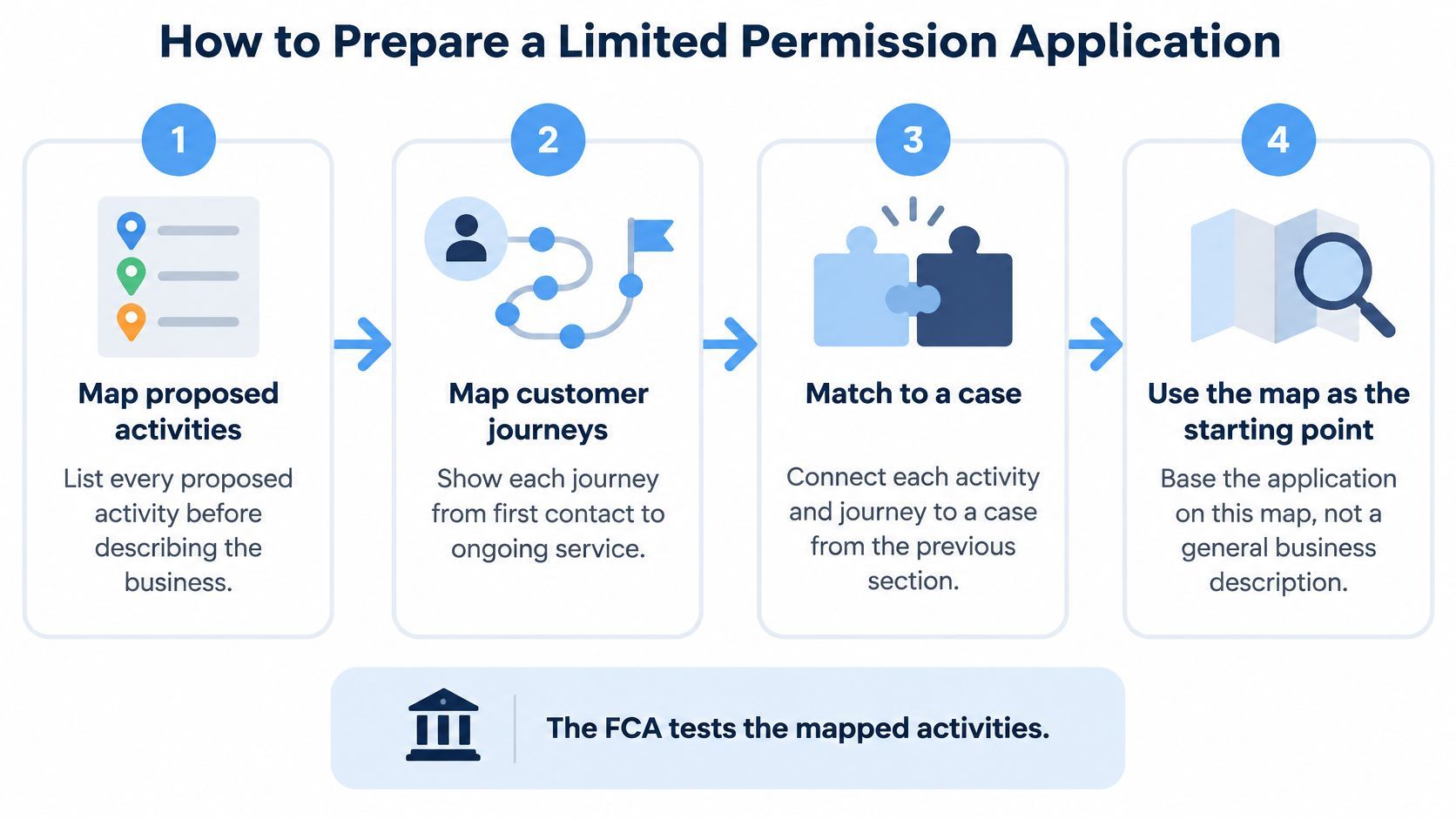
The diagram below shows how the scoping work has to precede drafting so the application rests on mapped activities rather than broad marketing descriptions.
Work through these eight preparation steps in sequence before submitting anything to the regulator:
- Map every proposed activity and customer journey to a qualifying case. Start with a granular inventory of products, channels, and handovers rather than a general company overview, because the FCA tests regulated activities, not how you describe your brand. Common slip: writing a broad retailer or service-provider narrative that contradicts what happens on the checkout screen or sales floor.
- Verify that credit broking isn't the core trade and that your strategy fits. Stress-test your commercial model over the medium term so growth targets don't push credit income past your primary revenue stream. Common slip: presenting an aggressive three-year expansion plan where finance commissions overtake core sales.
- Draft the regulatory business plan with aligned client forecasts. Build a structured FCA regulatory business plan that sets out expected client numbers at authorisation and after the first full year of trading alongside your operational model. Common slip: dropping optimistic volume projections into the narrative that clash with the revenue and staffing lines in the financial model.
- Compile complete previous-regulation disclosures. Pull together full records of any prior regulation covering the firm or relevant principals, including the regulator's name, full address, and regulatory identification number. Common slip: omitting a historic licence or supervisory record tied to a group entity or earlier venture.
- Confirm solvency using reconciled financial figures. Back your solvency confirmation with verifiable balance-sheet and cash-flow numbers showing the business can meet its liabilities as they fall due. Common slip: entering rounded management estimates with no clear audit trail back to management accounts or bank statements.
- Verify regular reporting capability before submission. Confirm that your team has the systems, data fields, and named owners ready to submit regular regulatory returns through the FCA's reporting system (RegData) from day one. Common slip: treating regulatory reporting as a box to figure out after approval arrives.
- Gather and disclose complaints, litigation, investigations, and governance history early. Audit customer disputes, legal claims, regulatory inquiries, and board or controller track records up front and address any sensitive points with a clean factual narrative. Common slip: holding back a minor dispute or past inquiry until a case officer uncovers it and asks why it was left out.
- Maintain a controlled evidence register. Link every financial forecast, policy, responsible individual, and claimed limited-permission activity in one central tracker, clearly tagging what is already operational versus what is "to be established" ahead of launch. Common slip: attaching freshly downloaded policy templates as proof of live controls when nobody in the business has tested or run them yet.
Keeping Scope and Evidence Aligned Before Filing
One nuance trips up otherwise capable teams: knowing the difference between a binding rule, formal guidance, and a supervisory expectation on day-one readiness. The FCA accepts that certain commercial steps, such as activating a live lender feed, may sit as "to be established" until permission is granted. Core governance, financial soundness, disclosure accuracy, and reporting readiness don't fall into that bucket; they must be real and verifiable when you submit.
Preparation check: If an assessor asked to see the exact spreadsheet behind your solvency confirmation or the workflow showing how a complaint escalates, could your team send it within an hour without rewriting anything?
Getting that foundation right is why the first step of our authorisation service at Glentorion is to examine a client's planned activities, jurisdiction, existing material, and open questions, then agree the exact work, deliverables, and responsibilities before drafting begins. Sorting scope and cross-document consistency early stops minor gaps from multiplying across forms, forecasts, and policies.
How Long Assessment Takes and What Slows It Down
Founders often bundle internal drafting time and regulator review time into one blurry estimate. They're two completely separate clocks. Preparation time sits entirely under your control, while assessment time starts only once a submission reaches the FCA and passes initial completeness checks.
The timeline below separates applicant-controlled preparation from the statutory framework once an application is lodged.
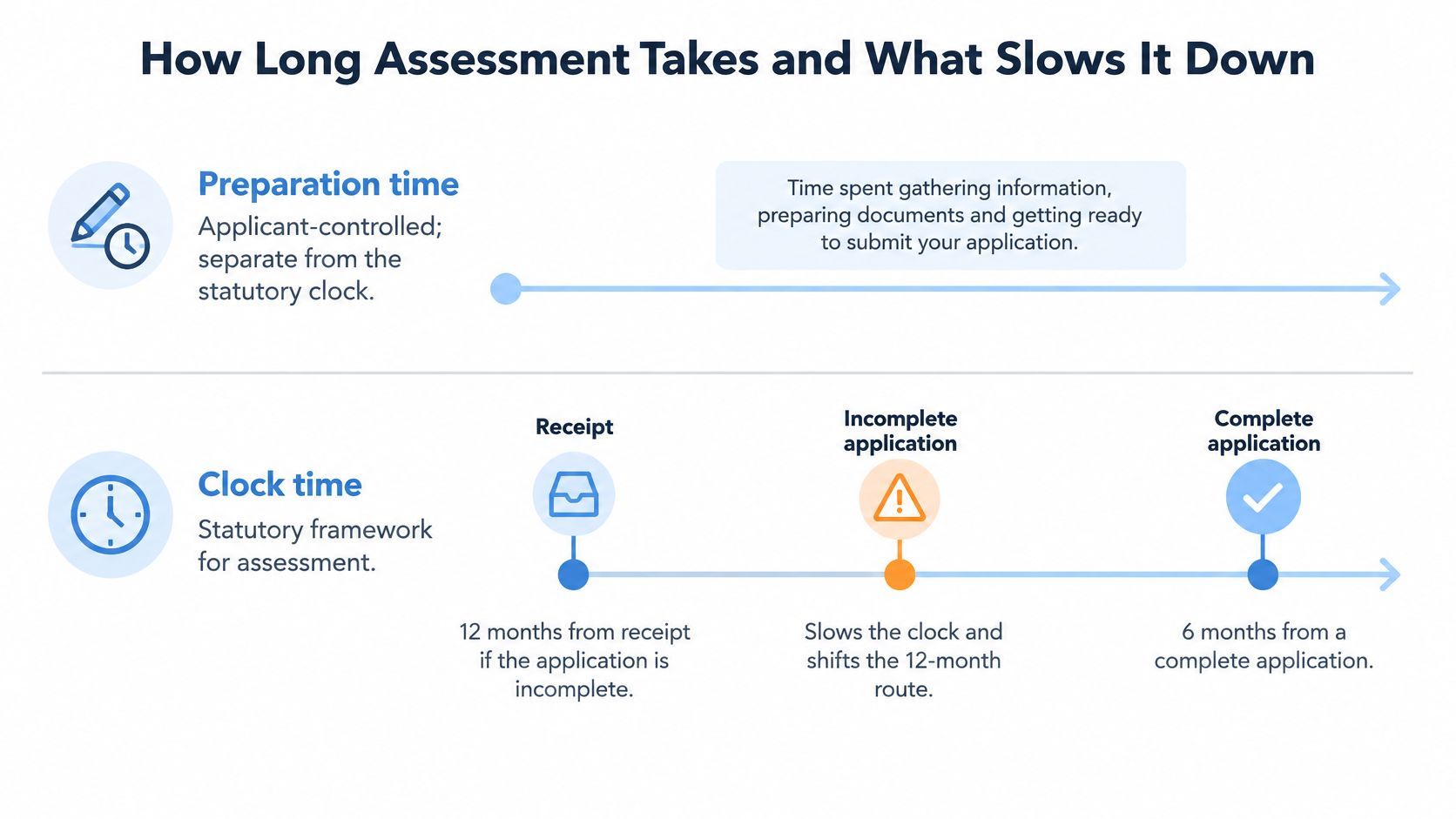
Public FCA materials frame assessment timing in two distinct ways, and compliance teams need to understand both before committing to a commercial launch date. Under the FCA's authorisation application guidance, the statutory outer framework allows determination within six months of a complete application, or 12 months from receipt where an application is incomplete, whichever is earlier. Historical FCA consumer-credit data also once reported an average of around eight weeks for limited-permission cases, compared with nearly 20 weeks for full-permission cases, though that figure is a past operational benchmark rather than a guaranteed service level.
At the same time, the FCA Authorisations Operating Service Metrics for 2025/26 Q2 explicitly state that processing a complete application for Part 4A permission has no statutory deadline, measuring performance instead against internal FCA operating targets. In that reported period, limited permission in Credit and Lending posted a 100% result against the relevant service metric, with 98 applications received and 124 determined. Headline service performance can still coexist with real applicant uncertainty, because hitting an aggregate target doesn't promise any individual firm a decision within a fixed number of days. Always verify the current FCA position before setting investor or product milestones, because regulatory decisions remain with the relevant authority and approval and decision dates aren't guaranteed.
The Assessment Stages and What Triggers Follow-Up Questions
Understanding the sequence of the FCA application process helps teams see where weeks disappear. An application moves through five distinct stages: internal preparation, submission and completeness check, detailed case-officer assessment, one or more clarification cycles, and final determination.
Limited permission shortens assessment complexity only when the initial filing is complete, internally consistent, and backed by primary evidence. Unresolved gaps push the file straight into clarification cycles, wiping out the speed advantage of a narrower permission scope. Six recurring issues generate most regulator follow-up questions:
- Unclear Business-Model Boundaries: Ambiguous wording around whether broking is incidental, how sales channels operate, or where unregulated services stop.
- Weak Financial Assumptions: Client forecasts at authorisation and after 12 months that don't tie neatly to staffing, cash runway, or solvency figures.
- Incomplete Complaints History: Omitting or downplaying material customer complaints, dispute trends, or root-cause fixes.
- Governance Gaps: Unclear allocation of senior oversight, missing escalation routes, or key controls assigned to people without the capacity to run them.
- Controller Complexities: Unmapped ownership chains, overseas holding structures, or missing background disclosures on significant shareholders.
- Unresolved Legal or Regulatory Matters: Pending litigation, past supervisory inquiries, or open investigations left unexplained in the core narrative.
Before pressing submit, run a two-question readiness test: can you evidence every claim in the form today, and could your team answer a case officer's follow-up question without a last-minute scramble for documents?
When Limited Permission Needs Rethinking After Launch
Treating authorisation as a finish line is the biggest strategic mistake UK credit firms make. Permissions often need variation as business models evolve, and the regulator's own filing activity shows how frequently firms outgrow the scope they started with. As the FCA limited permission application form makes clear through its detailed scrutiny of activities, interim permission, financial position, complaints, litigation, investigations, and governance history, the regulator is testing whether your controls fit live operational risks, not whether a box was ticked two years ago.
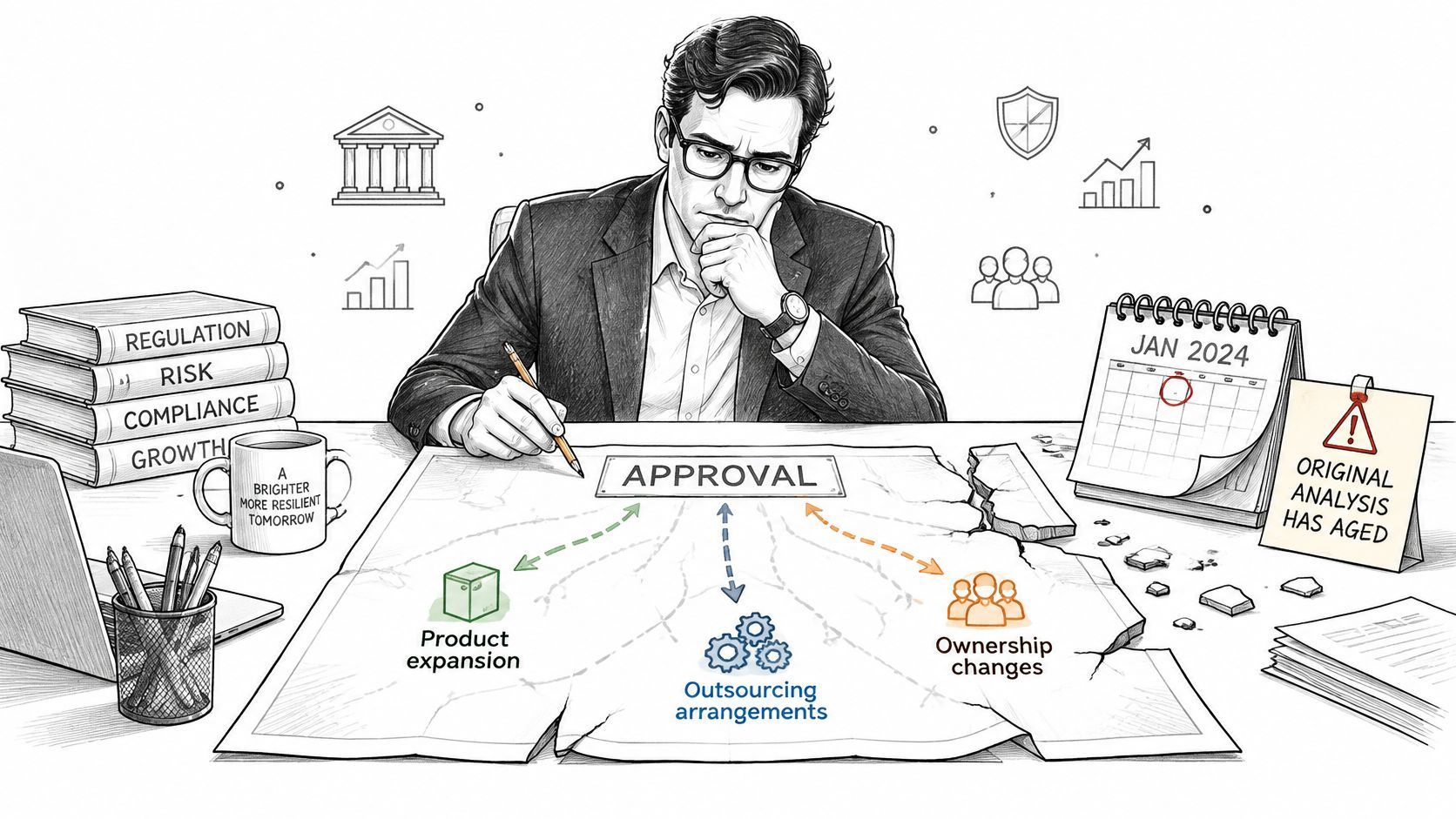
Consider how quickly a valid permission expires in practice. Suppose a home-improvement retailer holds limited permission for showroom credit broking. Eighteen months after launch, the commercial team adds an in-house finance product or equips regional sales reps to close finance-backed orders inside customers' homes. Both moves break the cumulative category test. Updating an internal compliance manual won't fix that breach; the firm needs an FCA variation of permission before rolling out the new model.
Five commercial shifts routinely invalidate an original limited-permission analysis: product expansion into lending, debt work, or different agreement types; outsourcing arrangements that hand regulated customer interactions or operational controls to third parties; ownership changes that alter controllers, group links, or strategic direction; complaints trends that expose poor customer outcomes or mis-selling risks; and new customer segments that change vulnerability profiles or sales channels.
None of these triggers arrives with a warning label. Each one looks like ordinary commercial progress, which is exactly why eligibility needs re-testing rather than assuming yesterday's analysis still holds.
Running a Pre-Change Permission Review
Build a mandatory compliance gate into your commercial roadmap so no new product launch, outsourcing contract, or ownership change goes live before your permission is re-tested. Keep the review tight and repeatable:
- Re-run the activity map against every eligibility test. Check the proposed change against both the cumulative own-goods conditions and the secondary-broking criteria to see if any single limb breaks.
- Audit the evidence register against live operations. Confirm that items previously tagged "to be established" are functioning properly and that existing controls, reporting fields, and Consumer Duty monitoring still cover the updated customer journey.
- Confirm the permission position before launch. Document a formal sign-off confirming either that the change sits cleanly inside current permissions or that a variation of permission must be submitted and granted before the commercial shift goes live.
The discipline here is sequencing. A variation submitted after a product has already launched leaves the firm trading outside its permissions in the gap, which creates a far harder conversation with the regulator than a pause in the launch calendar ever would.
Three Recurring Review Points After Authorisation
Commercial drift doesn't always arrive as a major product launch; sometimes it creeps in through small channel tweaks or vendor add-ons. Assign a named senior owner to review three core areas on a fixed calendar cycle:
- New Activities and Revenue Mix: Check quarterly whether any new sales channel, fee stream, or finance option has shifted credit broking closer to becoming the primary business or introduced excluded activities.
- New Customer Groups: Review twice a year whether marketing or channel expansion has brought in domestic-premises buyers, different borrower demographics, or higher-vulnerability segments requiring stronger controls.
- New Third Parties and Lenders: Review every newly onboarded lender, broker, technology platform, or outsourced service provider against your documented journey map, commission disclosures, and operational-resilience oversight.
The cadence matters less than the ownership. When one accountable person carries the review diary and the authority to block a launch, permission re-testing becomes a routine cost of commercial growth instead of an emergency discovered during a supervisory visit.
Confirm Your Permission Route Before You Apply
Limited permission is not a fixed status you win once. It is a position your business model has to keep earning, because eligibility turns on what you do rather than the label you apply. The decision rule before filing is straightforward. Pursue FCA limited permission only if every proposed activity maps cleanly to a qualifying limited case, every claim in your submission can be evidenced right now, and your firm can operate controls and submit regulatory returns from day one. If even one revenue stream, sales channel, or credit feature points toward full authorisation, plan for full permission from the outset instead of stretching a limited application that stalls or triggers an early variation.
Four actions, in order, before opening any FCA form:
- Write the complete activity map covering every product, sales channel, fee flow, and customer journey.
- Run the cumulative and secondary tests line by line against each entry in that map, so a marginal revenue stream is caught by the cumulative effect rather than waved through on its own.
- List every evidence gap, separating missing financial or governance records from pre-launch operational setups, since the first kind blocks submission and the second kind only needs a credible delivery plan.
- Flag any activity pointing to full permission, plus any cross-border or payment-rail touchpoints that sit alongside your credit flow. Firms whose customer journeys involve cross-border funds or multi-currency payouts should also review international money transfer regulations so adjacent payment obligations are understood before the route is fixed.
Authorisation decisions remain with the relevant regulator, and approval dates are not guaranteed, so build your commercial timetable around the regulator's current position rather than optimistic assumptions. Where activities sit close to a regulatory boundary, a specialist scoping review before filing prevents months of rework. Glentorion's Head of Market Structure & Regulation, Rosie Murphy Williams, brings deep expertise across FCA, MAS, and DFSA regulatory frameworks, helping teams test perimeter edges accurately before committing to a route.
Answer one practical question with your team this week: looking at how you plan to sell and grow over the next year, which of your activities would the FCA test as limited, and which as full? Write the answer down. When products, outsourcing, customer segments, or ownership change, test it again, because the route that fits today only stays valid while the business model underneath it stays the same.
Glentorion helps UK financial and crypto firms scope the right FCA authorisation route, assemble consistent application packages and financial projections, manage variations of permission as business models evolve, and prepare senior teams for regulator interviews. By pairing experienced regulatory consultants with structured cross-document review and change tracking, the team surfaces perimeter and evidence gaps before your submission reaches the FCA. Explore how the team supports authorisation and variation readiness at Glentorion.
- FCA limited permission
- limited permission
- consumer credit authorisation
- FCA authorisation
- Part 4A permission