Business Plan Risk Analysis for FCA Authorisation
Published
The most popular advice on business plan risk analysis is to list your risks, colour them red, amber or green, and move on. That advice will not survive FCA review. A reviewer doesn't need a prettier list, they need to trace each risk to a permission, a named owner, a control that operates, and evidence they can test.
Good Business Plan Risk Analysis is therefore not a SWOT slide with softer wording. It's a scored, owned and dated register, plus a cash runway test that checks whether your commercial launch date and your permission date are the same date. If those two timetables disagree, your forecast is fiction, however tidy the spreadsheet looks.
Table of Contents
- Why Regulators Reject Weak Risk Analysis
- Scoring Likelihood and Impact Consistently
- How to Run the Seven-Step Risk Analysis
- Building a Risk Register Regulators Can Trace
- Stress-Testing Cash Runway and Permission Timing
- Checking Consistency Across Every Document
- Presenting the Analysis in the Business Plan
- Confirm the Analysis Before You Submit
Why Regulators Reject Weak Risk Analysis
The FCA's guidance on asset management applications reports that applicants commonly fail to identify risks arising from their business model or adequately evidence how those risks will be removed or mitigated. The same guidance notes that the FCA determined 310 UK asset management applications between April 2023 and April 2024 and 18% were withdrawn or rejected. Poor-quality information was among the stated issues.
That failure matters beyond launch. The Office for National Statistics business demography bulletin reported that 38.4% of UK businesses born in 2019 survived to 2024, meaning 61.6% did not remain active for the full five-year period. Authorisation is a starting line, not proof of viability.
The Gaps Reviewers Find First
- Outsourcing impacts unexplained: The plan names a provider but doesn't say what fails if the provider fails.
- Conflicts of interest unaddressed: Affiliates, market makers or introducers appear in the model without a control.
- Senior-manager competence unevidenced: A title is listed, but no one can explain the control they own.
- Operation in practice unclear: The described firm couldn't run on the staff and systems budgeted.
Treat this as a test of the business, not a presentation exercise. Work in this order: define the permissions, map each activity to risk categories, quantify base and downside cases, assign accountable owners, specify controls, evidence them, then reconcile the whole package. That sequence also helps you test your plan against the FCA threshold conditions before a case officer does it for you.
Scoring Likelihood and Impact Consistently
Score every risk over the same plan period as your financial projections. If your forecast runs for three years, likelihood means likelihood within those three years, not someday in theory. Without that anchor, two competent people will score the same risk differently and both will claim they're right.
| Score | Likelihood over the plan period | Impact on the plan |
|---|---|---|
| 1 | Rare, would need an unusual event | Minor, absorbed within the normal budget |
| 2 | Unlikely, could occur once in several years | Low, a one-off cost or a delay of a few weeks |
| 3 | Possible, plausible within the plan period | Moderate, a missed milestone or material cost overrun |
| 4 | Likely, expected at least once in the plan period | Major, threatens a launch date or a permission condition |
| 5 | Almost certain, already visible in the evidence | Severe, threatens solvency or the permission itself |
Multiply likelihood by impact to get a score from 1 to 25. Band it consistently: 1 to 4 low, 5 to 9 medium, 10 to 15 high, and 16 to 25 critical. Don't move the bands to make an uncomfortable risk look acceptable.
A Worked Example You Can Copy
Say an outsourced custody provider might miss its service levels. You score likelihood 3 and impact 5, because customers couldn't access assets, giving 15, high. That's your inherent score, before controls.
You then add monthly service monitoring, a tested failover arrangement and a contractual step-in right. Likelihood falls to 2, impact stays at 5, so the residual score is 10, high. Notice what didn't change: the impact if it happens is still severe. Controls usually reduce likelihood or speed up detection, they rarely make a custody failure trivial.
Practical rule: A residual score is only credible if the control behind it has evidence today. A planned control earns a planned score, not a lower submitted score.
Measure impact against your own categories: harm to customers, your solvency, market integrity, and the permission itself. Refusal or a restrictive condition can cost more than a one-off financial loss because it removes the revenue line entirely. Now score five risks from your draft and write one sentence of justification for each number. If you can't write that sentence, you don't have a score, you have a guess.
How to Run the Seven-Step Risk Analysis
Run the steps in order. Skipping to controls before you've defined permissions is how firms produce polished policies for activities they're not applying to carry on.
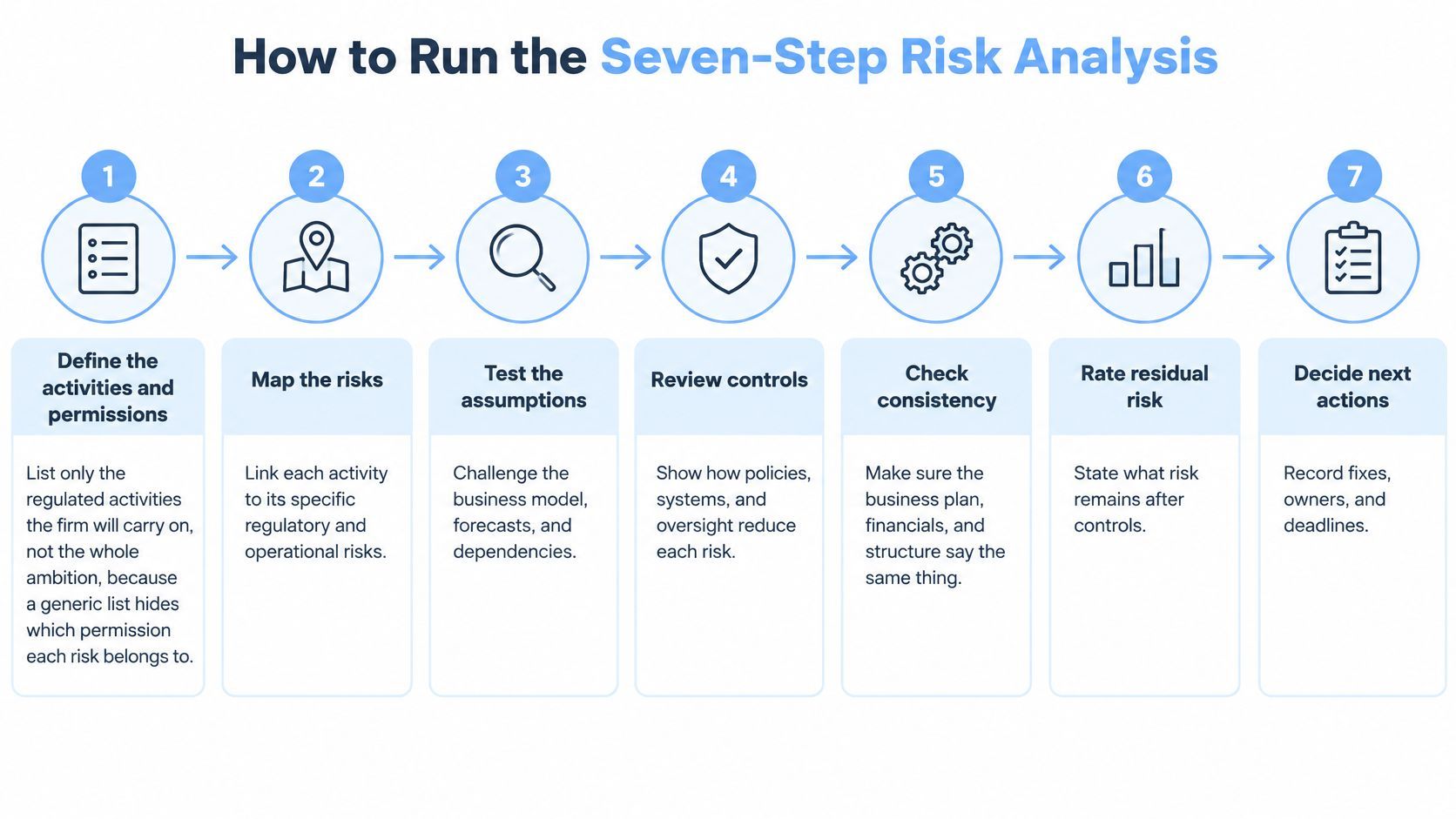
- Define the activities and permissions. List only the regulated activities you'll carry on, not your whole ambition for year five. A generic list hides which permission each risk belongs to, and a reviewer will ask you to split it anyway. The common slip is copying a competitor's permission set because it looks complete.
- Map each activity to risk categories. For every activity, work through customer, prudential, operational, outsourcing, conflicts and financial-crime risks. A structured financial crime risk assessment prevents the financial-crime column being filled with one generic money laundering line. If a category doesn't apply, write why rather than leaving it blank.
- Quantify base-case and downside assumptions. Put numbers on customer take-up, pricing, staffing and operating costs for each material risk, over the same period as your projections. The slip is a downside case that trims revenue slightly but leaves costs and launch dates untouched.
- Assign an accountable senior manager. Name a person, not a team, a committee or an outsourced provider. That person must be able to explain the risk in interview without reading the policy aloud. If the owner is still to be hired, say so and date the hire.
- Specify preventive and detective controls. Preventive controls stop the risk occurring, such as blocking onboarding until checks pass. Detective controls reveal it early, such as exception reports or sample file testing. Most material risks need both, because prevention always leaks.
Evidence and Reconciliation Close the Loop
- Evidence that each control operates. Point to a policy, a log, a test result or a signed record. Mark anything not yet built as planned, with an owner and date, rather than describing it in the present tense. Reviewers spot aspirational present tense quickly.
- Reconcile across the application. Check the analysis against your business plan, policies, financial projections and likely interview answers. If the register says compliance monitoring is weekly but the forecast funds one part-time officer, one of those documents is wrong.
You're finished when each risk has a row a reviewer can follow from activity to evidence without asking a question. If they still need to ask who owns it, what triggers action, or where the proof sits, the analysis isn't done yet.
Building a Risk Register Regulators Can Trace
Your register is the document a regulator will test everything else against. Each row needs a risk statement, its category, one accountable owner, the trigger showing the risk is materialising, the control, the residual score, the evidence source, and the documents it affects. Missing any one element breaks the chain.
| Risk category | Example risk | Accountable owner | Control | Evidence |
|---|---|---|---|---|
| Customer | Retail customers onboarded without suitability checks | Head of Customer Operations | Mandatory suitability questionnaire before first transaction | Questionnaire completion log and sample file review |
| Outsourcing | Custody provider misses service levels | Chief Operating Officer | Service-level monitoring with step-in rights | Monthly service report and tested failover |
| Conflicts | Affiliated market maker receives preferential pricing | Compliance Officer | Conflicts policy and best-execution monitoring | Conflicts register and pricing review log |
| Financial crime | High-risk customers onboarded without enhanced checks | MLRO | Risk-based onboarding triggers and sanctions screening | Screening logs and quarterly sample testing |
| Prudential | Capital falls below requirement after a launch cost overrun | CFO | Monthly capital forecast with a defined buffer | Signed forecast and buffer breach report |
These rows work because they're specific enough to challenge. "Operational risk" isn't a risk statement. "Custody provider misses service levels and customers cannot withdraw" is, because it names the event and the harm.
Slips That Make a Row Fail Review
- Provider named as owner: An outsourced firm can't be accountable for your permission, and a committee can't be interviewed.
- Unwritten policy cited as evidence: Mark it to be established, with a completion date, or the row misleads.
- Control without a trigger: If nobody knows what tells them the risk is happening, monitoring won't happen.
Use the affected-document column seriously. A custody failure sits in your business plan, your outsourcing description and your financial resilience assumptions, so one change must update all three. Understanding what counts as evidence helps you separate a real artefact from a statement of intent.
Build five rows now, starting with your highest inherent scores. Then ask each owner to explain their control in one minute. Anyone who can't isn't ready, whatever the register says.
Stress-Testing Cash Runway and Permission Timing
Timing is the risk most crypto business plans understate. The FCA's cryptoasset regime policy statement sets the application window for firms seeking to rely on the regime's savings provisions from 30 September 2026 to 28 February 2027, with the expanded regime expected to come into force on 25 October 2027. The regime is expected to cover cryptoasset trading platforms, intermediaries, custody, stablecoin issuance and arranging staking, with financial-resilience requirements including capital and stress testing.
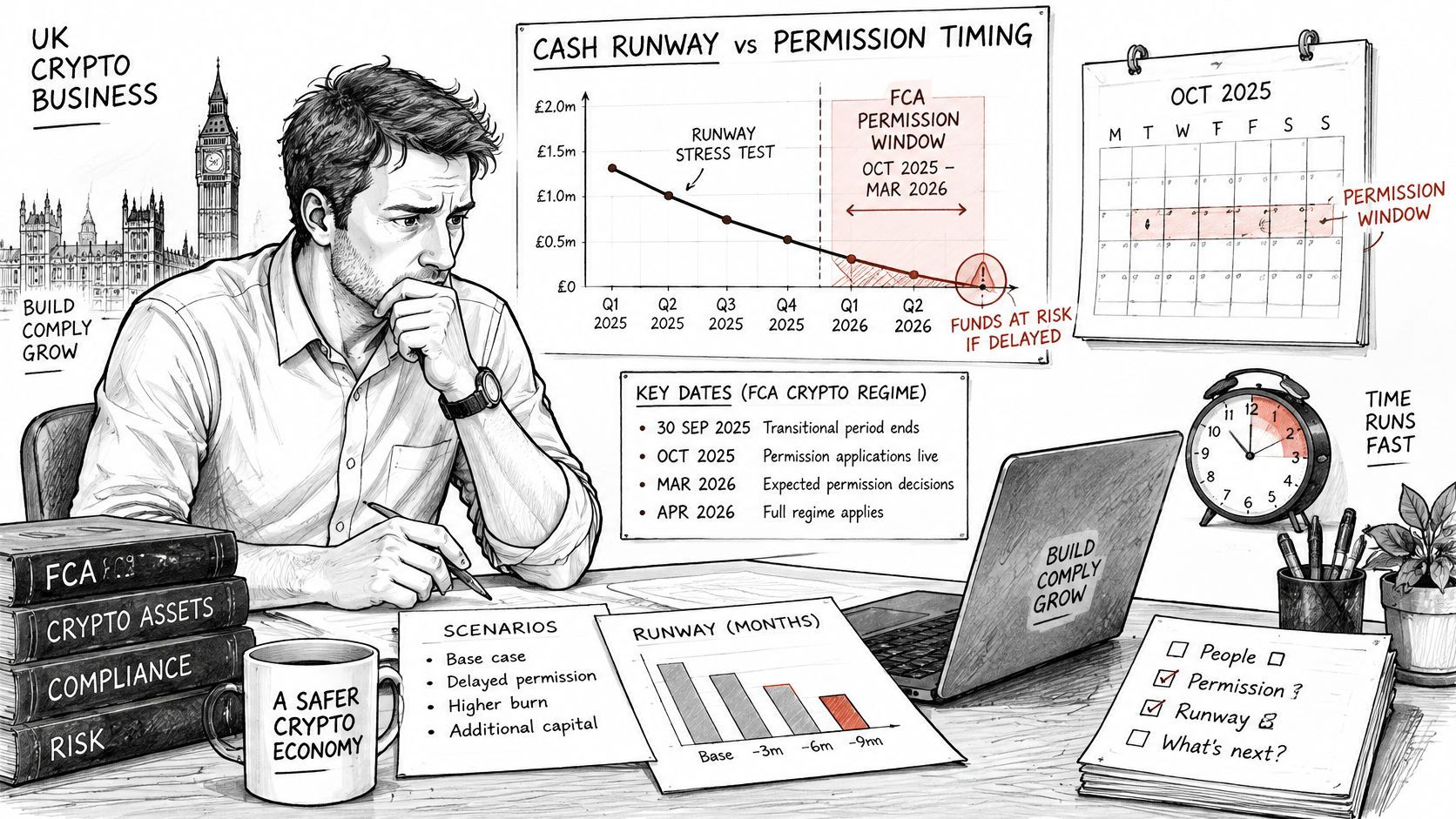
Existing MLR registration isn't equivalent to future authorisation, so your plan needs a dated transition strategy. A commercial plan can be correct in every line and still fail if the permission arrives later than the revenue. I would model permission timing before modelling growth.
| Scenario | Assumption changed | What to check in the cash forecast | Trigger for action |
|---|---|---|---|
| Base case | Permission granted by the planned launch | Revenue and staffing start on the modelled dates | Launch date confirmed against the authorisation timetable |
| Prolonged review | Decision arrives after the planned launch | Costs continue while permitted-activity revenue is deferred | Cash runway falls below the agreed threshold |
| Partial refusal | One activity is refused or needs a variation | Revenue lines tied to that activity are removed or paused | Onboarding paused for the affected customer group |
| Severe downside | Delay, cost overrun and weaker take-up together | Liquidity, capital and staffing under combined stress | Capital or liquidity falls below the minimum set in the plan |
Link Every Revenue Line to a Legal Route
For each scenario, connect every revenue line to the permission or exemption that makes it lawful, then find the month cash crosses the threshold your board has agreed. If you need a practical forecasting cadence, striveX's guide to weekly cash forecasting shows how to keep that view current rather than rebuilding it quarterly. Separate temporary revenue volatility, which you manage with cost discipline, from risks that threaten solvency, which need capital action or a paused launch.
The key risk is often not refusal. It's a timing mismatch between your launch plan and the regulator's permission timeline.
Name the month your runway crosses the board threshold under the prolonged-review case. Then write down the action you'd take that month, who decides, and what you'd stop spending on.
Checking Consistency Across Every Document
A risk analysis fails when individually reasonable documents contradict one another. Say your business plan describes the founder as responsible for compliance, while your outsourcing schedule assigns that function to a provider. Both read plausibly alone. Together they tell a reviewer that nobody owns the control.
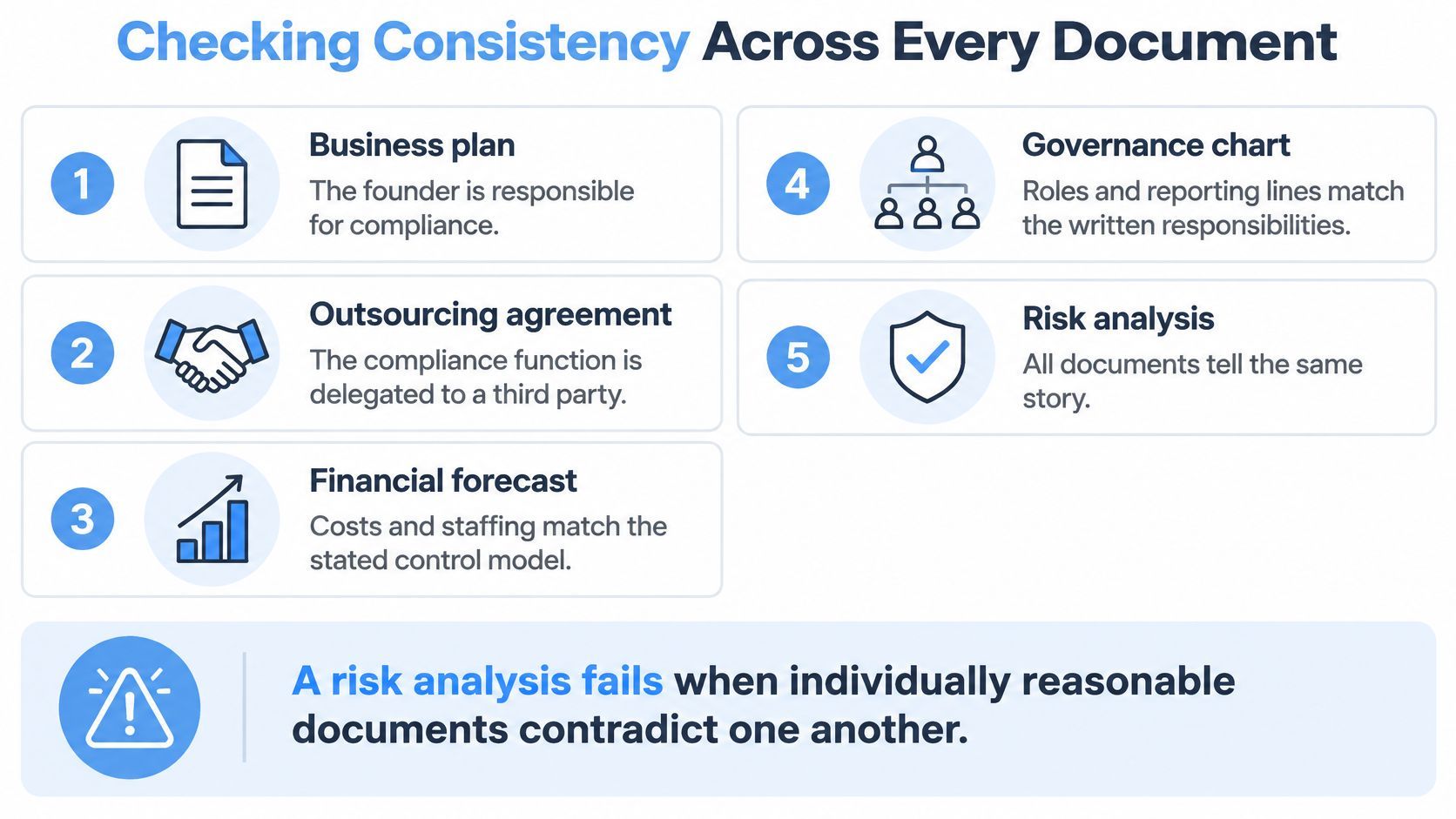
List every document that describes risk, controls or responsibilities: the business plan, financial model, policies, governance chart and interview briefing. For each critical assumption, check evidence quality, accountable owner, affected documents, and the change that would alter it. In our second step we bring the business plan, financial information, policies and application answers together, review the documents, resolve findings and revisit affected material when facts change. We also identify the evidence still needed, the questions to be resolved and the decisions requiring further client involvement, so gaps stay visible.
Three Questions That Expose Weak Ownership
- Who performs the control: Can the named person describe the actual steps, not just the policy title?
- What happens when it fails: Can they name the escalation route, the back-up arrangement and the customer impact?
- What exists now: Can they separate operating arrangements from planned ones without hesitating?
For multi-jurisdiction firms, one change to custody, outsourcing, governance or customer scope can touch several submissions at once. Set a hard rule that any such change triggers a full impact review before drafting continues.
Ten-Point Check for This Week
Record an owner and date against every failure.
- Individual owner named: Every risk names one individual who can explain its control.
- Operating or planned marked: Every control is marked as operating or planned, with a date for each planned control.
- Responsibilities matched: Every named responsibility matches the governance chart and outsourcing schedule.
- Revenue linked to permission: Every revenue line links to a legal route and a permission.
- Same plan period used: Every financial assumption uses the same plan period as the risk scores.
- Change triggers review: Every change to custody, outsourcing, customer scope or jurisdiction triggers a full impact review.
- Launch date checked: The launch date is checked against the authorisation timetable.
- Threshold month shown: The downside case shows the month cash crosses the agreed threshold.
- Impact tolerance stated: Each important business service has a stated impact tolerance.
- Corrections tracked: Each finding names the documents it corrects and the person responsible for the correction.
Presenting the Analysis in the Business Plan
Place the risk analysis as a distinct section after your permissions and activity description, and before the financial projections. The reviewer should meet your risk logic before your numbers, so the numbers read as the consequence of that logic. Burying risk at the back signals it was written last.
Open with a one-page summary of your ten highest residual risks, each with its band, owner, and the plan section where it's evidenced. Attach the full register as a numbered appendix, so every projection line and policy can cite the risk it depends on. If you're still shaping the wider plan, business advisory and planning support can help with general plan structure, but the regulatory risk logic must be built for the permission you're seeking.
Show the Scenarios Beside the Numbers
Include your cash runway results side by side: base, prolonged review, partial refusal and severe downside, with the threshold month in each. Pairing this with a business plan SWOT analysis is useful only if the weaknesses and threats feed scored register rows rather than sitting as commentary.
If you're in scope of operational resilience requirements, add a table of important business services with an impact tolerance for each, meaning the maximum tolerable disruption before intolerable harm is caused to consumers, firms or markets. The FCA operational resilience expectations expected in-scope firms to have mapped and tested important business services and set impact tolerances by 31 March 2025. State the capability you'll invest in to stay within each tolerance.
Close with a version and change log showing which risks were rescored and which documents changed. That log proves the analysis was maintained rather than written once for submission.
Confirm the Analysis Before You Submit
Ask one gate question before submission: could a reviewer trace every material risk from activity to evidence today, without your help? If the answer is unclear, you're not ready, and more drafting won't fix it. Checking is cheaper than answering the same gaps under formal information requests.
Run the Submission Gate
- Row completeness: Check every register row for an owner, trigger, control, residual rating, evidence source and affected documents.
- Owner sign-off: Confirm each named owner has reviewed and accepted their row.
- Mock challenge: Run a regulator-style interview using only the exact evidence cited in the application, and record which answers stop the discussion.
- Open-items log: List each unresolved issue with evidence still needed, decision required and person responsible.
Don't bury open items in draft comments or email threads. A visible log with dates forces decisions while you still have time to act on them. It also stops one person's assumption becoming another person's submitted fact.
Remember that regulatory decisions remain with the relevant authority and approval and decision dates are not guaranteed. That's exactly why your downside case deserves the same prominence as your base case, not a footnote.
If a named owner can't explain their control in interview conditions, the row isn't ready, whatever the residual score says.
Where any check is unclear, the next step is a scoping conversation with the people who can confirm permissions and timetable. Our Discovery Call covers the activity and market you want to enter, your current stage and available material, the questions holding preparation back, and the scope of professional help needed.
End with one decision only: the draft is ready for review, or it needs another pass on ownership, evidence or timing. Record a named owner and date for that pass.
If your register still has rows without a named owner, evidence that doesn't exist yet, or a launch date that assumes permission arrives on request, Glentorion can help you rebuild that analysis into a traceable, interview-ready application package. We review business plans, financial assumptions and controls together so every document describes the same operating firm. Visit Glentorion to scope your route, timetable and evidence gaps before you submit.
- business plan risk analysis
- regulatory authorisation
- risk register
- stress testing
- FCA authorisation