E-commerce Payment System Explained for UK Merchants
Published
88% of money lost to in-scope authorised push-payment scams was returned to victims during the first ten months of the UK reimbursement policy, according to the joint FCA and Payment Systems Regulator response on the National Payments Vision. That figure reframes an e-commerce payment system: it isn't just checkout software, but a chain of organisations with responsibilities for money, records and losses.
For a UK merchant or payments founder, the useful starting point isn't which gateway charges least. It's who controls the funds, who must resolve a failed payment, and whose regulatory permissions cover each activity.
Table of Contents
- How an E-commerce Payment Moves From Checkout to Bank
- Which Payment Methods Carry UK Online Sales
- Who Pays When Online Payments Go Wrong
- Licensing Routes for Payment Providers
- AML, KYC and Safeguarding Customer Funds
- Integration Checklist and Decision Before Launch
How an E-commerce Payment Moves From Checkout to Bank
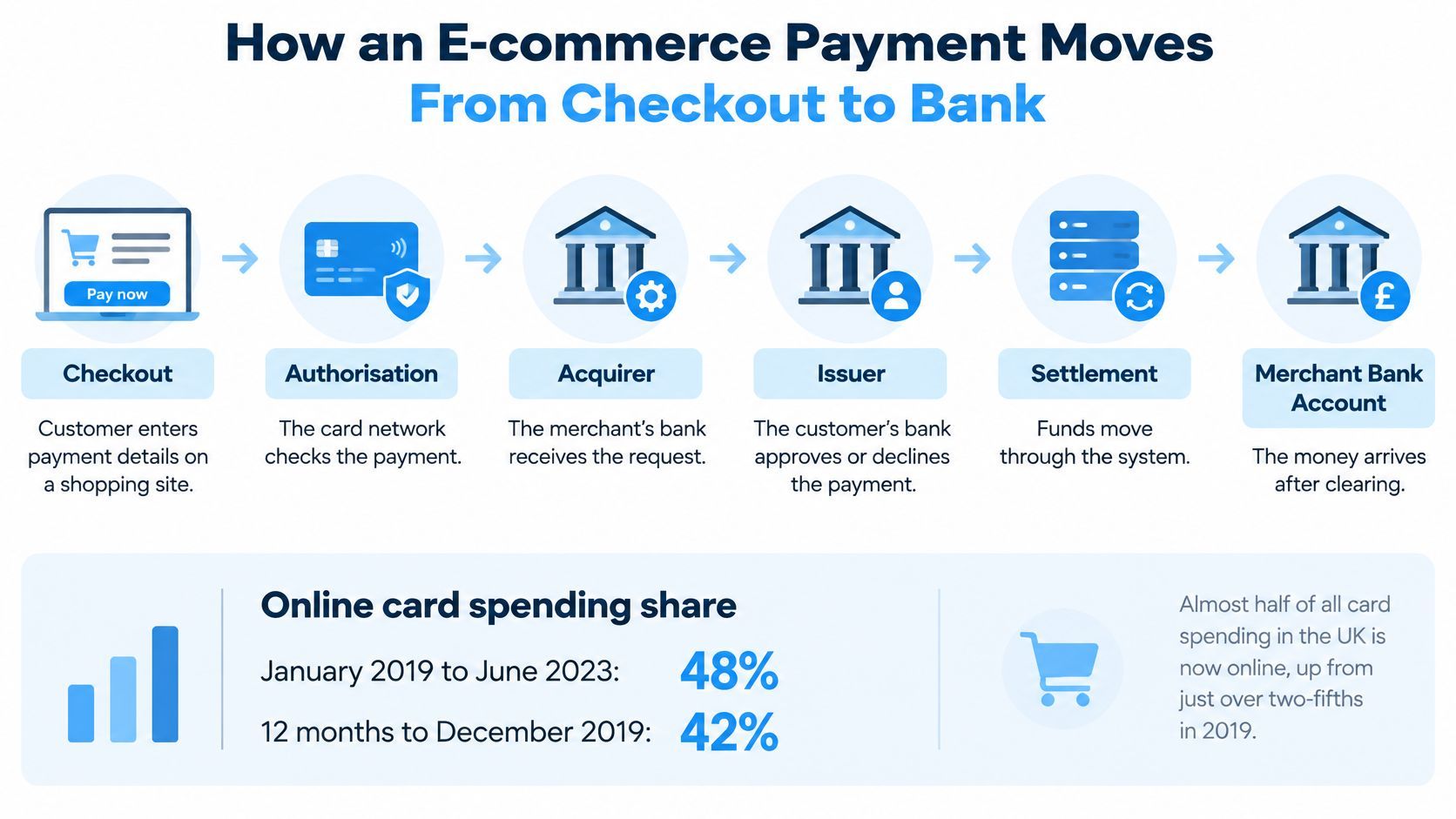
Online spending averaged 48% of total card spending between January 2019 and June 2023, compared with 42% during the twelve months ending December 2019, according to the Office for National Statistics. The ONS also makes an important distinction: e-commerce describes how someone places an order, not necessarily how they pay.
An e-commerce payment system is the set of parties, rails, records and controls that move a customer's payment from checkout to the merchant's bank account. Think of a shipping tracker: several organisations handle the same delivery, but each records a different event.
Follow the payment through its tracking events
- Checkout creates the request. The customer submits their basket and card or wallet details. The merchant connects the order reference to a payment reference.
- The gateway sends the authorisation request. It passes the request through processing infrastructure to the acquirer, card scheme and issuing bank. The gateway is a communications service, not automatically the organisation holding money.
- The issuer approves or declines. The customer's bank returns a response code, usually while the customer waits at checkout. Approval isn't evidence that the merchant has received settled funds.
- The merchant captures the payment. Capture instructs the system to collect the approved amount, often when goods are dispatched. An authorisation that isn't captured may expire.
- Settlement reaches the merchant. The acquirer pays the merchant under its contractual settlement schedule, after applicable deductions. The ledger should distinguish authorisation, capture, fees, refunds and settlement.
Parties in an e-commerce payment and their roles
| Party | Role in the payment | What it holds or records |
|---|---|---|
| Customer | Authorises the payment at checkout | Card or wallet credentials and consent |
| Merchant | Creates the order and requests payment | Order data and customer details |
| Payment gateway | Passes the payment request between checkout and processors | Transaction IDs and status history |
| Acquirer | Receives card transactions for the merchant and settles funds | Merchant account and settlement files |
| Card scheme, for example Visa or Mastercard | Routes authorisation messages between acquirer and issuer | Network rules and message logs |
| Issuing bank | Approves or declines and holds the customer's account | Account balance and authentication outcome |
| Payment or e-money institution | Holds or moves funds under regulatory authorisation | Safeguarded customer funds, where applicable, and reconciliation records |
A merchant can contract directly with an acquirer or use a payment service provider that aggregates merchants under a broader arrangement. A marketplace collecting for third-party sellers introduces another funds relationship; a gateway-only provider may never hold funds at all.
For terminology, Disputely's guide to understanding e-payment processing provides a complementary introduction. Bank transfers follow a different route from cards, making the UK Faster Payments system relevant when mapping pay-by-bank.
Practical rule: Treat each payment status like a parcel-tracking event. A dispatch notification isn't proof of delivery, and an authorisation isn't proof of settlement.
The business decisions are which methods to offer, who bears losses, and which licence or safeguarding duties apply.
Which Payment Methods Carry UK Online Sales
Digital wallets accounted for 35% of UK e-commerce transaction value in 2022, according to the government-commissioned Future of Payments Review figures reproduced in the ONS digital trade publication. The same breakdown puts credit cards at 24%, debit cards at 22%, account-to-account payments at 9%, and buy now, pay later at 8%, with cash on delivery and prepaid each at 1%.
Those are shares of transaction value, not the number of shoppers or checkout attempts. Wallets also aren't necessarily separate money rails: a card-linked wallet can present a tokenised card to the same underlying card infrastructure.
UK e-commerce transaction value by payment method, 2022
| Payment method | Share of e-commerce value | What it means for checkout |
|---|---|---|
| Digital wallets | 35% | Tokenised cards inside a wallet, fewer fields for the customer |
| Credit cards | 24% | Useful for higher-value purchases, with card dispute routes |
| Debit cards | 22% | Card network rails, funds drawn from the customer's account |
| Account-to-account, or pay-by-bank | 9% | Potentially faster settlement, different consumer protections |
| Buy now, pay later | 8% | Deferred payment, with credit-risk and affordability responsibilities |
| Cash on delivery | 1% | Collection risk and slower reconciliation |
| Prepaid | 1% | Pre-funded balances, with product-specific refund routes |
Compare protection before price
Credit cards can offer chargeback and Section 75 protection, subject to eligibility and the circumstances of the purchase. Chargeback is a scheme process, not a promise that every dispute succeeds.
Open Banking pay-by-bank doesn't reproduce card chargeback rights. Consumer-initiated variable recurring payments also shouldn't be presented as carrying equivalent card purchase protection or the Direct Debit Guarantee. A scam reimbursement claim and a dispute about undelivered goods aren't interchangeable.
A cheaper rail can lower the merchant's processing bill while leaving the customer with a less familiar dispute route.
The decision rule is to support methods covering your expected sales first, then add alternatives where a defined customer need or operational case justifies them. Open Banking payments reached approximately 31 million transactions in March 2025 and grew 67% year on year, according to Open Banking Limited's impact report, but that broader payment activity isn't a measure of retail checkout adoption alone.
A practical shortlist might be:
- Cards and card-linked wallets first. Cover familiar purchasing habits and established dispute processes.
- Pay-by-bank selectively. Test settlement benefits alongside refund handling and customer disclosures.
- BNPL for a defined use case. Allocate lending, affordability, complaints and integration responsibilities explicitly.
- Cash on delivery or prepaid only with a customer case. Don't build an integration solely to complete a menu.
Tagada's explanation of checkout payment choices can help frame the customer-facing comparison. For cross-border bank-payment propositions, assess the account arrangements separately, including what a SEPA bank account does and doesn't provide.
Who Pays When Online Payments Go Wrong
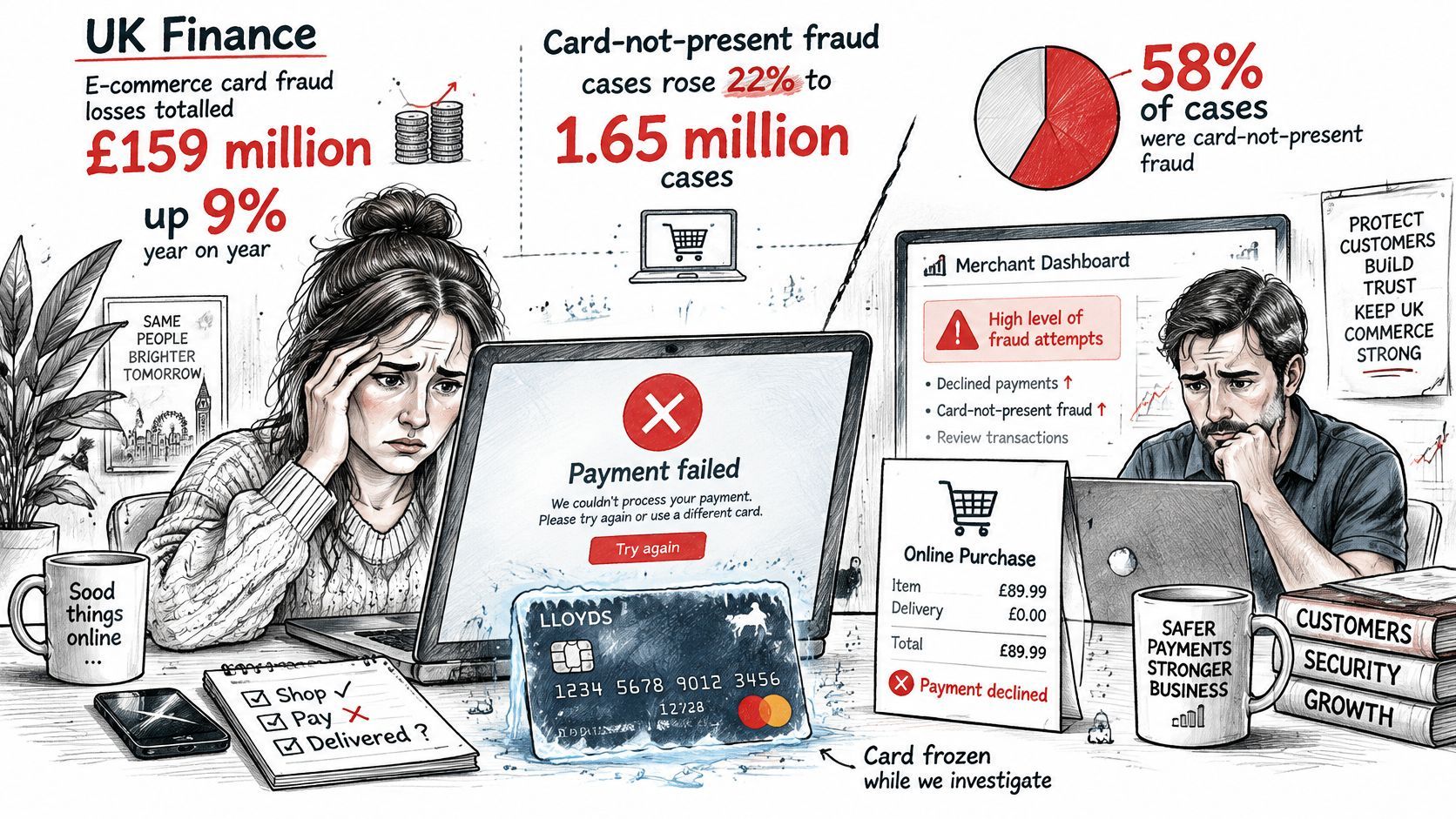
A high approval rate doesn't prove that checkout is secure. In the first half of 2025, e-commerce card fraud losses reached £159 million, up 9% year on year, while card-not-present fraud cases rose 22% to 1.65 million, according to UK Finance's Half Year Fraud Report.
Authorisation confirms an issuer's decision at a particular moment. It doesn't certify delivery, remove every dispute right or guarantee that the merchant will retain the money.
Build controls around the whole transaction
- Risk-based 3-D Secure. Allow eligible low-risk journeys to proceed frictionlessly and challenge transactions requiring stronger authentication. Don't assume every authenticated payment produces the same liability outcome.
- Device and behavioural signals. Investigate inconsistencies between account history, device characteristics and purchasing behaviour.
- Velocity limits. Detect rapid attempts across cards, accounts or delivery addresses.
- BIN and issuer-country checks. Use the card's issuing context as a risk signal, not an automatic reason to reject overseas customers.
- Tokenisation. Reduce exposure to reusable card details.
- Post-authorisation monitoring. Review suspicious orders before fulfilment and investigate patterns that emerge after checkout.
Preserve issuer response codes and authentication outcomes in the orchestration layer. A soft decline may call for authentication, insufficient funds shouldn't trigger uncontrolled retries, and suspected fraud needs a different response from a technical timeout.
Allocate losses by the type of failure
For cards, an acquirer may debit the merchant following a valid chargeback under the applicable contract and scheme rules. Authentication can affect fraud liability, but it doesn't eliminate disputes about non-delivery or defective goods. Capture delivery evidence, cancellation communications and refund records alongside authentication evidence.
For bank transfers, the APP reimbursement requirement took effect in October 2024 for in-scope Faster Payments and CHAPS payments, with eligible losses generally reimbursed by the sending provider and costs normally shared 50:50 with the receiving provider, as explained in the FCA's review of APP fraud controls and complaint handling. Eligibility, exclusions and vulnerable-customer protections matter; this isn't a general guarantee against merchant insolvency or disappointing purchases.
The FCA's payments portfolio letter describes an intended move towards a more agile authentication framework and identifies tokenisation and dynamic security codes as ways to reduce fraud without necessarily adding another customer step. That's regulatory direction, not permission to disregard existing authentication requirements.
Assign named owners for fraud rules, model changes, investigations and reimbursement decisions. Segment approval rates and losses by channel, device, method, authentication path and false positives. Otherwise, increased approvals can conceal increased losses, while aggressive blocking can hide lost legitimate sales.
Licensing Routes for Payment Providers
Does money pass through an account your business controls? That question is a useful starting point, but it isn't the complete licensing test. Payment initiation can be regulated without the provider ever possessing customer funds.
The legal analysis concerns the activity performed, the contracts and the exclusions available. A product called a gateway can provide only technical messaging, or sit inside a wider service involving merchant acquiring and money movement.
Likely UK licensing route by business role
| Business role | Likely UK status | Key rules | Practical note |
|---|---|---|---|
| Merchant selling its own goods | Usually no payment licence for receiving its own sales proceeds | Consumer and card scheme rules | Use a regulated acquirer or PSP |
| Gateway or technical provider that never holds funds | Often outside authorisation where the technical-service exclusion applies | PCI DSS and applicable outsourcing expectations | Confirm the exclusion's scope with counsel |
| Marketplace collecting funds for sellers | Often needs authorisation or a regulated partner | Payment-services perimeter, exclusions and safeguarding where applicable | Map the flow before launch |
| Authorised payment institution | Authorised to provide specified payment services | Capital, safeguarding, governance and Consumer Duty where applicable | Check the FCA Register and permissions |
| E-money institution | Authorised or registered under the applicable e-money route | Safeguarding of stored value and redemption rights | Relevant to qualifying wallets and stored balances |
The Payment Services Regulations 2017 and Electronic Money Regulations 2011 provide the core UK frameworks for these distinctions. Issuing electronically stored monetary value can raise an e-money question; accepting payment for your own goods isn't the same business activity.
Test the activity, not the label
- Map every flow from customer to seller. Include refunds, reserves, split payments, commissions and failed payouts.
- Mark each point of control. Identify the account holder, beneficial entitlement, instruction rights and any period when funds await onward transfer.
- Check exclusions against actual conduct. A technical-service or commercial-agent argument needs to match the contractual and operational arrangement, not a marketing description.
- Record the conclusion. Keep the legal reasoning, assumptions and conditions that would trigger reassessment.
Say a marketplace initially directs customers to a seller's own payment page. If it later collects customer money into its own account and pays sellers after delivery, that change requires a fresh perimeter assessment. An existing software integration doesn't settle the regulatory question.
Boundary check: A regulated partner's permissions don't automatically cover every activity your business performs.
An authorised payment institution must remain within its permitted services, and a marketplace must understand which activities its partner undertakes. Before signing, check the partner's legal entity, status, relevant permissions and restrictions on the FCA Register, then reconcile those details with the contract.
AML, KYC and Safeguarding Customer Funds
A payment firm needs to understand who its customers are, who controls them and whether their transactions make sense. Under the Money Laundering Regulations 2017, that means a business-wide risk assessment, appropriate customer due diligence, ongoing monitoring and records that support decisions. Sanctions screening is a related control under the applicable sanctions framework, not a substitute for those checks.
For merchant onboarding, collecting a company name and registration document isn't enough. The payment firm needs to identify the people behind the seller, understand its business and assess whether expected payments match the goods, services and markets described.
Make onboarding evidence usable
- Identify ownership and control. Record beneficial owners and the people authorised to act for the merchant.
- Understand the proposition. Examine the website, products, delivery model and expected customer locations.
- Monitor against expectations. Investigate unexplained changes in transaction patterns, refunds, beneficiary accounts or business activity.
- Retain decision evidence. Keep risk assessments, verification results, escalation records and approvals accessible to the responsible team.
These checks also help identify a compromised merchant account or a seller receiving money for a different business from the one approved. Define when staff must pause onboarding, restrict activity or escalate concerns.
Safeguarding is an operating arrangement
The FCA's safeguarding policy statement sets 7 May 2026 as the start date for the supplementary regime covering authorised payment institutions, authorised and small e-money institutions, and UK credit unions issuing e-money, while excluding payment institutions solely providing payment-initiation or account-information services.
The operational objective is to make relevant customer funds identifiable and protected if the firm fails. It isn't enough to describe an account as safeguarded in a policy.
- Reconcile customer funds daily. Investigate and resolve differences between the internal ledger and external account records.
- Document the protection arrangement. Maintain compliant segregation or an eligible insurance or guarantee arrangement.
- Identify each customer's entitlement. Ensure the records support allocation and return of money.
- Prepare for wind-down. Test access to records, account information and the people responsible for returning funds.
Card tokenisation isn't custody of money. Replacing card numbers with tokens can reduce card-data exposure and narrow PCI DSS scope, but it doesn't itself make a merchant a custodian or remove all PCI responsibilities.
Likewise, a tokenised deposit represents a bank deposit, e-money represents a claim on its issuer under the applicable framework, and a stablecoin needs analysis of its particular legal structure and redemption arrangements. Don't treat those labels as interchangeable. An electronic money account requires a different protection analysis from a conventional bank deposit or a cryptoasset balance.
Integration Checklist and Decision Before Launch
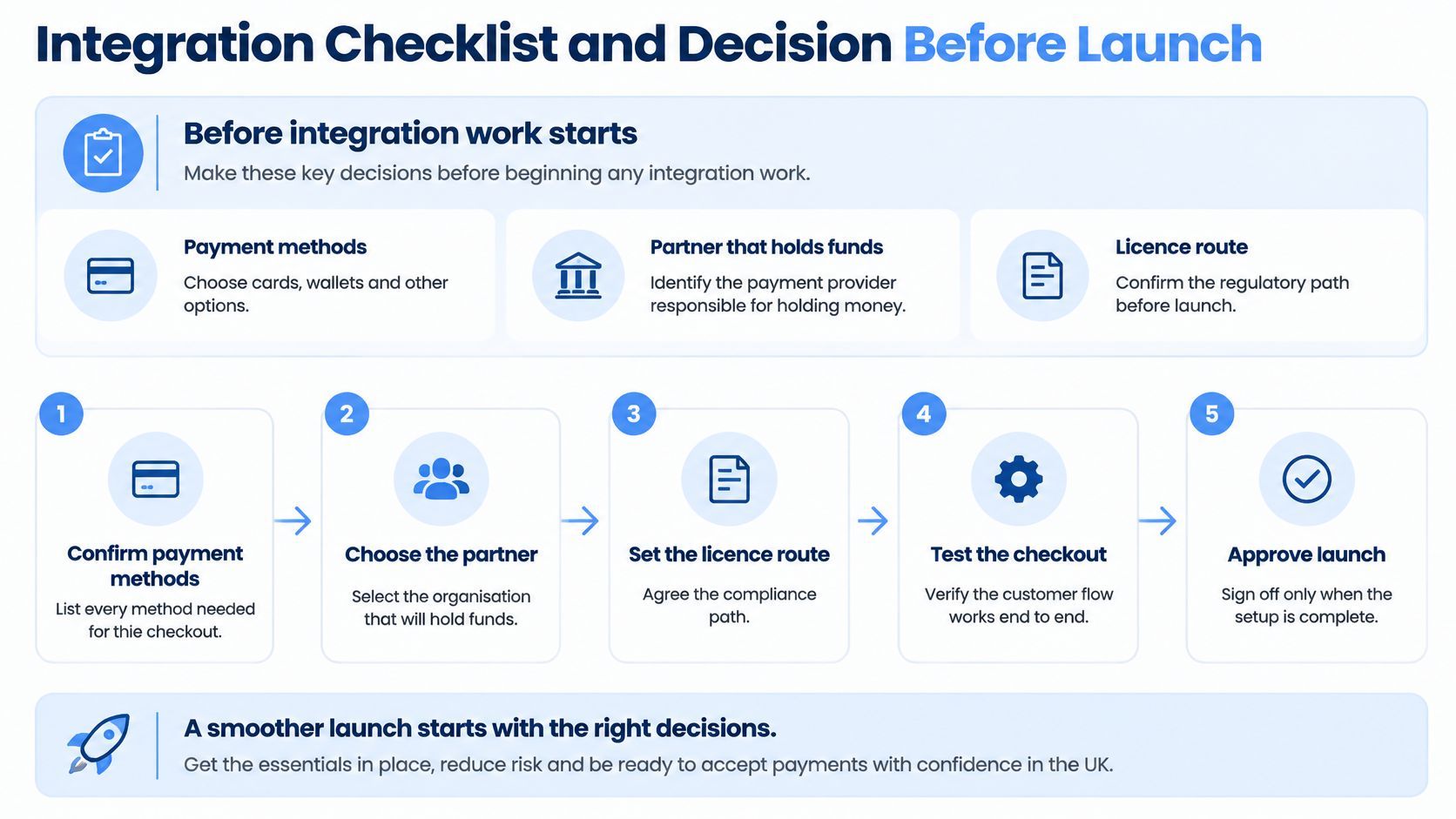
Before developers connect an API, settle the payment methods, the partner responsible for holding funds and the regulatory route. Those decisions determine the contracts, ledger design and evidence your business needs.
Treat the payment record as an operational case file, not just a successful API response. Finance, customer support, fraud investigators and compliance staff need to connect the same transaction to different decisions.
Evidence to retain before sign-off
- Approve the funds map. Name the regulated entity at every relevant step and record which accounts receive money. Retain a signed version covering successful payments, failed transactions and returns.
- Confirm each party's status in writing. Match FCA Register checks to the contracting entities and keep exclusion reasoning on file. Record any assumptions that could change when the product expands.
- Test authentication outcomes. Configure risk-based 3-D Secure and preserve the result in the payment record. Include successful challenges, failed challenges and interrupted customer journeys in acceptance testing.
- Agree card-data scope. Prefer tokenised integration over storing card numbers and retain a signed PCI DSS responsibility and scope document. Make responsibilities explicit for checkout scripts and third-party components.
- Make retries safe. Use idempotency keys for charge creation and retry logic, reusing the appropriate key for the same logical operation. Test a timeout after successful processing so the customer isn't charged again.
- Prove reconciliation end to end. Connect gateway transaction IDs to acquirer settlement files and bank statements. Create exception queues for partial captures, reversals, chargebacks and currency differences.
- Separate dispute workflows. Give refunds, card chargebacks and APP claims distinct routing and evidence requirements. Relevant PSPs should document eligibility decisions, gross-negligence criteria and vulnerable-customer handling.
- Allocate control ownership. Name owners for fraud rules, changes, alerts and evidence retention. Keep approvals and rollback instructions so staff can explain why a rule changed.
- Test customer-fund return where applicable. Run safeguarding reconciliation and demonstrate that records identify entitlements. Include provider failure and staff unavailability in the exercise.
Decide using total cost and operational readiness
Compare total acceptance cost, not only the advertised transaction charge. Include fraud losses, dispute work, failed-payment handling, reconciliation and customer support, then assign each cost to the party contractually responsible.
Crypto settlement adds another boundary to examine. NexaPay's discussion of accepting cards and settling in crypto is a useful prompt to separate the customer's payment method from the merchant's settlement asset, then assess conversion, custody and redemption responsibilities independently.
Glentorion's clients are financial and crypto businesses preparing for authorisation, and professional teams helping them move forward. Late discovery of an incorrect funds model can require coordinated changes to policies, application materials and integration code.
Once the flow map and partner list are drafted, a Glentorion scoping engagement can assess the regulatory route, responsibilities and evidence plan before those assumptions become embedded.
Bring your draft funds-flow map, proposed payment methods and partner list to Glentorion to scope the authorisation work and evidence your operating model needs. We combine regulatory consultants with software, systems and AI engineers to connect application materials, controls and management responsibilities, with deliverables agreed for the relevant route.
- e-commerce payment system
- payment processing UK
- PSP licensing
- AML KYC payments
- payment fraud controls