Anti Bribery and Corruption Policy: A UK Guide for 2026
Published
Around 117,000 bribe offers were identified in the UK during 2023–24, while Spotlight on Corruption's analysis of official crime data reported only five bribery prosecutions in 2025–26. That gap is the whole argument for taking an anti bribery and corruption policy seriously. Bribery reaches British businesses far more often than the courts ever see it, and the firms that come out badly are usually the ones that treated the policy as a document to file rather than a system to run.
I'd start from an uncomfortable premise: a policy protects nobody on its own. What protects a company is being able to show, with dated records and named owners, that prevention controls were operating at the moment someone offered the money. Everything below is about building that evidence, not about writing nicer prose.
Table of Contents
- Why an Anti Bribery Policy Matters Under UK Law
- Six Components Every Anti Bribery Policy Needs
- Risk Assessment and the Sectors Where Bribery Hides
- Governance and Who Owns the Policy
- Controls for Gifts, Third Parties and Facilitation Payments
- Training, Speak-Up Channels and Handling an Incident
- Scaling Controls for a Small or Fast-Growing Firm
- Test Whether Your Policy Works Before a Regulator Does
Why an Anti Bribery Policy Matters Under UK Law
Say a UK company appoints an agent in a market where permits move slowly. The agent pays a local official a small sum to release a licence, invoices the company for “expediting services”, and nobody in London asks what the fee bought. The directors knew nothing. Under the corporate offence, that ignorance is no defence.
The Bribery Act 2010 created four principal offences: offering, promising or giving a bribe; requesting, agreeing to receive or accepting one; bribing a foreign public official; and the corporate offence of failing to prevent bribery. As the Parliamentary post-legislative scrutiny of the Bribery Act records, the Act came into force on 1 July 2011 and reaches organisations incorporated in the UK or carrying on part of a business here, even where the conduct happens overseas. An organisation can be liable where an associated person bribes another to obtain or retain business or a business advantage, unless it proves it had adequate procedures designed to prevent bribery.
That legal test is practical, not decorative. It asks what procedures existed, who owned them, what records showed they were used, and whether they were active when the payment was made. A policy approved after the event cannot do that work. Nor can a board statement with no approval thresholds, diligence records, training evidence or review triggers behind it.
The numbers that mislead boards
The same parliamentary scrutiny recorded only one to seven defendants prosecuted annually for Section 1 offences in England and Wales between 2011 and 2017, with nought to four convictions in most years. Parliament also noted inconsistent recording across police forces and courts, and no single public dataset. Small numbers here reflect recording and enforcement capacity, not the frequency with which staff get asked for money.
The first conviction under the Act shows how ordinary the conduct can look. A court clerk accepted a small bribe to cancel a speeding ticket and was jailed. No offshore structure, no complex scheme, just a payment to make a problem disappear.
The legal question is whether adequate procedures existed when the bribe occurred, not whether a policy was approved afterwards.
That is the standard a board should apply clause by clause. If a prosecutor asked for proof that a control operated last March, the answer should be a dated record, a named owner and a clear review trigger. For a practical companion on what non-compliance exposes a firm to, Lighthouse Consultants on bribery compliance sets out the consequences in plain terms. Read it alongside your own policy and ask one question of every clause: what would I hand over?
Six Components Every Anti Bribery Policy Needs
| Component | What the policy must state | Evidence to keep |
|---|---|---|
| Top-level commitment | Board statement, named senior owner, zero-tolerance position | Board minutes approving the policy and the owner's appointment |
| Risk assessment | Bribery risks by product, jurisdiction, intermediary, government touchpoint and transaction type | Dated risk register with a named owner for each risk |
| Proportionate procedures | Controls scaled to each risk tier, with approval thresholds | Control matrix and approval logs |
| Due diligence | Screening rules for agents, introducers, consultants and partners | Completed diligence checklists and an exceptions log |
| Communication and training | Training by risk category, speak-up channels, consequences of breach | Attendance and completion records by role |
| Monitoring and review | Testing schedule, management information, review triggers | Test results, board management information and review minutes |
Those six rows aren't my invention. The UK Government guidance on the Bribery Act 2010 structures adequacy around proportionate procedures, top-level commitment, risk assessment, due diligence, communication including training, and monitoring and review. Under section 7, a commercial organisation can be liable when a person associated with it bribes another intending to obtain or retain business or a business advantage for the organisation, and the defence is proving adequate procedures were in place.
Publication isn't implementation
The guidance sets a quality bar for procedures: they must be clear, practical, accessible, effectively implemented and enforced. A policy uploaded to a shared drive fails three of those five tests before anyone reads it. Staff can't find it, haven't been trained on it, and no one has ever enforced a breach.
Drafting follows from that. Write the rule, name the person who applies it, and name the record it produces. "Gifts must be reasonable" is a sentiment. "Gifts above the threshold in Appendix A need written approval from the head of compliance before they're offered, logged in the gifts register within two working days" is a control. If you've already built disciplined process documentation elsewhere in the business, reuse that discipline here, and our piece on why standard operating procedures are important explains how to write procedures people follow.
Proportionality scales with risk, not headcount
Proportionality is tied to the organisation's bribery risks and the nature, scale and complexity of its activities. That means a twelve-person firm appointing agents in three higher-risk markets may need heavier controls than a 500-person domestic business selling to private customers. I'd resist any argument that begins "we're too small for this". Size determines how much bureaucracy you can carry, not how much exposure you have.
The detailed rules for gifts, donations, facilitation payments and third parties sit in the controls below, and ownership of each record sits in the governance discussion.
Risk Assessment and the Sectors Where Bribery Hides
A risk assessment answers one question: where could someone pay or receive a bribe to help this business? You map that across products, jurisdictions, intermediaries, government touchpoints and transaction types, then attach a control to each exposure you find.
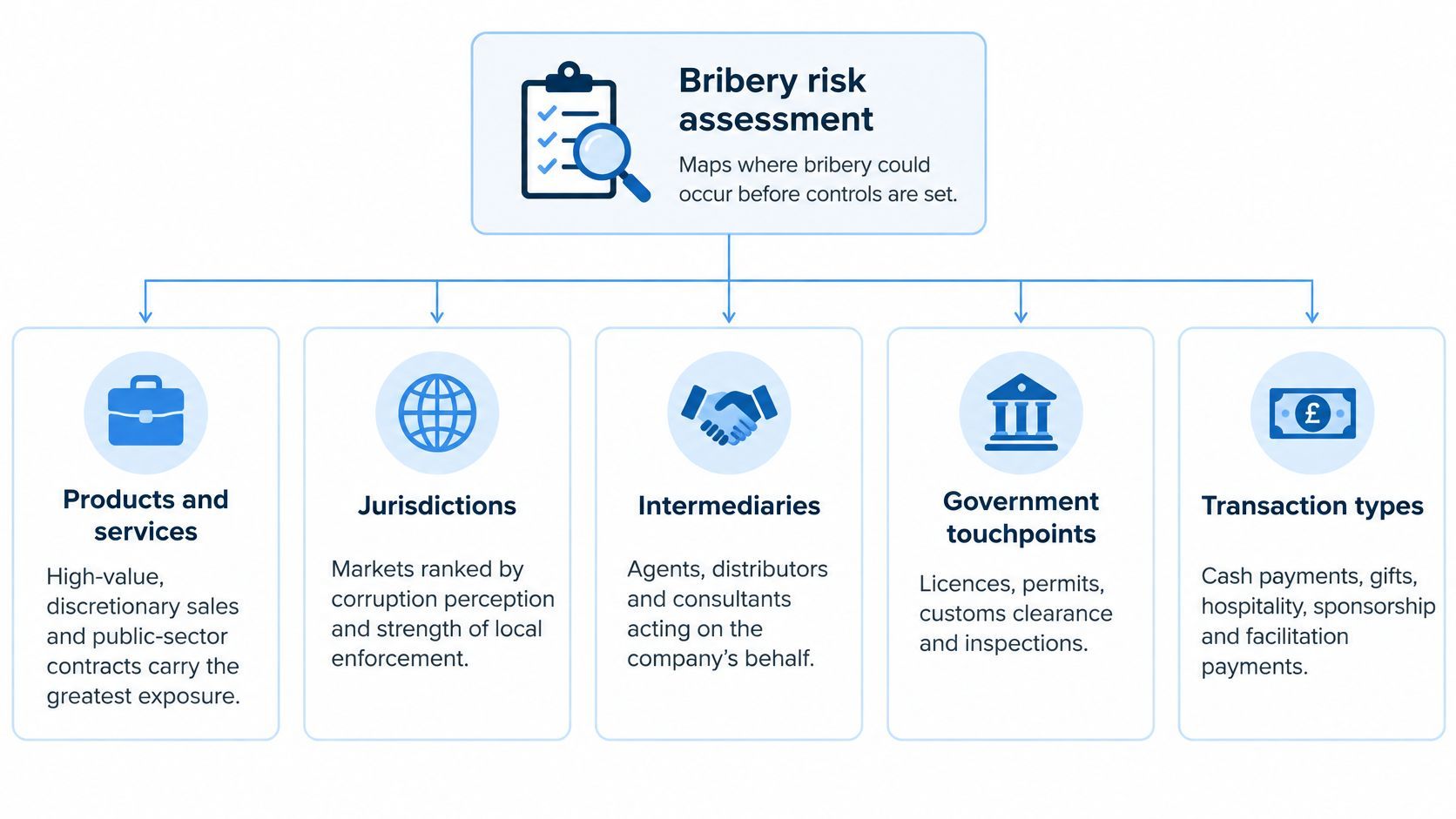
| Risk area | Why exposure rises | Typical control response |
|---|---|---|
| Third-party intermediaries and agents | Paid to win or retain business, often through layers of payments | Enhanced due diligence and senior approval before engagement |
| Government licensing or permits | Officials hold discretion over the outcome | Escalation and documented decisions for each approach |
| Public procurement and tenders | Contract value and influence over awards | Segregated approval and independent bid review |
| Construction and labour contracts | Long subcontract chains and high contract values | Supplier diligence, payment checks and audit rights |
| Hospitality, gifts and sponsorship | Routine, low-value and easily disguised | Approval thresholds and a central register |
| Cross-border expansion into higher-risk markets | Local practice and uneven enforcement | Country risk rating reviewed before entry |
Where the exposure is real, not theoretical
The UK Anti-Corruption Strategy 2025 reports that defendants were prosecuted for 15 offences under the Bribery Act 2010 in 2024, and cites a case in which four construction managers were convicted of bribery offences connected with labour contracts worth more than £15 million between 2012 and 2018. Construction is a useful reminder that bribery doesn't only live in exotic export deals. It sits in labour supply, subcontractor selection and site-level payments, in contracts long enough for the arrangement to become routine.
Rate each risk high, medium or low using factors you can evidence rather than instinct: contract value, whether a public official influences the outcome, how many intermediaries sit between you and the customer, and whether payment terms are unusual. Write the reasoning down. A rating with no rationale is impossible to defend and impossible to review.
Refresh triggers, not an annual ritual
An assessment refreshed every January regardless of what changed is a calendar entry, not a control. Reassess when the business changes:
- New market: a country entry decision should carry a bribery risk rating before the first contract is signed.
- New intermediary type: an introducer paid on success is a different animal from a reseller buying stock.
- New product or route to market: public-sector bids and discretionary high-value sales change the exposure profile.
- Ownership or structure change: new shareholders, new group entities and new related parties bring new government touchpoints.
Founders building their first risk framework will find risk planning advice for startup founders useful for structuring the exercise, and our guidance on financial crime risk assessment covers how to document inherent risk, controls and residual risk so the assessment holds up under challenge. Low prosecution volumes never justify a low rating. Rate the business you run, not the case count you read about.
Governance and Who Owns the Policy
Governance is three lines, and each one needs a name attached. The board sets the tone and approves the policy. A named senior owner holds it, answers for it and reports on it. Operating teams (sales, procurement, finance, onboarding) run the controls day to day.
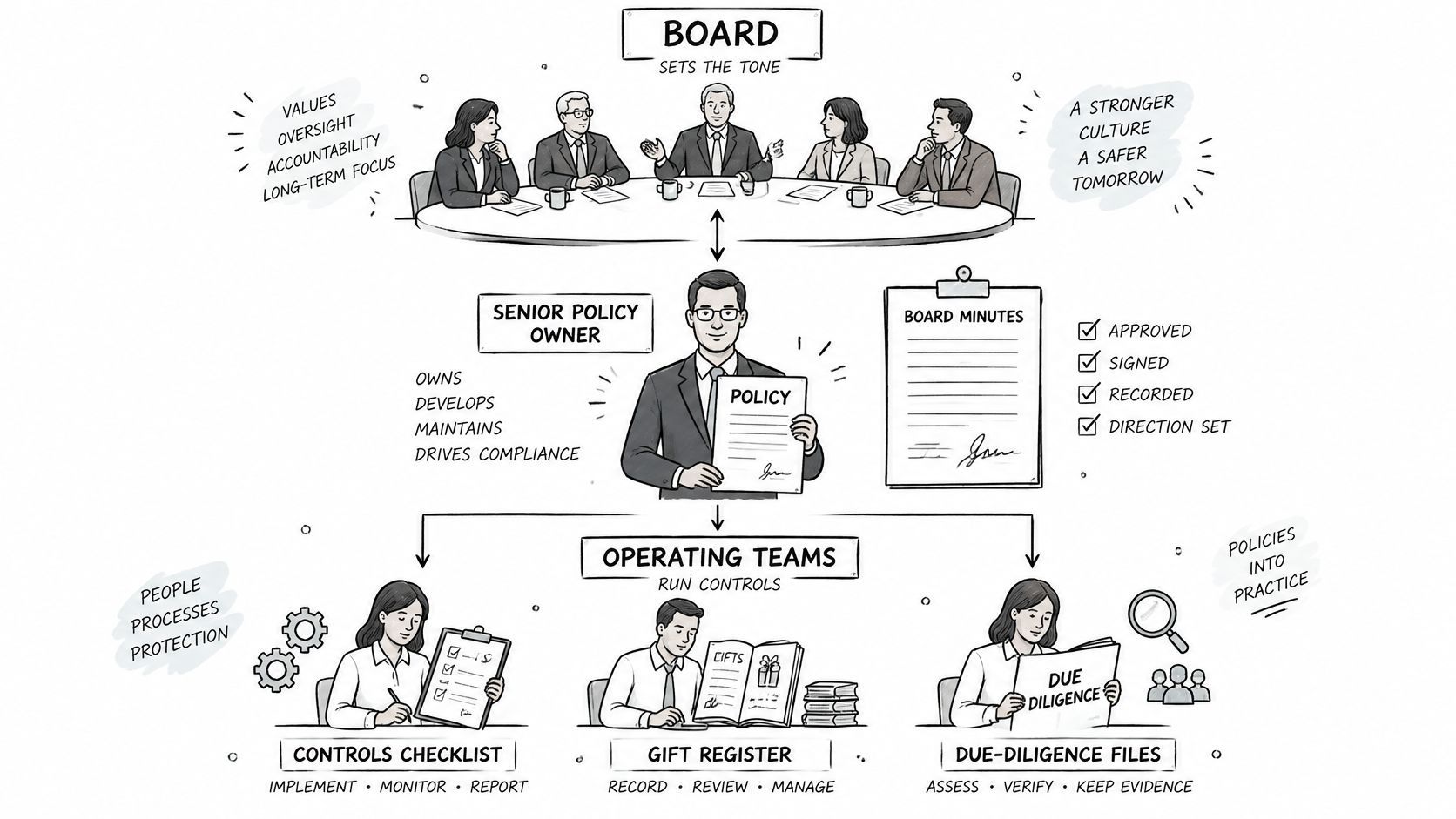
The Serious Fraud Office guidance on evaluating a corporate compliance programme asks whether controls are risk-based, clearly communicated, accessible, effectively implemented and enforced, against the section 7 test of "adequate procedures designed to prevent" bribery by associated persons at the time of the conduct. Notice what isn't in that list: the existence of a policy.
The minimum governance record
Keep a register that links each identified bribery risk to four things: a named control owner, the supporting evidence that the control operates, a review frequency, and a management-information metric the board sees. That single table does more for a defence than any amount of policy prose, because it converts intent into accountability.
The escalation line runs from control owner to senior owner to board, and it needs teeth. Designate someone with authority to pause a transaction or an onboarding when a red flag appears, without needing a committee. If stopping a payment requires three signatures and a fortnight, the payment will go out.
Practical rule: if a control has no owner who can produce a record of it operating, treat it as absent when you assess your own adequacy.
Timing is the part firms get wrong
A policy approved after an incident offers little protection, because the question is what existed when the bribe occurred. Good evidence looks like this: board minutes dated before the relevant period approving the revised policy, a named owner for intermediaries with a documented approval log, and a quarterly review where the board challenged a rating and the challenge is recorded. Minutes that only say "the policy was noted" record attendance, not oversight.
Where senior managers hold individual accountability, bribery controls belong in their statements of responsibility rather than in a generic compliance annexe, and our note on SMCR conduct rules sets out how personal accountability changes the standard of evidence expected. One check for this quarter: open your risk register, and for every row ask the named owner to show you the control working.
Controls for Gifts, Third Parties and Facilitation Payments
Controls behave like the locks, logs and keys of a building. A lock without a log tells you nothing afterwards about who came through the door. Each rule below therefore has a trigger, an owner and a record.
The UK Government's Bribery Act guidance identifies the policy areas that communications and training should cover, including decision-making, financial controls, hospitality and promotional expenditure, facilitation payments, charitable and political donations, penalties for breaches, and management responsibilities at different levels. That list is your drafting checklist.
Gifts, hospitality, donations and sponsorship
Set a value threshold above which senior approval applies, and a lower one below which staff record the item. Keep one central register rather than departmental spreadsheets, and require the recipient's employer and role, the business purpose, the date and the approver. Ban anything offered while a tender, licence or inspection decision is pending, regardless of value.
Donations and sponsorship need diligence on the recipient and a documented business purpose. The question to ask is who benefits: a charity connected to the official deciding your permit is a bribery risk wearing a philanthropic label.
Facilitation payments and third-party diligence
State plainly how the policy treats facilitation payments, and give staff a script for the moment an official asks for a small cash payment to release goods: refuse, ask for the official basis and a receipt, escalate to the named owner, and record the request even if nothing was paid. Where personal safety is at risk, the policy should say so explicitly and require immediate reporting rather than leaving staff to improvise.
Diligence should be tiered. Simplified checks are acceptable for low-risk suppliers with no government contact and no influence over contract awards. Enhanced diligence applies to agents, introducers, consultants and partners paid to win or retain business, and it should cover ownership, reputation, the commercial justification for the fee and the payment destination. Contracts carry compliance obligations, audit rights and termination for breach. Conflicts belong in the same file, which is why our guidance on managing conflicts of interest pairs naturally with third-party onboarding.
Payment controls and exceptions
No payment releases without complete supporting documentation: contract, invoice, evidence of delivery, and a bank account in the counterparty's own name. Every exception is escalated, recorded and closed with a decision, not waived.
Take a concrete case. An introducer asks for a success fee to be paid to a personal account in another country. The rule should trigger three things automatically: enhanced diligence on the introducer and the account holder, a hold on the payment, and senior review with a written outcome. If your policy doesn't produce that path without anyone exercising judgement, it isn't a control.
Training, Speak-Up Channels and Handling an Incident
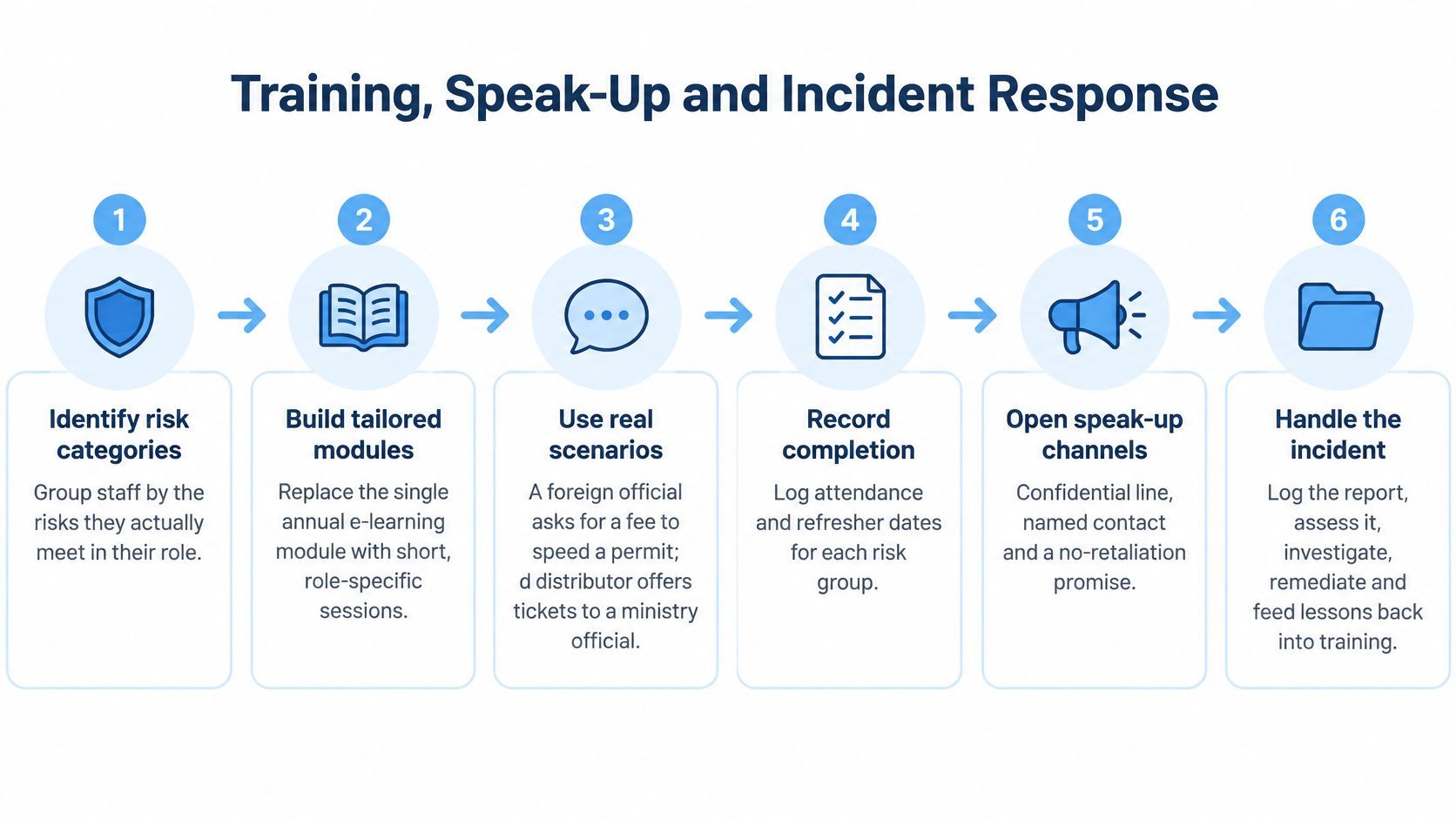
One annual e-learning module for everyone is the most common wasted spend in this area. A finance clerk needs to recognise a suspicious invoice; a sales director needs to handle a distributor offering tickets to a ministry official; a logistics coordinator needs to know what to do at a border. Group staff by the risks they meet, build short role-specific sessions around those situations, and log completion and refresher dates by risk group.
Speak-up channels need three features to be used at all: a confidential route that doesn't run through the reporter's line manager, a named contact, and an explicit no-retaliation commitment that senior management repeats out loud.
The incident sequence
- Record the report with its date, source and details, because a contemporaneous note is worth more than a recollection six months later.
- Preserve evidence immediately: emails, invoices, chat messages, payment instructions and call notes, before anyone tidies a mailbox.
- Classify the matter as an attempted bribe, a solicitation, a facilitation request or suspicious third-party behaviour, even where no payment was made, because the attempt is the risk event.
- Escalate to the named senior owner, and to the board where the policy requires it, so the decision sits above the commercial team involved.
- Decide on external advice, taking legal or law-enforcement guidance where the facts warrant it rather than waiting for certainty.
- Investigate, remediate and record the outcome, including the control gap that allowed the event and the fix applied.
Why the response shapes the consequences
A UK Deferred Prosecution Agreement is available to organisations, but not individuals, in cases involving bribery, fraud and other economic crime. Prosecution is suspended for a defined period while the organisation satisfies specified conditions, under judicial supervision: the judge must conclude the arrangement is in the interests of justice and its terms fair, reasonable and proportionate. How a firm behaves after suspected misconduct surfaces is therefore part of its exposure, not an afterthought.
Run the customs example through the sequence. An employee reports that an agent asked for cash to speed a clearance. Log the report the same day, preserve the agent's messages and the invoice, classify it as a facilitation request, escalate to the senior owner, take legal advice on the agent relationship, then suspend the agent, retrain the logistics team and record the closure. That file is what adequacy looks like in practice.
Scaling Controls for a Small or Fast-Growing Firm
Founders ask the same question first: how much policy is enough? Enough to run, not enough to impress. Guidance repeats the six principles but rarely converts them into an operating model a ten-person company can staff, so here's the minimum viable version I'd build.
- Board statement: a signed zero-tolerance position with one named senior owner, minuted.
- Risk register: five to ten risks written from your own products, markets and intermediaries, each with a control owner and a review date.
- Third-party rule: simplified checks for low-risk suppliers, enhanced diligence for any agent or introducer paid on success.
- Gifts and payments: one hospitality threshold, one central log, and a hold on any payment without complete documentation.
- Speak-up and training: a single confidential reporting route plus short scenario-based sessions for sales, procurement and finance.
- Review triggers: a new market, a new intermediary, a change in ownership or a material rise in contract value forces a reassessment.
Proportionate doesn't mean light-touch. A small firm entering a high-risk market needs stronger controls than a larger domestic one.
Fast growth is itself a trigger. Controls designed for ten staff rarely survive a doubling of headcount in a new jurisdiction, because the informal check ("ask the founder") stops working the moment the founder isn't in the room. Rebuild the approval path before the new office opens, not after the first incident.
When we draft policies and operating arrangements, we distinguish what's already in place from what the business still needs to establish, because a regulator will ask that exact question and an honest gap list with dates is far stronger than an aspirational document.
Test Whether Your Policy Works Before a Regulator Does
The confidence gap is the finding worth pinning above your desk. The Home Office Economic Crime Survey 2024 estimated that 3% of UK businesses with employees experienced at least one bribery incident during the preceding 12 months, while 87% believed they had adequate processes to minimise corruption risk. A policy can be approved, circulated and still leave no usable evidence when the question turns from what the firm says to what the firm did. Bribery risk is cumulative in that sense. Small gaps in approvals, diligence and escalation become hard to defend once a payment, intermediary or market entry is already in motion.
Attestations and training completion rates measure belief. Testing measures behaviour. Sample transactions and check three things: that approvals exist, that diligence and approval records are dated before the relevant event, and that training reached the people in the highest-risk roles rather than the people easiest to schedule. Look for the record trail, not the statement of intent. A diligence pack completed the week after an agent started work is a filing exercise, not a control. A gift logged only after the event has the same problem.
Treat low reporting as ambiguous. It can mean low exposure or weak detection, and you cannot tell which from the number alone. Test the channel: ask staff in high-risk roles whether they know how to report confidentially, and check whether reports from agents or overseas offices ever arrive at all. Outsourcing the testing is fine, provided the board still owns the findings. The point is to see whether the policy operates under pressure, when someone needs an answer quickly and the usual informal route is unavailable.
| Metric | What it shows | Review trigger |
|---|---|---|
| High-risk third parties screened before onboarding | Diligence coverage | Any high-risk onboarding without completed checks |
| Due-diligence exceptions outstanding beyond a set period | Control backlog | Any exception open beyond the period set in the policy without senior sign-off |
| Gifts and hospitality above approval threshold | Approval discipline | Repeated breaches within one business unit |
| Payments lacking complete supporting documentation | Payment control quality | Any unexplained gap |
| Staff and intermediaries trained by risk category | Training reach | Completion below target in any high-risk role |
| Hotline reports and investigation closure times | Speak-up use and response speed | Closure times lengthening over consecutive reviews |
| Repeated findings by business unit or jurisdiction | Concentration of weakness | Findings in two consecutive reviews |
One action for this quarter: run your policy against that table, and log every gap with a named owner and a due date. Where the work needs external support, the scope, fees, responsibilities and service commitments are set out in a written engagement agreement, so nobody is guessing who owns which deliverable.
If your anti bribery and corruption policy reads well but you cannot produce the register, the approval logs and the board minutes behind it, that is the gap we close. Glentorion prepares policies and operating arrangements that distinguish what is already in place from what still needs to be established, checks consistency across application documents and prepares management teams to explain their controls in regulator interviews. Visit Glentorion to scope a review of your bribery controls and evidence before a regulator, an investor or a prosecutor asks for it.
- anti bribery policy
- Bribery Act 2010
- failure to prevent bribery
- anti corruption compliance
- UK anti bribery controls