Why Standard Operating Procedures Are Important in 2026
Published
A policy can be signed, filed and still fail on the first busy Monday. That's why standard operating procedures are important in regulated firms. They don't restate intent. They show who does the work, when they do it, what they check, what they record and who takes over when something goes wrong. Without that chain, a supervisor can't test your controls and your own managers can't prove they ran.
Table of Contents
- Six Reasons Standard Operating Procedures Matter at a Glance
- What an SOP Is and How It Differs from Policy
- Why Written Policies Alone Fail Under Scrutiny
- Where Operations Break Across Change, Suppliers and Access
- Designing SOPs That Survive Disruption
- Learning From Incidents and Near Misses
- Financial Promotions and Approval Workflows as an SOP Test
- Check Your SOPs Before Your Regulator Does
Six Reasons Standard Operating Procedures Matter at a Glance
A standard operating procedure, or SOP, turns a policy into repeatable steps. It names the owner, timing, inputs, checks, records and escalation route for a task. The table below gives you the short version you can take into a board meeting.
| Reason | Failure it prevents | Evidence a reviewer checks |
|---|---|---|
| Consistency | Same task performed differently by different teams | Same steps and signed records across teams |
| Compliance | Controls that exist only in policy wording | Documented steps linked to each rule |
| Auditability | Gaps nobody can reconstruct afterwards | Named owner, timestamp and retained evidence for each step |
| Incident response | Improvised action during a crisis | Trigger, escalation route and recovery sequence |
| Interview readiness | Managers unable to explain their controls | Staff can walk through the procedure against the document |
| Governance | Board unable to show oversight of operations | Version control, review dates and approval records |
Consistency matters because growth creates variation, and variation creates errors that nobody intended. Compliance matters because a rule only protects you once a named person performs a step that satisfies it. Auditability matters because memory isn't evidence, and a reviewer needs records they can retrieve months later.
Incident response matters because pressure shortens judgement, so the trigger and recovery sequence must be decided in advance. Interview readiness matters because managers who can't walk through their own procedure don't sound in control of it. Governance matters because version control and approval dates show the board oversees operations, rather than assuming someone does.
Ask one question of every row. If this step failed on a Friday evening, would the document tell someone what to do on Monday morning?
If the answer is no, you don't have a procedure yet. You have a description of good intentions.
What an SOP Is and How It Differs from Policy
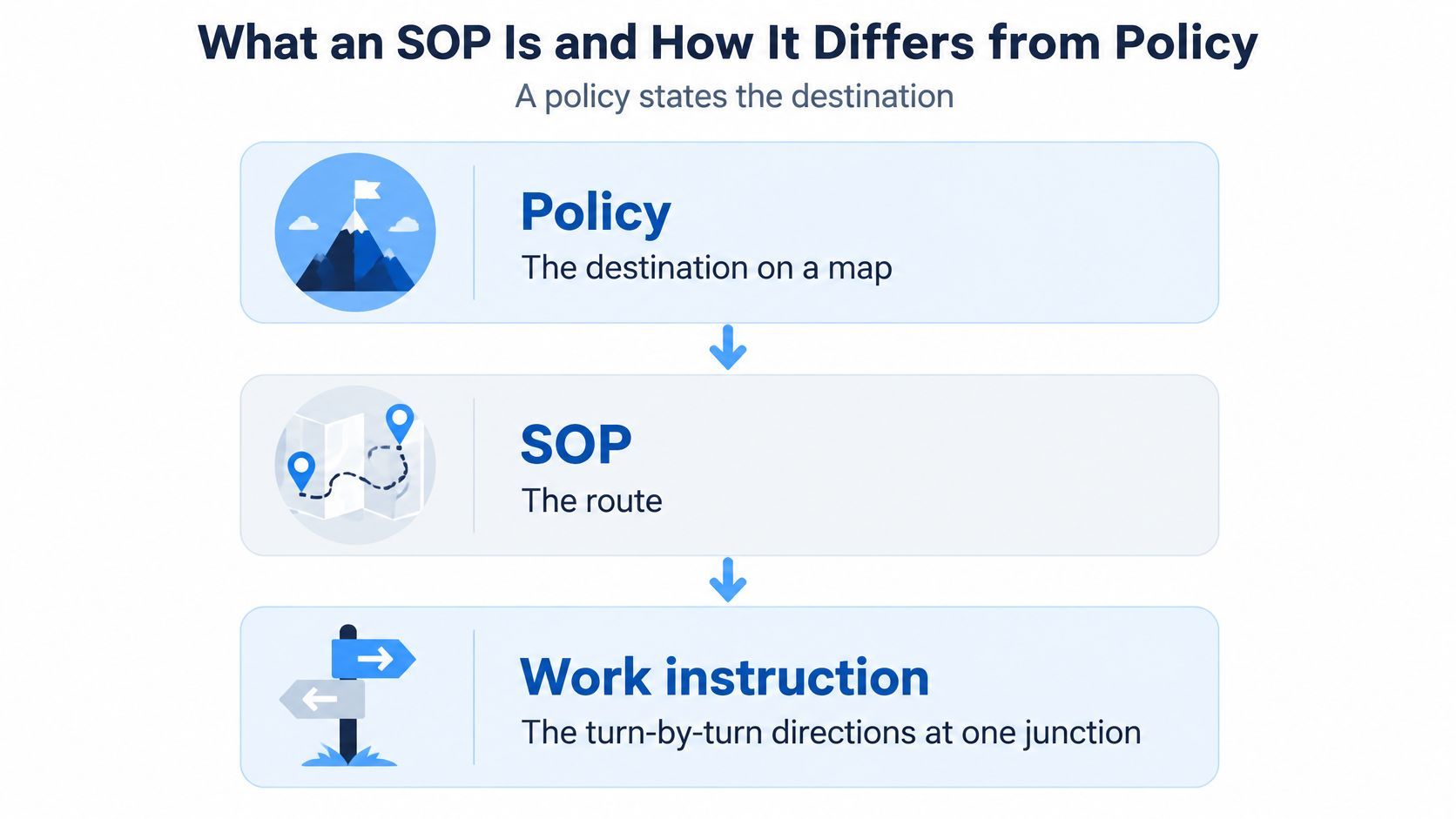
Think of travel. A policy is the destination on a map. An SOP is the route. A work instruction is the turn by turn direction at one junction. All three are useful, but they answer different questions.
The three levels in practice
A policy states a commitment, for example that client money is safeguarded and reconciled. The SOP names the control owner, frequency, inputs, checks, escalation thresholds and evidence to keep. A work instruction then covers one screen, form or task, written so a new starter can complete that single step correctly.
The common mistake is writing policy language inside an SOP. The document says reconciliations are performed promptly, but it doesn't say who performs them, which report they use or how anyone would know one was missed. That's why approval needs a traceable record too, and many firms formalise sign off using digital signatures for operating procedures so version approval is evidenced rather than asserted.
Current controls and planned controls
Supervisors also care whether a procedure describes arrangements already operating or arrangements you still have to establish. Don't claim a control exists before it does. Mark the status clearly, assign an owner for building it and keep the evidence that supports your position.
That distinction is live for UK crypto businesses. The FCA policy statement on the cryptoasset regime distinguishes registration since January 2020 under the Money Laundering Regulations from the forthcoming framework where firms conducting newly regulated cryptoasset activities by way of business in the UK will need authorisation under the Financial Services and Markets Act 2000 unless an exemption applies. Authorisation requires a firm to show it satisfies and will continue to satisfy the statutory Threshold Conditions.
Use this test for every document. Can a new employee perform the task from the document alone, and can an auditor see that it happened?
Why Written Policies Alone Fail Under Scrutiny
FCA fines have been linked to internal control failures, including weak, deficient or absent fraud controls, as discussed in the Chartered Institute of Internal Auditors parliamentary briefing on FCA fines. A signed policy does not show that a control operated, or that identified issues were addressed promptly. The test is what people do and what evidence remains.
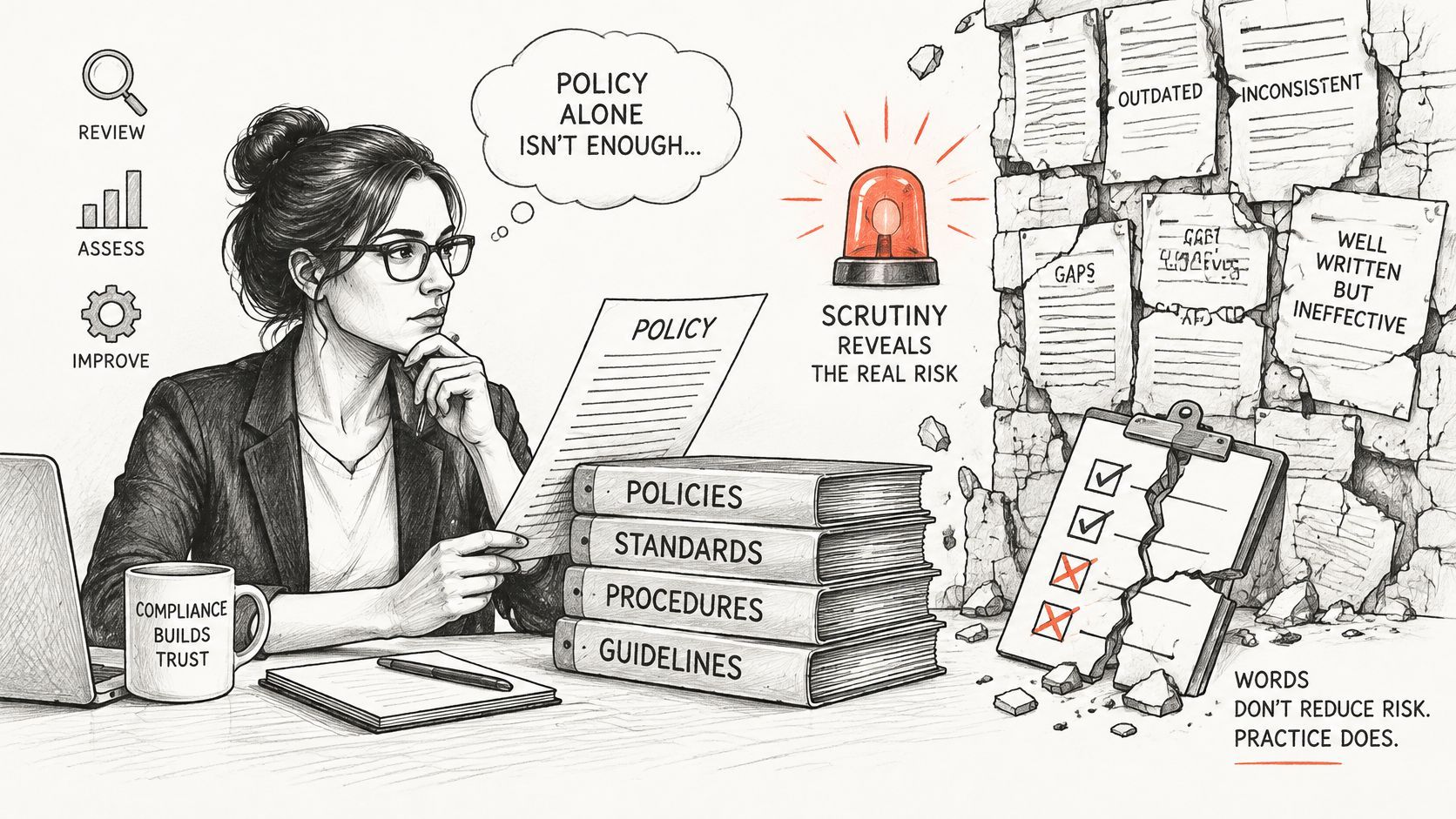
Policy language can sound complete while leaving the work undefined. “Fraud is monitored” does not identify who reviews which report, when they do it, what counts as an exception, who receives an escalation or how the response is tracked to closure. An SOP makes those dependencies visible, much like a route map that shows each handoff rather than merely naming the destination.
Two versions of the same control
- Policy version: Payments above a set threshold are reviewed before release.
- SOP version: The payments lead reviews the daily reconciliation report by a set time, records sign-off, escalates unmatched items to the financial controller and logs a missed review for same-day follow-up.
The second version can be tested because it specifies who performs the control, when it is performed, what information is reviewed, what exceptions are escalated and how remediation is tracked. A retained record lets a reviewer follow the control from the information examined through to the decision and any corrective action. The guide to how evidence is explained to a reviewer explains how to make that chain clear.
The same briefing describes control issues remaining unresolved for extended periods. A procedure that assigns no owner or deadline can leave a known problem sitting in meeting minutes without progress. A recorded finding is not the same as a closed finding.
Practical rule: Every exception needs a named owner, a due date and a closure record. Without all three, follow-up can drift.
A supervisor will ask three plain questions: Who performs this control? When does it run? What evidence proves it ran? If the SOP cannot answer them, polished policy wording alone will not demonstrate that the control works. The procedure earns its value when staff can follow it, exceptions trigger action and the evidence shows what happened, including where the process failed.
Where Operations Break Across Change, Suppliers and Access
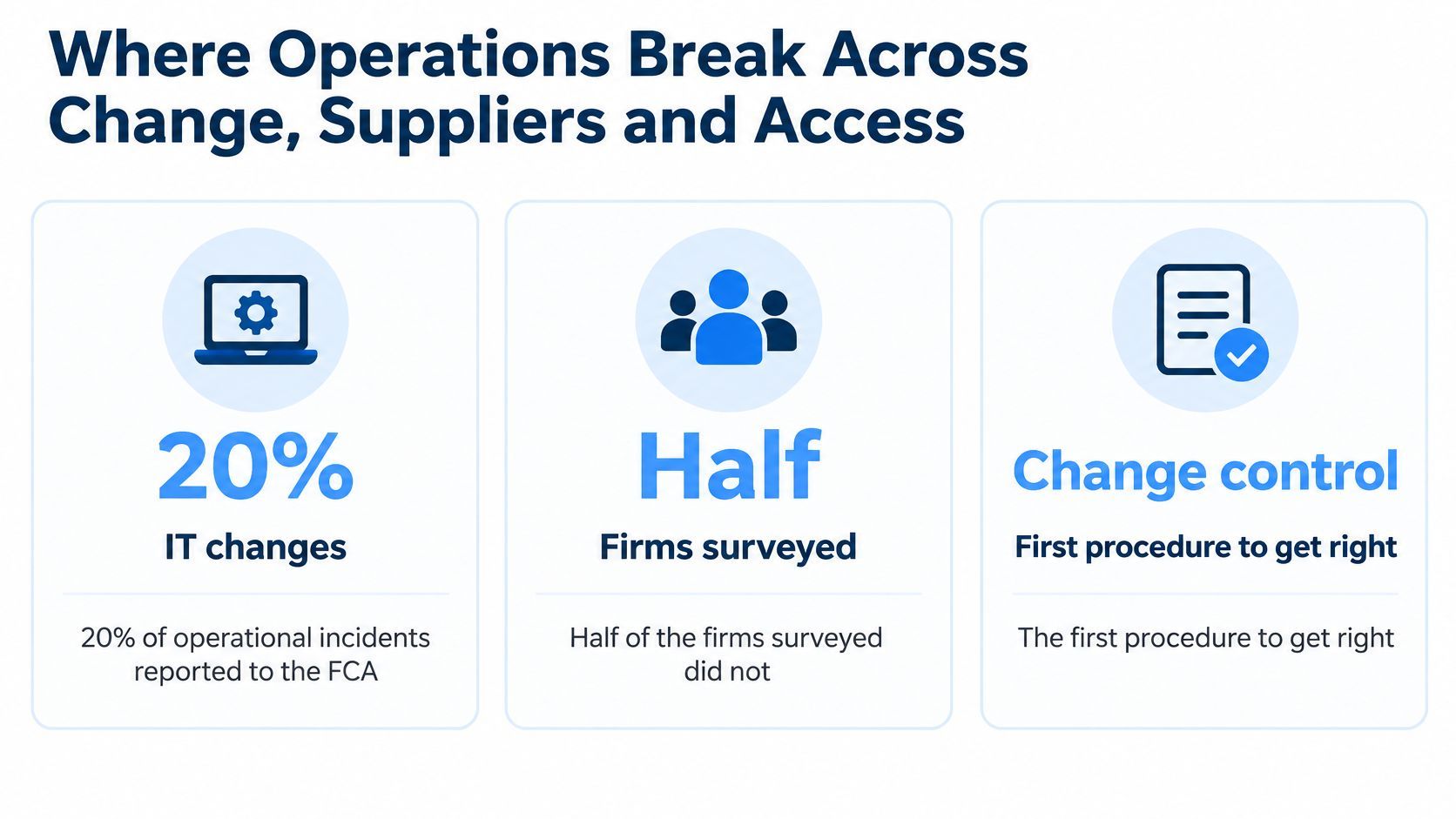
Failures cluster at interfaces, where people, technology, suppliers and change processes meet. The FCA consultation paper CP19/32 on operational resilience reports that IT changes caused 20% of operational incidents reported to the FCA, while half of firms surveyed did not maintain a complete list of third parties with access to their systems and data. It also records that 26% lacked a board approved information security strategy and only 56% said they could measure the effectiveness of information asset controls.
| Figure | Finding | What the SOP must specify |
|---|---|---|
| IT changes | 20% of operational incidents reported to the FCA | Formal approval, pre and post implementation checks, segregation of duties and rollback criteria |
| Third party access | Half of surveyed firms lacked a comprehensive list of third parties with access to systems and data | Maintained register, named responsibilities and regular access reviews |
| Information security | 26% lacked a board approved information security strategy | Clear link from the board strategy to access and incident procedures |
| Control measurement | Only 56% could measure the effectiveness of information asset controls | Metric, data source, frequency and owner |
What to write for each failure point
Start with change control, because an unmanaged release can break a service that was working an hour earlier. Specify who approves, what testing must pass and what triggers a rollback. Our approach to change impact analysis across application documents applies the same discipline when facts change mid process.
Treat supplier access as a procedure, not just a contract clause. Keep a live register, review access on a set cycle and record removals. Then define measurement properly, with a metric, source, frequency and owner. A well built custom dashboard for insurance teams shows the principle clearly, because control status becomes visible rather than buried in spreadsheets.
Retain approvals, test results, exception logs, reconciliations and incident timelines. A reviewer should be able to reconstruct what happened and why, without interviewing the person who happened to be on shift.
Designing SOPs That Survive Disruption
Two terms decide whether a UK procedure is resilience ready. An important business service is one whose disruption could cause intolerable harm to clients or threaten the soundness, stability or resilience of the UK financial system or the orderly operation of financial markets. An impact tolerance is the maximum tolerable level of disruption, measured by time and any other relevant metrics, beyond which intolerable harm could occur.
Those definitions come from the FCA operational resilience pages, which require firms to identify each important business service, define an impact tolerance for it and maintain testing plans showing how they can remain within that tolerance. The FCA states firms in scope were required to complete mapping and testing by 31 March 2025, while continuing to make investments necessary to operate consistently within their tolerances.
Why restore quickly is not a procedure
A generic promise to restore service quickly tells staff nothing as the clock runs. Your SOP must show what happens at each point, which dependencies are involved and when senior management takes over. Map the people, processes, technology, facilities, information and third parties the service depends on, then test severe but plausible scenarios against that map.
| Element | What the SOP states | Worked example |
|---|---|---|
| Control owner | Named role accountable for the step and a deputy | Head of payments operations, deputy is duty settlements lead |
| Impact tolerance | Maximum tolerable disruption, in time or other metrics | Service must not be down for more than 24 hours |
| Escalation threshold | Point at which the step passes to senior management | Escalate once recovery has used half the tolerance |
| Recovery action | Steps to restore the service within tolerance | Switch to secondary provider and run manual reconciliation |
| Retained evidence | Records proving the step ran and what it found | Timestamped logs, test results and sign off records |
| Test frequency | How often the scenario is run and what triggers a retest | Annually, and after any material change |
Set the escalation threshold well before the tolerance is breached, not at the moment of breach. If half the tolerance is gone and recovery isn't working, that's a senior decision, not a team level judgement call. Record the decision, the time and who made it.
Review mapping, tolerances and vulnerabilities at least annually or after material change. A new cloud provider, wallet infrastructure change or loss of a key employee can invalidate last year's assumptions. Update the procedure, retest and keep the lessons learned record with the test evidence.
Pick one important business service and run a tabletop scenario against its SOP. Write down every point where the team would stall, guess or wait for someone who isn't named.
That gap list is your real procedure quality score. An SOP that only describes business as usual gives false assurance, because it has never been asked to work under disruption.
Learning From Incidents and Near Misses
UK aviation shows what disciplined reporting achieves. The Civil Aviation Authority annual safety review reported no fatal accident involving a UK commercial airline since 1989, while its 2023 review recorded more than 47,000 Mandatory Occurrence Reports, including 230 accidents and 73 serious incidents. Safety came from capturing and investigating events, not from claiming failures never happen.
Apply the same logic to an incident SOP. It should specify six things in order.
- Trigger: The event that starts the procedure, such as a failed settlement or third party outage.
- Classification: Who decides severity and whether the event is reportable.
- Escalation: A named role, a deputy and a time limit at each level.
- Recovery sequence: The ordered steps that restore the service within tolerance.
- Evidence: Timestamped logs, decisions and communications kept as the incident timeline.
- Learning loop: A post incident review that updates the procedure, training and controls, with an owner and deadline.
Capture near misses the same way you capture losses. A reconciliation that almost missed its deadline tells you where the process is fragile, as our guide to anti money laundering audit preparation shows for financial crime controls. Fix the procedure after the near miss, not after the harm.
Financial Promotions and Approval Workflows as an SOP Test
Say an overseas marketing team or an affiliate publishes a campaign that reaches UK consumers, and nobody in UK compliance sees it. The firm assumes the promotion sits outside its perimeter because it wasn't produced in London. That assumption is wrong, and it's a common one.
The FCA cryptoassets pages state the regime applies to every firm marketing qualifying cryptoassets to UK consumers, regardless of whether the firm is based overseas or the technology used, and that since 8 October 2023 such promotions have been within the FCA's remit. Geography doesn't remove the obligation. Reach creates it.
The four lawful routes your SOP must check
- Authorised communicator: Communication by an authorised person.
- Approved communication: Communication by an unauthorised person after approval by an authorised person.
- Registered cryptoasset business: Communication by an FCA registered cryptoasset business relying on the relevant Financial Promotion Order exemption.
- Another exemption: Communication under another applicable exemption.
Your approval SOP must record which route applies before anything is published. It should capture the audience, promoter status, approver or exemption relied upon, required warnings and sign off records. It also needs controls over changes to published material, because an approved page that is later edited is no longer the approved page.
Each check should produce evidence a reviewer can follow from the live campaign back to the approval. Who checked the warnings? Who confirmed the promoter's status? Who approved the final version, and on what date?
Treat every affiliate and overseas team as inside your compliance perimeter until your SOP proves otherwise.
Close the blind spot with one explicit step. No campaign capable of reaching UK consumers is published, amended or reposted without a recorded route check. That single control prevents the scenario most firms only discover after a regulator finds the page first.
Check Your SOPs Before Your Regulator Does
Run this audit on Monday. It doesn't require new software, only honesty about what your documents say.
- Inventory: List every process tied to a regulated activity or important business service, marking what operates now and what's still to be established.
- Assign owners: Name one accountable role per control, with a deputy.
- Run disruption scenarios: Test a supplier outage or failed reconciliation and record where the team stalls.
- Check the evidence trail: Confirm each step produces a record a reviewer can retrieve.
- Set review triggers: Schedule an annual review, plus updates after material change, incidents or new products.
The output feeds directly into authorisation and supervisory work. We prepare policies and operating arrangements that distinguish arrangements already in place from those the business still needs to establish, then bring the business plan, financial information, policies and application answers together, resolve findings and revisit affected material when facts change. Focused interview preparation then helps your team explain the business, its controls and responsibilities, as set out in our overview of FCA compliance requirements for applicants.
If the audit exposes gaps, don't rewrite everything at once. Fix the procedures tied to your most important services first.
If your audit shows procedures that describe intent but can't prove execution, we can review your SOP set against your planned regulated activities, identify missing owners, evidence and disruption steps, and help you rebuild them into testable controls. Visit Glentorion to scope a review of your operating arrangements before a supervisor tests them for you.
- standard operating procedures
- SOP compliance
- operational resilience
- regulatory governance