Managing Conflicts of Interest: A Practical FCA Guide
Published
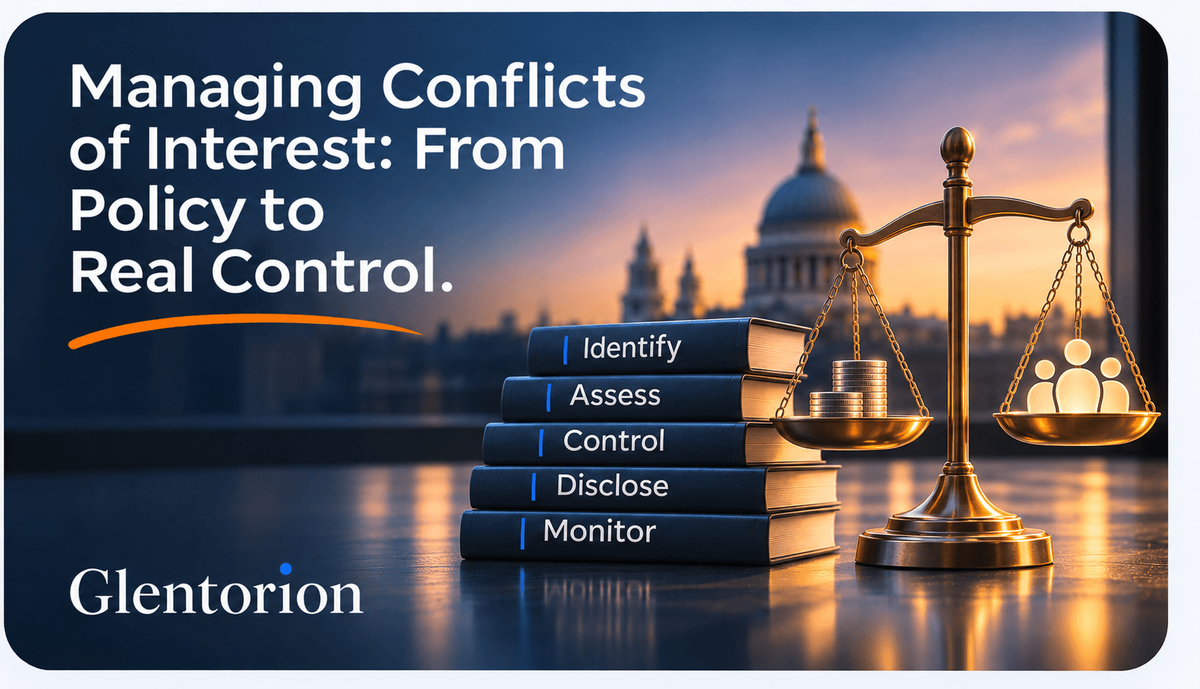
The most popular advice on managing conflicts of interest is also the weakest. Write a policy, keep a register, get annual declarations, and you're covered. You're not. A policy describes intent. It doesn't stop a bonus scorecard from rewarding the wrong sale, a founder from approving a token listing that benefits the firm, or a team from committing to a transaction before clearance. I would judge any framework by a harder test. Can an outsider see, from dated records, that each control operated before client harm became possible?
Table of Contents
- The Conflicts Management Cycle at a Glance
- Where Conflicts Hide in Financial and Crypto Businesses
- How to Identify and Rank Each Conflict
- Matching Each Conflict to the Right Control
- When Disclosure Is the Right Answer
- Keeping the Register Live and Monitoring Breaches
- How FCA, MAS and DFSA Expectations Compare
- Confirm Your Conflicts Framework Before Submission
The Conflicts Management Cycle at a Glance
A conflict of interest exists when a firm, or a person working for it, has an incentive that could lead it to act against a client's interest, whether or not anyone has acted on it yet. Think of it as a fault line. The stress is present before the earthquake, so the work starts with finding it early and reducing the pressure.
Five stages that must leave evidence
| Stage | Question it answers | Evidence to hold |
|---|---|---|
| Identify | Which services, clients, pay lines and decisions could create an adverse incentive? | Conflicts inventory with named owners |
| Assess | How likely is client harm, and how serious would it be? | Scored assessment with written rationale |
| Control | Which mechanism removes or limits the conflict at its cause? | Control design, control owner and operating records |
| Disclose | Do the controls give reasonable confidence that client harm will be prevented? | Client disclosure text and a record of when it was given |
| Monitor | Does the register still match the business, and do the controls work? | Review logs, breach records and change triggers |
Identify is only as good as the business map behind it. If the map omits an affiliate, a referral fee or a shared decision-maker, the later stages look tidy while missing the risk. Assess then ranks likelihood and impact so senior managers spend attention where client harm is most plausible.
Control is where most frameworks should do their real work, by changing who decides, who sees information, or how people are paid. Disclose is the residual step when controls don't give enough confidence. Monitor closes the loop by testing whether the register still matches the business and whether breaches cluster around a weak control.
Practical rule: If a stage produces no record a reviewer can test, treat that stage as unfinished.
The UK baseline sits in SYSC 10 under the FCA Handbook, which requires firms to identify and prevent or manage conflicts, with disclosure after prevention and management. MAS and DFSA regimes set comparable expectations for Singapore and Dubai firms, but you should check the specific rules for your licence. In practice, monitoring fails most often, because the business changes faster than the register.
Where Conflicts Hide in Financial and Crypto Businesses
Conflicts come from incentives, not only from obvious personal relationships. Under FCA Handbook SYSC 10, firms must take all appropriate steps to identify and prevent or manage conflicts between the firm and a client, and between clients, including where the firm or a relevant person could gain financially at the client's expense, hold an interest in a transaction outcome distinct from the client's interest, favour another client, or receive third-party inducements.
| Conflict source | Adverse incentive | Typical example |
|---|---|---|
| Remuneration and sales targets | Staff rewarded for volume or product sales | Bonus tied to product take-up rather than suitability |
| Commissions and third-party inducements | Payment from a third party for steering business | Fee from a platform for routing client orders |
| Referral and introducer arrangements | Payment for bringing in customers | Per-account fee for funded accounts |
| Group and affiliate relationships | Shared profit or shared systems across entities | Affiliate exchange sharing customer data or staff |
| Personal account dealing | Staff trading ahead of or against client orders | Employee trading a token before a client order |
| Proprietary trading and market making | Firm profits from the same trade as a client | Market maker quoting against its own client book |
| Token treasury and listing decisions | Firm benefits from a token's price or listing | Firm holds the token it lists for clients |
| Outsourced providers | Provider paid on activity, not outcome | Custodian or liquidity provider paid per trade |
| Dual advisory and commercial roles | One person advises clients and sells to them | Adviser also earns on the product recommended |
One small firm with several hidden conflicts
Say a small crypto firm has a founder who holds the token being considered for listing. The same team supports an affiliated exchange, shares customer data, and earns a referral fee for each funded account. That's not one conflict. It's a listing conflict, an information conflict, a client favouritism risk, and a pay-driven onboarding incentive sitting in the same people.
A small firm with concentrated ownership can therefore carry more structural conflict than a larger firm with separated teams. Fewer staff doesn't mean fewer incentives. It often means the same person proposes, approves and profits from a decision.
Take each row in the table and mark which of your own services, pay lines, affiliates and people it touches. If a row has no owner in your business map, that's a gap to close before you draft policy wording.
How to Identify and Rank Each Conflict
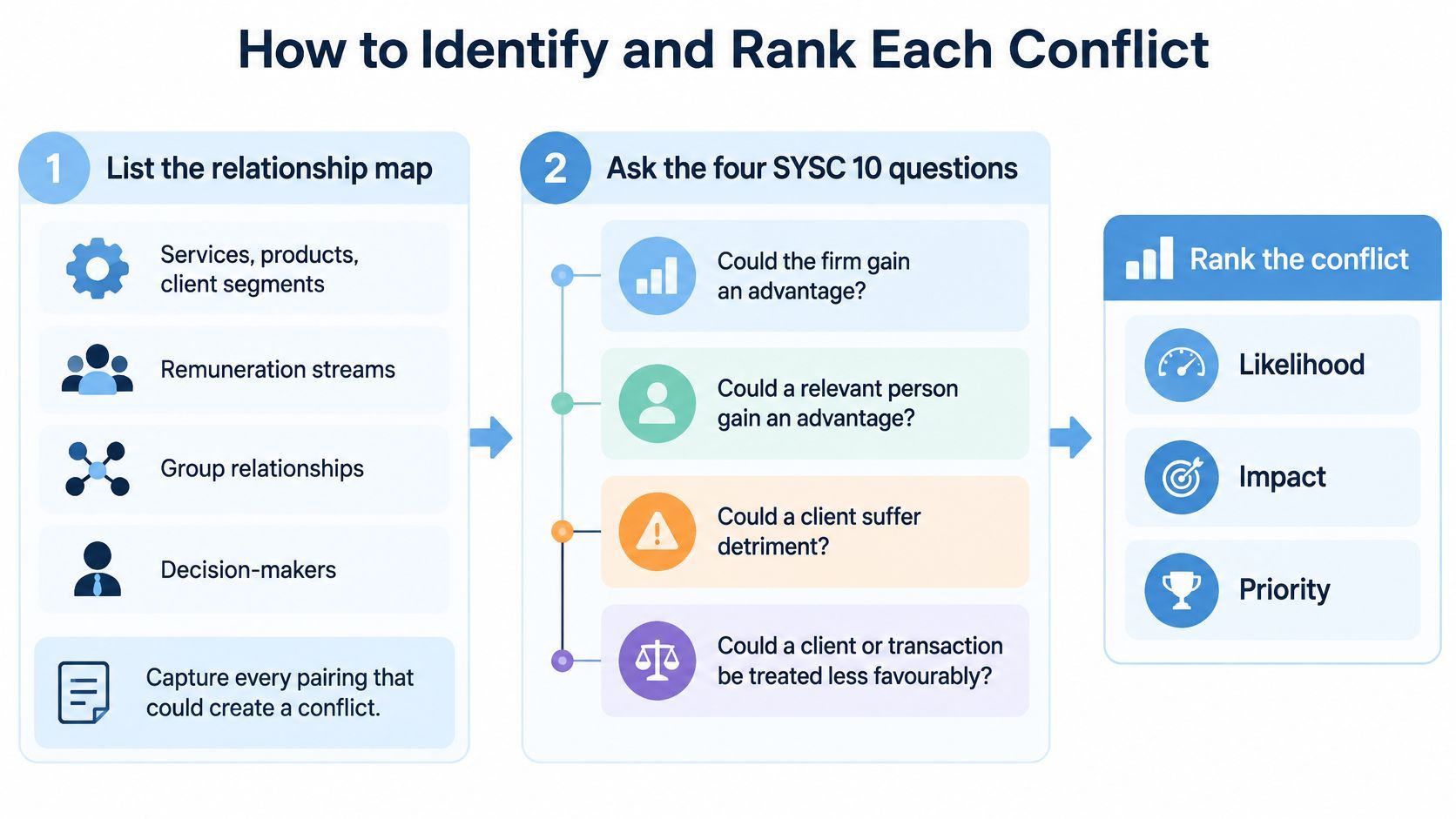
Identification works when it's mechanical. You're building pairings, testing each one, and writing down why it matters. The same discipline helps when you're preparing a broader financial crime risk assessment, because both exercises fail when the underlying business map is incomplete.
The five steps
- List the relationship map. Capture each service, product, client segment, remuneration stream, group relationship and decision-maker. Include outsourced providers and anyone who can influence a recommendation, listing, allocation or price, not only front-office staff.
- Ask the four questions for each pairing. Could the firm or a relevant person gain at a client's expense? Does the firm hold an outcome distinct from the client's? Could it favour one client over another? Does a third-party inducement apply? A yes to any question creates a register candidate.
- Score likelihood and client impact. Use a simple three-point scale for each, then write one sentence explaining each score. Numbers without reasoning don't help a reviewer, and they won't help you prioritise controls either.
- Assign an owner and choose the response. Name the person accountable for that conflict and record whether you'll prevent it, manage it with controls, or disclose it because controls aren't enough. Unowned rows drift.
- Set a review trigger for each row. Link the row to events such as a new product, a pay change, a new affiliate, a token listing or a new outsourcing contract. That trigger is what stops the register freezing at authorisation.
Where firms slip
The common slip is scoring the visible sales conflict and missing the structure behind it. A team may record that an adviser could favour a higher margin product, then overlook the bonus scorecard that creates that pressure or the affiliate that shares a server and sees client flow. I would always trace the money, the information and the approval route together. If you only follow one, you'll miss the mechanism.
A finished row should read as one complete line of reasoning. Source, question triggered, likelihood and impact scores with rationale, named owner, chosen response, control or disclosure, and review trigger. For example, a per-account introducer fee might trigger the inducement question, score high on likelihood because payment follows funding, and require a flat fee redesign owned by the commercial lead with compliance approval.
Treat the assessment as a document a regulator can ask to see. The reasoning must be on paper, dated and attributable, not held in a workshop memory.
Matching Each Conflict to the Right Control
Controls should address the mechanism that creates a conflict. Change the incentive where possible, separate incompatible duties where needed, and use monitoring to test whether safeguards work in practice. Disclosure is appropriate when controls cannot reduce the risk enough. Generic training or a longer policy will not correct a structural incentive on its own.
The FCA consultation on conflicts requirements proposes that firms maintain an effective written conflicts policy proportionate to their size, organisation, and the nature, scale, and complexity of their business, including segregating incompatible tasks and responsibilities. Proportionality does not remove the need for clear accountability. A responsibility matrix can link each regulated activity to an accountable manager, preparer, approver, monitoring function, and escalation route. These responsibilities should fit the firm's wider FCA compliance requirements.
| Conflict cause | Control to apply | Evidence a reviewer will ask for |
|---|---|---|
| Incompatible duties in one person | Separate the duties or require a second approver | Approval records and role descriptions |
| Sensitive information reaching commercial teams | Information barriers and access controls | Access logs and barrier sign-off |
| Decisions that benefit the firm | Independent review before the decision | Review minutes and evidence of reviewer independence |
| Pay linked to sales or product take-up | Remuneration restrictions and control-function sign-off | Pay design papers and scorecard review |
| Client orders competing with firm or staff orders | Transaction allocation rules and pre-clearance | Allocation policy and pre-clearance log |
| Staff personal trading | Restricted list, pre-clearance, and monitoring | Personal dealing records and breach reports |
| Third-party payments for steering business | Ban, cap, or disclose the payment | Contracts, fee schedules, and disclosure texts |
| Conflict that controls cannot reduce enough | Disclose before business starts | Client disclosure record and timing |
Personal dealing and pay need operating controls
For personal dealing, set up pre-clearance, a restricted list, and monitoring of staff accounts. Where a firm conducts designated investment business, the COBS 11 test also applies. Personal transactions must be prevented if they are prohibited under the Market Abuse Regulation, involve misuse or improper disclosure of confidential information, or are likely to conflict with an obligation owed to a client. The test covers trades likely to conflict with client duties, not only proven insider dealing.
Pay design needs equivalent scrutiny. Risk, compliance, and other control functions should be independent of the commercial teams whose targets they check. Their remuneration should not depend on sales generated by those teams. Otherwise, the reviewer has a financial reason to soften the challenge.
Consider a firm that replaces per-account referral fees with a flat fee for introducers. The change reduces the incentive to steer clients towards funded accounts regardless of suitability. It is stronger evidence of control than adding a policy paragraph that tells staff to act fairly. Keep the fee terms, approval records, and relevant monitoring available to show how the arrangement operates.
Apply the same test to every control: does it limit the incentive or opportunity that creates the conflict, and can the firm show that the control operates? A policy sets expectations; records of approvals, reviews, access, and breaches show whether the arrangements work. If the evidence only records that a conflict exists, the control may not be doing enough.
When Disclosure Is the Right Answer
“We may have conflicts of interest” tells a client almost nothing. Compare it with a specific statement: “We receive a fee from partner X for each client it introduces. The fee does not change which product we recommend, and advisers are not paid on volume.” The second version identifies the source, explains the risk and states the mitigation.

Could a client make an informed decision from this text alone?
Disclosure is required when a firm's arrangements do not provide reasonable confidence that client harm will be prevented. It must be made before the firm undertakes the business. Under FCA Handbook SYSC 10, the firm must clearly disclose the general nature or sources of the conflict, or both, with enough detail for the client to make an informed decision. Explain the specific conflict, the risk to the client and the measures taken to mitigate it.
What to check before a disclosure goes live
- Specific conflict: Name the arrangement, payment, holding or dual role, rather than relying on a generic category.
- Nature and source: Explain where the incentive comes from and who benefits.
- Client risk: State how the conflict could affect price, recommendation, allocation or service.
- Mitigation: Describe the controls already operating and the risk that remains.
- Timing and receipt: Record when the disclosure was provided, to whom, and how the client confirmed receipt.
Give the client enough time to decline or choose differently. A disclosure buried after onboarding, or shown after an order is placed, cannot support an informed decision. Keep the version provided with its delivery record and any client acknowledgement.
Disclosure is not a substitute for an effective control. If the incentive can be removed or reduced at reasonable cost, relying on disclosure alone leaves the structural cause in place. Treat each disclosure as a reason to examine whether the arrangement should continue, and whether there is evidence that the stated mitigation operates. A policy document alone does not show that the conflict is controlled.
Keeping the Register Live and Monitoring Breaches
A register can look complete and still be out of date. In its 2025 wholesale banks supervision insights, the UK Financial Conduct Authority reviewed conflicts-of-interest registers and breach data across 7 wholesale banks and found firms commonly updated their registers when their business scope changed, including expansion into new markets or products, while recorded breaches primarily involved violations of internal conflict-management procedures, for example committing to transactions before completing the required conflicts clearance.
That finding matters because the failure wasn't mainly missing policy language. It was people bypassing the procedure. Clearance after commitment is not clearance.
Why registers go stale
New markets, product launches, token listings, outsourcing changes, pay changes, personal account dealing rules, related-party arrangements and changes in senior-manager responsibilities each create fresh incentives. None enters the register automatically. Without a trigger, an owner and a workflow, you get a silent conflict, one that never appears because nobody was required to look for it.
Accountability for that workflow should be explicit, as it is under the FCA senior managers regime. If everyone owns conflicts in general, nobody updates a specific row when the business changes.
A simple live system
- Change log feeding the register: Require product, commercial, technology and HR changes to raise a conflicts check before launch.
- Named owner per row: Give each owner a duty to confirm the row after a relevant change or state why it doesn't apply.
- Quarterly breach review: Look for trends by team, product and control, not only single incidents.
- Escalation examples: Keep records showing a conflict was escalated, decided and mitigated, not merely noted.
One bank in the review was the only firm that recorded no conflicts-related breaches during the three-year period examined. Senior management should challenge whether an absence like that is credible for the firm's activities. Zero breaches may mean strong controls. It may also mean staff don't recognise or report breaches.
Hold dated register versions, change log entries, breach trends and escalation records as one evidence set. That set shows a living governance process tied to business change, transaction approvals and implementation.
How FCA, MAS and DFSA Expectations Compare
A group operating across jurisdictions cannot rely on one conflicts standard without checking how each regulator applies its rules. UK firms should map the register to SYSC 10 and the SYSC 3 disclosure standard. Singapore firms should identify the MAS requirements for their licensed activities and distinguish binding rules from supervisory expectations. DIFC firms should check the DFSA conduct rules for their licence category. ADGM firms should consult the FSRA rulebook, while VARA firms should check the VARA rulebook.
Use one register with a column for each applicable regime. For every conflict, record the relevant rule, the register entry it applies to and any difference in disclosure wording. Where regimes address the same conflict, apply the stricter standard and record why. This helps groups working across crypto asset regulation in multiple jurisdictions keep their mapping tied to the rules that apply.
The shared framework is to identify conflicts, prevent or manage them, disclose when controls fall short and retain evidence. The details vary: thresholds, wording and disclosure requirements may differ. A UK disclosure may not satisfy a regulator in Singapore or the Gulf, so confirm the relevant interpretation with the authority or qualified counsel. Staff should also understand which regime applies to their work. Role-based learning can support that understanding, and building an effective compliance training program offers a way to structure it around responsibilities rather than generic annual slides.
Confirm Your Conflicts Framework Before Submission
Run this pass or fail test this week. Each check points back to the work that builds it.
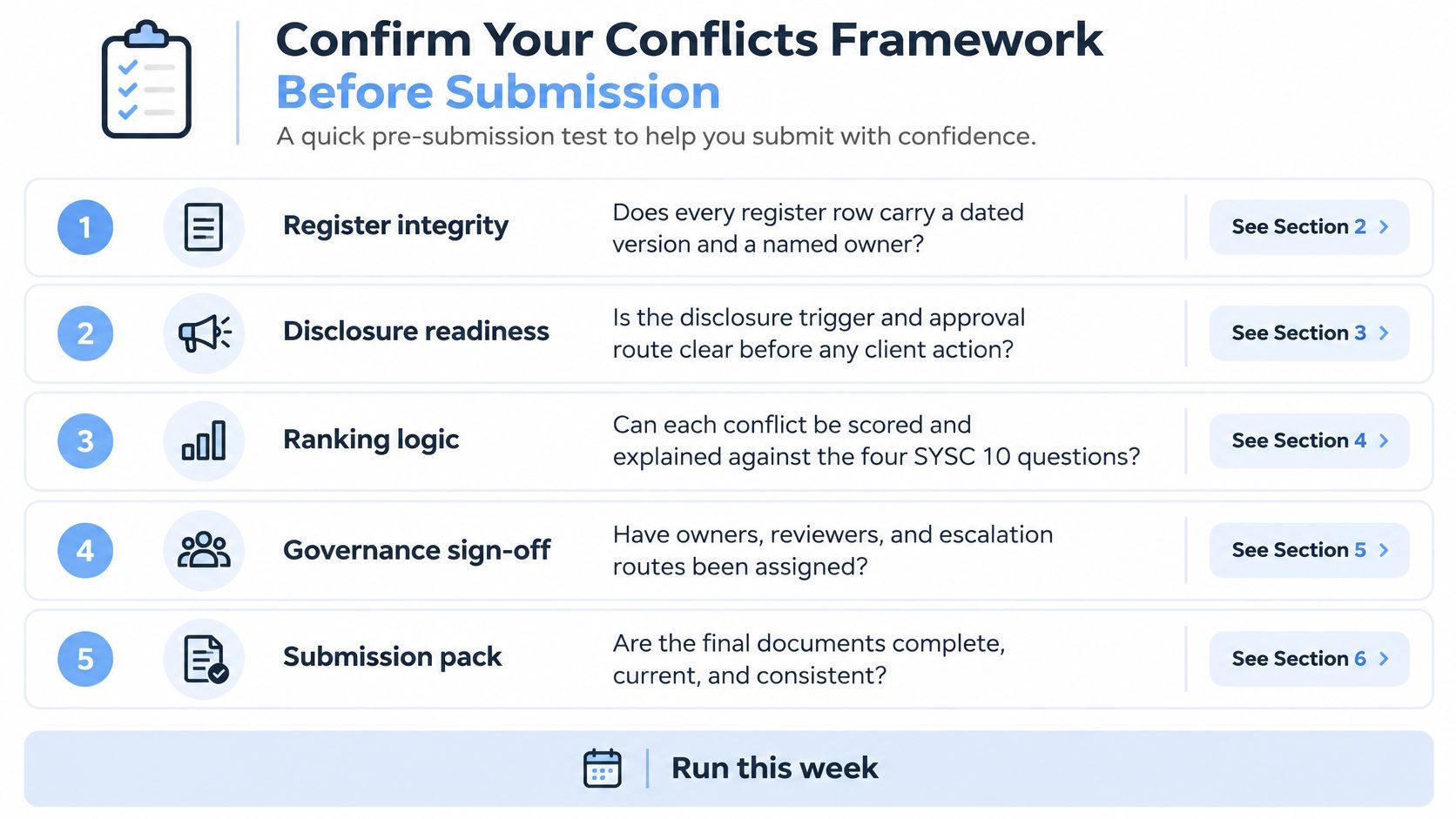
- Register integrity: Does every row carry a dated version and a named owner?
- Control evidence: Is each conflict linked to a control and an evidence item, with proof the control operates rather than only that it's designed?
- Disclosure readiness: Has every text passed the informed-decision test, with timing and receipt records?
- Change coverage: Does the change log show a review after each material change, including new markets, products, token listings and pay changes?
- Breach learning: Does the breach log show a quarterly trend review and at least one worked example of a conflict escalated rather than only recorded?
- Proportionality: Does the responsibility matrix link each activity to an accountable manager, preparer, approver, monitoring function and escalation route?
- Regime mapping: Has the register been mapped against each regime that applies to the firm?
Next, map the register against the business plan and operating model. Glentorion identifies the evidence still needed, the questions to be resolved and the decisions requiring further client involvement. Our first step is to examine planned activities, jurisdiction, existing material and open questions, then agree the work, deliverables and responsibilities. Regulatory decisions remain with the relevant authority, and approval and decision dates are not guaranteed.
If your register can't yet show who owns each conflict, which control operates, and what changed after your last product or pay decision, Glentorion can help you close those evidence gaps and prepare a coherent conflicts framework for authorisation. Visit Glentorion to discuss scoping your planned activities, jurisdiction and submission materials before you file.
- conflicts of interest
- FCA conflicts rules
- SYSC 10
- conflicts register
- conflicts policy