SMCR Conduct Rules Explained for UK Firms
Published
A complaint, a missed limit, or a safeguarding break is already in a folder, and the disciplinary meeting is in the diary. The emails are saved. What is missing is the rule. Until someone names which of the SMCR Conduct Rules is engaged, HR cannot pick a fair sanction, Compliance cannot brief the regulator, and the Senior Manager cannot tell whether this is a personal accountability problem. Label the standard before you judge the person.
Table of Contents
- The SMCR Conduct Rules Staff Must Follow
- Who the Conduct Rules Cover Inside a Firm
- Reasonable Steps Senior Managers Must Evidence
- How to Embed the Rules in Policies and Roles
- Training That Shows Staff How the Rules Apply
- Reporting Conduct Rule Breaches on Time
The SMCR Conduct Rules Staff Must Follow
That unnamed file is where most investigations stall. People argue about tone and outcome before they have agreed the legal standard. The FCA Handbook guidance in COCON separates the five original individual rules from the later Consumer Duty rule. Earlier FCA material described those five as integrity, due skill, care and diligence, openness with regulators, treating customers fairly, and proper standards of market conduct. Current FCA material adds a duty to act to deliver good outcomes for retail customers where the Consumer Duty applies.
The ten standards
| Rule | Who it binds | What it requires |
|---|---|---|
| Individual Conduct Rule 1 | Most Conduct Rules staff | Act with integrity |
| Individual Conduct Rule 2 | Most Conduct Rules staff | Act with due skill, care and diligence |
| Individual Conduct Rule 3 | Most Conduct Rules staff | Be open and cooperative with the FCA, the PRA and other regulators |
| Individual Conduct Rule 4 | Most Conduct Rules staff | Pay due regard to customers and treat them fairly |
| Individual Conduct Rule 5 | Most Conduct Rules staff | Observe proper standards of market conduct |
| Individual Conduct Rule 6 | Staff where the Consumer Duty applies | Act to deliver good outcomes for retail customers |
| Senior Manager Conduct Rule 1 | Senior Managers only | Take reasonable steps so the business you are responsible for is controlled effectively |
| Senior Manager Conduct Rule 2 | Senior Managers only | Take reasonable steps so that business complies with regulatory requirements |
| Senior Manager Conduct Rule 3 | Senior Managers only | Delegate only to an appropriate person and oversee that delegation |
| Senior Manager Conduct Rule 4 | Senior Managers only | Disclose information the FCA or PRA would reasonably expect |
Individual Conduct Rules 1 to 5 bind most Conduct Rules staff. They are the floor for day-to-day behaviour, not a code that only senior people read.
Individual Conduct Rule 6 is narrower. It binds staff only where the Consumer Duty applies, and it requires them to act to deliver good outcomes for retail customers. It sits alongside Rule 4. Fair treatment stays in force. Good outcomes don't replace it, and a wholesale-only firm shouldn't paste Rule 6 into every job description.
The four Senior Manager Conduct Rules bind Senior Managers only. Control of the area, compliance of that business, delegation to an appropriate person with real oversight, and disclosure of what the FCA or PRA would reasonably expect are personal duties. They aren't a second copy of the individual rules.
Integrity is not a poor outcome
The same COCON guidance sets the investigation line. A breach of Individual Conduct Rule 1 requires conduct involving a lack of integrity. A breach of Rule 2 requires a lack of due skill, care and diligence. A mistake, weak performance, or a poor customer outcome is not automatically dishonesty.
Test the behaviour against the rule and the facts. Did the person mislead a customer, conceal a breach, or ignore a conflict they understood? A badly handled conflict often decides the label, which is why the conflicts register and the decision around it belong in the file before anyone drafts a warning. If the person followed the process, used the information they had, and still got it wrong, you are usually looking at competence, care, or diligence.
Practical rule: Write the rule number on the front of the disciplinary file before you open it. If you cannot name the rule, you are not ready to judge the person.
That order stops a competence failure being dressed up as dishonesty, and it stops a real integrity breach being softened into a training note.
Who the Conduct Rules Cover Inside a Firm
Map people before you rewrite policies. A job title is a weak proxy for scope, and an unsigned assumption is a weak defence.
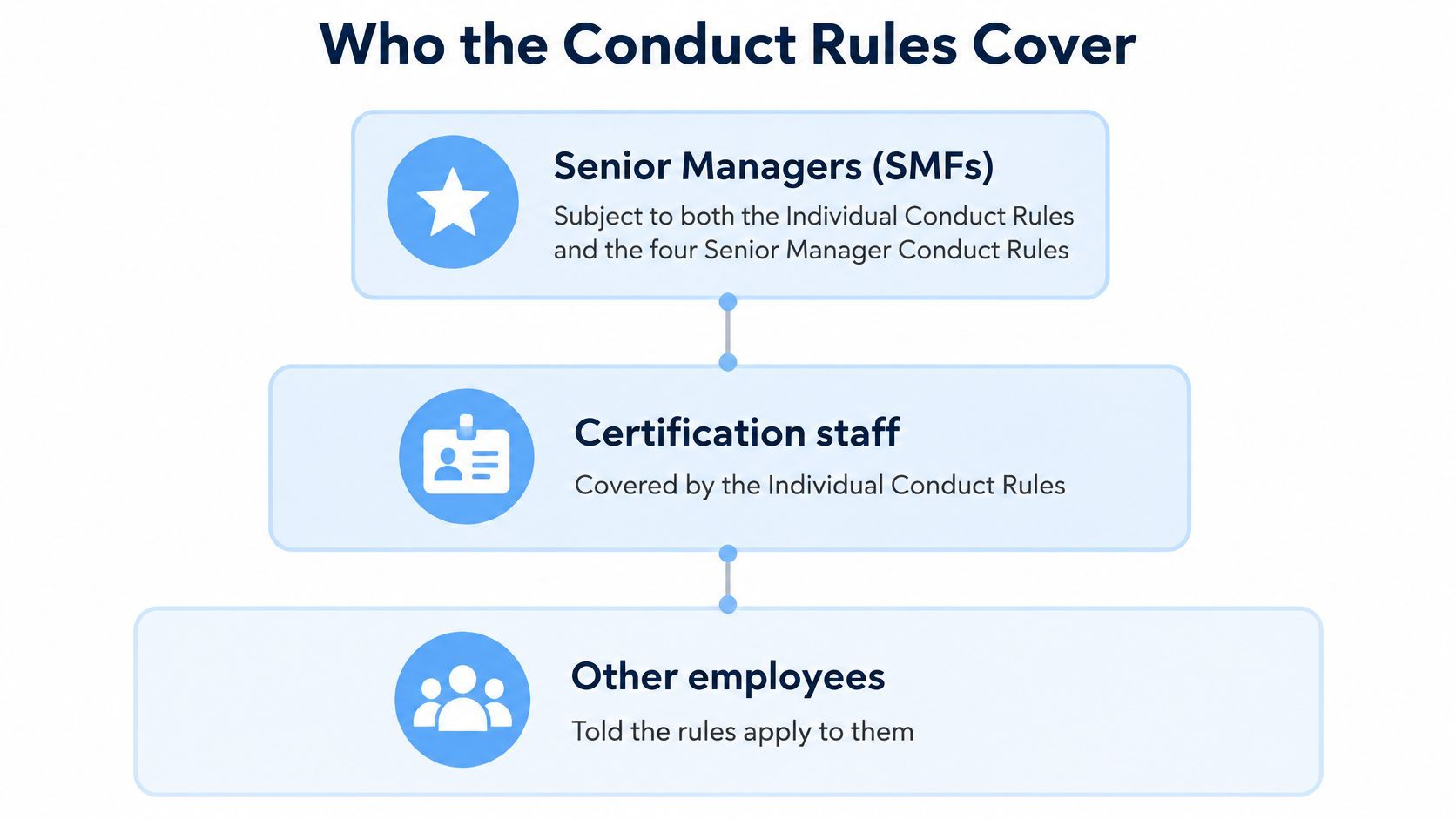
Senior Managers who hold a Senior Management Function are in both sets. The Individual Conduct Rules apply to them, and so do the four Senior Manager Conduct Rules. Certification staff and most other employees are subject to the Individual Conduct Rules. They don't carry the senior-manager set unless they are covering an SMF.
Specified ancillary staff fall outside. Don't treat "ancillary" as a vibe attached to a grade. Keep a documented exclusion list. Typical ancillary work is reception, post, security, catering, and cleaning, and only where that person performs no regulated activity. A receptionist who also takes client instructions, or a security lead who approves access to client assets, is no longer ancillary. The exclusion should name the person, the tasks, and the reason they are out.
Why the list cannot be informal
The reach of the regime is why a tidy list matters. As the FCA's account of the Senior Managers and Certification Regime sets out, Parliament legislated in December 2013 after conduct failures that included the manipulation of LIBOR. The FCA and PRA applied it to UK banks, building societies, credit unions, and PRA-designated investment firms from March 2016, to insurers in December 2018, to almost all FCA solo-regulated firms in December 2019, and to benchmark administrators in December 2020. A crypto firm, a payment firm, and a benchmark administrator can all have Conduct Rules staff. The population is not "the bankers upstairs".
Place the statutory Duty of Responsibility beside the Conduct Rules, not instead of them. A Senior Manager may face action where the firm breaches a requirement in that manager's area and the manager failed to take reasonable steps to prevent or stop the breach. The Conduct Rules ask how the individual behaved and how they ran the area. The Duty asks whether reasonable steps were taken against a firm breach. You need both lenses when you look at an approved-person and SMF population.
One joint task closes the map. HR and Compliance should hold an in-scope list and an exclusion list that reconcile to payroll. New joiners, leavers, and people who change desks should move between those lists in the same week the payroll code changes. A list that only Compliance maintains will drift the first time a contractor is extended.
Reasonable Steps Senior Managers Must Evidence
A Senior Manager is not on the hook merely because misconduct happened in their area. The question is whether governance was reasonably designed and operated to prevent, detect, or correct a breach.
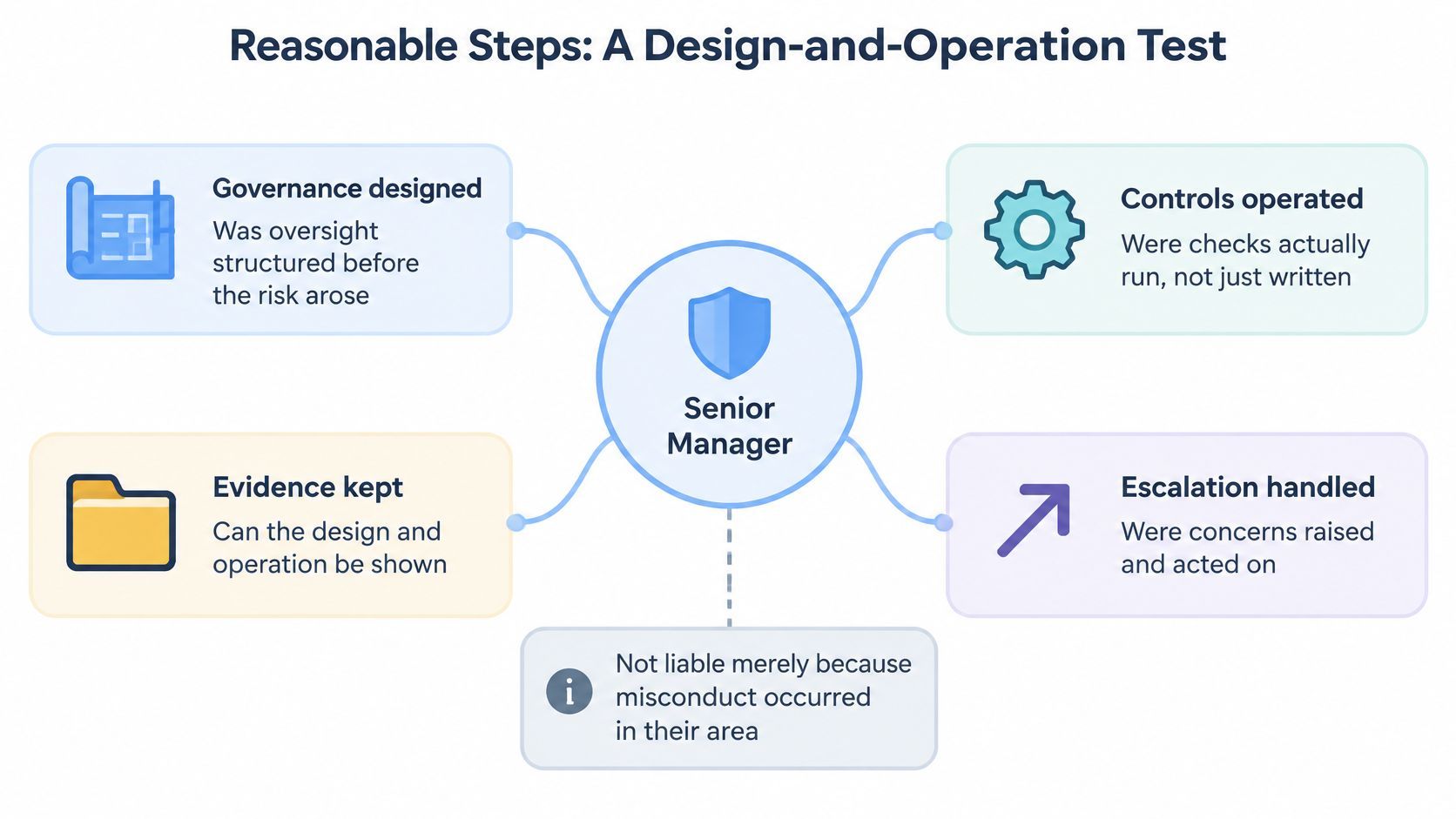
The FCA's Senior Managers Regime pages frame this as a control-and-evidence obligation for solo-regulated firms, not a personal ethics test. In operational language the four senior duties ask four things. Is the area controlled? Does that business comply with the requirements that apply to it? Is work handed only to an appropriate person, with oversight that still reaches the SMF? Is the regulator told what the FCA or PRA would reasonably expect to receive?
What should already be on the file
A newly appointed SMF should be able to walk through contemporaneous records, not a story rebuilt after the event. I would expect this pack:
- Responsibility map: each material activity tied to an SMF, matching the statement of responsibilities.
- Written delegations: the delegate, the limit of their authority, and the oversight the SMF keeps.
- Management information: thresholds that turn a metric red, not a dashboard with no trigger.
- Committee decisions and risk acceptances: who accepted the residual risk, and for how long.
- Incident logs plus challenge and remediation: the question asked, the action agreed, and the date it closed.
Say two payments firms both put the operations SMF's name on the safeguarding map. In the first, monthly safeguarding MI has a red threshold. The SMF challenges a miss in the committee pack, and remediation is tracked to closure. In the second, there is no MI line and no escalation route. The name is on the map and nowhere else. Missing ownership, a weak escalation route, or undocumented oversight is what turns a firm breach into an individual issue. The same split appears in custody. A wallet-control break that reaches the SMF with a decision right is a different file from a break that lives only in an operations chat.
A name on the map is not oversight. Oversight is the indicator that reached you, the decision right you used, and the reason the step was reasonable.
That is the interview question worth rehearsing against the Senior Managers arrangements you already hold. What did you know, what indicators reached you, which decision rights did you use, and why were the steps reasonable? If the answer needs a reconstruction, the control was not being operated.
How to Embed the Rules in Policies and Roles
Run this sequence against documents you can open today. A Conduct Rules policy that nobody uses fails because it describes a firm that doesn't exist.
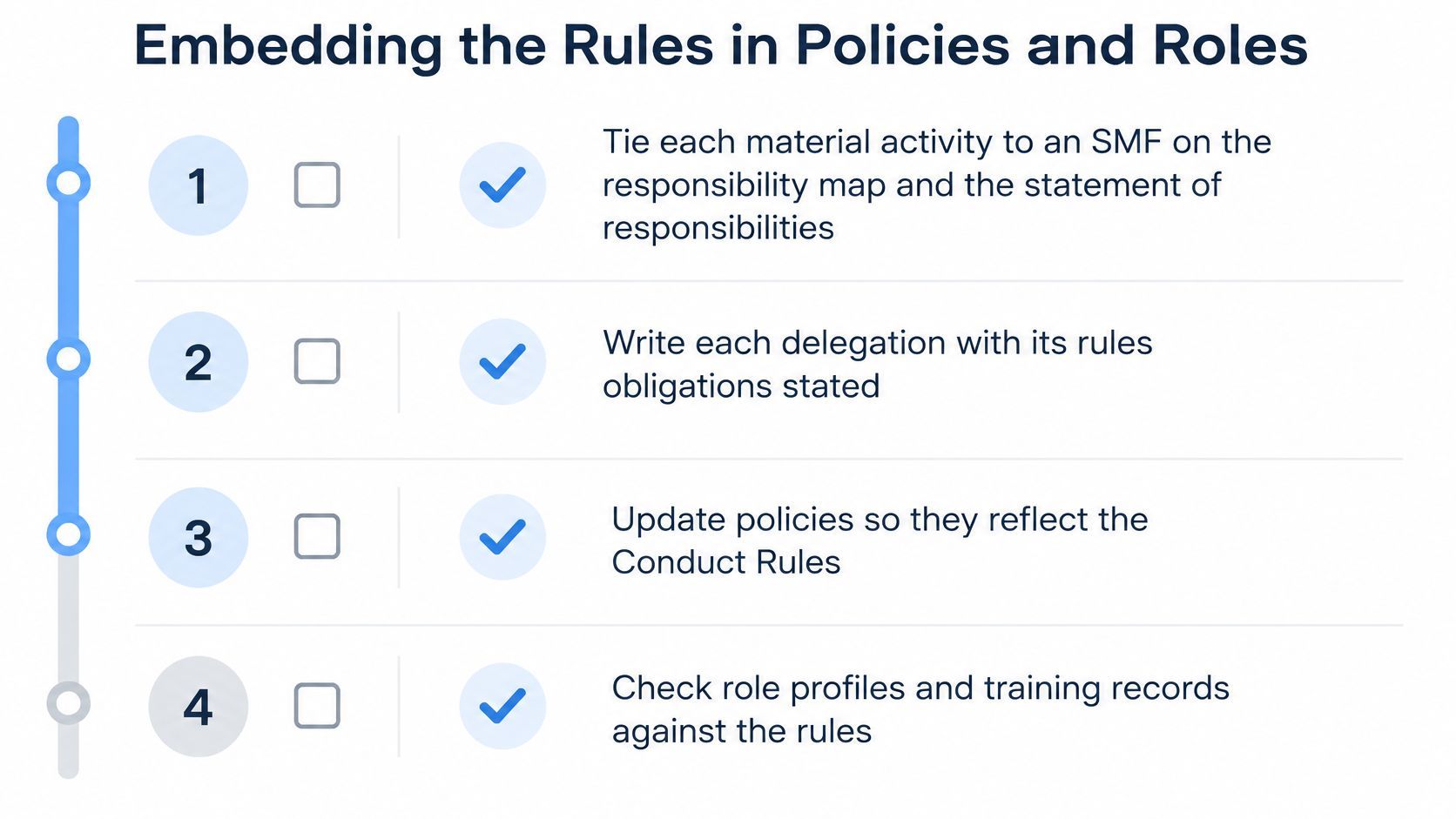
- Tie each material activity to an SMF on the responsibility map and on the statement of responsibilities. If an activity has two owners, it has none. Crypto custody is a good test. Wallet administration, client-asset reconciliation, and incident response should each name one SMF, even where a delegate does the daily work.
- Write each delegation with the delegate, the limits, and the oversight the SMF keeps. "Operations will handle it" is not a delegation. A limit might be a value, a client type, or a ban on waiving a control without the SMF.
- Put the applicable rules into the staff handbook, the disciplinary policy, and new-joiner materials, so a suspected breach has a defined route. People drafting those documents get further, faster, once they see what policy courses actually cover, including how a rule becomes a procedure rather than a slogan.
- Set management-information thresholds that would tell the SMF the area is not controlled. A safeguarding break should hit the operations SMF on a defined MI line. A compliance newsletter is not that line.
- Connect incident, complaint, market-abuse, and financial-crime logs to the rule that might be engaged. The log field can be a simple drop-down. If the field is blank, the case is not ready for HR.
- Record challenge, risk acceptance, and remediation at the time. Reasonable steps that appear only in a later reconstruction are weak steps. The minute should show the question, not just the decision.
What to leave in its own document
Fitness and propriety assessments, and certification assessments, stay as separate documents even when they sit in the same governance pack. Folding them into the Conduct Rules policy makes both harder to evidence. A standard operating procedure can point to those assessments. It shouldn't swallow them.
Once a quarter, check that the map, the policies, and the MI still describe the same activities. Do it after a product launch, a new venue, or a change of SMF, not only on a calendar date. If the firm has started settling in a new asset and the MI pack still tracks yesterday's product, the embedding work has already slipped.
Training That Shows Staff How the Rules Apply
The duty comes before the course design. The firm must tell people that the Conduct Rules apply to them and take all reasonable steps so they understand how the rules apply to their roles. The FCA Handbook in SYSC 23 treats suitable training as part of those steps. You also need evidence that understanding was supported. A policy in a compliance library doesn't meet that test. The same Handbook source is clear that solo-regulated firms must report Conduct Rules breaches, so the training has to show people the path from a suspected breach to an assessment and, where needed, a notification.
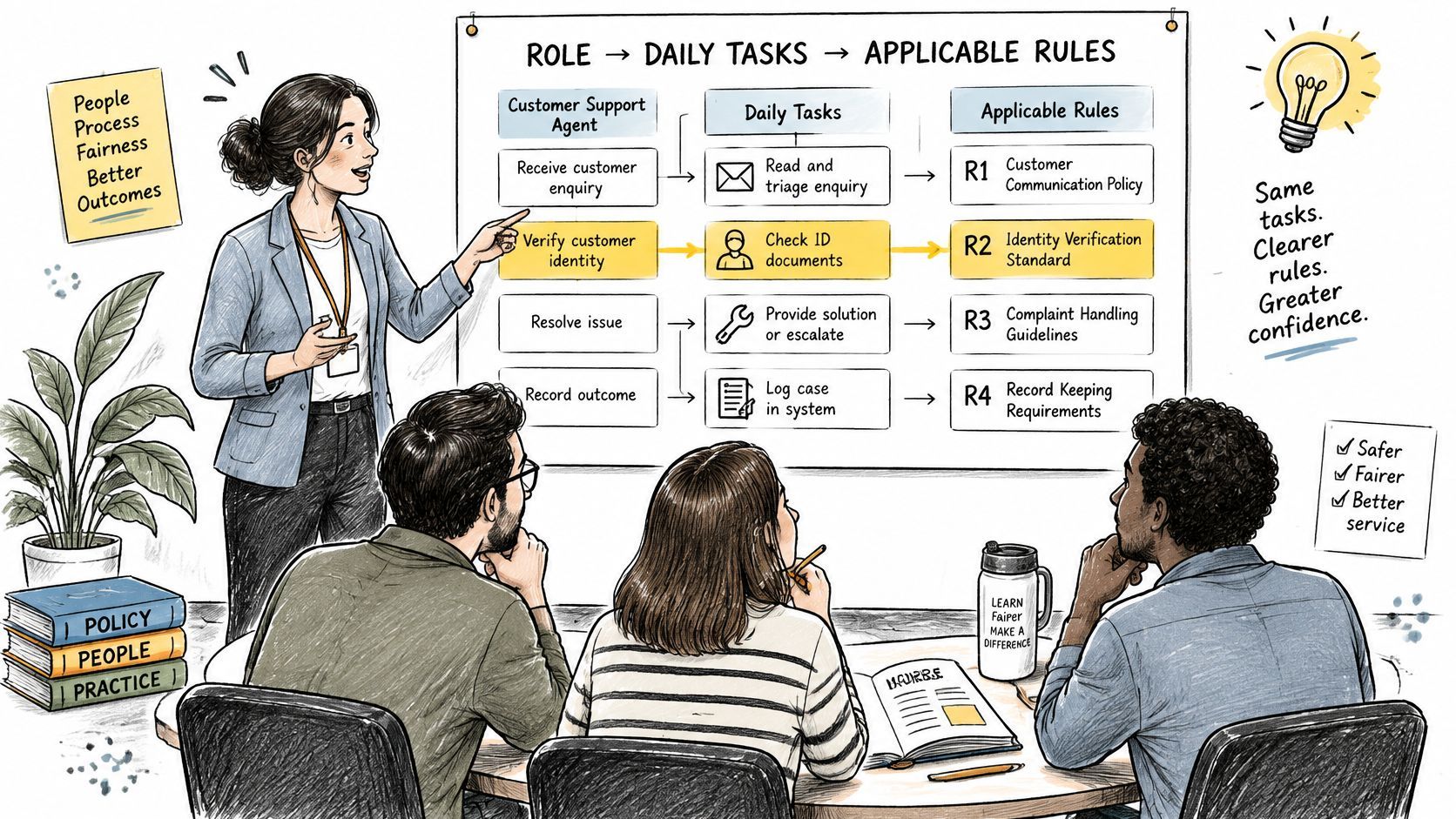
Scenarios that match the job
One generic e-learning module is a weak control. It proves attendance, not understanding. Match the scenario to the work.
- A trader or market-facing dealer works through proper standards of market conduct, including what they do with an order that looks like it was placed to move a price.
- A complaints handler works through fair treatment and, where the Consumer Duty applies, good outcomes for retail customers. The case should include a vulnerable customer, not only a fee dispute.
- An SMF works through control, delegation, and telling the regulator what it would reasonably expect. Use a missed MI threshold, not a slide about "tone from the top".
Three moments matter more than an annual bulk upload. Train before a joiner performs the role. Train again when responsibilities change, including a temporary cover. Run a refresher after a real incident, using anonymised facts from your own log so people recognise the control that failed.
Record who attended, which scenarios were used, and a short assessment or an attested discussion. A completion tick without the scenario name will not show that the person understood their role.
Training doesn't replace the fit and proper assessment for certified staff or for Senior Managers. Those assessments ask whether the person is suitable to perform the role. Training asks whether they have been shown how the rules bite on that role. Keep the evidence apart.
The minimum pack a supervisor should be able to open is short. It is the population list, the communication that the rules apply, the role-relevant materials, the completion evidence, and the date of the last refresh. If any of those five is missing, the reasonable-steps claim on training is already thin.
Reporting Conduct Rule Breaches on Time
The clocks are different, and they should sit inside the disciplinary workflow rather than in a side memo that Legal reads after the hearing.
| Person | Trigger | Deadline | How to notify |
|---|---|---|---|
| Conduct Rules staff other than a Senior Manager | Sufficiently serious disciplinary action for a breach | Annual, via REP008 | RegData return |
| Conduct Rules staff with no such action in the year | Matter not reportable under this requirement | No notification deadline | No filing for that matter |
| Senior Manager | Disciplinary action for a Conduct Rule breach concluded | Within 7 business days | Form D |
| Senior Manager leaving the firm | Disciplinary action concluded and SMF leaving | Within 7 business days | Form C |
| Any SMF with an appeal under way | Appeal does not suspend the duty | Report on time and state appeal status | Form D or Form C |
The FCA's Conduct Rules notification guidance is the source of that split. For staff other than Senior Managers, the firm reports through the annual REP008 return in RegData when disciplinary action is sufficiently serious. A matter that never reaches that threshold is not reportable under this requirement. Don't inflate a coaching note into a breach so that it "looks complete", and don't hide a written warning because the year-end return feels awkward.
For a Senior Manager, notify within 7 business days after disciplinary action for a Conduct Rule breach has been concluded. Use Form D, or Form C where the SMF is leaving. An appeal doesn't pause the clock. Report the action and record the appeal status. Waiting for the appeal outcome is a separate notification failure, even if the internal decision was sound.
One trigger, one file
Name HR, Compliance, Legal, and the SMF's supervisor for each step, from allegation through investigation, decision, appeal, and submission. One controlled trigger beats four inboxes.
The case file should preserve:
- The rule allegedly breached, written as the rule number, not a paraphrase.
- The evidence considered, including what was discarded and why.
- The decision rationale and the sanction, with the dates of each step.
- The approvers, and confirmation that the filing went in.
Track the percentage of concluded SMF cases notified within 7 business days. Reconcile HR disciplinary records to the regulatory return on a set cycle. That reconciliation is the check which stops a valid internal decision becoming a missed FCA notification. If the HR system shows a concluded SMF sanction and RegData or the Form D log doesn't, the gap is yours to close before a supervisor finds it.
Glentorion scopes regulatory authorisation work to the planned activities, the jurisdiction, and the people who will explain the controls. If your Conduct Rules population, responsibility map, or breach file would not stand up to a supervisor's questions, we can examine the existing material and the open decisions with you under a written engagement. Visit Glentorion when you want that work defined before the next case lands.
- SMCR conduct rules
- COCON
- senior managers
- FCA compliance
- breach reporting