How to Write Standard Operating Procedures in 2026
Published
Most advice on how to write standard operating procedures tells you to keep it short, keep it simple, and get it signed off. For a regulated financial or crypto firm, that's bad advice. A short, tidy happy-path SOP reads well in a board pack and proves very little when a regulator, auditor or interviewer asks who acted, what record proves it, and what happened when the system failed.
A regulator-ready procedure isn't office documentation. It's evidence that a required control has been turned into repeatable action by named roles, with thresholds, records and escalation routes that staff can follow under pressure. If your SOP can't survive a missing person, a supplier outage or an AI-generated draft that somebody rubber-stamped, it isn't finished.
Table of Contents
- What a Regulator-Ready SOP Must Contain
- How to Draft the Procedure from the Real Task
- Link Every Step to a Control and a Record
- Write the Procedure for When Something Fails
- Version the SOP and Govern Any AI Use
- Check the Procedure Pack Against Live Practice
What a Regulator-Ready SOP Must Contain
| Section | What it must state | Evidence it produces |
|---|---|---|
| Purpose | The risk or regulatory outcome the procedure exists to achieve | Link to the control objective or rule |
| Scope | Entity, activity, customers, jurisdiction and explicit exclusions | Boundary of who must follow it |
| Roles | Doer, checker and accountable senior manager | Named ownership, not a department label |
| Prerequisites | Systems, data, access and prior approvals required before step one | Readiness before work starts |
| Procedure | Numbered actions and decision points in the order of the real task | Repeatable steps a new joiner can run |
| Escalation | Who is called, the time limit and what is recorded | Route when a threshold or exception hits |
| Records | System of record, fields captured and retention | Proof the step happened |
| Control checks | Frequency, sample, threshold and checker | Test that the procedure is operating |
| Review | Owner, version, effective date and review trigger | Proof the text is still current |
Start with that table in a blank document. For an FCA, PRA, DFSA or VARA facing firm, every row answers a question a reviewer will ask anyway, and a gap in any row becomes a finding.
How Each Row Works in Practice
Purpose names the outcome, not the activity. Don't write "customer withdrawals". Write "complete source-of-funds checks and sanctions screening before any withdrawal is released", so the reader knows what failure looks like. Scope then pins down the legal entity, the regulated activity, the customer type and the jurisdiction, and it excludes work done by another group company. That exclusion matters, because reviewers test boundaries first.
Roles must separate the doer, the checker and the accountable senior manager. "Compliance" isn't a role. "Onboarding analyst prepares, compliance manager approves, SMF holder owns the outcome" is. Prerequisites list what must exist before step one, such as system access, verified identity documents and prior credit approval, so staff don't start a case they can't finish.
The procedure itself runs in numbered actions with decision points. If a sanctions match appears, the case stops, it doesn't proceed with a note. Escalation names the role to call, a time limit and the record created on escalation. Records name the system of record and retention, not "filed appropriately". Control checks state frequency, sample and pass threshold, and review states the owner, version, approval date and the event that forces an update.
The UK Government Standard Operating Procedure Guidelines published on 17 January 2007 require an SOP to account for both regulatory requirements and security practices, but they don't prescribe a single template. Depth should therefore follow the harm if a step is missed, and the text should separate arrangements already running from those still to be built. That distinction sits at the heart of FCA compliance requirements in an authorisation pack, where claiming a future control is live will unravel at the first follow-up question.
Practical rule: If a row in the table can't be filled with a name, a system or a threshold, you don't have a drafting problem. You have an operating gap.
How to Draft the Procedure from the Real Task
The UK Health and Safety Executive methodology on procedures and human factors treats an SOP as a risk-control instrument, and it starts with task analysis rather than writing. I would follow that sequence exactly, because procedures written from policy documents describe the firm you wish you had.
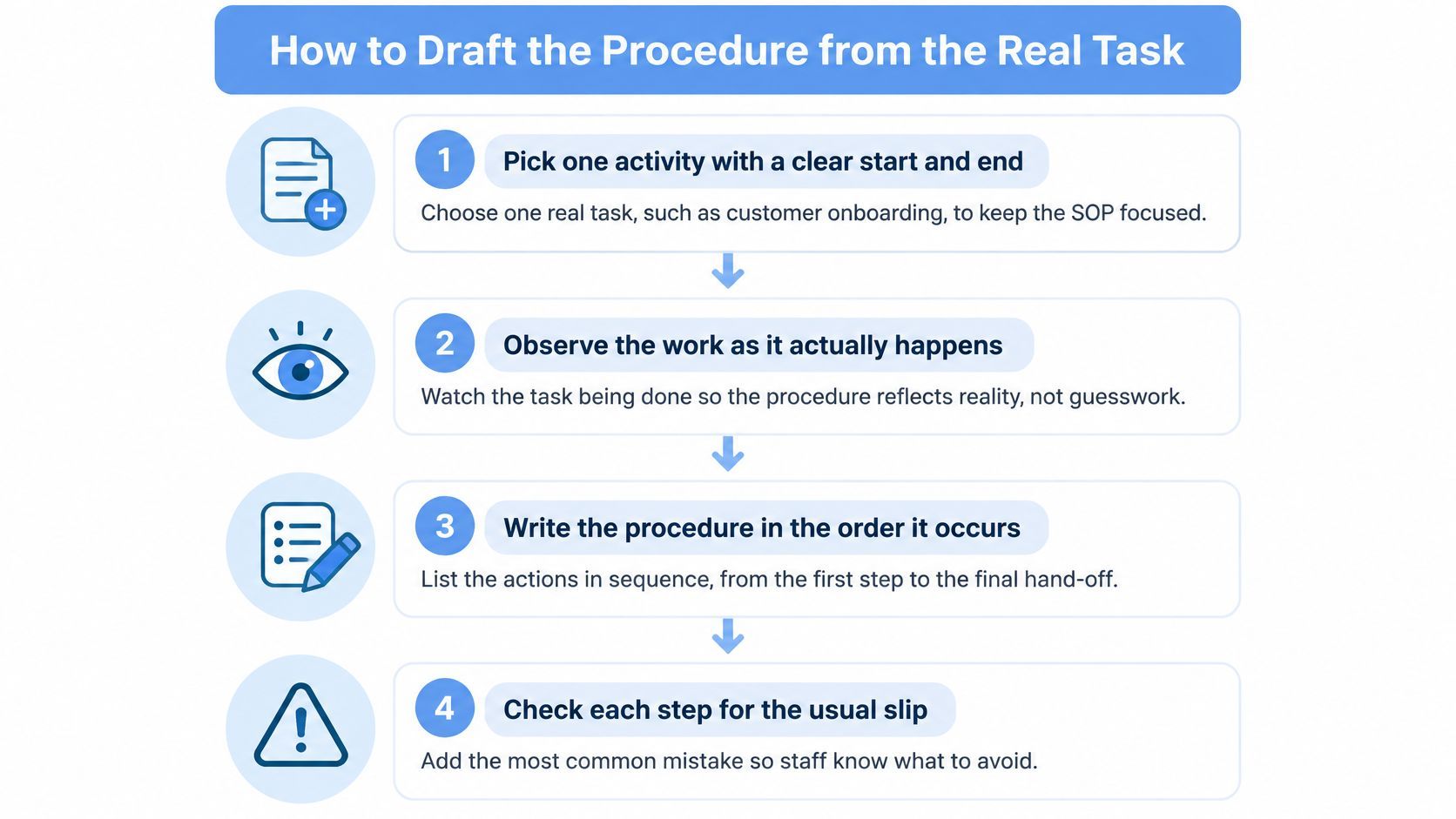
- Pick one activity with a clear start and end, such as customer onboarding, a transaction-monitoring alert, an incident escalation or a regulatory submission, and name the important business service it supports, because a bounded task exposes real handoffs. The usual slip is choosing a whole department, which hides those handoffs.
- Walk the task with the people who do it and list failure modes and consequences before writing any step, because operators know where cases stall and which screens lie. The usual slip is writing from the policy document instead of observed practice.
- Decide whether a procedure is the right control, or whether the gap is competence, system access or a missing policy, because paper can't fix a capability problem. The usual slip is writing a procedure to fix a training gap.
- Draft for the user, with one action per numbered step starting with a plain verb, naming the system and the role, with yes or no decision points and a flowchart where judgement would be misread under pressure. The usual slip is wording such as "review as appropriate", which nobody can test.
- Split a long task into short sections that can be reopened after an interruption, because staff resume mid-case far more often than they start cleanly. The usual slip is one long document nobody opens mid-task.
- Have operators run the draft in the live environment and log ambiguity, missing evidence, unavailable systems and contradictions, because that's where the procedure will either work or fail. The usual slip is testing in a sandbox that lacks the real queue.
- Assign an owner, version, effective date, review trigger and a list of other documents affected by change, because an unowned text drifts within weeks. The usual slip is approved text with no named owner.
- Approve only once the test log is cleared, or each open item is accepted by a named senior manager, because approval should record residual risk rather than hide it. The usual slip is approving with open items unrecorded.
Wording That Survives a Test Run
Step wording decides whether two testers do the same thing. Writers who need a disciplined model for concise, unambiguous instructions can use ASD-STE100 procedure writing guidance as a reference for controlled language, short sentences and one instruction at a time. You don't need to adopt simplified English wholesale, but borrowing its discipline kills most ambiguity before testing starts.
A procedure doesn't replace competence. Training and demonstrated ability are tested separately, and a signed acknowledgement that somebody read version three proves nothing about whether they can handle a borderline source-of-funds case.
You're done when a tester who didn't write the draft completes the task in the live system and produces the named record, without asking the author what a step meant.
Link Every Step to a Control and a Record
A step without a control is an instruction. A step without a record is a claim. You fix both by adding one control line under each material step, without rewriting the whole procedure.
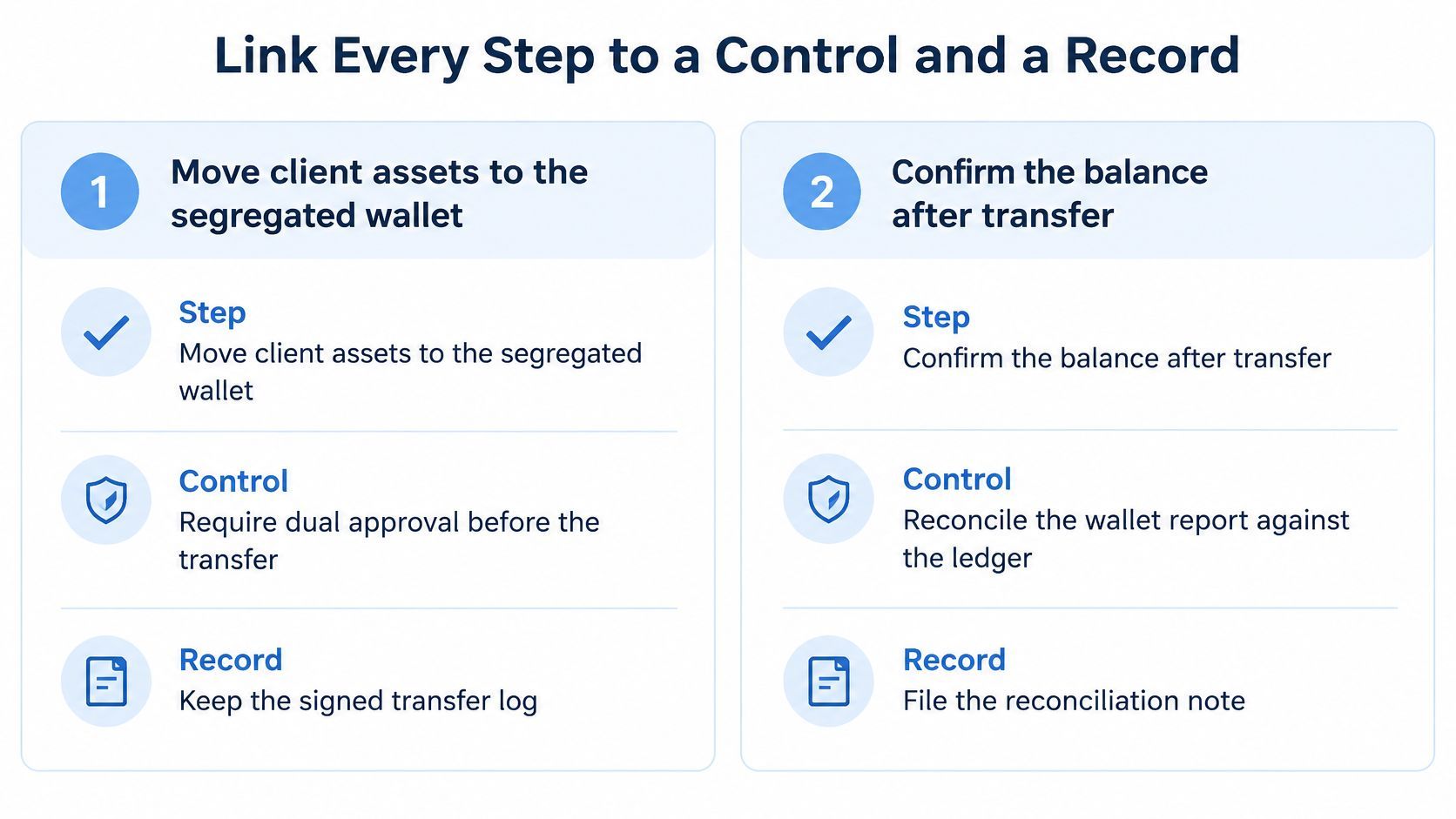
Take a crypto safeguarding step, "move client assets to the segregated wallet". On its own, that tells a reviewer nothing. Add the control line and it becomes auditable.
- Control objective: Client assets stay separate from firm assets at all times.
- Roles: Operator initiates, independent checker approves, neither can do both.
- Threshold: No release above the dual-approval limit without senior sign-off.
- Exception route: Break-glass access only, with a same-day report to the accountable manager.
- Record: Approval log, transaction hash and timestamp in the custody system.
Apply the same line to an onboarding identity check, a monitoring alert closure and filing a regulatory return. The pattern doesn't change, only the threshold and the record do. Firms building this discipline across a control inventory will find the thinking behind audit readiness for compliance-focused enterprises useful, because a risks and controls matrix forces exactly this pairing of risk, control and evidence.
Six Tests Before You Call It Finished
The UK statistical quality principles and procedures identify six quality dimensions, relevance, accuracy, timeliness and punctuality, accessibility and clarity, comparability, and coherence. Used as a writing test rather than a statistics rule, those dimensions catch most SOP defects.
| Quality dimension | Test question | Failure sign |
|---|---|---|
| Relevance | Does it address a real process and user need? | Steps describe a process nobody runs |
| Accuracy | Are steps and control thresholds correct? | Limits differ between the SOP and the system |
| Timeliness | Does it support the required deadlines? | Escalation or filing has no time limit |
| Accessibility and clarity | Can staff execute it without asking anyone? | Two testers take different actions on the same step |
| Comparability | Is it consistent across teams and periods? | Each team runs the same task differently |
| Coherence | Does it align with policy, records and systems? | A field the SOP names does not exist in the system |
Flag any step that names a control but points to no field in a system. That step can't be evidenced, so in a review it'll be treated as not operating. Procedure writing meets your wider financial crime risk assessment, because a risk that maps to a control with no record is an unmitigated risk, whatever the policy says.
Then build a sampling habit. Each month, pull a small set of completed cases and check that the record matches the SOP step for step. When it doesn't, record the miss as a procedure defect first and a staff error second. Most repeated misses mean the text, the system or the threshold is wrong, and blaming the operator just guarantees the same miss next month.
Write the Procedure for When Something Fails
Say your trading platform supplier drops out during a client withdrawal window. Your happy-path SOP says the analyst checks the queue, approves, releases. It says nothing about who can pause withdrawals, what clients are told, how long you tolerate the outage, or what evidence you capture while the phones ring. In that moment, staff improvise, and improvised actions leave inconsistent records.
A concise SOP is easier to read. It's also weaker evidence of readiness. I would rather defend a modular procedure with a short failure module attached to each important business service than a two-page summary backed by a separate continuity plan nobody opens during an incident.
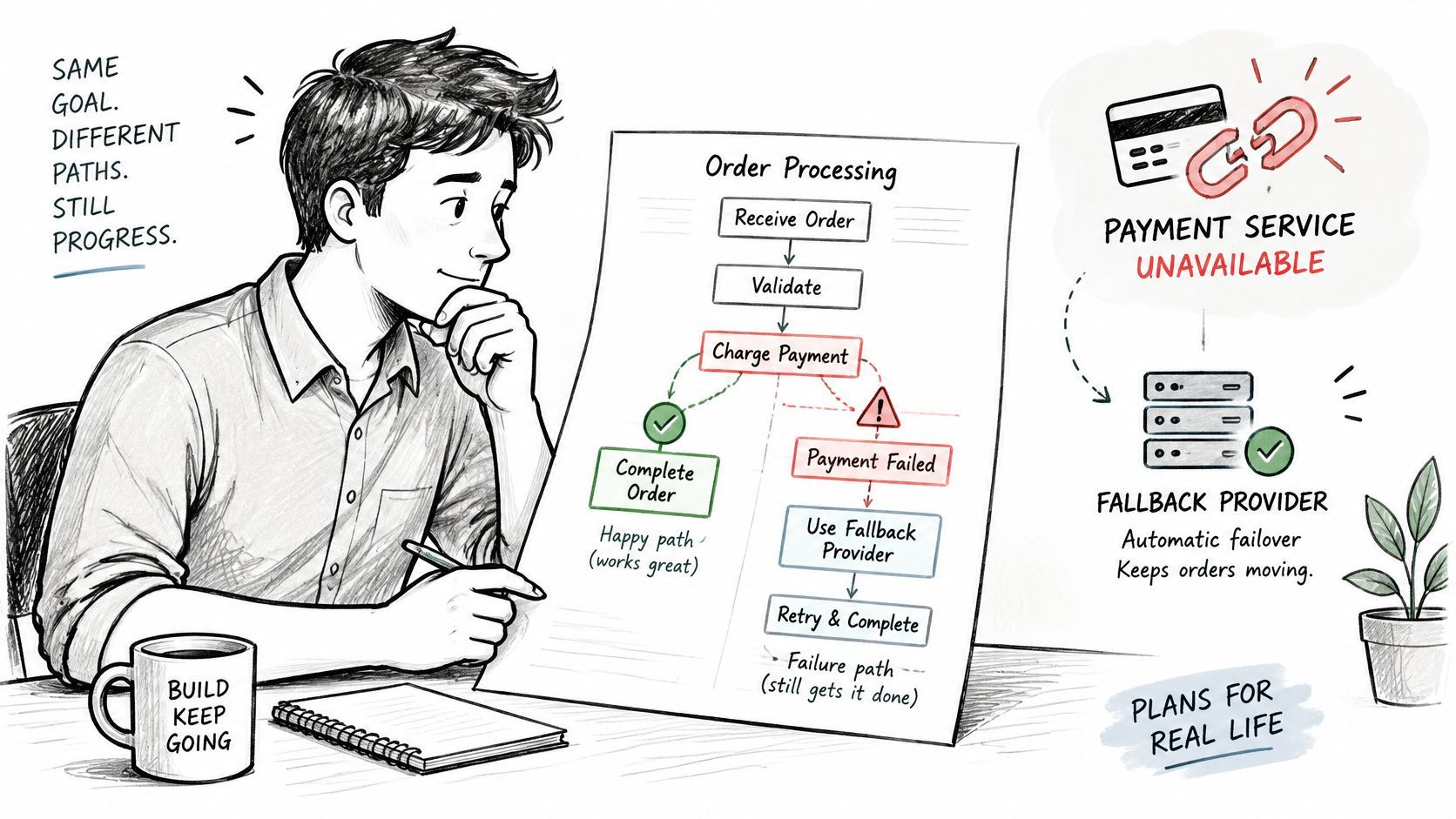
What a Failure Module Contains
Each module names eight things in plain operational language.
- Trigger: The specific event that activates the module, such as supplier outage, key-person absence, chain halt or custody-platform failure.
- Decision right: The named role who may pause, reroute or release work, and who deputises.
- Fallback: The alternate route, manual workaround or safe stop state.
- Escalation threshold: The duration, value or client impact at which senior management and the board contact are informed.
- Communications: Who is told, in what order, using which approved wording.
- Evidence capture: What is logged during the incident, including timestamps, decisions and client impact.
- Recovery objective: The point at which normal service resumes and backlogs are cleared.
- Lesson route: How the post-incident finding changes the SOP, with an owner and a date.
This isn't extra paperwork for its own sake. The FCA operational resilience framework requires firms to identify important business services, set maximum tolerable disruption levels, map the people, processes, technology, facilities, information and third parties supporting them, and test vulnerabilities, with boards and senior management accountable for approving the self-assessment. Your SOP is where that mapping becomes an instruction a duty manager can execute at 2 a.m.
For a crypto firm, that discipline applies across the whole service life. Impact tolerances, contingency plans and third-party dependencies aren't a business-continuity appendix you review once a year. They're live parameters inside the procedures for withdrawals, safeguarding, trading access and client communications.
Return to the outage. A resilient withdrawal SOP would state that the duty operations manager may suspend releases when the platform can't confirm balances, that clients receive a holding message within the stated window, that every suspended case is logged with its queue position, and that releases resume only after reconciliation confirms no duplicate payments. The post-incident review then decides whether the tolerance, the supplier clause or the SOP itself changes.
A procedure that only describes success tells a reviewer you've never tested failure.
Finally, check the trace an interviewer will follow. They'll move from the SOP to the application narrative, to governance minutes approving the tolerance, to the third-party contract that supports the fallback, and then to the answer your responsible manager gives in the room. If any link in that chain contradicts another, the SOP stops being evidence and becomes a liability.
Version the SOP and Govern Any AI Use
Treat every SOP as a controlled document. Never reuse a version number. Retire superseded copies from shared drives, team channels and printed folders, so nobody follows an old withdrawal limit because the PDF was easier to find. Review at least annually, and also whenever a system, supplier, senior manager or rule changes.
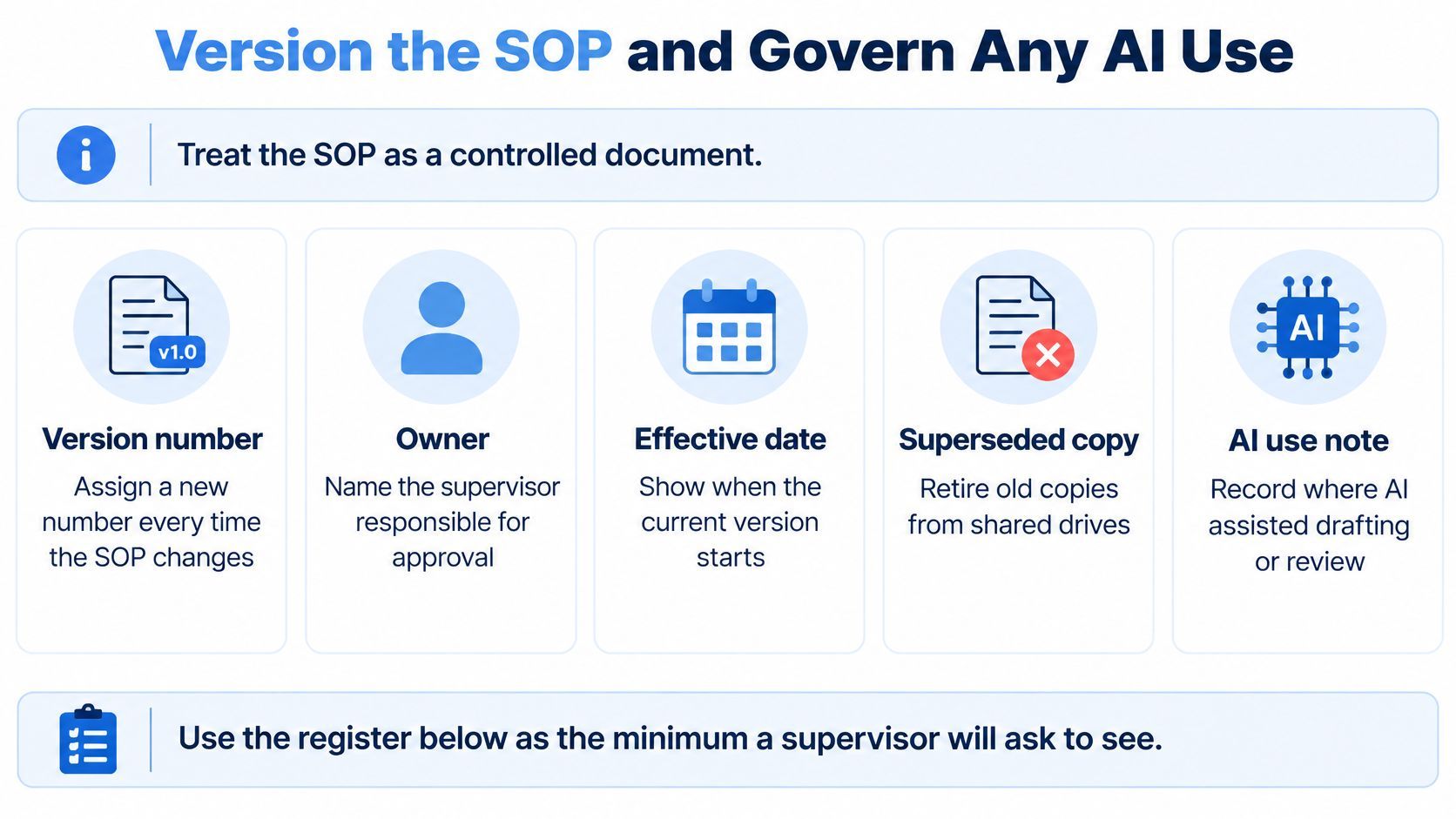
| Field | What to record | Why it is examined |
|---|---|---|
| Document ID | A stable code tied to one process | Trace the text to the control inventory |
| Version | The next number, never reused | Show what was in force on a given date |
| Status | Draft, approved or superseded | Stop use of a retired copy |
| Owner | A named role, plus the accountable manager | Locate the person who must explain it |
| Effective date | The date the version becomes binding | Align with go-live or a rule change |
| Review trigger | Annual date plus incident, system, people or rule change | Prove the text is maintained |
| Change reason | What changed and which other documents moved | Show impact when facts change |
| Approval | Name, role and date | Evidence of senior sign-off |
AI Use Needs More Than a Disclaimer
A one-line note saying "AI may be used" is not a control. The UK Government AI Management Essentials tool describes an AI management system as governance elements and activities supporting decisions and outcomes from AI use, and senior governance is expected to authorise and review those uses. Your SOP should therefore specify what AI may and may not do inside the procedure.
Name approved uses, such as summarising published source material or drafting a first classification for review. Name prohibited inputs, such as client personal data or unpublished supervisory correspondence entered into a public tool. For each approved use, record the model and version, require source checks against the underlying material, set an exception threshold that forces manual handling, and separate the person or system drafting from the person approving.
Keep an audit log of prompts, outputs and changes made, and set an incident route for wrong output that reaches a client or a filing. Re-test periodically for drift, because a model update can change behaviour without changing your procedure text. Writers formalising this for the first time can draw on guidance for managing enterprise AI governance risks to structure ownership, risk tiers and review cadence, but the SOP still has to translate that governance into step-level instructions.
State explicitly which decisions AI may support and which stay with accountable management. A suspicious-activity judgement or a fitness-and-propriety conclusion must remain a human decision owned by a named manager, however good the draft looks.
Human in the loop is not a control unless that human has time, competence, authority and a record of the challenge they made. If your reviewer has ninety cases and no power to reject output, you don't have oversight, you have a signature. This is also a process design question, which is why it belongs in your business analysis process model rather than in an IT policy alone.
Check the Procedure Pack Against Live Practice
Submission isn't the success metric. The FCA cryptoasset registration data reports that as at 1 October 2026 it had received 427 applications since becoming supervisor on 10 January 2020, and of 393 applications determined, 68 were registered, representing 17%, while 265, or 67%, were withdrawn. A pack that can't survive substantive review tends to end in withdrawal, not approval, so check yours against live practice before a reviewer does.
Five Checks You Can Run This Afternoon
- List the activities the business will perform and map each one to a single procedure, a senior manager and a system record. Any activity with no procedure, or any procedure with no activity, is a gap.
- Mark each procedure as already operating or still to be established. We prepare policies and operating arrangements that distinguish arrangements already in place from those the business still needs to establish, because a document describing a future control as live will fail the first follow-up question.
- Cross-check three documents only, the SOP, the application or business-plan description of the same activity, and the policy that sets risk appetite. Where they disagree, fix the facts before polishing the prose. Our second step brings the business plan, financial information, policies and application answers together, reviews the documents, resolves findings and revisits affected material when facts change.
- Confirm training and acknowledgement records exist for every role named in the Roles row, with dates and the version each person signed. A named checker who has never been trained on the current version is an interview problem waiting to happen.
- Run one live test of the highest-harm procedure and record what the test could not evidence, such as a field that doesn't exist in the system or a checker who lacks access. That test log becomes your remediation list.
Keep a decision log alongside these checks, and update the SOP when a fact changes, not at the next annual review. Late changes to people, suppliers or thresholds are exactly where packs become internally inconsistent, and consistency is what an anti-money laundering audit or an authorisation case officer will test first.
Preparation should also reach the people who'll be questioned. Our fourth step helps the client's team explain the business, its controls and responsibilities, and uses focused preparation to identify questions that still need work before an applicable interview. Your next action this week is simple. Pick one important business service, complete the section table for its procedure, and run that live test.
If you're preparing an authorisation pack and your procedures don't yet match how work happens, Glentorion can help you draft, review and align your SOPs, business plan and application answers so they tell one consistent, evidenced story. Our team combines regulatory consultants with systems and AI engineers to prepare management for regulator scrutiny and interviews. Visit Glentorion to discuss your route, your procedure pack and the gaps you need to close before submission.
- operating procedures
- SOP writing
- financial compliance
- crypto regulation
- operational resilience