Regulatory Business Plan FCA: A Step-by-Step Guide
Published
Most of the advice about the FCA regulatory business plan is the same advice, repeated: get a template, fill in the headings, keep it short. That advice produces the most common failure in an application package. A plan that reads well, yet contradicts the spreadsheet filed next to it without anyone noticing.
The template isn't the problem. The problem is that a template gives you headings, and headings don't tell you whether the sentence inside them is true, owned by anyone, or backed by a document. A reviewer isn't marking prose. They're testing whether the firm in the plan is the same firm in the financial forecasts, the governance chart, the statements of responsibilities and the answers in Connect.
So treat the regulatory business plan FCA submission as a traceability exercise. Every material statement carries an owner, a document and a status, and the whole package stays consistent when a fact moves.
The test to apply to every sentence: who answers for this, what dated document proves it, and does the arrangement exist today? If any of the three has no answer, the sentence isn't ready to file.
Table of Contents
- Mapping Each Activity to the Right Permission
- Moving From Crypto Registration to FSMA Authorisation
- Required Sections of an FCA Business Plan
- How to Build Projections and Capital Plans That Agree
- Linking Every Claim to an Owner and Evidence
- Timing Your Filing Around Completeness
- Pitfalls That Stall Reviews and How to Fix Them
- Confirm the Plan Is Ready Before You File
Mapping Each Activity to the Right Permission
The permission set decides everything downstream. Get it wrong and every later section inherits the error: revenue lines in the forecast for activities nobody is authorised for, a governance chart missing the function that owns a control, and interview answers describing a business the regulator hasn't permitted.
Start from a list of services, not a list of headings.
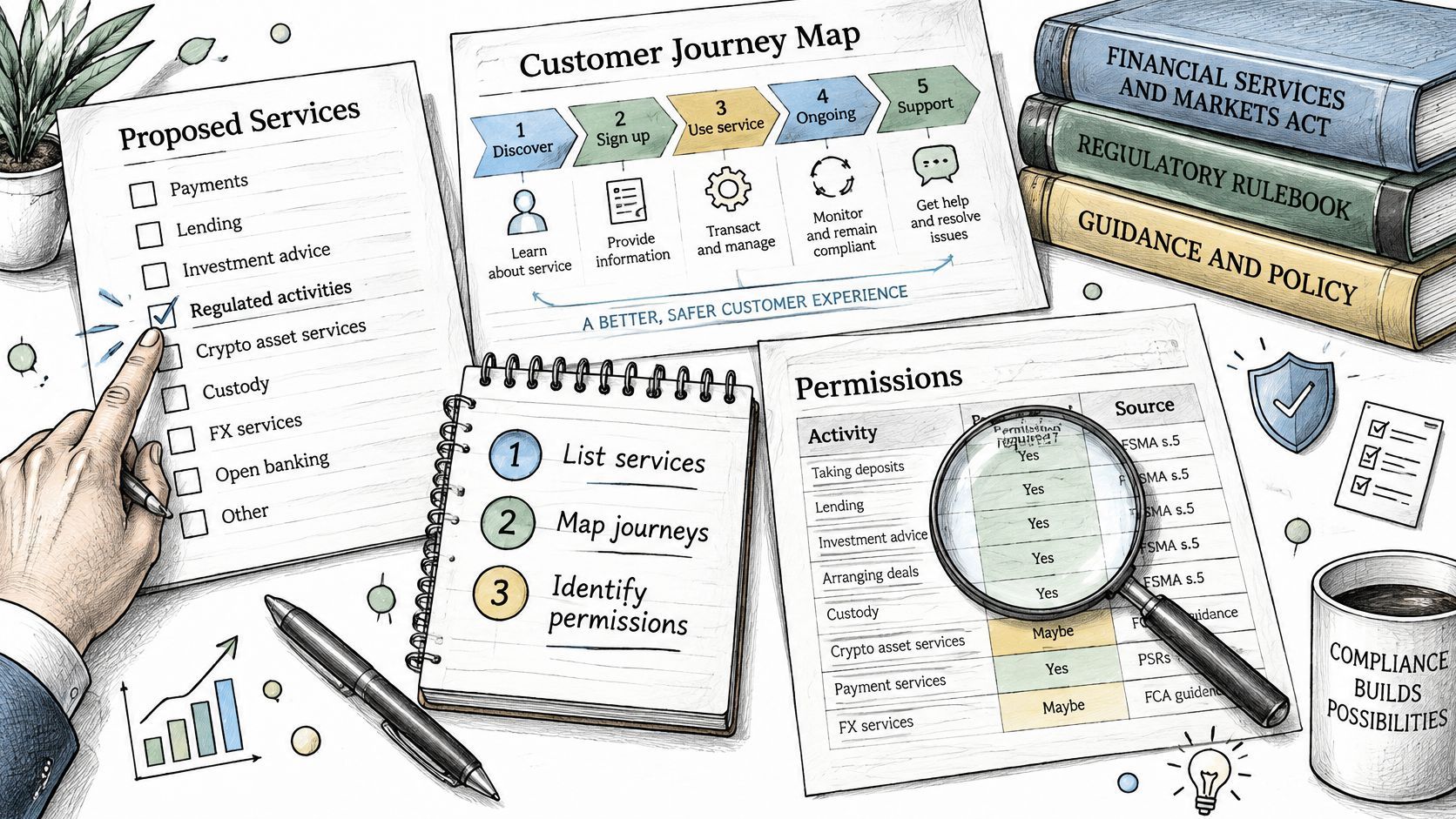
Step one, list the activity rather than the label. Write down every proposed service, every customer journey and every revenue stream, including the ones planned for year two. "Crypto services" is a label. It tells a reviewer nothing about where the perimeter sits, and it's the line that gets challenged first.
Step two, map each line to a permission. For a Part 4A application that means naming the regulated activity precisely. For cryptoassets, the FCA's guidance on the FSMA and Handbook regime for cryptoasset firms lists the activities that need authorisation: issuing qualifying stablecoins in the United Kingdom, safeguarding qualifying cryptoassets and relevant specified-investment cryptoassets, arranging safeguarding, operating a qualifying cryptoasset trading platform, dealing in qualifying cryptoassets as principal or agent, arranging deals, and making arrangements with a view to cryptoasset transactions.
Step three, justify what sits outside. Each non-regulated function gets one sentence explaining why it falls outside the perimeter. That sentence is what stops a reviewer assuming you've misread your own business model.
| Vague line | Precise activity | Customer and control to name |
|---|---|---|
| Crypto services | Operating a qualifying cryptoasset trading platform | UK retail clients; order handling and market abuse controls named in the plan |
| Stablecoin offer | Issuing qualifying stablecoins in the United Kingdom | Stablecoin holders; reserve and redemption controls |
| Custody | Safeguarding qualifying cryptoassets | Client wallets; custody agreement and reconciliation procedure |
| Brokerage | Arranging deals in qualifying cryptoassets | Introduced clients; conflict and disclosure controls |
Now run the consistency test in both directions. A permission with no matching product line in the plan should be removed before drafting continues. A product line with no permission should be flagged and resolved, not footnoted. Already-authorised firms changing their activity mix run the same test, and our note on variation of permission covers when a change needs its own application rather than an update.
What you end up with is a permissions map, and it becomes the spine for the rest of the document. Governance follows from it, because every mapped activity needs someone accountable. Forecasts follow from it, because every mapped activity has a revenue line and a cost line. Evidence follows from it, because every activity needs a control someone can point at. Our business and activity assessment starts exactly there: the services you intend to provide, your customers and how the business will operate.
Moving From Crypto Registration to FSMA Authorisation
Registration under the Money Laundering Regulations answers a different question from authorisation. It says the firm has controls against financial crime. It doesn't say the firm is prudentially sound, that its conduct arrangements work, or that anyone has tested its business model. Treating registration as page one of the FSMA application is the assumption that costs firms the most time.
The conversion is methodical. List every current cryptoasset activity and mark which ones the existing registration covers. Then identify the permissions you'll seek alongside registration and map each to the specific activity from the perimeter list. Next, describe how interdependent offerings work together, for example a trading platform that depends on custody, lending or stablecoin settlement, and say where each party sits in that chain. Anything outside the perimeter gets its own justification sentence, not a passing mention.
The FCA has published information for cryptoasset firms that will need authorisation, including a dedicated regulatory business plan upload in the future application form, so the plan is worth drafting to that structure now rather than reformatting it later (FCA cryptoasset application and registration guidance).
The registered population is small, and that shapes how much precedent exists to lean on. In its published 2025/26 authorisations data the FCA recorded 14 approvals under the crypto regime identified as 5MLD, against 589 in credit and lending, and the same published authorisation metrics note that the new regime for cryptoasset firms is scheduled to start on 25 October 2027.
Record each interdependency as a matrix row with an owner, a control and a status. Where the FCA's published FAQs are silent on how a specific arrangement is treated, that's an open item to raise with the regulator, not a gap to close with an assumption.
Required Sections of an FCA Business Plan
| Plan section | What reviewers expect | Evidence to attach | Common gap |
|---|---|---|---|
| Aims, objectives and permission sought | Why each permission is needed and how it fits any group strategy | Group structure chart and permission map | Permission requested wider than the activities |
| Market position and customers | Target customers, competitors, distribution model and any existing customer base | Market analysis and customer journey maps | Generic 'crypto services' or 'payments' description |
| Products, services and fees | Regulated and unregulated services, planned future offerings and how fees are charged and explained | Product terms and fee schedule | Future products left out |
| Client money and safeguarding | Whether client money or assets will be held and how they are protected | Safeguarding or custody arrangement | Safeguarding described but not yet in place |
| Governance and board | Board composition, committees and their terms | Terms of reference and board calendar | Committees named with no members |
| Staffing and senior managers | Key personnel, controllers, close links and senior managers with responsibilities, suitability and experience | Statements of responsibilities and CVs | Responsibilities overlap or are missing |
| Outsourcing | Each outsourced activity and how it will be overseen | Contracts and due diligence file | Oversight owner not named |
| Financial projections and capital | How minimum capital requirements will be maintained | Forecast model and capital calculation | Forecasts not tied to the operating model |
| Compliance, AML and risk appetite | AML/CTF controls, risk appetite and business continuity | Policies and risk register | Policies still in draft |
The FCA's authorisation guidance for consumer investment firms sets out the substance behind those rows. The plan explains the firm's aims and objectives, why the permission is needed and, where relevant, how the applicant fits a wider group strategy. It describes market position, customer profile, distribution model, products and services, and what makes the business different from competitors. Projected financial information has to show how minimum capital requirements will be maintained, not just that the firm expects revenue.
The rows reviewers test hardest
Financial sustainability, governance and staffing attract the follow-up questions, because they're the easiest to contradict. Board composition and committees belong in the governance section, with terms of reference that name real people. Staffing covers key personnel, controllers, close links, senior managers and other significant influence functions, together with their responsibilities, suitability and experience. Outsourcing needs each arrangement identified and an explanation of how the outsourced activity will be overseen, which means naming the person doing the overseeing.
Generic text fails here. The FCA's sample business plan guidance is explicit that an application must be specific to the applicant, and it asks for the principal place of business, legal status and trading history before anything else. A plan that could have been written for any firm on the register reads as unfinished.
A SWOT section earns its place only if it feeds the permission map and the risk register rather than sitting beside them, which is the approach in our note on keeping a SWOT analysis honest inside an authorisation business plan.
Run this test on each row above. Does the plan state a position, clearly and in the present tense where the arrangement exists? And does a dated, signed document back it? A row that fails either half isn't written yet.
How to Build Projections and Capital Plans That Agree
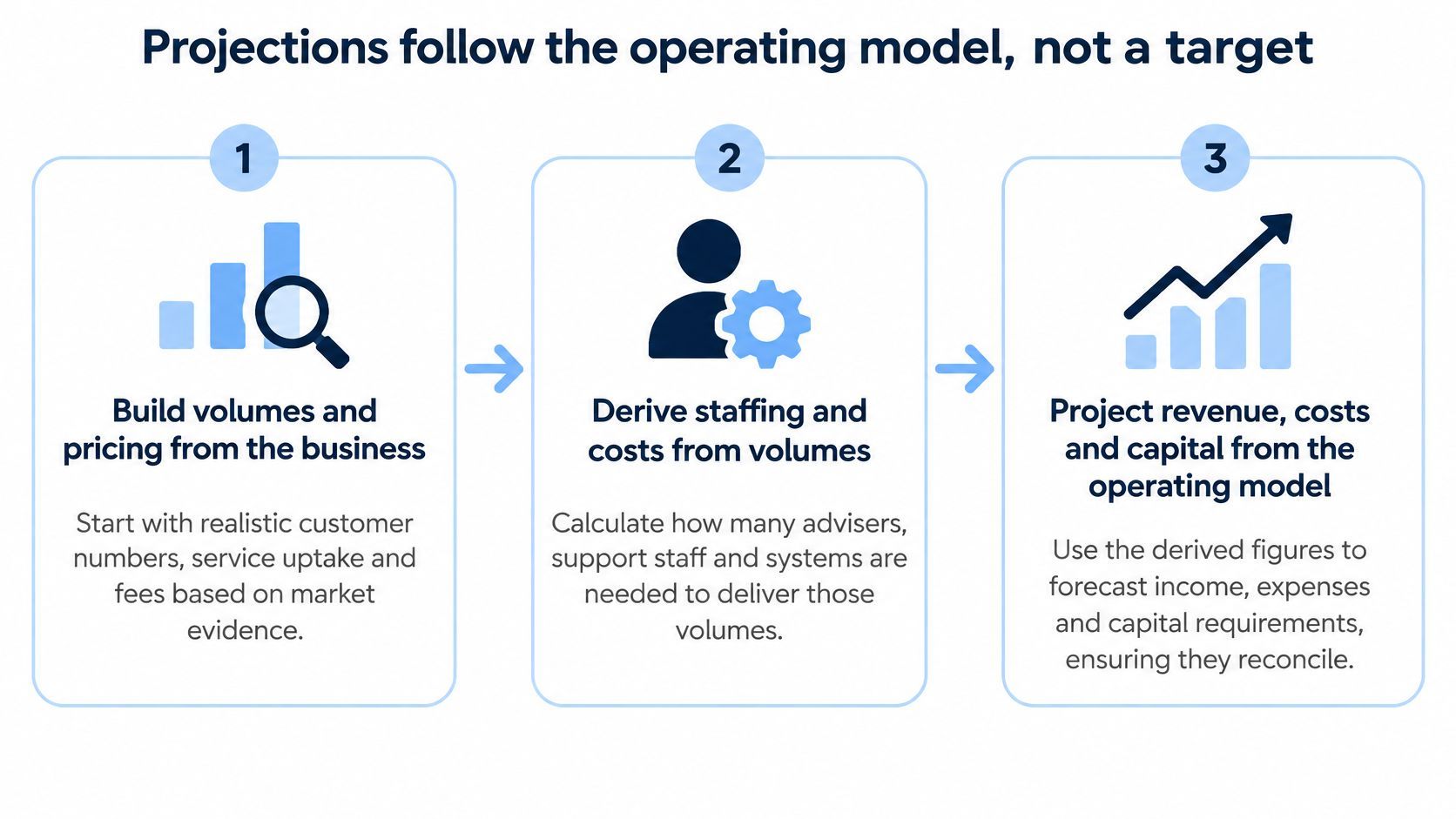
Projections come after the operating model, never before it. Every figure should trace back to volumes, customers and staffing already described in the plan. When the numbers are set first and the narrative is written to fit, reviewers find the seam in minutes.
The build, in order
- Build volumes and pricing from the business description. Start with realistic customer numbers, uptake and fees, and cite the market evidence behind them. The common slip is a revenue target that arrives before the customer segments that would produce it.
- Calculate the minimum capital each permission requires. Show headroom above it for each forecast year, separately, because a single blended figure hides the permission that is in fact thin.
- Model the first two years monthly. Cover staff, outsourcing fees, systems, compliance and audit costs. Annual figures flatter a firm that runs out of money in month nine.
- Run a stress case. Slower take-up, one permission delayed and an overrun on an outsourced function, all at once. Then show whether capital still holds. If it doesn't, the plan needs a funding trigger, not softer assumptions.
- Set funding sources with dates. Include wind-down funding that covers the period needed to exit, because the FCA's application guidance expects the firm to be capable of meeting standards on an ongoing basis, not just at launch.
- Match every cost line to a person, contract or policy. A compliance salary in the model should appear as a named role in the staffing section and a cost in the outsourcing section. Three documents, one fact.
- Have finance and compliance review the model together and record the version. Two reviewers catch the internal contradictions that one reviewer, close to the numbers, stops seeing.
The FCA's sample business plan guidance asks for all regulated and non-regulated services, why authorisation is required, whether the firm will hold client money, how fees are charged and explained, the compliance structure and how sufficient capital will be maintained. Those are consistency tests dressed as content requirements.
A forecast that needs a sentence of explanation to reconcile with the plan has already failed. The written account and the spreadsheet should be readable side by side without a contradiction.
What a consistent set looks like
One headcount figure appears everywhere. One launch date appears everywhere. The financial figures and the written account can be read together without a correction. If the team building the spreadsheet is separate from the team writing the narrative, the drift starts immediately. We bring financial and regulatory input together for that reason, so the figures and the account are reviewed together rather than reconciled afterwards.
If your team is starting from a blank workbook, the financial forecasting toolkit from Accountant She gives a usable structure to build the roadmap before the regulatory overlay goes on top.
Linking Every Claim to an Owner and Evidence
The working document behind the plan is a requirements-to-evidence matrix, not a narrative. One row for every permission, regulated activity and material assumption. The columns are the rule or threshold condition that applies, the accountable owner, implementation status (operational now, or to be established), the supporting document, the dependency and the change impact.
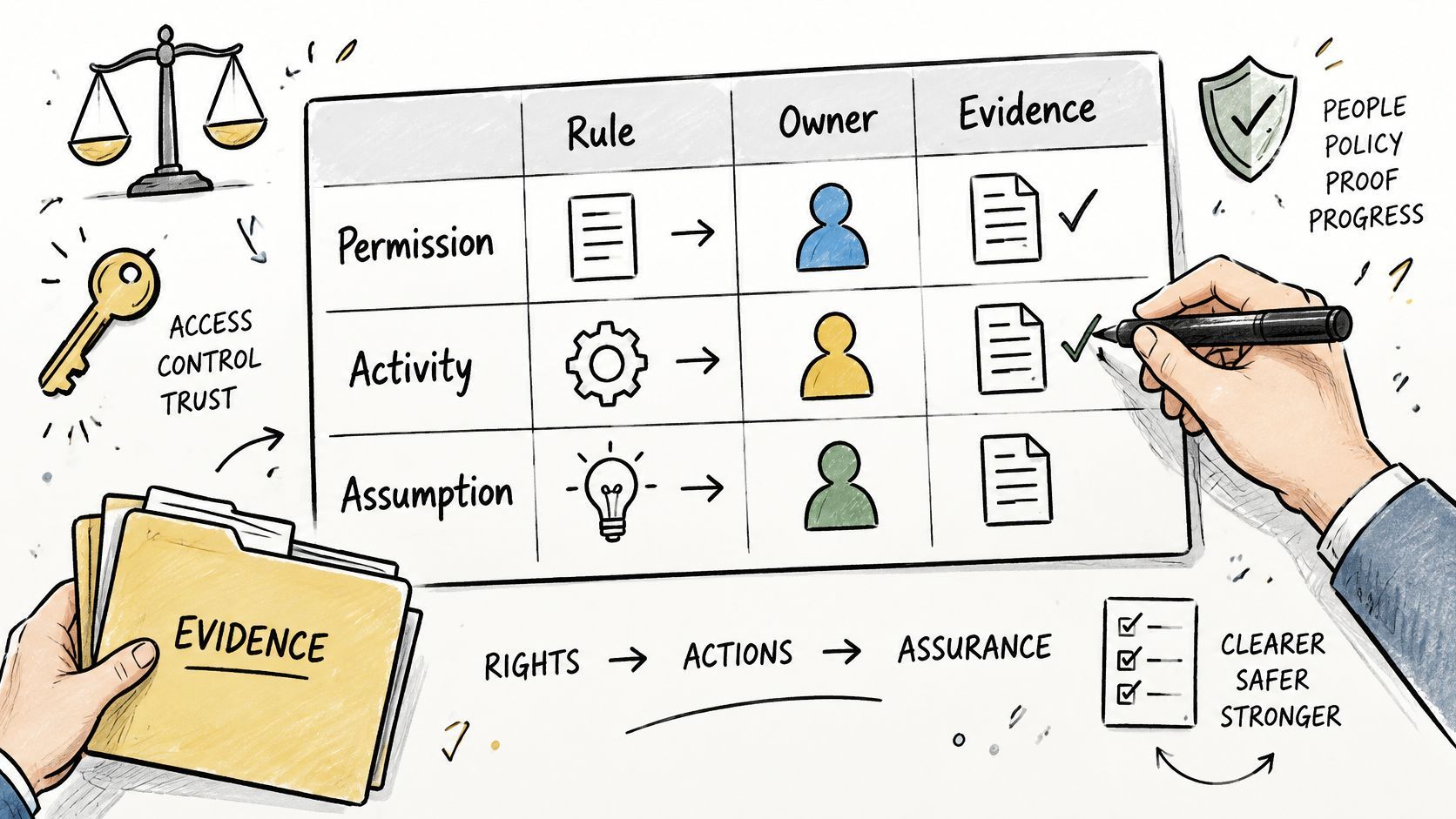
Here's a single row worked through, for a firm planning to hold client assets:
| Field | Entry |
|---|---|
| Rule or threshold condition | Client money and assets requirements, plus the custody permission |
| Accountable owner | Holder of the chief operations function (SMF24) |
| Status | To be established |
| Supporting document | Custody agreement and reconciliation procedure |
| Dependency | The safeguarding decision, still open |
| Change impact | Alters the custody cost line in the forecast and the outsourcing section |
That row is more useful than a page of prose about safeguarding, because it tells you what's missing, who owns it and what else moves when it changes.
The sequence is fixed. Map the activity, define the business model and customers, link each material risk to an owner, control, policy and evidence item, then reconcile the narrative with forecasts, governance documents, SM&CR responsibilities and application answers. Then run three reviews in order: completeness, cross-document consistency and operational realism. Many firms skip the third, which is the one that catches a control that exists on paper and has nobody to operate it.
Status is where honesty pays
Separate four things clearly: what exists today, what's committed with an owner and a date, what depends on another decision, and what risk remains after all of that. A control marked to be established with a named owner and a date reads better to a reviewer than one that claims to be operational and can't be demonstrated. Our note on what counts as evidence in an application sets out the difference between a policy document and proof a control runs.
Trigger rule: when a core fact changes, every row it touches reopens before the plan is shared again. Not just the paragraph that named it.
That discipline is the second step of our authorisation work: the business plan, financial information, policies and application answers are brought together, reviewed, findings resolved, and affected material revisited whenever facts change. The FCA's own service data shows 99.1% of applications across all metric areas were determined within statutory deadlines in Q1 2025/26, which is a measure of regulator timeliness and says nothing about applicant readiness (FCA authorisations operating service metrics). Quoting it as a launch date is the pitfall.
Timing Your Filing Around Completeness
| Application or metric | Period or result | Incomplete application | What it means for planning |
|---|---|---|---|
| Part 4A (FSMA) application, complete | Usually 6 months | Up to 12 months | Timing depends on threshold conditions being met |
| Payments or e-money application | Usually 3 months | No separate period published; the 3 months assumes completeness | Same threshold conditions apply |
| Solo-regulated applications, October to December 2024 | 99.3% within statutory deadline | Not applicable, this is a service metric | Measures regulator speed, not applicant readiness |
The six-month figure applies to a complete Part 4A application, and an incomplete one can run to twelve months. Payments and e-money applications are usually assessed within three months, per the FCA's application guidance. Every one of those periods is conditional on the applicant demonstrating it can and will comply with the Principles for Businesses, the relevant Handbook rules and, for FSMA firms, the threshold conditions. Nothing about the timetable removes the obligation to file a complete, decision-ready package.
Work backwards from the gates, not forwards from ambition
Set the decision gates before you set a filing date. UK substance and presence. Governance appointments, with named individuals and signed statements of responsibility. Safeguarding or prudential arrangements where they apply. Wind-down funding. Complaints and conflicts controls. Each gate is binary: it's either done and evidenced, or it isn't.
Then build the calendar backwards. The filing date sits after the last gate closes. Leave room for information requests. Keep a second window open for the changes the regulator's questions will trigger, because an answer to one question often reopens two documents.
Regulator speed is not your readiness. During October to December 2024 the FCA determined 99.3% of UK solo-regulated applications within the statutory deadline (FCA authorisations operating service metrics, 2024/25 Q3), so an application that sits in the system for a year is usually waiting on the applicant rather than the queue.
The practical consequence: a launch date that gets announced before the gates close creates pressure to file an unfinished package, and an unfinished package enters the longer statutory route. Our guide to the FCA application process walks through where each stage sits. The launch date follows the gates. Never the other way round.
Pitfalls That Stall Reviews and How to Fix Them
| Symptom | Likely cause | Fix before filing |
|---|---|---|
| Projections show profit but minimum capital is not explained | Capital figures not tied to the forecast | Recalculate capital resources by permission and add a funding decision gate |
| Policies written in the future tense | Policies describe intent, not current arrangements | Mark each arrangement as in place or to be established, with an owner and date |
| Group policies cite overseas entities | Policies reused across jurisdictions without UK edits | Add UK-specific responsibilities and remove overseas-only references |
| Launch date appears before evidence exists | Timeline set before readiness gates | Tie the launch date to completion of each gate |
| Interview answers contradict the plan | Plan written by advisers, not the responsible individuals | Run a mock review with each responsible individual |
| Documents are undated or unsigned | Drafts left in the filing package | Freeze versions, sign off each document and record the version number |
Those symptoms are what a reviewer sees before the cause is clear. Behind them sit deficiencies the FCA names repeatedly: weak senior-management competence, inadequate understanding of the regulatory framework, failure to identify or mitigate business-model risks, unclear UK mind-and-management arrangements, inadequate outsourcing analysis and unaddressed conflicts of interest (FCA authorisations operational efficiency data). Read that list as a description of interviews, not of documents. It's a list of things a person failed to explain.
The interview is the real test
Run a mock review with each responsible individual. Ask them to explain the business, the controls they own and where their responsibility stops, without the plan in front of them. Log every question they can't answer as a work item with an owner. This is focused preparation rather than rehearsal, and it's the fourth step of our authorisation work: helping a client's team explain the business, its controls and its responsibilities, and using that session to surface the questions still needing work before an applicable interview.
Two habits cause most of the remaining damage. The first is leaving drafts in the package: the FCA asks applicants to submit documents that are up to date, specific, final and appropriately signed off (FCA guidance for cryptoasset firms), so mark drafts as drafts and keep them out. The second is reusing group policies across jurisdictions. A group can share a template, but the FCA expects a UK-specific account of who does what and which customer-facing activities happen here.
For each deficiency, name three things: the person who answers for it, the document that proves it, and the change required if the honest answer is no.
Confirm the Plan Is Ready Before You File
Run this in one sitting, with the permissions map and the draft model on the table.
- Every permission maps to a product line. No orphan permissions, no unpermitted revenue.
- Every material statement has an owner and a dated document. Including the ones in the governance section.
- The financial figures and the written account agree. One headcount, one launch date, one funding position.
- Policies are marked as in place or to be established. With a named owner and a date on the second category.
- Each responsible individual can explain their area without the document. If they need to read it, the answer isn't theirs yet.
One failed item is a decision to delay filing, not to file and fix later. File when the gates are complete. Wait when a gate depends on an unresolved client decision, because assumptions don't survive the first information request.
Keep the boundaries straight too. The FCA makes the authorisation decision, approval dates aren't guaranteed, and no plan quality changes that. Plan against a range rather than a single date.
Then the next step is small and concrete. A scoping engagement examines the planned activities, the jurisdiction, the material you already have and the open questions, and the work, deliverables and responsibilities are then agreed in a written engagement agreement setting out scope, fees and responsibilities. Bring the permissions map and the draft financial model into that first conversation, so the gaps are visible from the start rather than discovered at month four. If the same team also runs the company's wider filings, a VAT compliance checklist from Action Accountants is a useful cross-check that the finance side is in order while the application is in progress.
Glentorion prepares FCA application packages for financial and crypto businesses, from the permissions map through to the business plan, the financial projections and interview preparation, with the figures and the written account reviewed together rather than stitched together at the end. If you're weighing up a filing, bring your draft plan and model to a scoping conversation and we'll tell you which gates are still open. Visit Glentorion to start that conversation.
- regulatory business plan
- FCA authorisation
- Part 4A permission
- FCA application
- threshold conditions