FCA Application Fees: 2026 Categories and Budget Guide
Published
FCA application fees run from £280 for Category 1 to £225,170 for Category 10, and the category you pay depends on the permissions you request. There's no single filing charge, and none of it comes back if the application fails.
Put those two facts side by side and the subject changes shape. It stops being a price comparison and becomes a funding and runway question: what does the whole route cost, when does each part fall due, and how much cash does the business need before a decision lands? The spread between the cheapest and the most expensive route is wide enough that a scoping choice made in week one still shows up in the bank balance a year later.
Table of Contents
- FCA Application Fee Categories at a Glance
- What Sets Your Fee Category and How Permissions Combine
- Why the Fee Is Due at Submission and Never Refunded
- Crypto Registration and Periodic Fees After Approval
- Budgeting the Full Cash Requirement Beyond the Fee
- Confirm Your Fee Category Before You Commit
FCA Application Fee Categories at a Glance
The FCA's application fees span 10 categories, from £280 for Category 1 to £225,170 for Category 10. The FCA's application fee guidance sets out the published range. For a founder, that difference is a runway question: how much cash must be committed to the application, and what scope of activity will that money support?
| Route or case | FCA fee category | Application fee | What it covers |
|---|---|---|---|
| Lowest published tier | 1 | £280 | Limited permissions with the smallest application scope |
| Small payment institution | 3 | £1,500 | Payment services at the small payment institution route |
| Authorised payment institution, specified services | 4 | £5,000 | Money remittance, payment initiation or account-information services |
| Cryptoasset registration under the Money Laundering Regulations | 6 | £10,000 | Registration for cryptoasset businesses; periodic fees continue after registration |
| Limited-permission case or simple legal-status change | Whichever category otherwise applies | 50% of the applicable tariff | Reduced charge where the rules allow a simple change of status |
| Highest published tier | 10 | £225,170 | The broadest and most complex applications |
Use the closest matching route to establish the application-fee line in your budget. Then consider what the route requires beyond payment: a broader permission request can mean more material to prepare and explain, as well as a higher fee. The category is therefore part of the business's funding decision, not a price tag.
Before committing cash, check that the planned permissions match the services the business expects to provide at launch. If the proposed scope changes during preparation, review the fee category and the work needed to support the application.
What Sets Your Fee Category and How Permissions Combine
Price an application by sector or by legal form and you'll land on the wrong number. The FCA identifies two principal drivers: the regulated activities the firm proposes to carry on and the complexity of the application, as its fees framework confirms. A payments business and a crypto business with the same headcount, the same investors and the same office can sit in different categories because they're asking for different things.
Think of a building permit. A single-storey storage unit is reviewed against one use. A mixed-use block with shops, offices and flats on six floors triggers a longer review, more drawings and a bigger fee. The applicant isn't paying more because of the postcode. They're paying for the scope they asked the authority to assess. Permissions behave the same way, and the fee is a one-off charge for processing the application rather than a deposit that comes back after a refusal.
The scoping checklist that comes before pricing
- List every regulated activity the business will carry on at launch, named the way the Handbook names it rather than the way the website describes it.
- Note anything planned after launch. A second activity pencilled in for month nine is far cheaper to price now than to bolt on later.
- Confirm legal status and whether the change involved is the kind of simple status change that attracts a reduced tariff.
- Map each activity to its fee category using the current tables, not last year's version saved in a shared drive.
- Record every case where more than one category could apply. These are the rows that decide the final figure.
- Flag where a narrower permission set avoids a higher tier, then test whether the narrower set still supports the business plan.
When several fees apply, you pay the highest one
The instinct is to add the tariffs together. Don't. Where more than one fee applies to an application, the tariff payable is the highest of the applicable tariffs, according to the Payment Services Regulations fee schedule in the FCA Handbook.
The rule in one line: where several categories are engaged, compare them and pay the highest, not the total.
That schedule also carves out a specific exception. A simple change of legal status is charged at 50% of the tariff that would otherwise apply under the FEES Annex 1 Part 6 treatment. Certain limited-permission cases attract a reduction on the same basis.
Payment services show why route mapping beats arithmetic. A small payment institution is priced in Category 3. An authorised payment institution applying for specified services such as money remittance, payment initiation or account-information services is priced in Category 4. Where both readings are arguable on your facts, the higher tariff governs, which makes the legal route a pricing decision rather than an administrative one.
Existing authorisations complicate this further. Firms taking on new cryptoasset activities need authorisation or a variation of permission and must pay an application fee even where they already hold anti-money-laundering registration, as the FCA Handbook fee annex makes clear. Scope changes therefore create two costs at once: a fresh filing fee and a wider evidence programme. The variation of permission guidance sets out how an added activity is priced against the existing permission set. Our business and activity assessment starts with the services you intend to provide, your customers and how the business will operate, because those three answers settle the activity list before any fee figure is quoted.
Why the Fee Is Due at Submission and Never Refunded
An application without the fee doesn't enter the queue. The FCA's consolidated policy statement is direct about the mechanic: an application submitted without the appropriate fee is incomplete and will not be processed, as recorded in Policy Statement 11/07.

The image is close to reality: the ticket gets you through the gate, and no ticket means no entry. The fee must be paid in advance of, or together with, the application, and it remains payable whether or not the application succeeds. A refusal triggers no refund.
Sequence the mechanics properly:
- Confirm the category against the permissions in the final draft, not the earlier plan.
- Fix the payment method and the filing authority before the filing date, since the person submitting needs authority to pay.
- Check the amount matches the category, particularly where several categories were arguable.
- Pay at or before submission, not after a follow-up call.
- Keep proof of payment in the filing file alongside the submitted forms.
The timetable risk is real. An underpayment can stop processing and delay the whole application while the payment is corrected, and everything downstream moves with it. Because the money is spent at filing, a refused application leaves the cost spent and the strategy to be rewritten. Authorisation decisions remain with the regulator, so the fee carries no guarantee of a return and no guarantee of a date. The control that prevents the problem is unglamorous: a payment and category check built into the final pre-filing review, run against the same authorisation application form that will be submitted.
Crypto Registration and Periodic Fees After Approval
Cryptoasset firms carry two separate cash obligations, and founders routinely confuse them. Registration with the FCA under the UK Money Laundering Regulations is priced in Category 6, and annual periodic fees remain payable after registration, as the FCA's cryptoasset registration guidance states. The registration fee buys the decision. It doesn't buy the supervision that follows.
For the 2026/27 tariff, the structure published in the FCA Handbook fee appendix is a minimum fee of £2,251 payable by every cryptoasset business, plus £6.01 for each £1,000, or part of £1,000, of income above £100,000. The variable element only engages once income passes that threshold, but the "or part" wording means a partial increment is charged as a full one. Income of £100,001 produces one £6.01 increment. Income at or below £100,000 produces none.
That single sentence moves the number that matters from the filing fee to the recurring charge.
| Projected UK cryptoasset income | Increments above £100,000 | Variable charge | Total periodic fee |
|---|---|---|---|
| £100,000 | 0 | £0.00 | £2,251.00 |
| £100,001 | 1 | £6.01 | £2,257.01 |
| £500,000 | 400 | £2,404.00 | £4,655.00 |
| £1,000,000 | 900 | £5,409.00 | £7,660.00 |
The base for all of this is projected revenue for the 12 months from registration, which is the basis the FCA's registration route applies. That makes the revenue assumption a document in its own right, not a line in a spreadsheet nobody can trace.
Revenue assumptions that don't reconcile with the forecasts invite the questions you'd rather answer before submission than after.
Three practical habits keep the schedule credible. Separate cryptoasset revenue from unrelated group turnover, so the figure reflects UK-relevant activity rather than the consolidated top line. Keep a version of the assumption schedule that matches the business plan and financial forecasts line for line. And reconcile the fee declaration to that schedule before filing. Inconsistency between the three documents is the fastest way to generate clarification requests, and it weakens the financial-resources analysis that sits behind them. The wider crypto asset regulation picture matters here too, because registration is now a staging post rather than a destination for most firms.
Budgeting the Full Cash Requirement Beyond the Fee
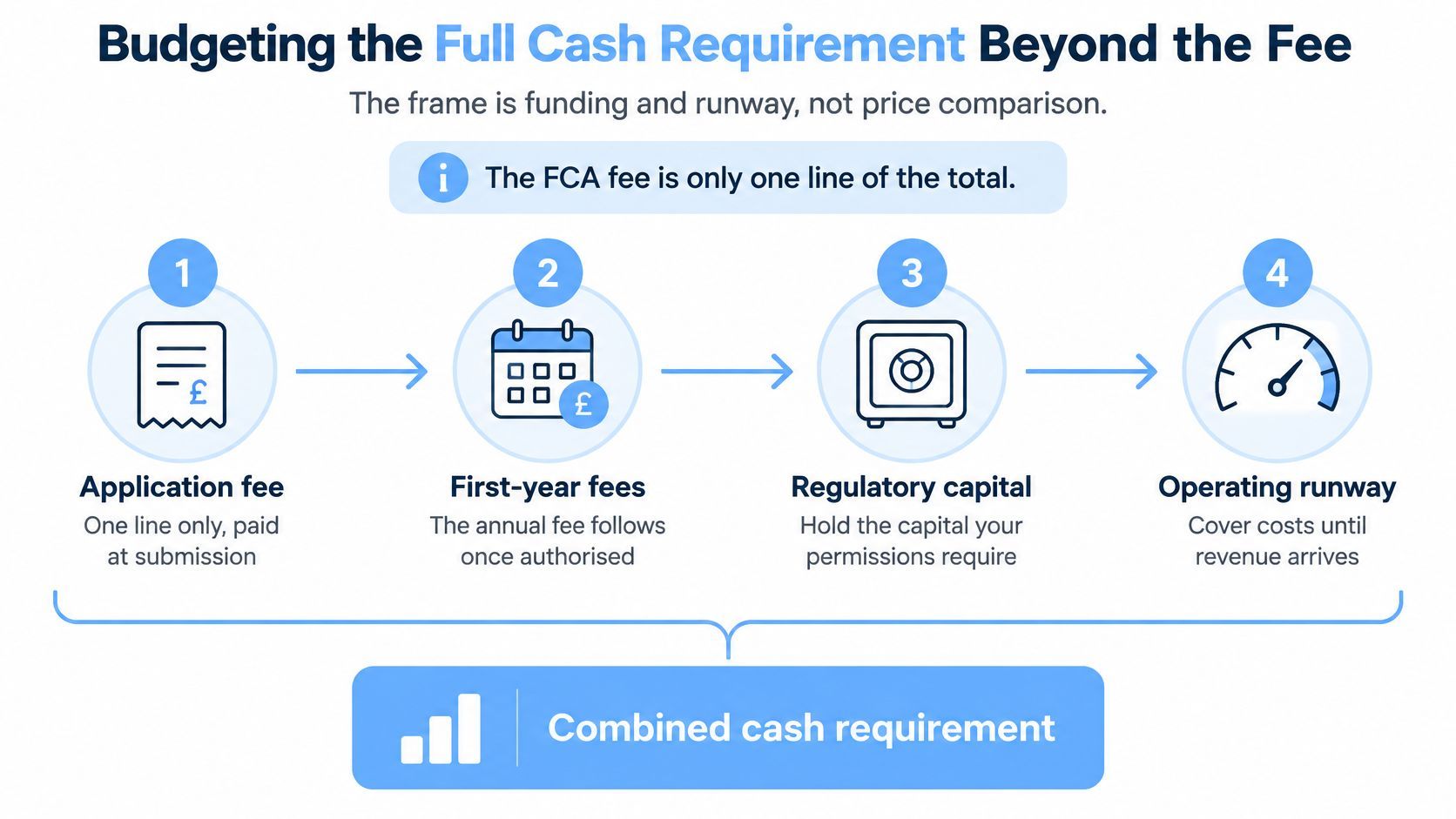
The fee is one line in a cash plan, and founders who budget only that line discover the rest by invoice. The FCA's printable fee guidance confirms two things that change the arithmetic: an unsuccessful application does not trigger a refund, and once a firm is authorised or registered it must also pay annual periodic fees, with the first year generally prorated according to the months remaining in the fee year.
The combined requirement has four layers. The application fee, paid at filing and at risk. The prorated first-year periodic fee, landing after approval. Regulatory capital, held before the firm can trade. And the operating runway that keeps the business alive until revenue arrives. Legal and specialist support, systems, insurance and possible remediation sit alongside them.
| Cost item | When it is payable | Refund position |
|---|---|---|
| FCA application fee | In full, at or with submission | Not refundable, including after a refusal |
| First-year periodic fee | After authorisation or registration, prorated by months remaining | Falls due after the decision, not at filing |
| Legal and specialist support | Under the engagement agreement | Governed by the engagement terms |
| Regulatory capital and systems | Before the firm can operate | Committed before trading and not recoverable from the regulator |
| Insurance and possible remediation | Budget from quotes obtained before you need them | Sunk once incurred |
Build two scenarios rather than one. In the low-cost column, take the fee at the lower tier that plausibly fits your permissions and add the minimum periodic charge. In the high-cost column, take the higher tier, add a periodic fee built on a credible revenue projection, and layer the operational items on top from written quotes. The point isn't precision. It's seeing the gap between the two columns and checking the bank balance covers the wider one.
Runway test: if the decision took six months longer than planned, would the business still be funded? If the answer is no, the constraint is capital, not the fee.
When you build that model in a spreadsheet, verify the formulas before you rely on them. The analysis of why AI miscalculates spreadsheet figures explains how plausible looking outputs can carry arithmetic that doesn't hold, which is exactly the failure mode a fee model can't afford.
Then sequence the spend: confirm the category, book professional support, pay the fee at submission, wait for the decision, pay the prorated first periodic fee, and fund operations from day one. Any additional regulator correspondence, interview attendance or ongoing support is agreed separately, so it shouldn't be assumed to sit inside the authorisation scope. Decision dates are never guaranteed either, which means the runway must absorb delay. Our business plan and risk analysis work sits alongside the cash model precisely because the narrative and the numbers have to tell the same story to the same reader.
Confirm Your Fee Category Before You Commit
Before filing, check that each permission matches the correct fee category and that no multi-category or reduced-tariff route applies. For cryptoasset firms, confirm that the periodic-fee schedule uses the projected UK income stated in the fee declaration. Then check the total cash requirement, payment method and who is authorised to submit.
A fee-category mistake can disrupt the filing and add avoidable work. Reviewing the planned activities and permissions together also helps clarify what evidence the application needs.
Glentorion's first step is to examine your planned activities, jurisdiction, existing material and open questions, then agree the work, deliverables and responsibilities. The Discovery Call covers your target market, current stage, available material, questions holding preparation back and the professional help you need. Head of Market Structure & Regulation Rosie Murphy Williams has deep expertise in FCA, MAS and DFSA regulatory frameworks.
Authorisation decisions remain with the regulator, and approval and decision dates are not guaranteed. Keep enough runway for the process, and treat the application fee as a committed cost once paid.
Glentorion helps financial and crypto businesses prepare for authorisation. Its team can review your planned activities, clarify the route and evidence required, and agree the scope of professional help you need. Visit Glentorion to start that conversation.
- FCA application fees
- FCA fee categories
- FCA authorisation cost
- FCA registration fee
- FCA periodic fees