UK Bank Licences: Types, Routes and Timelines for 2026
Published

The popular advice on UK bank licences is to choose mobilisation because it's the easier route. That's an incomplete answer. Mobilisation can move evidence, funding and operational-readiness work later, leaving founders with an authorised bank that still can't execute its intended launch.
The better starting point is the business model: what money will customers place with you, what will you do with it, and which capabilities already work? Choose the permission first, then map the dependencies between authorisation, build-out, funding and unrestricted operation.
Table of Contents
- UK Bank Licence Types and Which One Fits
- Threshold Conditions and What a Complete Application Shows
- Full Authorisation or Mobilisation Compared
- Timelines From Application to Exit
- Pitfalls and Jurisdiction Issues for Fintech and Crypto Firms
- Confirm Your Licence Route Before You Apply
UK Bank Licence Types and Which One Fits
A UK bank licence permits deposit-taking, but it's only one of several permissions a financial business might need. E-money, payment services and cryptoasset registration serve different purposes. An account in an app doesn't, by itself, tell you which permission fits.
The modern framework began on 1 April 2013, with the PRA responsible for prudential authorisation and supervision of banks and the FCA retaining conduct regulation, according to the Bank of England's review of the new-bank framework. That review records 11 banking licences in the PRA's first two years, with more than one-third going to new entrants, compared with fewer than 10% of the 39 licences authorised by the predecessor FSA between 2006 and 2012.
That history matters because the framework opened a meaningful route for new banks. It doesn't mean every fintech should become one.
UK permissions by regulator and deposit rights
| Permission | Regulator | Deposit-taking | Typical applicant |
|---|---|---|---|
| Full UK bank licence | PRA with FCA consent | Yes, no mobilisation cap | Firms planning full banking services |
| Bank with restrictions (mobilisation) | PRA with FCA consent | Yes, subject to a restricted total deposit ceiling | New banks completing build-out |
| Electronic money institution (EMI) | FCA | No, e-money only | Issuers of stored-value and payment accounts |
| Payment institution | FCA | No | Payment and remittance services |
| Cryptoasset registration under MLRs | FCA | No | Crypto exchanges and custodians |
No mobilisation cap doesn't mean unlimited business freedom. A fully authorised bank still operates within its permissions, prudential requirements and other applicable restrictions.
Start with the economic substance of the customer relationship. If the proposition requires accepting deposits from the public, assess the PRA-led bank route. If it centres on issuing e-money or executing payments, an FCA permission may fit without building a bank.
For a stored-value proposition, the distinction between banking and electronic money institutions deserves attention before the financial model hardens. Don't assume that describing customer balances as wallets resolves their regulatory classification.
Route test: Identify what customers give the firm, the obligation the firm owes them, and how the firm intends to use those funds.
Before committing to an application, answer these questions:
- Deposits: Does the business need to accept deposits?
- Customers: From whom, through which products and distribution channels?
- Readiness: Can the operation administer those relationships safely, or does it still exist mainly in a presentation?
Threshold Conditions and What a Complete Application Shows
The PRA authorises a bank with the FCA's consent. The Bank of England's Threshold Conditions factsheet identifies the joint tests, including appropriate capital and liquidity, adequate risk-management resources, fit-and-proper management, prudent conduct and effective supervision.
These aren't independent boxes. A credible capital forecast can still fail to support the application if the operating model can't deliver the forecast business. Likewise, an impressive governance chart offers little assurance if the people named on it haven't accepted responsibility or lack the information needed to discharge it.
Translate conditions into supervisory questions
Prepare management to answer concrete questions rather than recite policies.
- Capital and liquidity: What happens to resources when deposit growth disappoints, credit losses increase or funding becomes harder to obtain?
- Risk management: Who approves a new product, what information supports that decision, and who can stop launch?
- Management suitability: Which senior manager owns each material risk, and what relevant experience supports that allocation?
- Prudent conduct: How will staff identify poor customer outcomes and correct the underlying process?
- Effective supervision: Can the firm produce reliable records and explain its ownership, decision-making and financial position?
Build a governance map tied to the Senior Managers and Certification Regime, with responsibilities, reporting lines and escalation routes. Distinguish appointed staff from planned hires. A future appointment shouldn't appear elsewhere as an operational control already in place.
Document outsourcing with the same discipline. A supplier's sales presentation isn't evidence that the bank has agreed service levels, access rights, incident procedures or a workable exit arrangement.
Build a connected evidence package
Use linked workstreams rather than separate document-writing assignments.
| Workstream | What should agree | Mismatch to challenge |
|---|---|---|
| Business plan and financial model | Products, customers, launch sequence and revenue assumptions | Forecast deposit growth exceeds distribution capacity |
| Capital plan | Pillar 1, Pillar 2A, buffers and stress assumptions | Growth assumptions change without updating capital needs |
| Governance and responsibilities | Committee mandates, senior-manager duties and recruitment | A control owner hasn't joined |
| Outsourcing and suppliers | Contracts, oversight, service dependencies and exit plans | A critical service is described as contracted when negotiations remain open |
| Technology and controls | Build status, testing, access controls and operational procedures | The application describes intended functionality as live |
| Liquidity and funding | Funding sources, contingency actions and stress results | A funding assumption has no supporting commitment |
The Regulatory Business Plan should anchor this package. Treat it as the operating description against which finance, risk, technology and management test their own evidence, not as a narrative written after the model is finished.
A practical approach to application evidence distinguishes an assertion, its supporting record, its owner and its status. Record whether an arrangement is operating, contracted, being tested or merely proposed.
Mobilisation changes sequencing, not the end standard
The Bank of England's mobilisation guidance says mobilisation is for completing, rather than starting, the development of processes, people and systems. A narrower initial evidence package therefore needs a credible completion plan, not an empty space where capability should be.
For each deferred item, identify its prerequisite, accountable owner, acceptance evidence and effect on the exit application. A technology control may depend on a supplier contract; testing may depend on recruitment; a funding commitment may depend on regulatory progress.
Pick a reference date and ask whether every document describes the same bank on that date.
That test catches inconsistencies a document-by-document review misses. If finance assumes a launched product while operations assumes a pilot and compliance assumes recruitment is unfinished, the application isn't yet coherent.
Full Authorisation or Mobilisation Compared
The route that looks easier only moves the evidence, the funding and the exit risk later. The Bank of England's new-bank authorisation process sets out both paths, including mobilisation's £50 million total deposit limit, separately set capital requirements and a minimum liquidity requirement that is held continuously.
| Route | Deposit limit | Capital and liquidity | Best fit |
|---|---|---|---|
| Full authorisation | None arising from mobilisation | Full requirements from authorisation | Operationally mature firms with a tested model |
| Mobilisation (authorisation with restrictions) | Total deposits capped at £50 million | Set separately; minimum liquidity held continuously | Start-ups completing build-out of processes, people and systems |
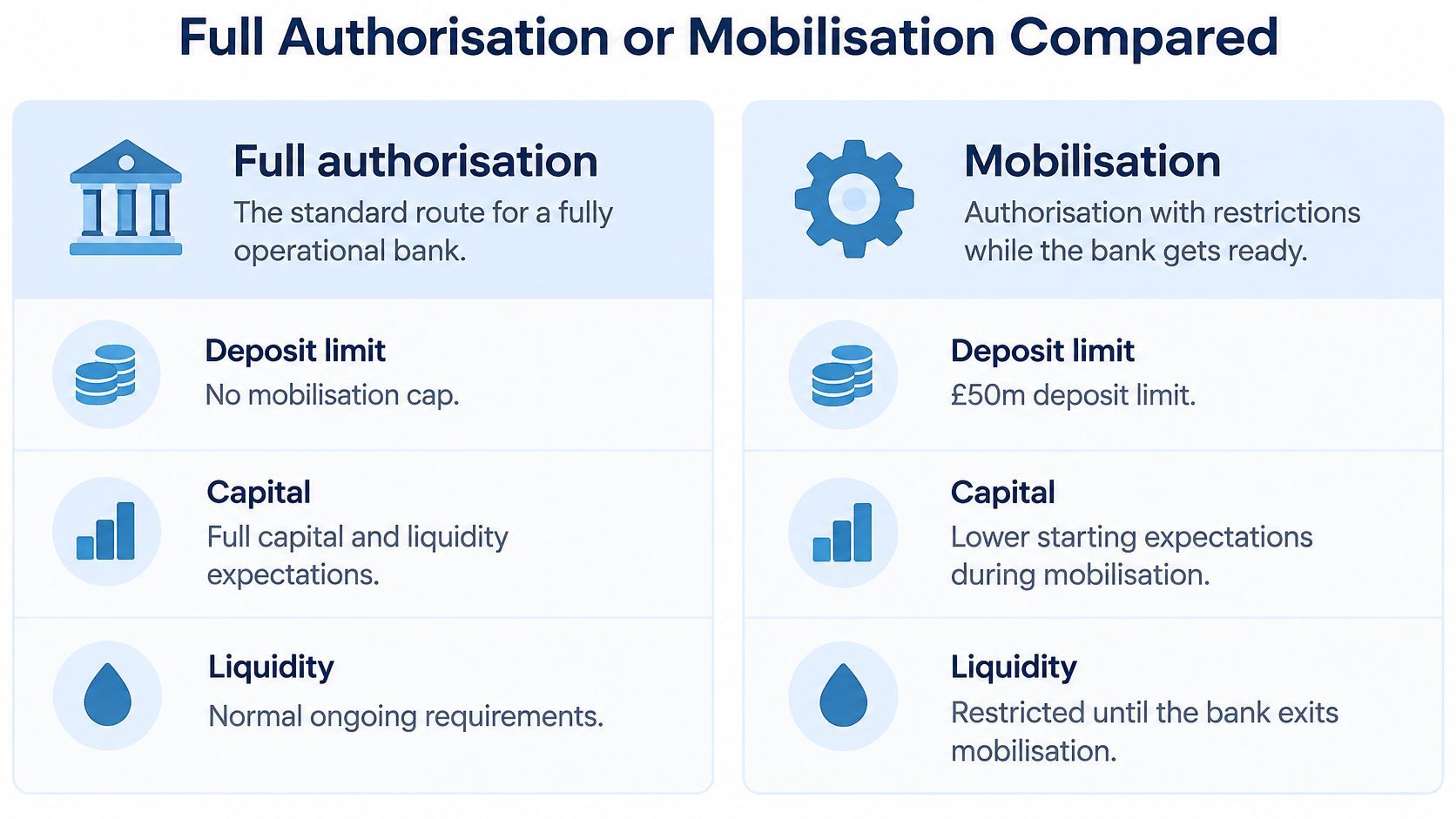
Mobilisation does not suspend liquidity obligations, and it is not a pre-authorisation sandbox. The bank is already authorised. Its board must oversee compliance with PRA and FCA requirements while management finishes the agreed build-out.
What changes is the order of the work. Items that a full application would have to show up front sit on a chain that closes only when restrictions come off: unfinished controls still need evidence, the build still needs cash, and exit still depends on both.
Take a fintech with a running product and an established customer base. Deposit administration, reporting, treasury controls and customer support are already tested, and management can explain the funding model under stress. Full authorisation is the more direct choice. Restricted authorisation would add a later permission change without fixing a readiness gap.
A start-up whose banking design is credible, but whose recruitment and systems integration are unfinished, faces a different chain. Mobilisation can let those activities finish after authorisation, which matters when investors or suppliers treat that status as a condition of their own commitment. Restricted deposits do not pay for the build. Payroll, supplier costs, testing and remediation need committed funding that works without the unrestricted launch.
Mobilisation can give greater certainty about regulatory status. It does not secure unrestricted operation. Management still owes the evidence required to remove the restrictions, and investors should treat exit as dependent on that case, not as an automatic next step.
I would choose between the routes by tracing those dependencies, not by comparing how large the first packs look:
- Operating capability: Is the proposed bank already capable of running its intended services?
- Build-out financing: Can committed resources support completion without unrestricted deposit growth?
- Exit evidence: Can management substantiate the funding, control and readiness case when needed?
A smaller initial submission helps only if every deferred item still has an owner, money and a realistic path out of restriction.
Timelines From Application to Exit
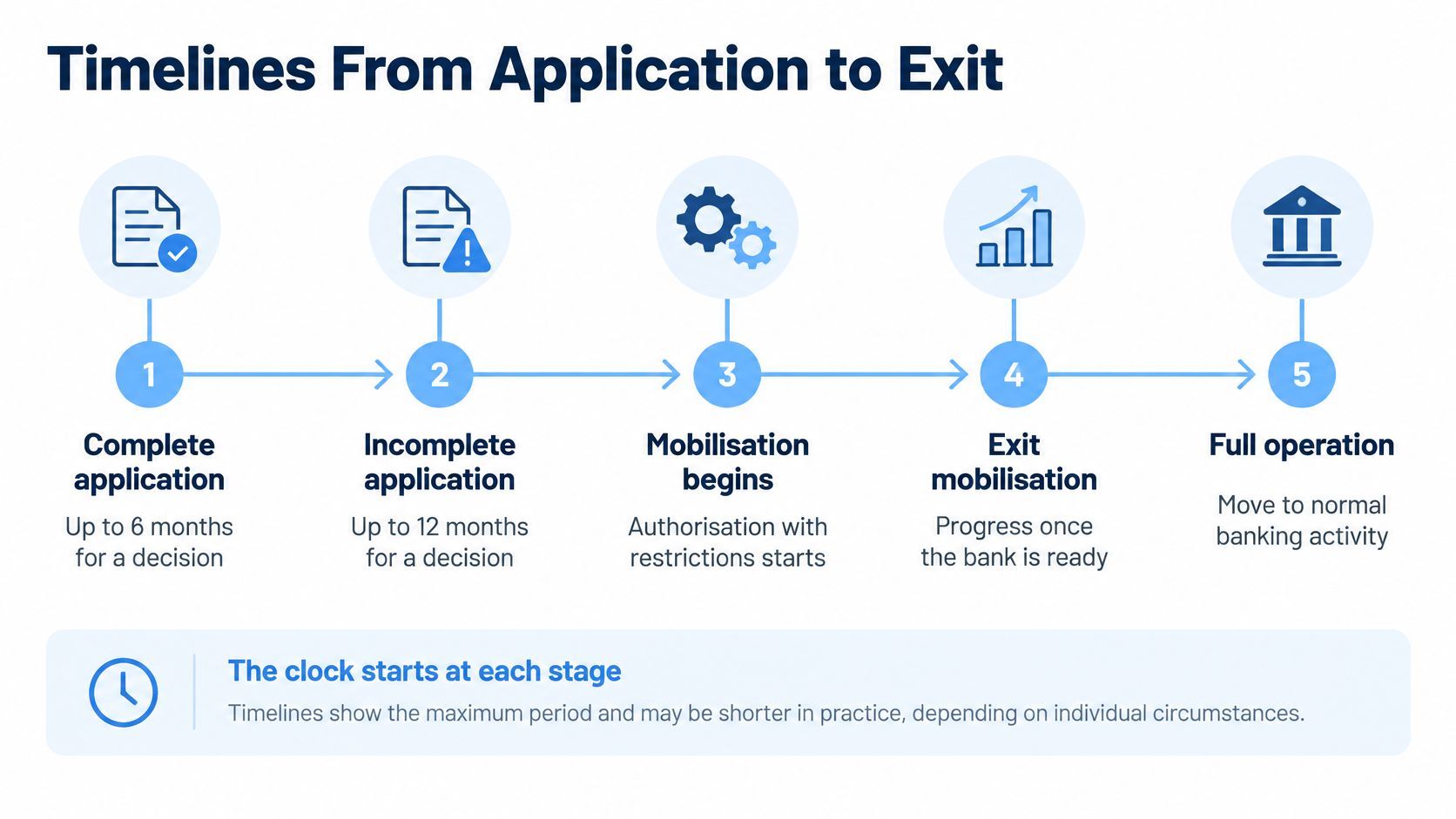
Mobilisation can look like the lighter timetable. It is not. The route moves evidence, funding and exit risk to a later date, so map that chain before you apply: what must be true at filing, what may still be unfinished, and what has to be proved before restrictions come off.
The statutory decision period is not the whole project timetable. Pre-application preparation, evidence remediation, recruitment and supplier work all change when a firm can file something credible.
The Bank of England's bank application materials distinguish a decision period of up to six months for a complete application from up to 12 months for an incomplete application. Those statutory deadlines apply to both authorisation routes.
Statutory and recommended timelines
| Stage | Typical duration | What drives it |
|---|---|---|
| Complete application | Up to 6 months | Statutory decision period once the application is complete |
| Incomplete application | Up to 12 months | Missing evidence requires further assessment |
| Mobilisation period | The build window set by the restriction | Finishing systems, people and controls while deposits stay restricted |
| Variation of Permission for exit | File early enough for assessment before the mobilisation limit | Time for regulatory review before restrictions are removed |
Treat the mobilisation and exit rows as planning parameters, not approval dates. A complete application and an incomplete application are alternative assessment cases, not stages a firm passes in sequence.
Plan backwards from an evidenced exit
The funding case usually decides whether the intended exit date can hold. Capital has to cover the applicable requirement and the stress assumptions. Liquidity evidence should join the funding plan, the contingency actions and the stress-testing results.
Do not file a forecast that assumes restrictions lift on the commercial launch date. Split funding into committed sources, conditional sources, and amounts that depend on customer behaviour.
Suppose management planned a year of mobilisation and only submits the exit request in month ten. The assessment time left is shorter than the firm built into its launch plan, so one open funding condition becomes a launch-date problem at once. That is a scheduling mistake. It is not a forecast of how fast the regulator will decide.
Work backwards along the dependency chain:
- Exit evidence: Fix the date by which management must sign a supportable funding and readiness case.
- Permission change: Leave assessment time before restrictions are meant to come off.
- Delivery milestones: Put supplier completion, recruitment, testing and remediation before that sign-off.
- Initial submission: Pick a complete-application target that matches the preparation you have.
I would keep filing and readiness on separate clocks. In the FCA application process, record distinct dates for submission, expected assessment, internal completion and commercial launch. Approval and decision dates stay with the PRA and the FCA, and they are not guaranteed.
Pitfalls and Jurisdiction Issues for Fintech and Crypto Firms
The most damaging mistake is treating authorisation as a writing project. Polished answers won't resolve a business model whose financial assumptions, operational arrangements and responsibilities contradict one another.
Fintech and crypto teams also need to separate activity classification, jurisdiction and permission status. Experience in another market can improve control design, but it doesn't establish that the UK applicant meets the UK test.
Common pitfalls and fixes
| Pitfall | Why it fails | Fix |
|---|---|---|
| Treating the licence as a form-filling exercise | Narrative and numbers describe different firms | Build a dependency map shared by finance, risk and operations |
| Assuming overseas regime experience satisfies UK tests | DFSA or MAS governance experience doesn't by itself establish compliance with UK Threshold Conditions | Map each Threshold Condition to UK-specific evidence |
| Assuming crypto registration equals authorisation | Registration and full FSMA authorisation are different permissions | Confirm the current regime status with the FCA before planning |
| Relying on secondary summaries of rules | Regulatory changes can leave summaries out of date during an application | Check each rule against FCA and PRA primary publications |
Reuse controls, not conclusions
An overseas group should identify which existing arrangements support its UK application. Group policies may provide useful foundations, but management must explain who makes UK decisions, which entity holds relevant records and how local staff obtain information from shared services.
Experience with the DFSA or MAS is useful for governance and control design. It doesn't replace a UK-specific assessment of responsibilities, resources, supervision and the proposed operating model.
This isn't an unusual applicant category. The Bank of England's bank-application reporting separately identifies UK-registered and non-UK-registered applicants. The practical question is how the proposed structure supports the UK application, not whether the wider group already has regulatory experience.
Separate registration from broader permission
A cryptoasset business shouldn't describe MLR registration as a banking licence or assume it settles permission for other financial activities. Nor should a team plan a future application on the assumption that a proposed authorisation framework is already operative.
For orientation, The Coin Course's FCA compliance guide can help teams organise compliance questions. Use explanatory resources to identify issues, then verify the applicable position against primary regulatory publications.
Status discipline: Label each relevant publication as an operative rule, proposal, guidance, supervisory expectation or commentary.
Keep that status alongside the publication date and affected activity in the application issues log. For changing cryptoasset regulation, assign someone to confirm commencement, scope and transitional arrangements before management approves the route.
This avoids turning an anticipated regulatory change into an unsupported statement about what the firm can do today.
Confirm Your Licence Route Before You Apply
A defensible route decision should survive scrutiny from the board, finance, operations and compliance. If each team means something different by ready, the application programme needs more definition before it needs more drafting.
The route summary should distinguish facts, assumptions and unresolved decisions. It should also explain what would cause management to reconsider full authorisation, mobilisation or a non-bank permission.
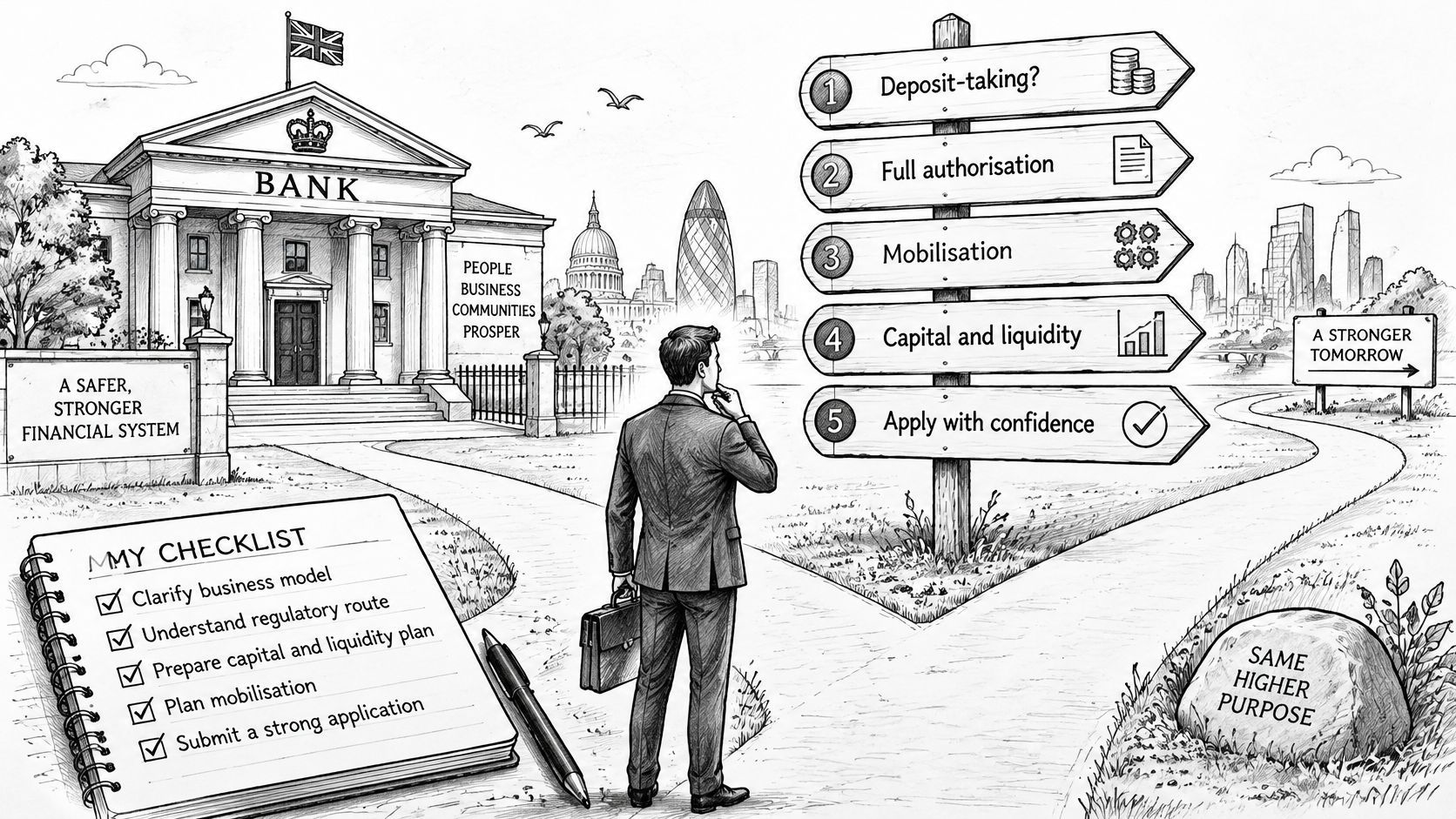
Make the decision actionable
- Confirm the activity. Describe the customer relationship and movement of funds before choosing the permission label. Include the intended customers and jurisdictions.
- Select the authorisation route. Test existing capability and committed build-out resources. Don't choose mobilisation merely because the initial submission appears lighter.
- Connect the evidence. Give finance, risk, technology and operations a shared dependency map, with current arrangements clearly separated from future commitments.
- Schedule backwards. Start from the intended unrestricted operation and allow for evidence approval, permission assessment and remediation. Keep commercial targets distinct from regulatory decision assumptions.
- Assign open questions. Record an accountable owner, the evidence needed and the decision that depends on the answer. An issue without an owner isn't a managed dependency.
At Glentorion, our first step is to examine planned activities, jurisdiction, existing material and open questions, then agree the work, deliverables and responsibilities. That scoping distinguishes what the client already has from what requires preparation, specialist input or a management decision.
Keep the limits explicit
Authorisation decisions remain with the relevant regulator. Approval and decision dates aren't guaranteed, and Glentorion doesn't act as a regulator or provide legal advice.
An adviser can help organise preparation and identify inconsistencies. Neither an adviser nor an indicative regulatory timetable can promise approval on a commercial launch date.
Write a concise route summary naming the intended permission, chosen route, target decision dates and unresolved questions. Add the evidence owner for each material dependency, then use that document in the first scoping conversation.
Glentorion offers regulatory authorisation support for financial and crypto businesses, including application preparation, review and management interview preparation within an agreed scope. Visit Glentorion to discuss your proposed UK banking activities, starting materials and route summary, and agree the work and responsibilities needed to move the application forward.
- UK bank licences
- PRA authorisation
- mobilisation bank
- bank licence timeline
- FCA authorisation