E Money Institutions Explained: A Practical UK Guide
Published

You've got a product idea that touches customer money. Maybe it's a branded wallet, maybe it's marketplace payouts, maybe it's card issuance wrapped around a spending account, and the question is no longer “Can we build it?”, it's “What licence do we need to run it safely and legally in the UK?”
That's where an e money institution sits. It's the route for firms that issue electronic money, hold customer funds in a regulated way and let customers use that value with someone other than the issuer. If you're comparing EMI authorisation with a payment firm model or a bank licence, the differences aren't academic, they shape your capital, safeguarding, product design and how the FCA will test your controls.
Table of Contents
- What an E Money Institution Actually Does
- The UK Regulatory Framework from 2011 to Today
- EMIs, Small EMIs, Payment Institutions and Banks Compared
- Capital Floors and the Schedule 2 Calculation
- Safeguarding Customer Funds in Practice
- The Authorisation Journey from Application to Interview
- Supervisory Expectations After Authorisation
What an E Money Institution Actually Does
A founder usually reaches this question after sketching a simple customer journey. Someone loads funds, sees a balance in an app, and then spends it on a card or sends it to a third party. That feels like a wallet product, but in regulatory terms the key issue is whether the firm is issuing electronic money rather than just moving money around.
Electronic money is monetary value stored electronically, issued when funds are received, and accepted by someone other than the issuer. That definition matters because it creates a distinct regulated activity, one that sits between plain payment processing and deposit-taking. A company that merely provides software around payments isn't automatically an EMI, but once it starts creating stored value that customers can later use, the regulatory picture changes.
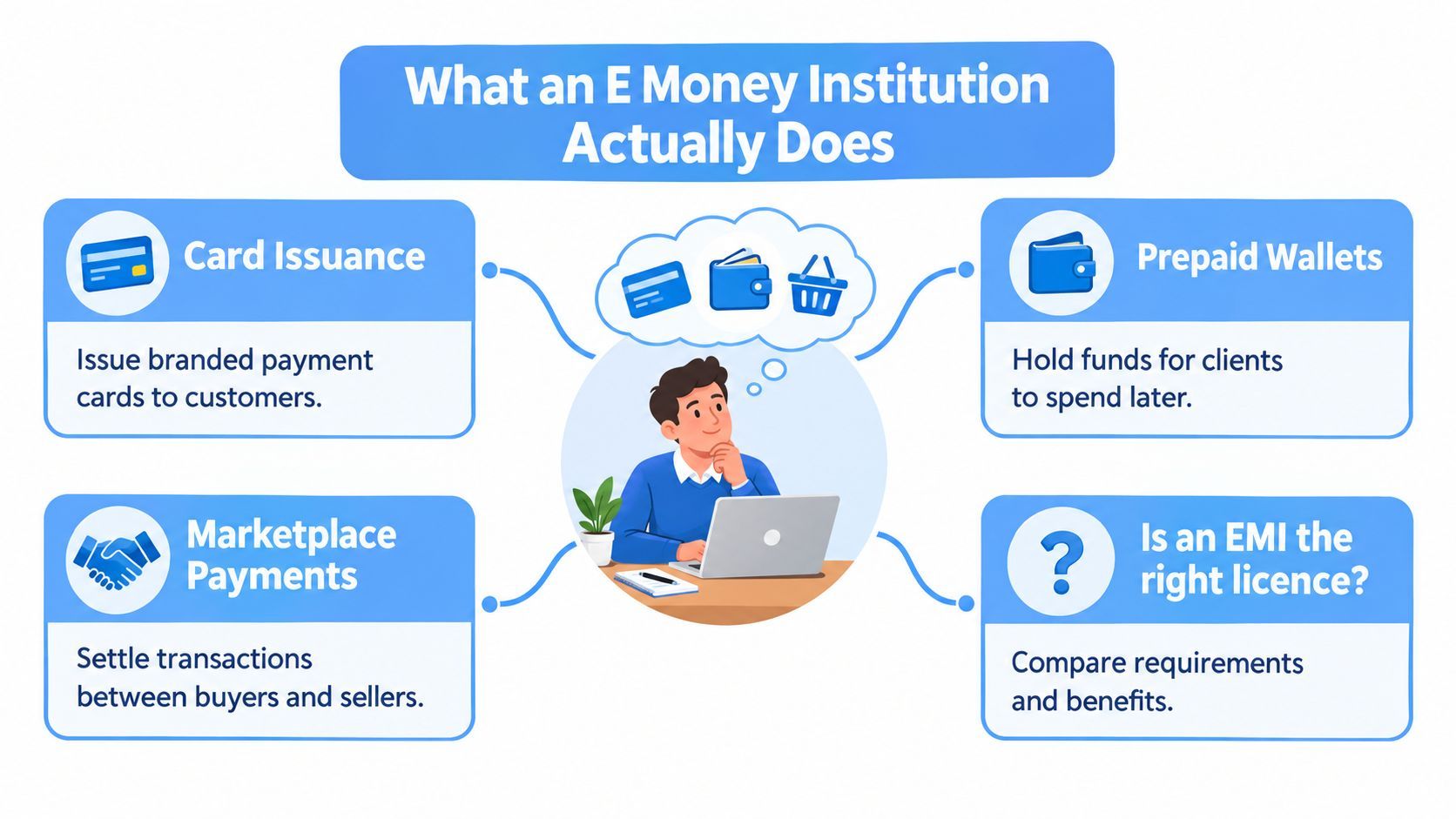
Where the boundary sits
The practical line is easier to see with examples. A prepaid wallet that stores customer value for later spending points towards EMI territory. So does a marketplace model where funds are collected, held and then used to settle payments between buyers and sellers.
A payment institution can move money and support payment accounts used for payment transactions, but it does not issue e-money. A bank goes further still, because it can take deposits and sits under a different prudential regime. An EMI is in the middle, it can provide payment services and issue e-money, but it doesn't become a bank by doing so.
Practical rule: if the customer's balance is meant to live as stored value that can be used beyond a single payment rail, you should test the EMI route early.
That distinction is why this licence is used so often by fintech founders building cards, wallets and marketplace payment flows. The category exists because customer money that is stored, redeemed and spent in a controlled way needs its own capital, safeguarding and supervisory framework. If your roadmap includes branded spending balances rather than just transactional transfers, the EMI perimeter is usually the one to examine first.
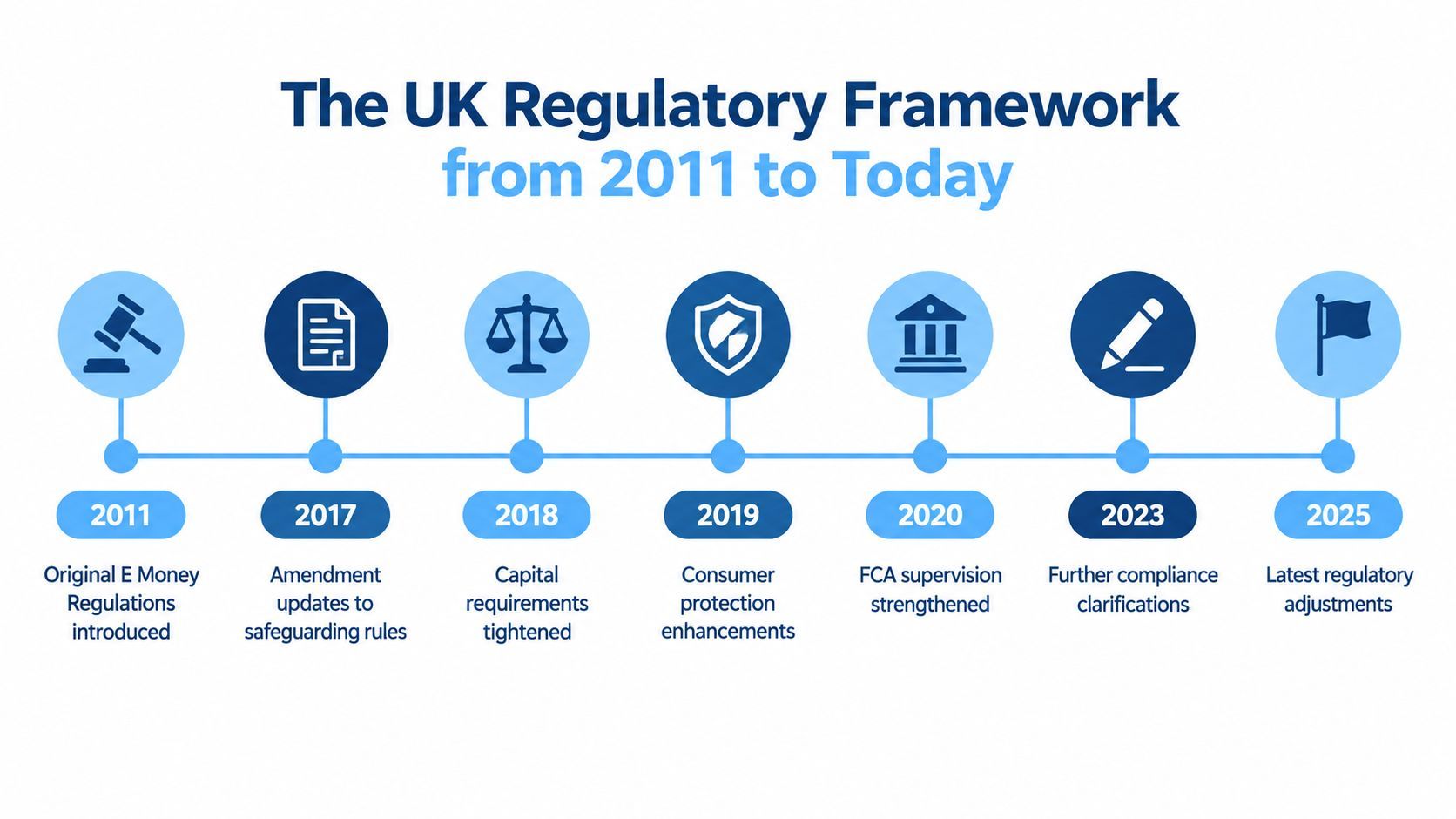
The UK Regulatory Framework from 2011 to Today
The UK's modern EMI framework began with the Electronic Money Regulations 2011, which came into force on 9 February 2011 and created the core authorisation, prudential and supervisory structure for electronic money institutions. That framework was never meant to be static. The legislation record shows amendments on at least 13 listed dates between 2013 and 2025, including changes in 2017, 2018, 2019, 2020, 2023 and 2025, so the regime has evolved as the market and the UK rulebook changed the current legislative record.
Why the framework keeps moving
Brexit made the regime more operationally complex. Firms authorised before the UK's withdrawal had to notify the FCA if they intended to keep operating through the transition period, and separate 2019 regulations dealt with deficiencies created by EU exit, including a limited five-year protection for some pre-existing contracts and outstanding e-money obligations. In other words, an EMI authorisation wasn't just a licence event, it became something firms had to keep mapping against transitional rules and legacy contract rights.
The 2023 changes mattered for a different reason. The Electronic Money, Payment Card Interchange Fee and Payment Services Regulations 2023 expanded the FCA's rulemaking powers over authorised and small EMIs, including areas such as client money, information controls and auditor appointments. Those powers came into force in stages, including 18 September 2023 and 1 January 2024, and they apply across England, Wales, Scotland and Northern Ireland. That means the regime is increasingly about day-to-day operating standards, not just incorporation documents and a neat authorisation pack.
The practical conclusion is simple. A founder can't treat EMI authorisation as a one-time legal gate and then forget about the rulebook. The UK framework now expects firms to track amendments, transitional obligations and supervisory powers throughout the life of the business, not just at launch.
See also the wider context in this overview of UK financial services regulation.
EMIs, Small EMIs, Payment Institutions and Banks Compared
Founders often compare these four models because they sound adjacent. They aren't. The choice changes what you can legally do with customer money, how much capital you need and which regulator will oversee you.
| Feature | Authorised EMI | Small EMI | Payment Institution | Bank |
|---|---|---|---|---|
| Permitted activity | Issue electronic money and provide payment services | Issue electronic money within the small-EMI regime, with restrictions | Provide payment services, but not issue e-money | Take deposits and provide banking services |
| Capital floor | €350,000 initial capital and ongoing own funds, or higher if the risk-based calculation requires it | Lower entry threshold, but subject to the small-EMI framework and own-funds recalibration triggers | Depends on the services provided, not an e-money capital floor | Much higher prudential regime, under banking supervision |
| Safeguarding or client money treatment | Safeguarding required for funds received in exchange for e-money | Safeguarding required | Safeguarding or client-money style protections depending on the activity | Deposit protection regime applies, unlike EMI safeguarding |
| Supervisor | FCA | FCA | FCA | PRA and FCA |
The trade-offs behind the table
A small EMI is a lighter UK-specific regime, but it isn't a casual version of an EMI. It still sits inside a regulated perimeter, and it comes with limits that matter if your roadmap grows quickly. A payment institution can be the right fit if you only move funds and never issue e-money, but the moment your product starts creating stored value, that model may be too narrow.
Banks sit in a different category altogether. They operate under deposit-taking permissions, full prudential oversight and a protection model that an EMI doesn't have. That's why choosing the wrong licence can become expensive later, not just in capital but in redesigning the product itself.
Decision point: the licence should follow the product you're actually building, not the version you hope to sell in two years.
Capital Floors and the Schedule 2 Calculation
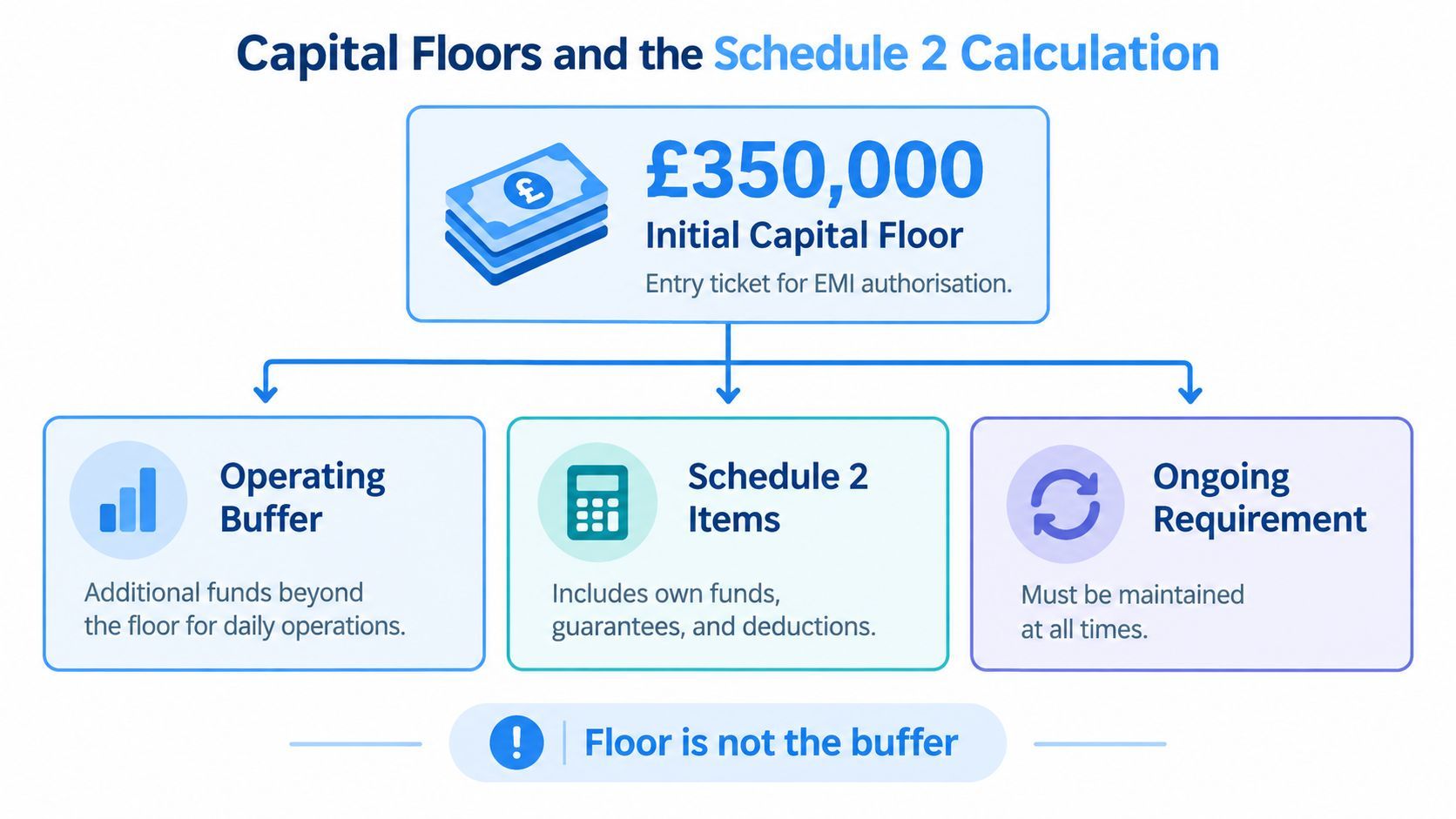
The first number most founders notice is €350,000, and it matters. Under the UK regime, that figure is the initial capital floor for authorisation, but it's not the whole prudential story. It's the entry ticket, not the operating buffer.
Why the floor isn't enough
The regulations also require authorised EMIs to maintain own funds of at least €350,000 or the higher amount produced by the Schedule 2 risk-based calculation, whichever is greater the regulation text. That calculation turns the business model into a prudential number by looking at things like issuance volume, payment-services activity, fixed costs and operational risk. If your forecast grows, your own-funds requirement may grow too.
For small EMIs, there's another trigger to watch. When average outstanding electronic money reaches €500,000 or more, the firm has to reconsider whether its capital methodology still fits the scale of the business. Where history is short, projected outstanding e-money supported by the business plan becomes relevant, which means the forecast itself becomes part of the prudential submission rather than just a commercial slide deck.
What a defensible submission shows
A strong application doesn't stop at “we have €350,000”. It reconciles projected own funds, the capital policy, the safeguarding model and the wind-down assumptions. It also shows how the firm behaves if revenue lands more slowly than expected or compliance costs rise.
Founder check: if your forecast, controls and capital policy don't line up on paper, the regulator will spot it quickly.
For practical planning, the point is to treat capital as a living requirement. The authorisation file should demonstrate monthly own-funds thinking, not a one-off threshold check. The FCA will care less about the headline number in isolation and more about whether the firm can keep that number above the line as the business scales.
If you're mapping the financial side of an application, this guide to financial risk assessments is a useful companion.
Safeguarding Customer Funds in Practice
Safeguarding is where many EMI models look tidy on paper and strain in daily operations. If you receive funds in exchange for issued electronic money, you must protect those funds through segregation or an approved insurance or guarantee route the safeguarding rules. The hard part is making that rule hold up every day.
What segregation really demands
Under the segregation method, relevant funds must stay separate from the firm's own money. If they are still held at the end of the following business day, they need to move into a designated account with an authorised credit institution, or into secure, liquid, low-risk assets held with an authorised custodian. Funds received through a payment instrument can use a limited timing exception, but they still need to be safeguarded by the end of five business days after the e-money is issued.
Safeguarding works only as an operating rhythm. Daily reconciliations, named ownership and exception handling have to connect the e-money ledger, settlement accounts, safeguarding accounts, outstanding customer balances and any breaks. If balances are not identified and moved promptly, a policy that looks compliant can still fail in practice.
What good control design looks like
A working model usually sets cut-off times, assigns reconciliation ownership, defines escalation thresholds, controls access and keeps evidence. The safeguarding account also has to be clearly designated for that purpose, so customer money does not blur with the EMI's own working capital during stress or insolvency.
The UK government's payment work has also made clear that safeguarding is about the return of customer funds if a firm becomes insolvent, and the FCA's supplementary safeguarding regime is scheduled for May 2026, following sector engagement from January to April 2026. That matters because the focus shifts to whether the controls work across different payment flows, not just whether a safeguarding policy exists on paper. The FCA's reporting materials require firms to distinguish funds received in exchange for issued e-money from funds received for unrelated payment transactions, which forces cleaner mapping of every customer-funds flow.
That is where the operational traps hide. A firm can have the right account opened in the right name and still fail if the reconciliation trail cannot show how intake, safeguarding, exception handling and return of funds connect.
Operational rule: if you cannot trace a balance from intake to safeguarding to reconciliation to exception handling, you do not really know whether safeguarding works.
The Authorisation Journey from Application to Interview
A sensible authorisation journey starts with scoping, not paperwork. The firm first needs to pin down the planned activities, target jurisdiction and the shape of the product, because an EMI application built on vague assumptions usually falls apart when the regulator asks what the customer receives and when. Once that's clear, the application package has to match the model the firm plans to run, not some cleaner future version.
What goes into the file
The core materials usually include the business plan, financial projections, governance arrangements and policies. The regulator will also want to see the distinction between current arrangements and the arrangements the firm says it will have in place at launch. If those two pictures don't align, the application starts to look more like a promise than a controlled plan.
An EMI application often becomes easier to assess when the evidence is organised around decisions the FCA will care about. Wind-down planning, safeguarding evidence and senior-manager responsibility are common pressure points. That's where structured preparation helps, because it forces management to answer the awkward questions before the FCA does.
What the interview really tests
The FCA's authorisation team tends to probe how the business will work in practice. They'll test whether the people named in the file understand the controls they're signing up to, whether the firm can explain its safeguarding model without drifting into marketing language and whether the answers are internally consistent across the documents. Post-submission correspondence usually revolves around clarifying those gaps.
If you're preparing this route, Glentorion's authorisation guidance is one example of the kind of preparation support firms use to organise the file, track findings and get management ready for interview.
Interview reality: the regulator is listening for control ownership, not polished slogans.
A strong team walks into the interview able to explain who does what, what evidence proves it and what happens if the model stops working. That's usually what separates a workable application from a pile of well-written policy drafts.
Supervisory Expectations After Authorisation
Authorisation isn't the finish line. It's the point where the firm starts living under ongoing supervision, with obligations that keep running whether or not the product has launched cleanly. The standing requirements include maintaining own funds, safeguarding customer money, retaining relevant records for at least five years from the date each record was created, and giving the regulator information about e-money issuance, payment-services activity and regulatory compliance whenever it directs the statutory recordkeeping and information provisions.
What good looks like in year one and beyond
In practice, good firms build monthly own-funds reconciliations, incident handling and operational-resilience reporting into normal management routines. They also keep a tight grip on notifications when anything material changes, because late disclosure is one of the most common post-authorisation failures. Weak wind-down planning and safeguarding reconciliations that drift are just as risky, especially once the business adds new products or payment flows.
For crypto-touching e-money businesses, the perimeter question matters too, because some firms move from lighter registration routes into full FSMA authorisation once their activity is properly characterised. That change usually comes with more formal expectations on governance and accountability, not fewer.
A short supervisory readiness check
- Own funds tracked monthly: show that the capital position stays above the regulatory minimum throughout the plan period.
- Safeguarding reconciliations current: prove that customer balances, safeguarding accounts and exception items tie together cleanly.
- Recordkeeping controlled: keep auditable records for the full retention period and make retrieval simple.
- Material changes escalated fast: don't leave the FCA to discover structural change late.
- Senior ownership clear: the people named in the file should still be able to explain the model.
You can think of year one as proof that the operating model works, year three as proof that it still works after product changes, and year five as proof that the business has kept evidence, controls and governance aligned. This note on FCA compliance requirements is useful if you're building a broader supervisory checklist around that idea.
Glentorion helps founders and compliance teams turn an EMI idea into a regulator-ready application, then prepare management for the interview questions that usually expose weak assumptions. If you're planning an EMI, small EMI or a payments model that touches customer funds, visit Glentorion to see how its authorisation and compliance work supports that process.
- e money institutions
- EMI authorisation
- UK payments regulation
- FCA safeguarding
- small EMI