Licence Application UK: How to Apply for an FCA Licence
Published
Your team has a launch plan, a compliance hire and a folder of policies. Then someone asks whether your existing payments permission covers the proposed crypto service, and nobody can give a documented answer. The application timetable is already under pressure before anyone has opened FCA Connect.
For a UK licence application, the first gate is choosing the right regulatory route. The next is showing that the business model, people, finances and controls form a coherent operating arrangement. A polished business plan won't compensate for the wrong permission, and submitting early won't make an incomplete file ready for determination.
Table of Contents
- Pick the Right UK Route Before You Apply
- Build the Evidence Pack and Submit Step by Step
- How Long Decisions Take and What Starts the Clock
- Why Applications Stall and How to Fix Them
- Interview Readiness and What Regulators Test
- Post-Submission Follow-Up and Outcomes
- Confirm Your Route Before the Window Closes
Pick the Right UK Route Before You Apply
Say a payments-firm founder adds a crypto exchange feature to the product roadmap. The team assumes its existing regulatory status is enough, so it starts drafting customer journeys rather than checking the perimeter. That assumption can force the team to redesign both its application and its launch plan.
The FCA's cryptoasset registration guidance makes clear that FCA-authorised firms, electronic-money institutions and payment institutions still need separate registration when providing cryptoasset services within the Money Laundering Regulations' scope. Existing status isn't blanket permission for a new business line.
UK licence route by activity
| Activity or situation | Route | First check |
|---|---|---|
| UK cryptoasset exchange or custody | FCA cryptoasset registration under the Money Laundering Regulations | Confirm the services fall inside the registration perimeter before launch |
| Existing FCA-authorised, e-money or payment firm adding crypto | Separate cryptoasset registration | Existing status does not cover the new business line |
| Crypto promotions aimed at UK consumers | Financial promotion regime with four lawful routes | A payments or e-money licence alone is not enough |
| Newly regulated cryptoasset activity under the incoming regime | FSMA cryptoasset authorisation | Check eligibility for the scheduled application window |
| Other regulated financial activity | Part 4A permission applied for through FCA Connect | Map each service to the permission it needs |
| UK sanctions licence | OFSI licence application | Different regulator and process from FCA routes |
Under the FCA's financial-promotion guidance, the four lawful routes are communication by an authorised person, approval by an authorised person, communication by an FCA-registered cryptoasset business using the relevant exemption, or another applicable exemption. A payments or e-money licence alone doesn't resolve crypto marketing permissions.
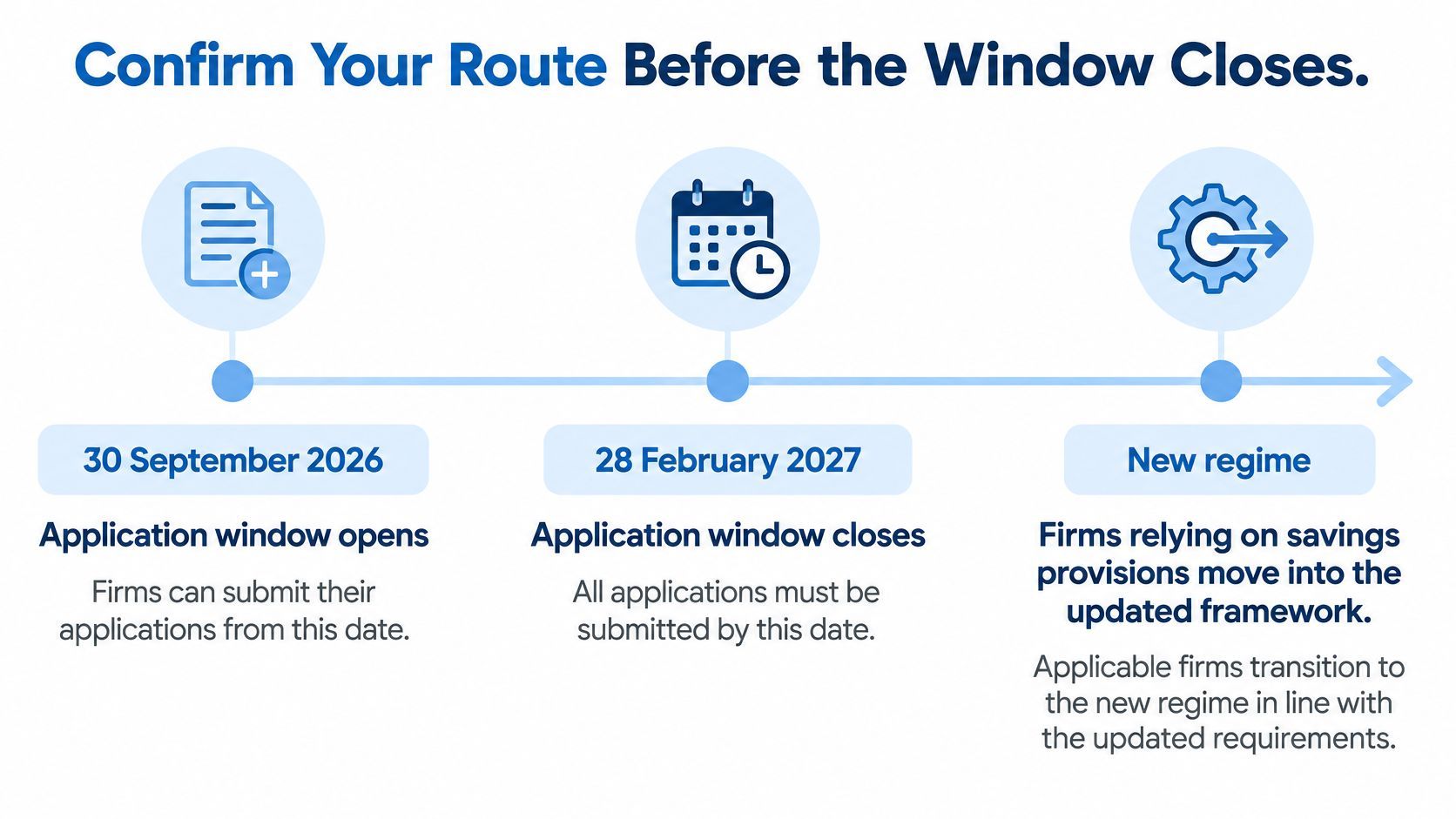
The FCA's cryptoasset application material gives a scheduled application window of 30 September 2026 to 28 February 2027, with the incoming regime expected to start on 25 October 2027. Treat that as transition planning, not evidence that current obligations disappear.
For a banking proposition, use our UK bank licences explainer to distinguish that route from crypto registration. Before choosing a form, list every service, customer group and transaction flow, then assign each service to its regulatory route.
Build the Evidence Pack and Submit Step by Step
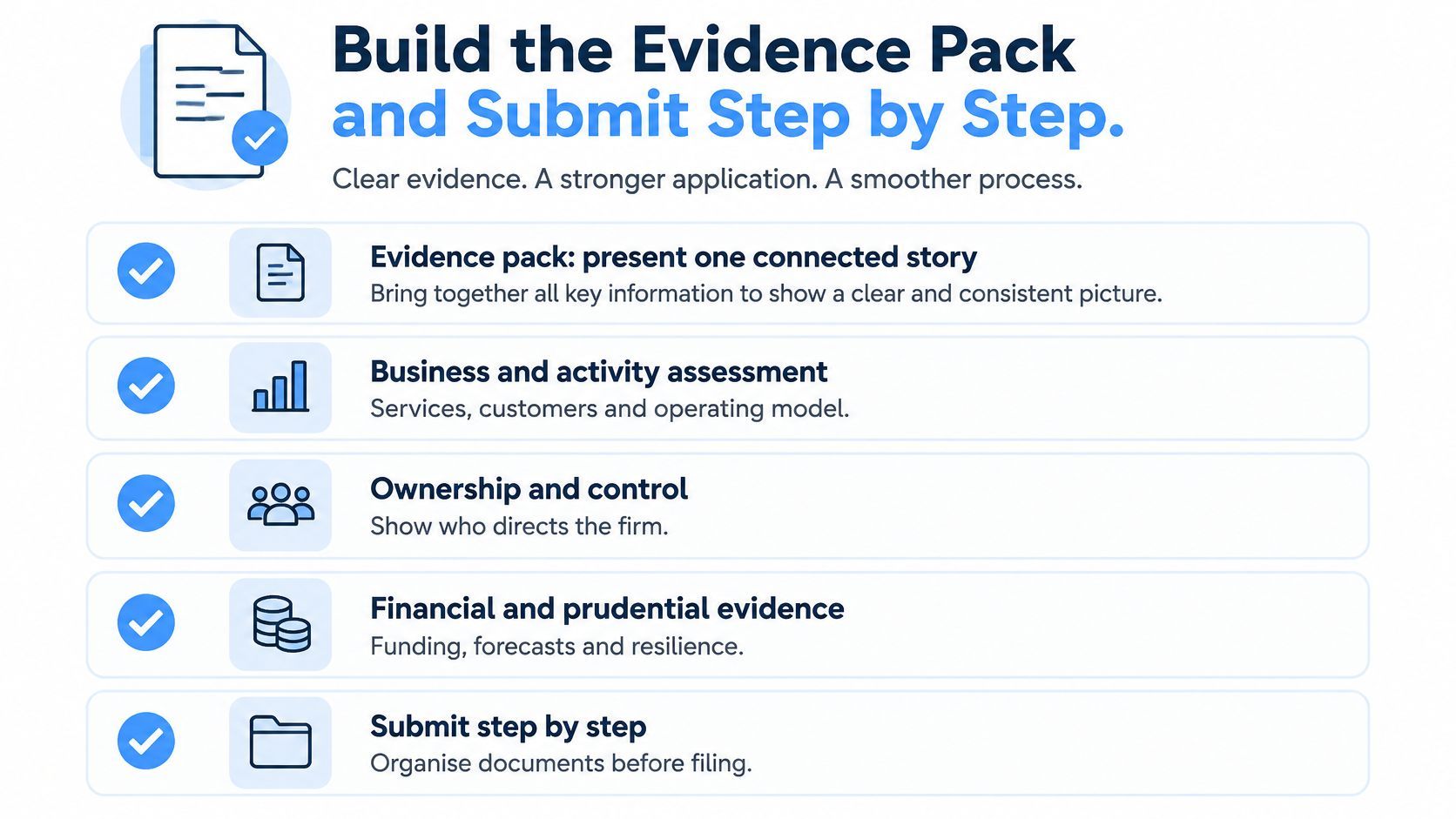
Build the evidence pack before treating the portal as the main task. A reviewer needs to understand the same business across the application answers, forecasts, policies and organisation chart. If those documents describe different arrangements, more documents won't solve the problem.
Our authorisation work starts by examining planned activities, jurisdiction, existing material and open questions. We then agree the work, deliverables and responsibilities, so the applicant knows which decisions remain with management and which drafting or review tasks sit with us.
Assemble a connected account
The business and activity assessment should cover intended services, customers and how the business will operate. Include transaction flows, customer onboarding, custody arrangements where relevant, and the division of work between the applicant and its providers.
The business plan must connect commercial ambitions to financial resources. Forecasts should explain their assumptions, while governance and ownership documents identify who directs the firm, who owns each control and which controlled functions are relevant.
Financial crime policies should distinguish arrangements already operating from those still to be established. Operational-resilience, outsourcing and technology evidence should make the same distinction, supported by implementation dates, dependencies and accountable owners.
Practical rule: If a document says a control operates, the responsible person should be able to show how it operates.
Follow the submission sequence
The FCA's application guidance identifies incomplete forms, missing signatures, inaccessible protected files, weak financial information and unready arrangements as application-quality problems. Use the following sequence to prevent avoidable gaps.
- Map the activities. Match every proposed service to its permission or registration route. The common slip is describing the product's brand rather than what the firm does.
- Set up FCA Connect and complete applicable forms. Allocate responsibility for portal access and form completion. Don't assume an attachment replaces a required answer.
- Assemble signed evidence. Collect approved versions, not a mixture of working drafts and final documents. Missing signatures are an avoidable filing defect.
- Reconcile the documents. Use an evidence matrix linking each application claim to its supporting document, owner and status. Check names, responsibilities, financial assumptions and control descriptions.
- Verify people and systems. Confirm relevant controlled-function holders and test whether systems are live or supported by a credible implementation plan. An unnamed future hire isn't a filled role.
- Resolve gaps and obtain management sign-off. Check protected-file passwords and the applicable fee arrangements before filing. An unpaid registration fee or inaccessible attachment can undermine an otherwise organised submission.
Our evidence explainer helps distinguish an assertion from material that supports it. Keep the matrix practical: document name, version, claim supported, accountable owner, open issue and resolution.
The release checklist should contain signed forms, shared passwords through an agreed secure channel, fee evidence and no unresolved questions in the evidence matrix. Management should explicitly approve any implementation commitments rather than letting a drafter make them by implication.
How Long Decisions Take and What Starts the Clock
A file can be submitted without the decision clock having started. The relevant date depends on the route and whether the regulator has the information it needs. Set launch expectations against that point, not the upload date.
Decision clocks and service metrics
| Application type | Time expectation | What starts the clock |
|---|---|---|
| Complete Part 4A permission application | Usually 6 months | Receipt of a complete application |
| Incomplete Part 4A application | Up to 12 months | Receipt of an incomplete application |
| Cryptoasset registration | 3 months to decide | All information needed for determination received; fee must be paid before consideration |
| New-firm authorisation, Q2 2024/25 | 95.6% within service standard | 356 applications handled; a timeliness measure, not an approval rate |
The FCA's authorisations operating service metrics set out the six-month pathway for complete Part 4A applications and the twelve-month pathway for incomplete ones. In Q2 2024/25, the FCA handled 356 new-firm applications and met its service standard in 95.6% of cases. This measures processing against a service expectation, not the chance of receiving permission.
For cryptoasset registration, the FCA's application instructions state that the decision period is three months once the regulator has all the information needed to determine the application. The FCA cannot consider the application until the registration fee is paid. Missing ownership explanations, unanswered questions or incomplete policies can postpone the point when that period begins.
Record the submission date separately from the date the FCA confirms it has the information needed to decide.
If that date is unclear, ask the FCA to clarify the application's status. Do not treat an internal estimate as confirmation that the decision clock has started.
A successful cryptoasset registrant also becomes liable for an annual periodic fee, in addition to the application fee. Include that ongoing cost in your planning rather than treating registration as a one-off payment.
Why Applications Stall and How to Fix Them
A file can be complete on paper and still fail to explain how the business will operate. A weak route choice or an unresolved operating arrangement often shows up as a vague activity description, conflicting documents or answers that raise further questions.
Application symptoms, causes and fixes
| Symptom at review | Likely cause | Fix before submitting and owner |
|---|---|---|
| Regulator questions the business model | Services and customers are described too vaguely | Set out the services, customers and operating flows; owner: product lead |
| Forms are rejected or delayed | Signatures are missing or files are password-protected without access details | Check each form and provide passwords through an agreed channel; owner: compliance lead |
| Financial projections are challenged | Assumptions lack support or do not match the proposed operation | Reconcile projections with resources and the capital plan; owner: finance lead |
| Key roles appear unfilled | Responsibilities and proposed role-holders are unclear | Confirm named individuals and their responsibilities; owner: chief executive |
| Systems are described as not ready | Technology is not live and there is no implementation plan | Describe the current status or provide a dated plan; owner: technology lead |
| Policies do not match operations | Policies assume arrangements that are not yet in place | Distinguish current arrangements from those still to be established; owner: head of compliance |
Use the table to diagnose patterns, not to assume every question has one cause. A challenge to a forecast, for example, may point to unresolved staffing costs, funding assumptions or launch sequencing.
Fix the underlying arrangement
A wording change helps only when the underlying arrangement is sound. If no one owns a control, assign responsibility before revising the policy. If the business model or proposed activities have changed, check which application answers and supporting documents need to change with them.
The FCA threshold conditions and their relevance to authorisation can help frame that assessment. Existing MLR registration does not establish readiness for a separate FSMA application. Assess the proposed activities, governance, financial assumptions and control ownership against the requirements of the route being pursued.
For a general preparation perspective on the financial narrative, see improving your business finance application.
Interview Readiness and What Regulators Test
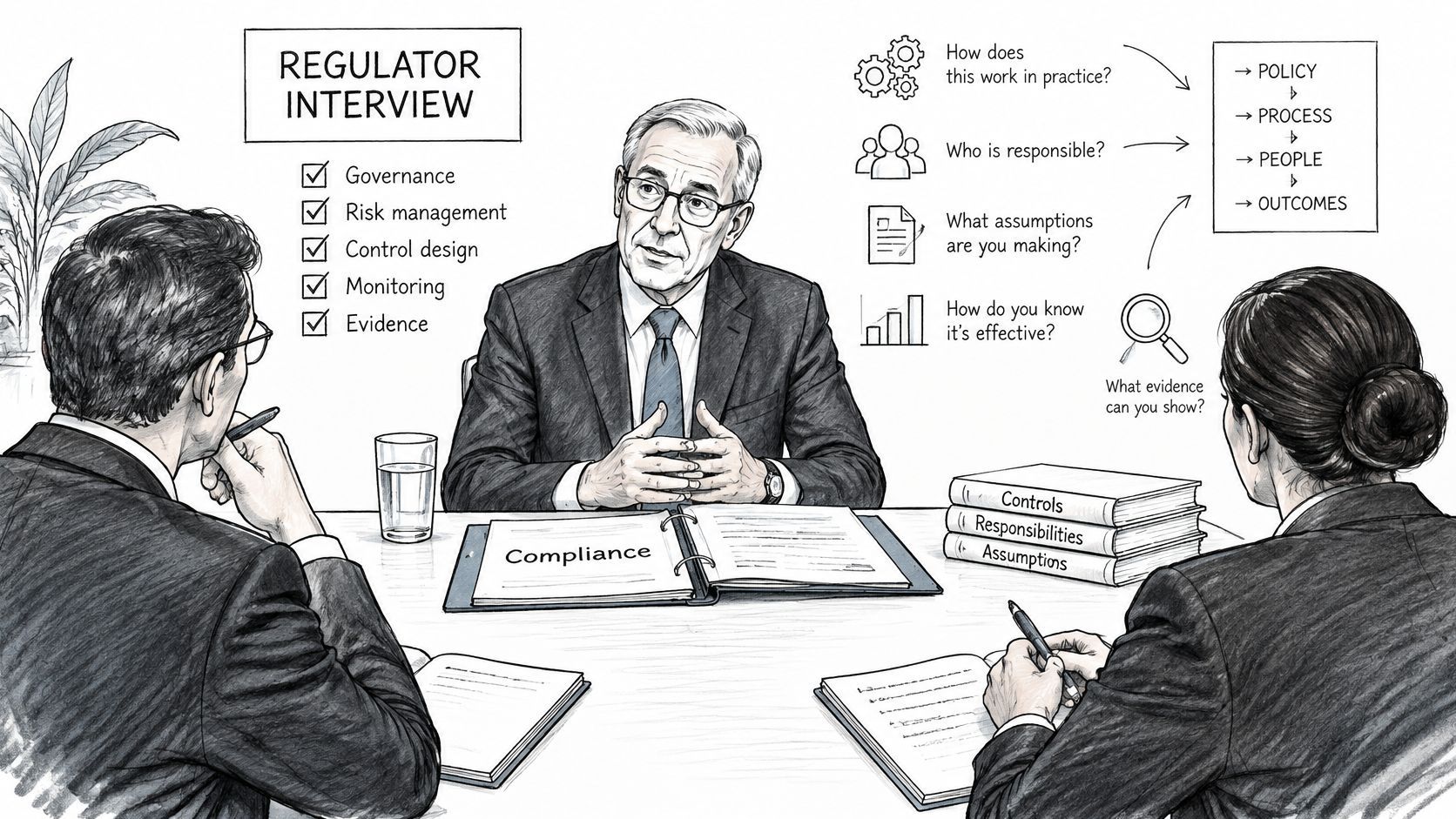
Where an application involves a regulator interview, senior staff need to explain the operating model without relying on a consultant to translate their own documents. Preparation should test understanding, not memory.
An executive who can repeat the AML policy but can't explain escalation decisions isn't ready. Equally, a technology lead should distinguish what the firm controls directly from what it depends on a provider to deliver.
Rehearse operational answers
Use these areas to structure preparation:
- Business model: Explain how customers enter, receive services and move funds or assets through the business.
- Accountability: Identify who makes decisions, who provides challenge and who covers absences.
- Financial crime: Walk through an alert, investigation, escalation and documented outcome.
- Dependencies: Explain oversight of outsourced services, technology failures and provider exits.
- Financial assumptions: Show how revenue, expenditure and funding assumptions were derived.
Ask each responsible person to prepare a concise account of their area, then reconcile it against the evidence matrix. Rehearse the questions where supporting material is weakest, including what happens when a control fails or an implementation date slips.
Our FCA approved person explainer helps frame the distinction between a job title and the responsibilities attached to a relevant role. Don't coach people to claim certainty where management still needs to make a decision.
A useful answer explains the arrangement, identifies its owner and points to evidence. It doesn't hide an unresolved issue.
For our engagements, additional regulator correspondence, interview attendance and ongoing support are agreed separately from the authorisation service. Confirm that scope early so preparation and attendance aren't confused.
The relevant regulator alone decides the application. Preparation improves the quality and consistency of answers; it doesn't guarantee approval or a decision date.
Post-Submission Follow-Up and Outcomes
Once the application is with the FCA, designate a correspondence owner and maintain a controlled response log. Answer each question directly, date the response and identify the document or evidence that supports it.
Don't send an updated policy without explaining what changed. Keep the evidence matrix aligned with each submitted version, preserving the original filing so the team can distinguish the initial account from subsequent amendments.
Control the response cycle
- Allocate the question: Name the person who can establish the facts, not merely the person who can draft the reply.
- Check affected documents: A change to outsourcing may also alter costs, responsibilities and continuity arrangements.
- Approve the response: Obtain the relevant management approval before committing to a new arrangement.
- Record the submission: Retain correspondence, attachments, versions and filing acknowledgements together.
Possible outcomes include a granted registration or permission, potentially subject to limitations or requirements, a refusal, or withdrawal when the applicant decides not to proceed. If refused, review the reasons and the applicable challenge rights and deadlines in the decision documents rather than assuming every route uses the same procedure.
The application fee is an upfront cost, not a payment for approval. For a successful cryptoasset registrant, the continuing fee obligation belongs in the operating budget and compliance calendar.
Put the decision into operation
- Confirm the decision in writing and record its date.
- Check conditions, limitations and requirements against the operating model before launch.
- Brief the board and accountable persons on what was agreed.
- Diarise applicable reporting obligations and fee dates.
- Reopen the evidence matrix whenever services, owners or systems change.
A permission should be read against the activity the firm intends to perform, not just filed as a certificate. The regulator alone determines the outcome, while the firm remains responsible for operating within it. A clear post-decision record gives management a reliable starting point when supervision begins.
Confirm Your Route Before the Window Closes
The FCA's cryptoasset regime materials schedule the savings-provisions application window to open on 30 September 2026 and close on 28 February 2027. The new regime is expected to take effect on 25 October 2027, according to the same FCA materials.
These are transition milestones, not an instruction to defer preparation. The FCA advises firms to apply as early as possible to maximise the period during which they can continue operating while their application is assessed, subject to the relevant conditions.
Turn the transition into assigned work
A firm registered under the Money Laundering Regulations, authorised under the Payment Services or Electronic Money Regulations, or relying on a section 21 financial-promotion approver should test whether its existing basis remains sufficient. Don't treat these statuses as interchangeable with the proposed FSMA permissions.
Use a management-owned action sequence:
- Inventory current and planned cryptoasset activities. Include services still in product development, not just those already generating revenue.
- Identify registrations or permissions that don't cover the inventory. Distinguish a potential variation of existing permissions from a new application.
- Build the evidence matrix and assign each gap to an owner with authority to resolve it.
- Set a target filing date comfortably before the scheduled window closes, allowing time for management decisions and corrections.
- Agree the adviser's mandate, including who submits, who approves answers and who controls access.
Test changes to the business model while the application is pending. A new custody arrangement, customer segment or outsourcing provider may affect the activity assessment, forecasts and control ownership simultaneously.
After our internal approval and the client's sign-off, we submit the agreed application on the client's behalf under the required mandate and access arrangements. That filing authority should be settled before the submission deadline becomes urgent.
The window is a deadline to plan against, not a reason to wait until its final weeks. Assign the route assessment and evidence owners now, while management still has room to change the proposed arrangements.
Glentorion helps financial and crypto businesses assess their authorisation route, prepare and review application evidence, and ready management for regulator interviews. Visit Glentorion to discuss a defined application engagement covering your planned activities, existing materials, deliverables and submission responsibilities.
- licence application UK
- FCA authorisation
- cryptoasset registration
- FCA application
- UK regulatory licence