Appointed Representatives FCA: How the Regime Works
Published
The AR route expands the principal's own regulated business. Founders and compliance teams sometimes treat appointed representatives under the FCA as a way to enter UK financial services while compliance sits elsewhere. In practice, becoming a principal pulls another firm's regulated activity inside the principal's governance, operating model and supervisory perimeter.
That mistake is expensive because direct authorisation remains narrow and selective, so a faster route can look attractive. The firms that stumble are usually not caught by a rule they forgot to read. They are caught when the principal cannot show what it approved, which risks it challenged, how it set limits, or why its oversight matched the representative's real business. The AR question is therefore evidential: could the principal defend its supervision as part of its own operating model, not as paperwork held at arm's length.
Table of Contents
- What an Appointed Representative Is
- Principal and Appointed Representative Duties Compared
- How Principals Must Oversee Their Representatives
- Reading Data and Evidence That Prove Oversight
- How to Appoint an Appointed Representative Safely
- Becoming an Appointed Representative
- When Oversight Fails and What Follows
- Deciding Whether the AR Route Fits Your Firm
What an Appointed Representative Is
An appointed representative (AR) is a firm or individual that carries out specified regulated activities under a written contract with an FCA-authorised principal firm, without holding FCA permissions of its own for those activities. Think of a tenant running a retail shop inside a landlord's licensed premises, where the landlord answers to the local council for everything that happens behind the counter.
Say a regional mortgage advisory start-up wants to advise retail borrowers without waiting through a direct authorisation process. It contracts with an authorised mortgage network acting as its principal. The principal decides precisely which regulated activities the start-up may perform, so the principal's permissions map sets the hard boundary of what the AR can and can't sell, advise on, or arrange.

Scale of the UK Regime
The regime has operated since 1986, and FCA appointed representatives data records around 33,000 active ARs in 2026. The same FCA figures show that ARs generated approximately £13.1 billion in regulated financial-services revenue in 2025, an increase of £0.9 billion, or 7.3%, from 2024. That puts the regime firmly at the centre of UK financial distribution rather than in a quiet corner for solo advisers.
Operating reality: Appointing an AR isn't simply a commercial distribution deal. It extends the principal's own operating model and places tens of thousands of firms inside a supervisory perimeter that both principals and the FCA actively police.
That structure creates a clear split of incentives and risk. The AR gains market access without completing direct authorisation, while the principal retains full accountability for the regulated business it has accepted and carries the ongoing oversight burden that follows. Getting the arrangement right depends on mapping each party's legal duties accurately, proving active oversight through verifiable records, running a disciplined onboarding gate, and recognising the early failures that trigger regulatory intervention.
Principal and Appointed Representative Duties Compared
Under the Financial Services and Markets Act framework, explained in the FCA Perimeter Guidance manual (PERG 5.13), the principal is legally responsible, to the same extent as if it had expressly permitted the conduct, for the AR's acts and omissions within the business it has accepted responsibility for. That statutory rule is binding law, not optional guidance, and it sets the foundation for every control a principal must operate.
| Area | Principal | Appointed representative |
|---|---|---|
| Legal status | Authorised by the FCA and holds the permissions | Holds no permissions for the appointed activities; acts under contract |
| Scope of activities | Decides which regulated activities the AR may carry out | Carries out only the activities in the contract |
| Accountability | Responsible for the AR's acts and omissions within accepted business | Accountable for compliant conduct of the activities it performs |
| Due diligence | Assesses the AR entity and relevant individuals before appointment | Supplies accurate, complete and current information |
| Ongoing oversight | Collects and tests management information, reviews the AR at least annually | Provides management information, records and access as agreed |
| Data and notifications | Notifies appointments and changes, submits annual revenue and complaints data | Keeps information it supplies accurate and up to date |
| Insurance and financial crime | Maintains proportionate financial-crime policies and required professional indemnity cover for current and former AR activities | Follows the principal's policies and procedures |
Reading the Split Between Principal and Representative
The asymmetry in that table is deliberate. The AR's duties are real and enforceable, yet they're strictly bounded by the written contract and the activities listed inside it. A principal's regulatory duties reach across every customer journey, financial promotion, complaint, and advice file produced under the business it has accepted. That is the commercial trade-off behind the route: the AR gets access to permissions it does not hold, while the principal accepts responsibility for the regulated activity and the evidence that supports it.
That means the principal must apply oversight equivalent to what would reasonably apply if its own staff carried out the regulated work. In practice, you need a risk-based AR file covering pre-appointment due diligence, senior-management fitness and competence checks aligned with FCA approved person requirements, financial-crime assessments, complaints logs, sample file testing, training evidence, breach logs, and recorded remediation decisions. The principal must also maintain professional indemnity insurance covering both current and former AR activities so historic liabilities don't fall through a gap after an appointment ends.
A contract can set scope, information rights, access, and commercial recovery between two companies. It cannot delegate regulatory accountability away from the principal. Commercial teams sometimes try to soften this exposure by inserting sweeping indemnity clauses into the AR contract. If an AR mis-sells a product or ignores a disclosure rule, the FCA holds the principal to account first. That is why the AR arrangement should be treated as an extension of the principal's own operating model, with evidence strong enough to show the oversight worked.
How Principals Must Oversee Their Representatives
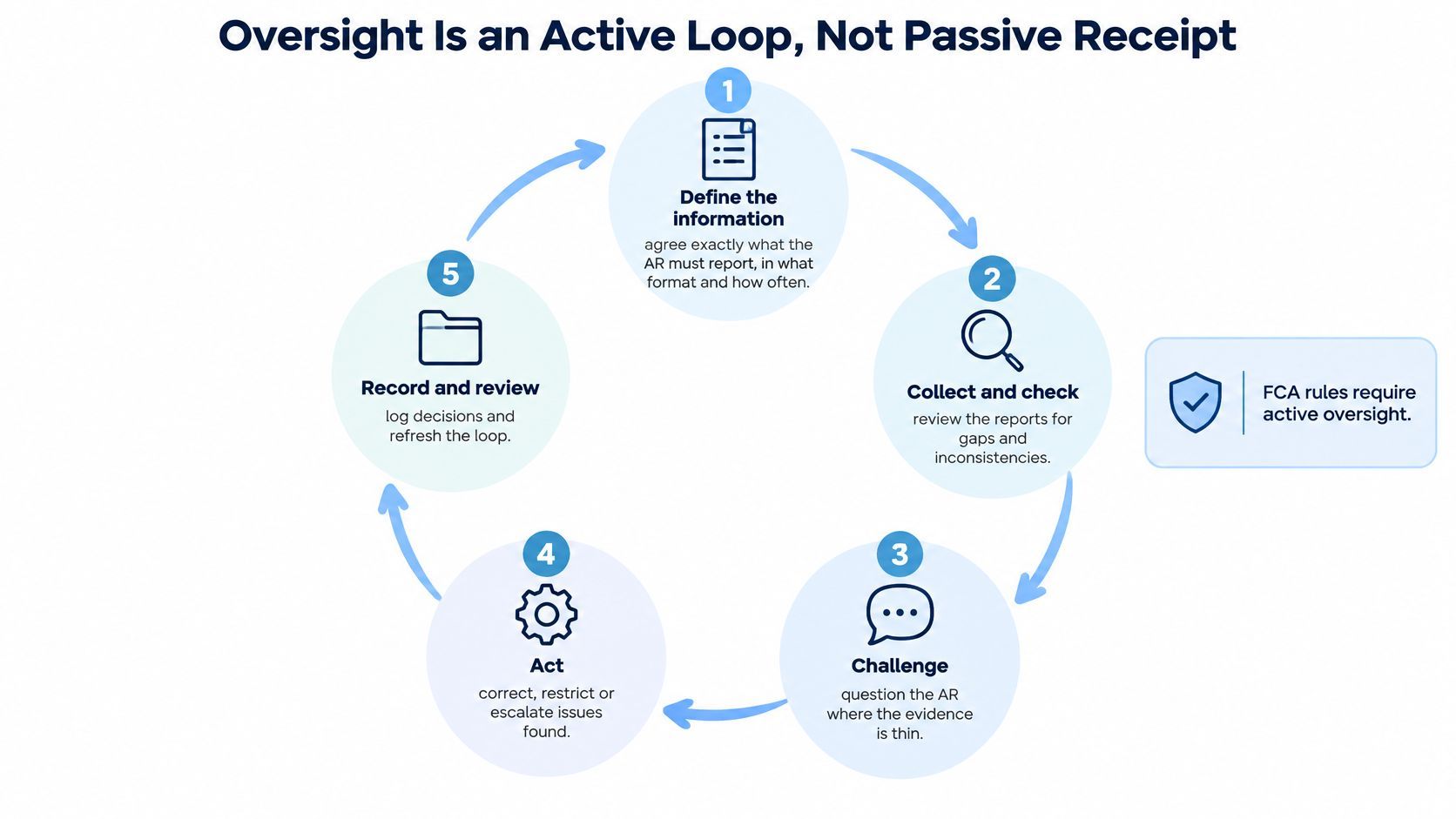
SUP 12.4 expects the principal to run the AR like part of its own operating model: the same challenge, evidence and escalation discipline applied to an internal team, adapted to contractual distance. Under the binding rules in FCA Handbook SUP 12.4, oversight is an active mechanism with records that let you reconstruct what you knew, when you knew it and what you did next.
The defensible version is a six-stage control cycle. Each stage leaves an artefact a supervisor can test without relying on memory:
- Define the required information: Agree in writing what management information the AR must submit, the exact format, the owner and the calendar schedule. This stage produces a signed MI schedule and data dictionary attached to the monitoring plan.
- Obtain and verify the data: Check that every submission about the AR entity, its senior individuals and its business volumes is accurate, sufficiently detailed and current. Your verification log and exception notes prove the numbers were tested rather than accepted at face value.
- Scrutinise for emerging risks: Compare figures across periods to spot conduct drift, capacity strain or unexpected product spikes before customer harm materialises. Written analytical commentary and risk-committee minutes evidence active challenge.
- Monitor live delivery within scope: Review customer-facing materials, call scripts, websites and advice files, and hold scheduled governance meetings with the AR's management. Dated script sign-offs, QA testing sheets and meeting action logs show real delivery was checked.
- Investigate exceptions and act: When testing uncovers a breach or thin evidence, launch a targeted review, restrict activities if needed and track corrective actions to closure. A documented breach register and signed remediation closure memo prove standards were enforced.
- Maintain direct record access: Give your compliance team enforceable, practical access to all AR records relevant to regulated activities, including CRM entries, client communications and accounting ledgers. Periodic access checks and audit-trail exports confirm that access works when needed.
Turning the Control Cycle into Routine Operations
Oversight breakdowns often happen between steps one and four when delivery dates sit in inboxes instead of a tracked calendar. Building these checks into structured standard operating procedures turns an abstract FCA rule into repeatable weekly habits for compliance analysts: confirm receipt, verify completeness, record variance, escalate exception, close action.
Contract governance tools help here too. Applying formal tracking disciplines aimed at avoiding missed deadlines and payments, as outlined by BoloSign, gives compliance teams a practical way to monitor contractual MI submission dates, annual attestation windows and insurance renewal milestones across multiple ARs without relying on ad-hoc email reminders.
Active oversight is proven by the questions asked when something looked slightly off, not by the length of the compliance manual sitting on the intranet.
Reading Data and Evidence That Prove Oversight
Policies alone don't satisfy UK supervisors. In its 2024 review, summarised in an FCA press release on principal oversight, the regulator surveyed 251 principal firms by telephone and conducted in-depth documentation assessments at 23 firms. It found that one in five principals hadn't completed a required self-assessment or an annual review of their ARs.
That single finding exposes the gap between writing an oversight framework and running a review calendar with named ownership. Under binding FCA rules in SUP 12, oversight is increasingly data-led: principals submit ongoing details through FCA onboarding, change, and termination notifications alongside the annual REP025 return, which captures AR revenue and complaints. The FCA uses those submissions to flag higher-risk principals and ARs, so you should read the same data pairs internally before the regulator ever asks.
| Signal | What it may indicate | Principal action |
|---|---|---|
| Complaints rising faster than revenue | Sales-practice, disclosure or suitability weakness | Call sampling and file testing, documented escalation |
| Revenue high but complaints near zero | Under-reporting or weak complaint identification | Reconcile complaints logs to customer volumes and run mystery shopping |
| Revenue falling sharply | Loss of business or activities drifting outside scope | Review the contract scope and the AR's permissions map |
| Annual AR review late or missing | No named owner or calendar | Assign an owner, set a review calendar and record completion |
| Principal self-assessment not completed | Principal's own oversight capability untested | Complete the annual self-assessment and record conclusions |
Reading complaints alongside revenue stops you from celebrating the wrong numbers. A fast-growing AR with flat complaints looks healthy at first glance, yet reconciling its complaint register against raw customer volumes and accounting records can reveal that frontline staff aren't logging verbal expressions of dissatisfaction as formal complaints. When you run call sampling or follow-up reviews, consistent note capture matters just as much as the test itself; adopting disciplined habits for documenting client calls after meetings, such as the structured call-note workflows detailed by VoxNote, helps ensure sales and advice records are complete enough to audit accurately.
Building a Defensible AR Evidence File
According to FCA guidance on principal responsibilities, principals must keep FCA-held records current, file annual REP025 returns, review each AR at least every 12 months, and assess every non-introducer AR's financial position annually under SUP 12. Understanding how regulatory evidence is assessed makes clear why weak documentation leaves even well-intentioned principals exposed during a supervisory visit.
A defensible AR file should contain seven core artefacts, each dated and tied to a named owner:
- Approval rationale: A written record explaining why the AR fits the principal's strategy, permissions, and risk appetite, signed off before onboarding.
- Responsibility map: A clear allocation showing which senior manager at the principal owns supervision, escalation, and annual sign-off for each AR.
- Risk-based monitoring plan: A schedule matching testing frequency and depth to the AR's product complexity, customer vulnerability, and revenue scale.
- Complaints and revenue MI: Reconciled figures linking accounting records, customer volumes, and complaint logs, paired with pre-set escalation thresholds.
- File-testing and call-sampling results: Objective audit sheets showing pass rates, coaching actions, and follow-up re-tests rather than vague summaries.
- Financial-stress triggers: Defined warning levels for cash reserves, debtor days, or revenue drops that trigger an out-of-cycle review of the AR's solvency.
- Documented exit criteria: Concrete conditions under which the principal will suspend business, restrict activities, or terminate the AR contract cleanly.
How to Appoint an Appointed Representative Safely
A principal's exposure starts the moment an AR speaks to a prospective customer, so onboarding needs a strict sequence with zero shortcuts. Every step below must leave a dated record in the AR file because those records are the exact audit trail supervisors examine if problems arise later.
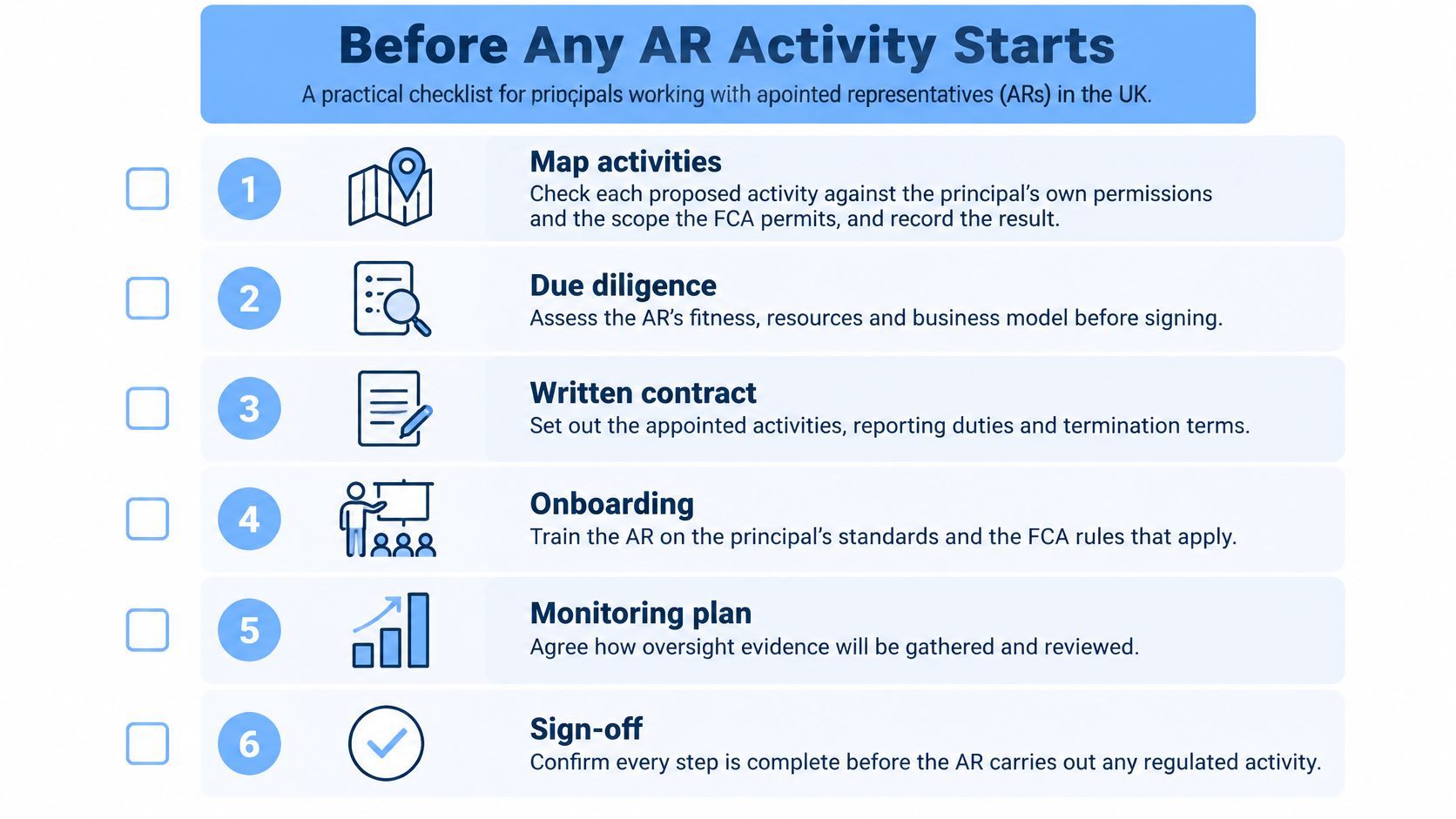
- Map every proposed activity to your permissions: List each product, advice type, and customer interaction the candidate wants to run, then verify it sits cleanly inside your existing FCA permissions and the permitted AR scope. Recording this mapping prevents accidental perimeter breaches before a single contract is drafted.
- Complete thorough entity and individual due diligence: Assess the AR's corporate structure, beneficial owners, and relevant senior individuals for fitness, competence, track record, and any prior complaints or regulatory history. Skipping background verification is one of the fastest ways to inherit undisclosed conduct risk.
- Stress-test the AR's financial position and resources: Inspect management accounts, cash reserves, and fixed commitments, and model how the AR handles a sudden revenue drop. A financially fragile AR faces commercial pressure to cut corners on advice quality or delay customer redress.
- Assess financial-crime risk across the customer journey: Evaluate money-laundering, sanctions, and fraud exposure specific to the AR's target customers, distribution channels, and payment flows. Set proportionate onboarding controls and transaction monitoring rules before launch.
- Execute a precise written contract: Draft clear terms setting out permitted activities, mandatory MI formats and deadlines, unrestricted record access, audit rights, and objective termination triggers. Ambiguous contract language slows you down precisely when you need to intervene fast.
Treating FCA Notification as a Hard Launch Gate
Commercial teams often push to begin marketing or soft-launching while paperwork sits in a queue. I would treat the final two steps as an immovable launch gate that no revenue target can override.
- Submit the FCA onboarding notification and wait for completion: Notify the appointment through the FCA's onboarding process with accurate, verified details for the firm and its individuals. No regulated activity, financial promotion approval, or client solicitation may start until the onboarding gate is fully cleared.
- Lock in the monitoring plan, review date, and named owner: Before day one of trading, confirm the first sample-testing date, enter the annual AR review onto the compliance calendar, and assign one accountable manager to oversee both. Starting live business without a calendarised owner guarantees the first review will slip.
Board test: If your compliance director left tomorrow, could a replacement open the AR file and verify within ten minutes why the firm was approved, what permissions it uses, and when its next audit falls due?
Becoming an Appointed Representative
If you're a founder or commercial director looking to operate as an AR, your preparation determines both how fast a credible principal approves you and how smoothly the relationship runs afterwards. Start with one essential filter: confirm that every regulated activity you plan to carry out already sits inside a prospective principal's FCA permissions. No principal can appoint you for an activity it isn't authorised to conduct itself.
Confirming Your Principal's Permissions First
Before scheduling introductory calls, look up candidate principals on the public Financial Services Register. Check their active permissions, any limitations or requirements attached to their profile, and whether they already supervise ARs in a similar sector. A principal with relevant product experience will ask sharper questions during onboarding, which is a good sign; a principal that offers effortless sign-up with minimal due diligence is a serious operational liability for your business if the FCA later restricts its permissions.
Preparing Your Onboarding File
Serious principals run structured due diligence before signing an appointment contract, so assembling a clean evidence pack upfront avoids weeks of back-and-forth. Focus your preparation on four practical areas:
- Senior-team and corporate disclosures: Compile complete career histories, qualifications, regulatory references, up-to-date financial statements, and a transparent log of any historical complaints or disputes. Commit to updating the principal promptly whenever ownership, senior staff, or financial conditions change.
- Line-by-line contract review: Read the proposed AR agreement closely with your leadership team, paying special attention to the exact permitted activities, MI delivery obligations, record-access clauses, fee structures, and termination triggers that could halt your trading overnight.
- Management-information workflow: Agree the exact data fields, spreadsheet or system formats, and monthly or quarterly submission dates before you sign. Build those exports directly into your CRM and accounting tools so reporting doesn't become a frantic manual chore.
- Customer-facing materials and complaints process: Have your website copy, call scripts, client agreements, disclosure documents, and complaints procedure ready for principal review and approval. Principals must monitor how you deliver regulated services, so giving them clean, auditable drafts accelerates launch approval.
When Oversight Fails and What Follows
Many boards assume weak AR supervision leads only to an awkward compliance letter or an internal remediation project. Supervisory outcomes prove otherwise: failing to oversee ARs can restrict the principal's own permissions, trigger an independent third-party review, or force the termination of active business lines.
In its FCA Annual Report and Accounts 2024/25, the regulator reported that supervisory interventions during 2024/25 resulted in the termination of 81 introducer ARs and 321 full ARs, totalling 402 appointments. The same report states that at least 32 principal firms voluntarily restricted their business during 2024 to prevent harm, while the withdrawal rate for AR appointments stood at 3.7% in 2024 and the combined rejection, withdrawal, and refusal rate for applications involving controlled functions reached 3.5%. Supervisory volume was equally heavy, with 1,933 AR-related supervisory cases and 3,199 cases involving principal firms opened in 2024 under the relevant monitoring measure.
Alongside those annual figures, the FCA tested how approximately 270 principal firms, roughly 10% of the principal population, were embedding its newer AR oversight rules. Its good and poor practice review on effective AR oversight confirmed that during calendar year 2024, supervisory interventions also led to 2 skilled-person reviews and 3 principal firms applying to have requirements imposed at the regulatory gateway.
| Outcome | Reported figure | Period |
|---|---|---|
| Introducer ARs terminated after FCA intervention | 81 | 2024/25 |
| Full ARs terminated after FCA intervention | 321 | 2024/25 |
| Total AR appointments terminated | 402 | 2024/25 |
| Principal firms voluntarily restricting business to prevent harm | At least 32 | 2024 |
| Skilled-person reviews | 2 | 2024 |
| Principal firms applying for requirements at the regulatory gateway | 3 | 2024 |
| AR appointment withdrawal rate | 3.7% | 2024 |
How Supervisory Interventions Escalate
For a principal's risk committee, those numbers show that enforcement isn't reserved for outright fraud. A typical supervisory intervention begins with a targeted information request asking for your latest AR annual reviews, REP025 reconciliations, and principal self-assessment. If the documentation is incomplete, outdated, or generic, the FCA escalates to formal feedback, voluntary business restrictions (VREQ), mandatory appointment terminations, or a costly skilled-person review under section 166.
Watch for three early warning signs inside your own firm before a regulator spots them for you:
- Slipping review calendars: Annual AR reviews or your principal self-assessment repeatedly deferred because compliance staff are stretched across other projects.
- Unexplained complaint clusters: Rising customer grievances around disclosure, suitability, or fees that aren't immediately matched by root-cause testing and remedial action.
- Thin or late management information: ARs submitting rounded estimates, missing agreed cut-off dates, or resisting requests for raw call recordings and client files.
Deciding Whether the AR Route Fits Your Firm
Before signing a principal agreement or launching an AR network, put your proposition through a straightforward three-question fit test. You need a clear "yes" to every question before proceeding:
- Does the planned activity sit squarely within the permissions the principal already holds? If any part of your product roadmap falls outside the principal's scope, the AR route won't cover it.
- Can the principal fund and staff ongoing oversight, including live monitoring, annual AR reviews, and its own annual self-assessment? If the honest answer is no, expect the arrangement to fail under supervisory scrutiny and don't proceed on that basis.
- Does leadership accept that regulatory accountability stays with the principal even when the AR runs the commercial operation? Both sides need total clarity on veto rights, file audits, and termination triggers from day one.
Weighing Speed Against Continuing Control
The commercial trade-off is plain. Operating as an AR gives a new business faster market access and lower upfront authorisation effort compared with pursuing direct FCA authorisation for firms. In return, you accept continuing oversight fees, operational constraints set by another firm's risk appetite, and reputational exposure if your principal runs into regulatory trouble of its own.
Choose the AR route when your business model fits cleanly inside a strong principal's permissions and you value speed to market over full regulatory independence. Choose direct authorisation when product control, long-term autonomy, or non-standard permissions sit at the core of your strategy.
Whichever route you lean towards, start with structured scoping rather than guesswork. Our first step in an authorisation engagement is to examine your planned activities, target jurisdiction, existing material, and open questions, then agree the work, deliverables, and responsibilities in writing before any regulatory filing or notification is made. Keep in mind that authorisation decisions remain with the relevant regulator, and Glentorion does not act as a regulator or provide legal or investment advice.
If your team is deciding between an appointed representative arrangement and direct FCA authorisation, we help financial and crypto businesses scope their planned activities, align their business plan, financial assumptions, and operating procedures, and prepare regulator-ready submissions and interview materials. Visit Glentorion to discuss a scoped engagement matched to your regulatory route and governance needs.
- appointed representatives fca
- FCA principal firm
- AR regime UK
- FCA oversight
- principal responsibilities