What Anti Money Laundering Means: UK Guide for 2026
Published

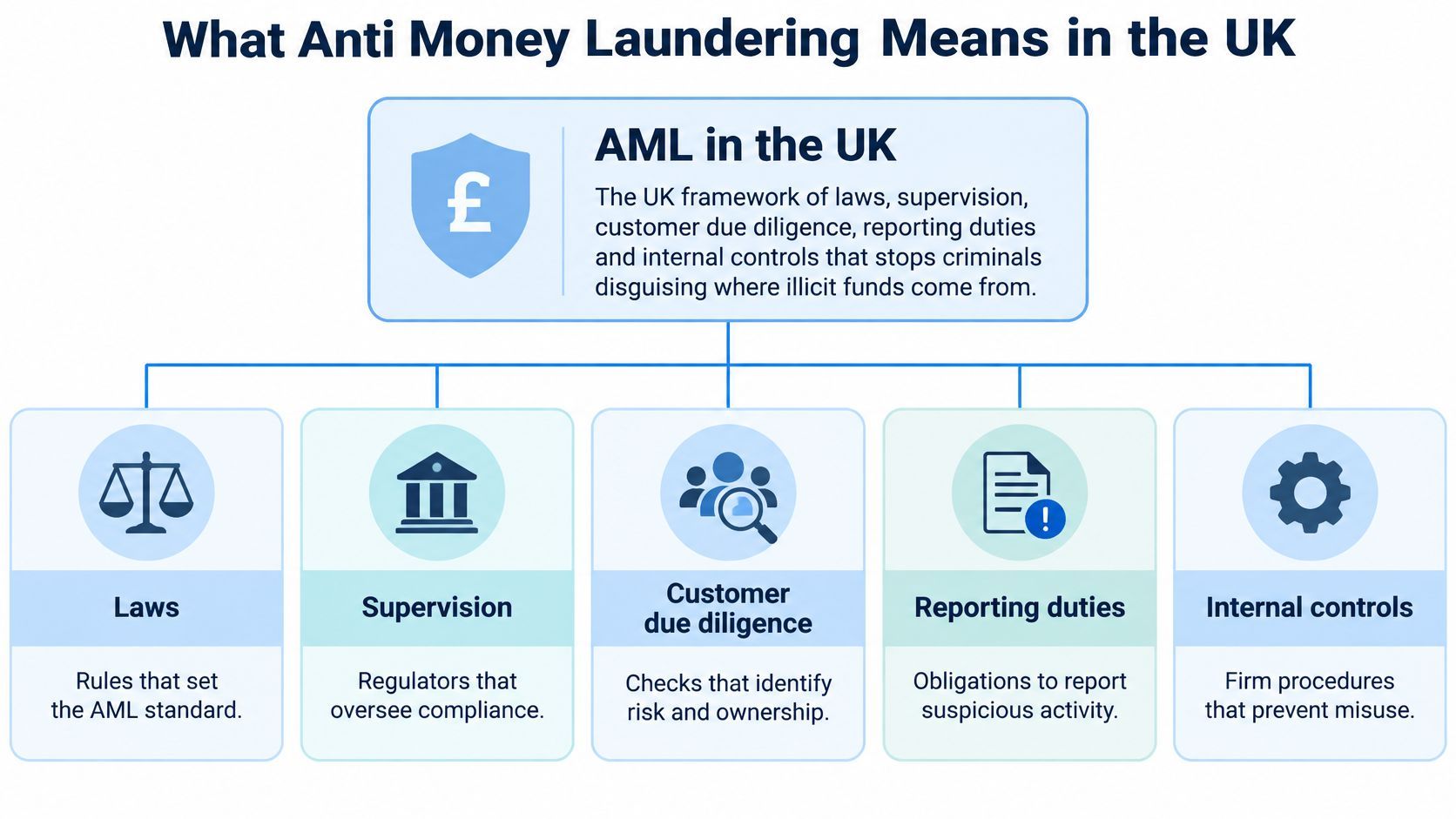
AML is the UK framework of laws, supervision, customer due diligence, reporting duties and internal controls that stops criminals disguising where illicit funds came from. Checking a passport is only one part of it.
The familiar advice to verify customers and write an AML policy misses the harder question: can your team demonstrate that its controls work? For founders and compliance teams, understanding what anti money laundering means in practice starts with connecting decisions, responsibilities and evidence, not buying an identity-checking tool.
Table of Contents
- What Anti Money Laundering Means in the UK
- Core Obligations and the Evidence Each Needs
- How Customer Due Diligence Works from Onboarding to Exit
- Suspicious Activity Reports and Monitoring Quality
- How AML Applies to Crypto and Financial Firms
- Building AML Controls Before You Apply
- Confirm Your AML Scope Before You Commit
What Anti Money Laundering Means in the UK
Anti-money laundering works as a connected control system. Think of a building's security: cameras, access passes, guards and alarms protect the premises only when someone connects them and responds to what they detect. An AML framework needs the same coordination.
The operating chain runs from business-wide risk assessment to customer risk classification, customer due diligence, enhanced checks where risk is higher, ongoing transaction monitoring, and escalation and suspicious activity reporting. Each decision should change what the firm does next.
The law and the businesses it covers
The UK Government's Money Laundering Regulations consultation explains that the 2017 Regulations came into force on 26 June 2017, replacing the Money Laundering Regulations 2007 and the separate transfer-of-funds regulations. The regime introduced approval tests for high-value dealers, estate agency businesses and accountancy service providers, while extending existing fit-and-proper requirements for money-service businesses and trust or company service providers.
Covered sectors include banks, investment firms, money-service businesses, trust and company service providers, accountants, auditors, estate agents and high-value dealers. Relevant cryptoasset businesses also sit within the AML supervisory framework.
For property-sector context, real estate AML guidance from Homebase offers a supplementary introduction. UK businesses still need to establish their own UK obligations rather than assume that property-industry guidance applies identically across jurisdictions.
What the controls are trying to detect
The classic laundering model distinguishes:
- Placement: Criminal cash first enters the financial system.
- Layering: Funds move through transactions or entities to obscure their trail.
- Integration: Funds reappear as apparently legitimate wealth.
These are explanatory categories, not a requirement that every suspicious case follows the same sequence.
The UK's supervisors include the FCA, HMRC, the Gambling Commission and 22 professional-body supervisors, identified in the National Risk Assessment of Money Laundering and Terrorist Financing. Together, 25 AML and counter-terrorist-financing supervisors oversaw more than 90,000 businesses during 2023–24, according to HM Treasury's supervision report.
Confirm your sector and supervisor before deciding which application route or guidance to follow.
Core Obligations and the Evidence Each Needs
| Obligation | What It Requires | Evidence to Keep |
|---|---|---|
| Business-wide risk assessment | Identify risks by customer, product, geography and channel | Written assessment that drives control design |
| Customer due diligence | Identify and verify customers and beneficial owners | Verification records and purpose of relationship |
| Enhanced due diligence | Extra checks where risk is higher | Documented rationale and senior approval where required |
| Ongoing monitoring | Scrutinise transactions against the customer profile | Alert logs and documented investigation outcomes |
| Suspicious activity reporting | Report known or suspected money laundering | MLRO decision records and filing audit trail |
| Training and record keeping | Staff understand the rules and records are retained | Training logs and records retained for the applicable statutory period |
Core AML obligations and the evidence supervisors expect should be read as paired requirements. A policy describes the intended process; a customer file, investigation record or approval demonstrates whether someone followed it.
The 2024 Economic Crime Survey found that 68% of businesses with employees had implemented at least one surveyed AML measure, as reported in the Economic Crime Plan outcomes progress report. That broad business population isn't a benchmark for regulated firms, but it illustrates why the mere existence of an AML measure says little about control maturity.
Make the evidence usable
Keep an evidence register that identifies the control owner, supporting records, storage location and review trigger. An investigator shouldn't need to search email threads to establish why a customer received a particular risk rating.
Training logs should record who attended, when they completed training and which typologies they covered. Test whether staff can recognise a scenario relevant to their role, such as a relationship manager receiving inconsistent explanations for incoming payments.
Practical rule: Keep enough evidence for another competent reviewer to reconstruct the decision without interviewing its author.
Record keeping also needs deliberate design. Specify applicable retention requirements, access permissions, retrieval arrangements and deletion controls rather than treating the archive as permanent storage.
A useful financial-crime risk assessment connects identified risks to specific controls. If the assessment identifies complex corporate ownership as a material exposure, the operating procedure should explain who investigates ownership gaps, what evidence they collect and when they stop onboarding.
The assessment must influence the workflow. Otherwise, the firm has a description of risk without a corresponding way to manage it.
How Customer Due Diligence Works from Onboarding to Exit
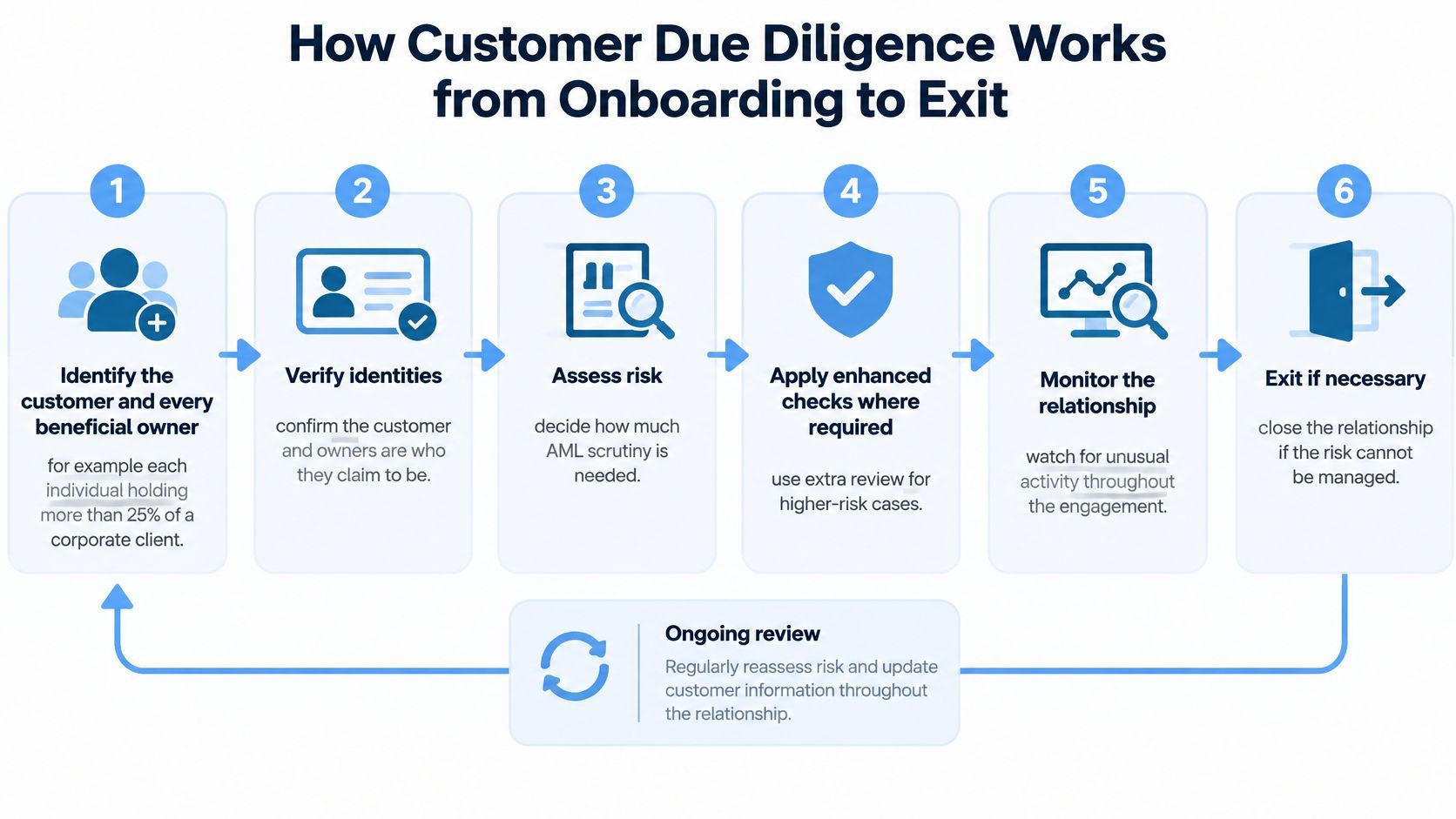
Customer due diligence, or CDD, establishes who the firm is dealing with and what activity makes sense for that relationship. The FCA's Financial Crime Guide requires identification and verification, understanding the relationship's purpose, risk-sensitive ongoing monitoring and current customer information; firms unable to apply CDD or satisfy themselves about beneficial ownership must not establish or continue the relationship.
Consider a crypto exchange onboarding a holding company with several ownership layers. A certificate of incorporation establishes part of the company's identity, but it doesn't explain the individuals behind it or the economic reason for its proposed transactions.
Follow the customer through the relationship
- Identify the customer and beneficial owners. Draw the ownership and control structure through the intermediate companies to the relevant individuals. Record ownership percentages and other control rights, applying the relevant legal definition rather than assuming a percentage test captures every controlling person.
- Verify identities using reliable, independent sources. Reconcile registry information, corporate documents and individual identity evidence. If the ownership chart conflicts with a filing, record how the discrepancy was resolved instead of quietly choosing one version.
- Understand the purpose and expected activity. Ask why the holding company needs the account, where payments will originate and which counterparties it expects to use. Record anticipated monthly activity and payment countries so investigators have a meaningful comparison later.
- Assess risk and apply enhanced due diligence where warranted. Examine the structure's complexity, geography, products and transaction channels together. For a higher-risk case, document source-of-funds evidence, the explanation for the ownership layers and the required approval.
- Monitor against the expected profile. A sudden change in transaction speed or destination should prompt an assessment of whether the original explanation still holds. Keep the investigation outcome, including a reasoned decision when no further action is needed.
- Refresh the information. Put a risk-based review date on the file and define event-driven triggers, such as an ownership change. Assign an owner so the refresh isn't merely a calendar reminder nobody follows.
- Stop when essential CDD cannot be completed. Don't open or continue a relationship that fails the applicable requirements. Consider whether the missing information and surrounding circumstances also warrant suspicious activity reporting.
Use automation without losing the decision trail
Teams assessing corporate-verification workflows can explore AI-driven KYB solutions from AmasaTech as an example of technology applied to business verification. Evaluate how any tool handles conflicting records, ownership chains and human review, not just document extraction.
For outsourced onboarding, a KYC-as-a-service assessment should make responsibilities explicit. The holding-company file still needs a traceable ownership conclusion, source-of-funds assessment, approval record and refresh date, regardless of who supplies the technology.
Suspicious Activity Reports and Monitoring Quality
More reports don't automatically mean better AML. A firm can generate substantial reporting volumes while investigators miss important patterns or close alerts without adequate reasoning.
The National Crime Agency's SARs Annual Report records 866,616 SARs received by the UK Financial Intelligence Unit in 2024–25 and states that SAR-related intelligence contributed to £230.4 million in asset denials in the financial year ending 2023, representing 36% of all assets denied that year. These are different reporting periods and measures, not figures from which to calculate a reporting success rate.
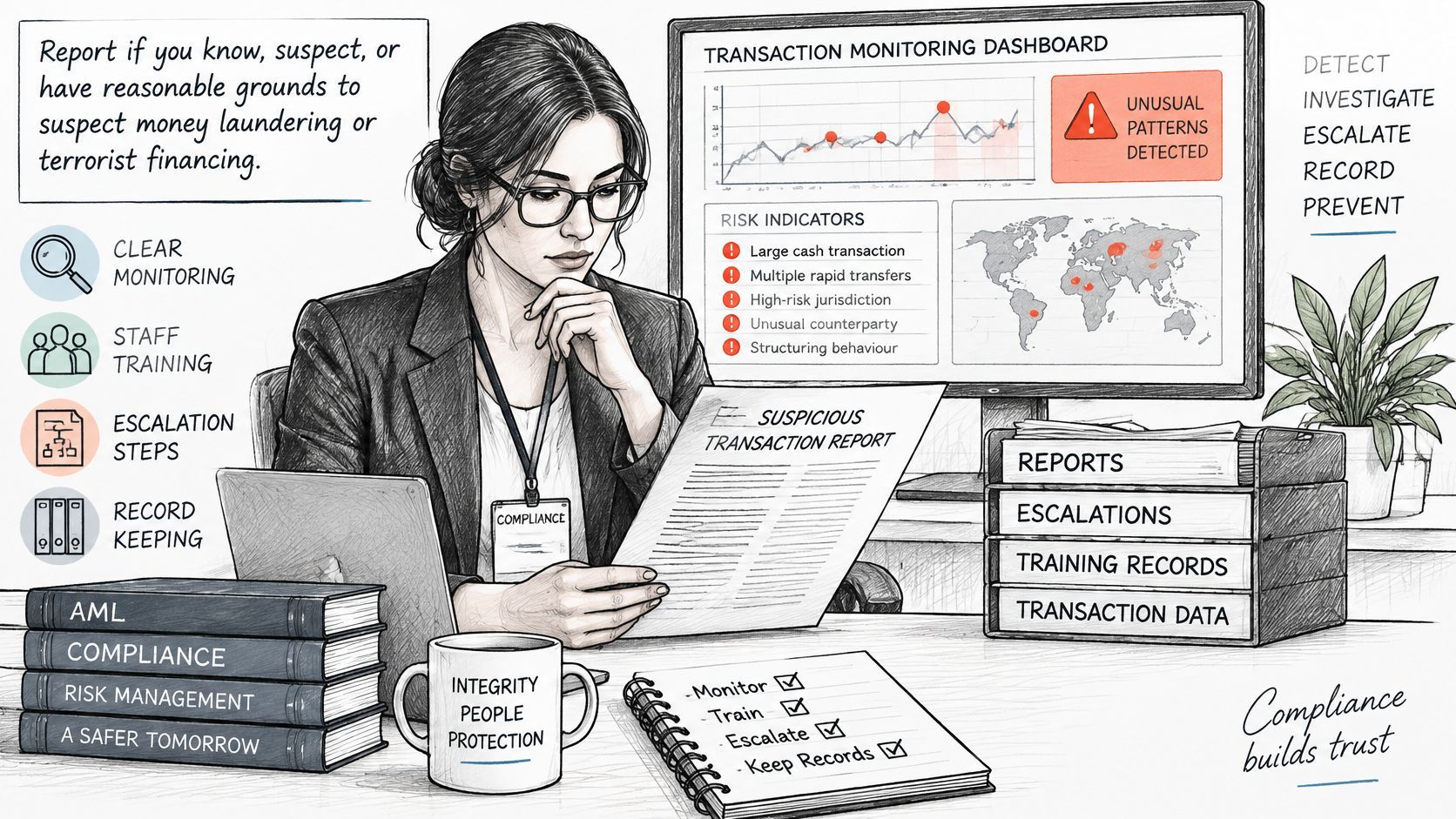
Regulated-sector staff have reporting duties when they know, suspect or have reasonable grounds to suspect money laundering or terrorist financing. The firm's procedures must explain internal escalation to the money laundering reporting officer, or MLRO, and external reporting responsibilities.
Separate an alert from a suspicion
An unusual transaction is a reason to investigate, not an automatic conclusion. The investigator should compare it with the customer's profile, examine relevant supporting evidence and explain whether the concern remains.
Preserve the trail from alert generation through investigation, MLRO assessment and any filing. Access restrictions and customer-contact procedures should address tipping-off risks without encouraging staff to make misleading promises about account activity.
A useful investigation explains what concerned the reviewer, what they checked and why they reached their conclusion.
For financial and crypto businesses, relevant indicators can include unusual transaction velocity, rapid movement through newly created wallets, inconsistent source-of-funds evidence and high-risk counterparties. Combine those indicators with customer and geographic risk rather than treating each as a standalone filing instruction.
Give directors information they can challenge
Management information should distinguish:
- Alert volumes: Which scenarios generate work, and whether workloads exceed investigation capacity.
- False-positive rates: Which rules produce alerts that reviewers can consistently explain as legitimate.
- Investigation ageing: Where unresolved concerns or operational backlogs remain.
- SAR conversion rates: How frequently investigations result in reports, with explanations for changes.
- DAML requests: Requests for a Defence Against Money Laundering, tracked separately from other reporting.
- Post-report controls: Restrictions, reviews and account decisions following escalation.
Avoid setting reporting quotas. Defensive filing can create noise and encourage unnecessary account closures, while weak escalation can leave criminal activity unaddressed.
The board's test is practical: which measures demonstrate that investigators are detecting meaningful risk, rather than merely clearing a queue?
How AML Applies to Crypto and Financial Firms
| Applicant Population | Period | Reported Outcome |
|---|---|---|
| Annex I applications for AML-only registration | Financial year ending 31 December 2023 | 40% rejected, withdrawn or refused |
| Cryptoasset registrations under the 2017 Regulations | Financial year ending 31 December 2023 | More than 88% rejected, withdrawn or refused |
These reported authorisation outcomes for AML applicants come from the FCA's publication on reducing and preventing financial crime, which reports 40% for Annex I applications and more than 88% for cryptoasset registrations in the stated period. The combined categories include withdrawals as well as regulatory refusals and rejections; they aren't refusal rates alone.
The practical message is that submitting an application isn't a procedural formality. Applicants need to explain their controls convincingly and support that explanation with evidence.
Match the controls to the transaction model
The Treasury's AML annual report describes FCA gateway scrutiny of cryptoasset exchanges and custodian wallet providers, including business-wide risk assessment, CDD, enhanced due diligence, transaction monitoring and SAR procedures. Reviewers assess whether those controls are proportionate to the firm's inherent business-model risk.
Say a platform lets customers send assets to newly created wallets. Its monitoring design should specify what information analysts can obtain, which combinations of behaviour prompt investigation and how analysts handle an incomplete explanation.
A generic rule labelled unusual activity doesn't answer those questions. Product teams, compliance staff and engineers need to agree what the system can detect and what happens when relevant information is unavailable.
Traditional firms need a distinct analysis too
A bank considering tokenised deposits or digital custody shouldn't assume that existing customer files settle every financial-crime question. Its assessment should address the proposed transaction flows, custody arrangements and exposure to counterparties that are themselves digital-asset businesses.
The product's label isn't enough. A tokenised security, a tokenised deposit and a cryptoasset can involve different services and counterparties, so the application should describe the actual arrangement rather than use digital assets as a catch-all category.
For shared terminology across product and engineering teams, BUNCH's compliance basics for fintech platform teams can support introductory discussions. Route-specific analysis still requires a separate assessment of cryptoasset regulation.
Application test: The business model, customer profile, product description, staffing assumptions and control evidence should all describe the same firm.
Don't describe manual reviews in a policy while projecting transaction volumes that the proposed team couldn't realistically investigate.
Building AML Controls Before You Apply
A dated remediation plan isn't permission to postpone essential controls. Distinguish between demonstrating readiness for the application and satisfying every applicable requirement before conducting the relevant business.
The following is a practical preparation standard, not a promise that a regulator will accept a particular gap. Route-specific requirements and supervisory instructions take precedence.
What should already work before submission
- Board-approved risk assessment: Management has assessed the intended business, approved its risk position and identified the controls needed to support it.
- Named MLRO and senior accountability: Responsibilities, reporting lines, authority and escalation arrangements are clear. The responsible people can explain their decisions.
- Tested CDD and enhanced due diligence procedures: Staff have applied the procedures to sample files and resolved ambiguities in the instructions.
- Product-specific monitoring scenarios: The team can explain the relevant typologies, required inputs, investigation workflow and limitations.
- Walked-through SAR process: An end-to-end exercise demonstrates how staff escalate concerns, the MLRO records a decision and the firm preserves filing evidence.
Testing can use controlled scenarios where live operations haven't begun. Label those records accurately: a simulation demonstrates preparation, not a history of operating effectiveness.
What may fit a dated remediation plan
Some improvements may be suitable for a controlled plan, provided the remaining arrangements are adequate and the regulator accepts the position:
- Threshold tuning: Adjust monitoring parameters when real activity provides a sound basis for calibration, without leaving material risks unmonitored.
- Further training cohorts: Schedule additional training while ensuring staff already performing relevant work are competent.
- Management-information enhancements: Improve presentation or analysis while retaining essential visibility over outstanding investigations and material issues.
Every item needs an owner, completion date, interim safeguard and closure evidence. If a proposed launch depends on completion, record that dependency explicitly rather than burying it in a project tracker.
Run a customer-file rehearsal
Use sample customers covering a straightforward retail relationship, a higher-risk payment pattern and a corporate customer with layered ownership. Trace each through onboarding, risk scoring, monitoring and refresh, checking whether the policy, business plan and financial projections remain consistent.
Specialist advisers can help assemble evidence and identify contradictions, but management retains responsibility for its controls. Authorisation decisions remain with the relevant regulator.
Glentorion does not act as a regulator or provide legal or investment advice. Obtain legal advice where questions about scope, reporting or proposed activity require it.
Confirm Your AML Scope Before You Commit
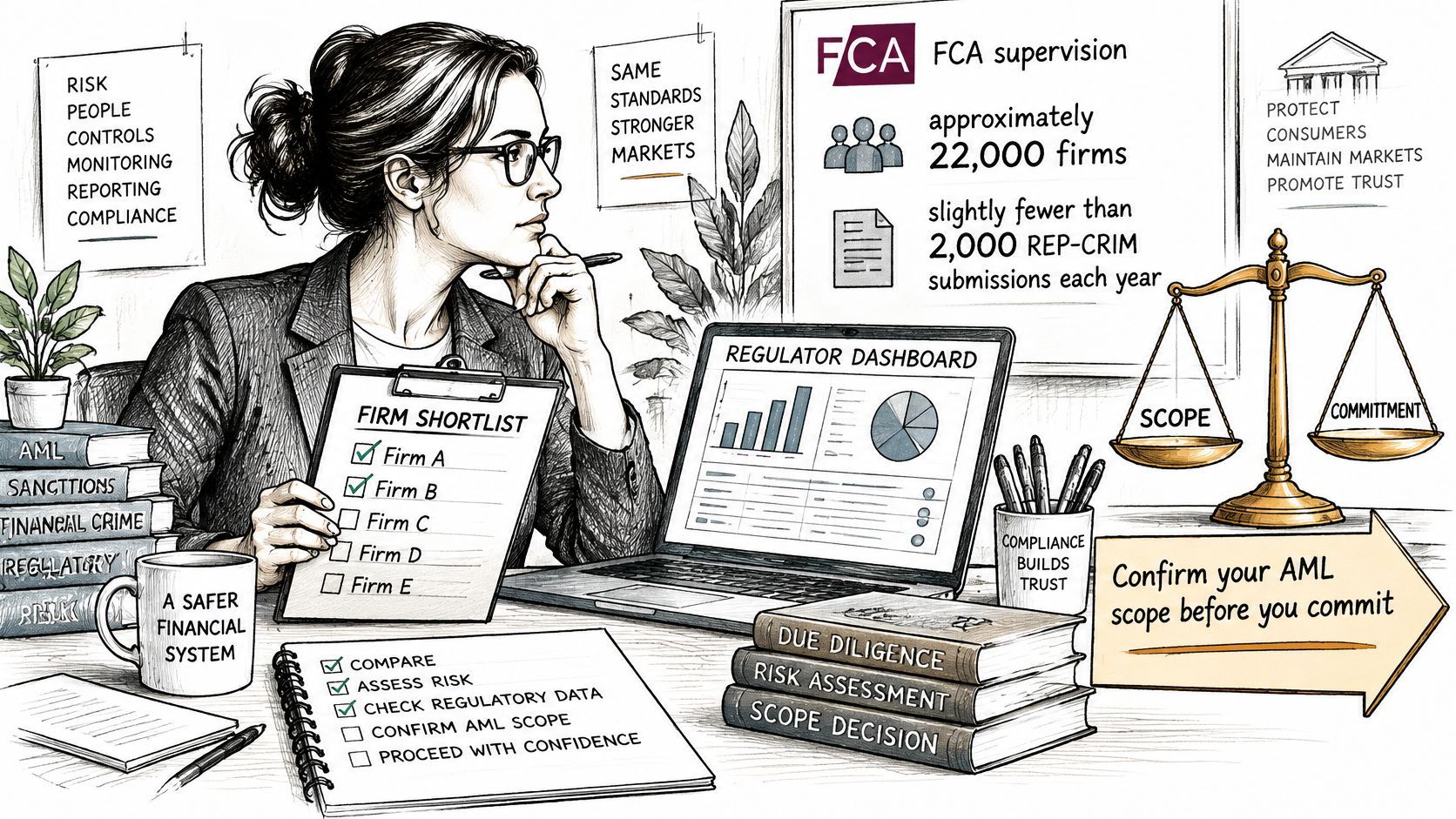
The FCA's financial-crime analysis states that it supervises approximately 22,000 firms under the Money Laundering Regulations and receives slightly fewer than 2,000 REP-CRIM submissions on average each year; for certain intermediaries, electronic-money institutions and consumer-credit firms, reporting depends on relevant activity and annual revenue of at least £5 million. Banks, building societies and mortgage lenders may have reporting obligations regardless of revenue.
AML supervision and REP-CRIM reporting aren't interchangeable. Establish the firm's classification before budgeting for reporting systems or assuming that another firm's obligations apply.
Make the scope decision explicit
- Confirm the firm type and supervisor. Where relevant, assess HMRC money-laundering supervision rather than assuming the FCA is the correct supervisor.
- Map each planned activity. Describe the services, customers, transaction flows and operating arrangements against the applicable scope.
- Check REP-CRIM separately. Apply the relevant activity and revenue conditions to the firm's classification.
- Validate the evidence pack. Ensure current arrangements and dated remediation items reflect the actual business model.
- Book a scoping conversation. Agree the regulatory route, deliverables, starting materials and division of responsibilities.
Glentorion works with financial and crypto businesses preparing for authorisation, and professional teams helping them move forward. We can help scope the planned activity, target jurisdiction and starting materials, while the firm keeps accountability for its controls.
Glentorion helps prepare and review authorisation applications, AML procedures and supporting evidence, with attention to consistency across the business plan, controls and management responsibilities. Visit Glentorion to discuss your planned activities, existing materials and the work needed to prepare a coherent application.
- anti money laundering
- AML UK
- customer due diligence
- suspicious activity report
- crypto AML