Digital Evidence Management System for Regulated Firms
Published

The most popular advice on this topic is wrong for regulated firms. You're told to buy a secure repository, migrate your folders, turn on search, and call the result evidence management. That solves storage. It doesn't prove what your firm relied on, who approved it, what changed, or which application answer a figure supports. A supervisor won't ask whether you can find a file. They'll ask whether you can defend it.
Table of Contents
- Why a Digital Evidence Management System Matters
- Fit for Purpose Tests Before You Buy
- Chain of Custody and Integrity Controls
- Evidence for Incidents Reports and Change
- Decision Context Beyond the File Store
- How to Select and Implement the System
- Agree the Evidence Scope Before Filing
Why a Digital Evidence Management System Matters
Say a founder is preparing an FCA application. The business plan says monthly transaction volumes will triple in year two. The number sits in a spreadsheet on a shared drive, copied into the financial projections, then pasted into an application answer. Six weeks later, the finance lead revises the assumption. The spreadsheet changes. The projections don't. Nobody can show which version the board approved.
That's the gap a digital evidence management system should close. In an authorisation setting, it isn't a bigger folder. It's the controlled record of what the firm relied on. Each item has a stable identity, a source, an owner, a version, and a link to the policy, financial assumption, or application answer it supports.
Three neighbours that aren't the same thing
A document repository stores files. A law-enforcement case system is built for seized devices, disclosure to prosecutors, and court continuity. A fit system for an FCA, DFSA, or similar file borrows the discipline of the second, then adds what authorisation needs: approval status and the regulatory use each record serves.
Less reporting doesn't remove that need. The UK government's 2025 regulatory action-plan update reported that, during 2025, the FCA consulted on proposals expected to reduce reporting burdens for more than 36,000 firms and generate over £25 million in annual administrative savings, while improving data quality through the Transforming Data Collection Programme. Fewer returns still need lineage. When a template changes, you must see which policies, controls, calculations, and records move with it.
Before any vendor demo, test for these basics:
- Intake with source capture: where the item came from, not just its filename
- Hashing at ingestion: proof the file hasn't changed
- Append-only custody log: a handling history nobody can rewrite
- Role-based access: separate rights for intake, review, and approval
- Retention and legal-hold rules: by record type and jurisdiction
- Linked search: across policies, answers, and supporting records
- Exportable reports: custody and approval trails a third party can read
Run the nine tests that follow before you watch a demo.
Fit for Purpose Tests Before You Buy
Score your current stack and any shortlisted product against this table, not against a feature brochure. Our guide to how evidence works in an authorisation file sets out the underlying logic if you want the background first.
| Control area | Minimum standard | Why a supervisor cares | Red flag |
|---|---|---|---|
| Identity of the item | Stable identifier, source system, collector and timestamp | Shows this is the record the firm relied on | Renamed files with no source |
| Integrity | SHA-256 at capture, rechecked on export and migration | Shows the file was not silently altered | Hash kept only in a spreadsheet |
| Custody | Append-only log of user, action, time and location | Reconstructs who handled the material | Editable or overwriteable audit log |
| Access | Separate roles for intake, review and approval | Separates duties on application evidence | Shared administrator logins |
| Retention and legal hold | Rules by record type, jurisdiction and matter | Balances retention with lawful deletion | One blanket retention period |
| Change impact | Link from item to policy, answer, owner and package | Shows what a changed fact invalidates | Manual search after every edit |
| Regulatory use | Version, approval status and return or question supported | Lineage for FCA and other filings | Figures pasted with no source |
| Incidents and resilience | Link to service, tolerance, action and provider | Evidence for operational resilience | Incident notes left in email |
| AI-assisted drafts | Human review, source set and challenge record | Stops unverifiable summaries becoming the file | Automatic acceptance of model output |
How to score a row
Pass rule: A row passes only when you've got all three of a named owner, a written procedure, and a third-party-readable export. Two out of three is a fail.
Walk the rows in order. Identity and integrity come first because everything else depends on knowing which record you're holding and whether it's intact. Custody and access come next, since a supervisor will want duties split between the person who uploads evidence, the person who reviews it, and the person who approves it for submission. Retention and legal hold stop you deleting material you should've kept, or keeping personal data you should've deleted.
The middle rows are where authorisation files usually break. Change impact means that when a director changes, an outsourcing provider is replaced, or a revenue assumption moves, the system shows every affected answer and policy. Regulatory use ties each figure to the return or question it supports, so a number never floats free of its purpose.
Where firms differ, and where they don't
A new crypto custody applicant and an already-authorised payments firm changing its outsourcing don't need the same retention clock. Both need the change-impact row. Multi-jurisdiction files covering FCA, MAS, and DFSA routes need the source jurisdiction recorded on the item, not a second repository per regulator.
Some failures are absolute. Hash values in a side spreadsheet can be edited by anyone with the file. One shared admin login destroys attribution. Auto-accepted AI summaries turn unverified text into your official record. Fast search doesn't rescue any of those. What the integrity and custody rows must record comes next.
Chain of Custody and Integrity Controls
Think of a physical exhibit. Police seal it in a bag, label it, and log every hand that touches it. Reviewers examine copies or photographs. The sealed original stays untouched. Your digital master works the same way.
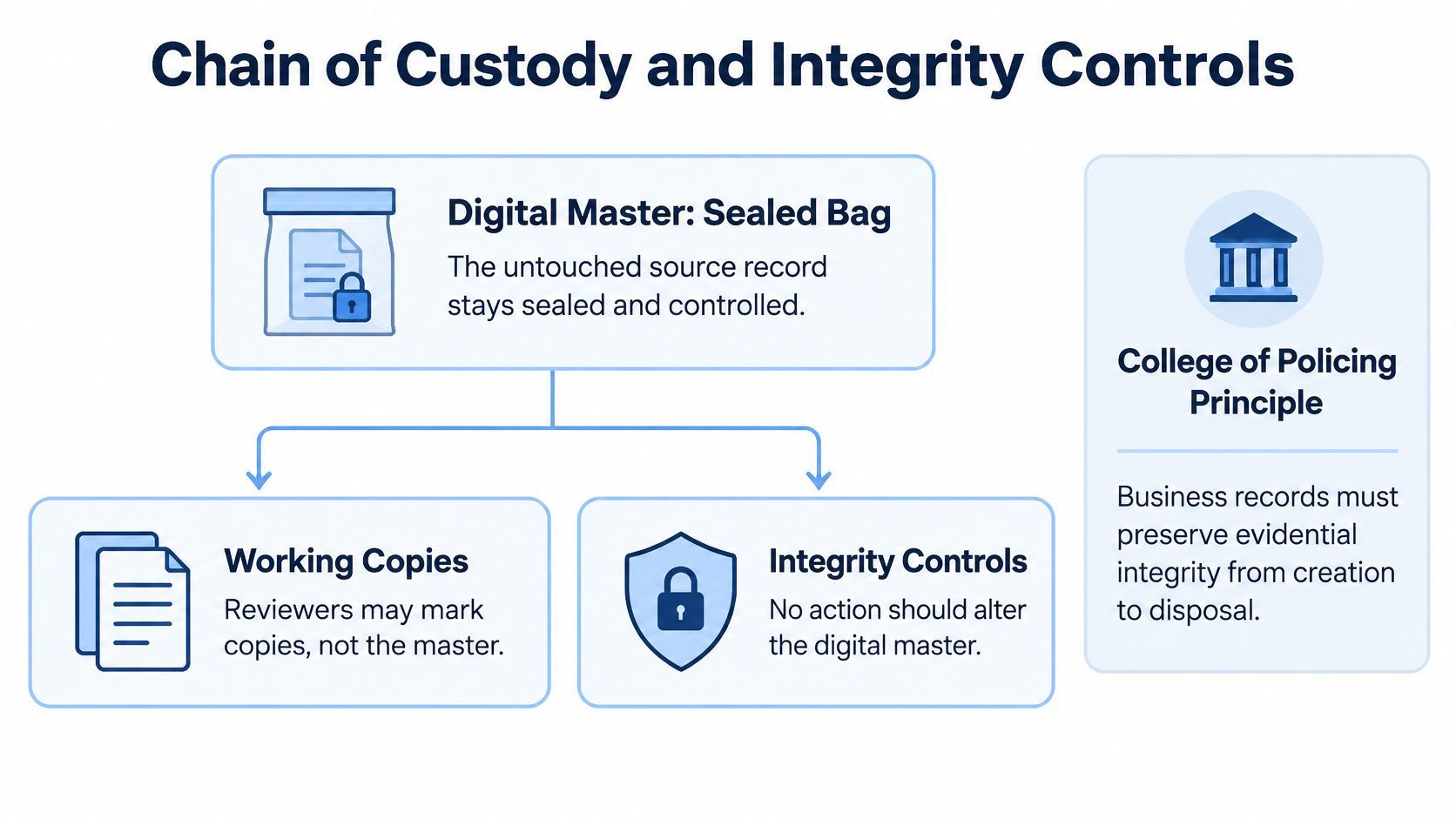
The College of Policing guidance on passive data generators states that no action by investigators or agents should alter data that may later be relied on in court, and anyone who must access original data must be competent and able to explain the relevance and implications of that access. Translated into business language: don't edit the master, and if someone must open it, they should be able to say why.
The design in practice
Keep a read-only master and issue controlled working copies for review and markup. Log every user, timestamp, action, transfer, and storage location so an independent reviewer can reproduce the result. Separate acquisition privileges from analysis privileges, so the person who captures a record isn't the only person who can interpret it. Make the log append-only, and make sure you can export it as a custody report on demand.
Add cryptographic integrity checks. Generate a SHA-256 checksum when the item is captured, store it in a tamper-evident audit record, and revalidate it on export or migration. Keep native formats beside rendered copies, because a PDF print of a spreadsheet drops the formulas that make the numbers checkable.
Treat metadata as its own attributes, not as part of a filename:
- Author and collector: who created and who captured the item
- Created and modified times: taken from the source, not retyped
- Source system and collection method: the tool or process used
- Version: tied to a stable evidence identifier
Conversion to PDF or paper, OCR, redaction, and deduplication can all strip metadata. If the context travels separately from the file, link the two through the evidence identifier so they can't drift apart. For practical detail on structuring those trails, see the resource on building auditable finance workflows with Loopfour.
Security around the master
Encrypt masters and working copies at rest and in transit, hold encryption keys separately from the evidence store, enforce multi-factor authentication on every privileged role, and require documented approval for access outside the normal workflow.
Map this to an authorisation file. Transaction extracts, board minutes, policy versions, and customer-journey screenshots must each trace to an approved source and a responsible individual. Customers retain ownership of information and materials submitted to the services, while granting the rights reasonably required to host, process, transmit, and protect that material. If the path can't be reconstructed, authenticity and continuity are weak even if the PDF looks complete.
Evidence for Incidents Reports and Change
Authorisation is only the first test. Once you're live, supervisors ask a different question: when something broke, what did you know, when did you know it, and what did you do?
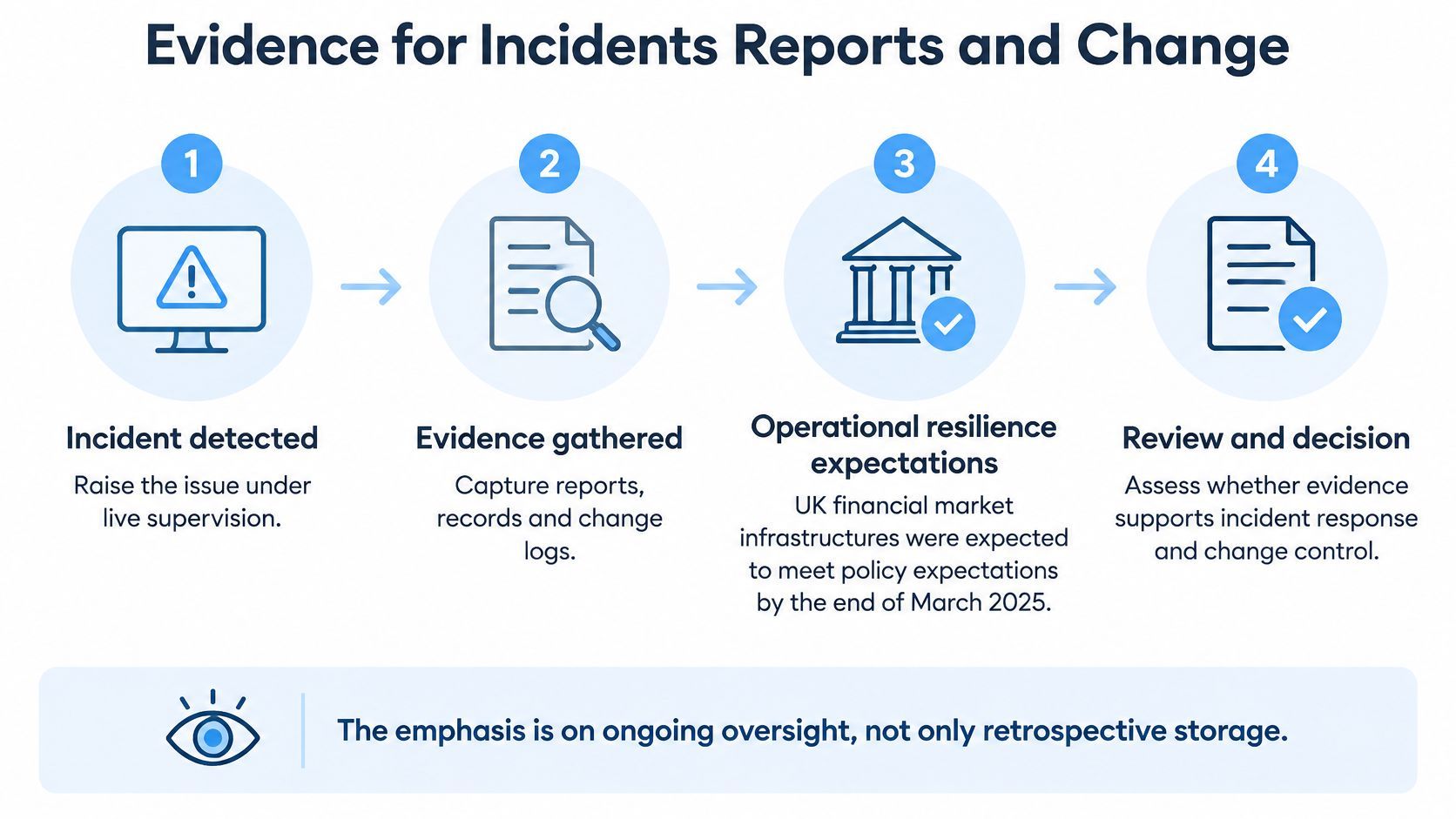
The Bank of England's 2025 financial market infrastructures annual report states that UK financial market infrastructures were expected to meet operational-resilience policy expectations by the end of March 2025, with supervisory work using firms' Operational Resilience Self-Assessments and firms testing "extreme but plausible" scenarios against impact tolerances. The Bank also consulted on operational-incident and outsourcing reporting for FMIs to produce consistent reporting of material third-party arrangements. Those rules bind FMIs directly. For other authorised firms, treat them as the benchmark to mirror, not as a direct obligation.
What the incident record should hold
Your system should link each event to a structured record containing:
- Incident or test identifier: one reference for the whole event
- Important business service affected: and its impact tolerance
- Assessor: who evaluated the event and when
- Control or provider affected: including outsourced services
- Recovery action: what was done, in what order
- Management conclusion: whether the firm stayed within tolerance or breached it
A hypothetical illustration
Say a crypto custodian loses a cloud region for four hours. This is a hypothetical example. Withdrawals pause, then resume. A weak file contains a post-incident summary written from memory. A strong file shows the timestamped alert timeline, the reconciliation proving balances were complete before withdrawals reopened, the vendor notice, and the board update, with original alerts unedited. The same discipline supports the kind of record review described in our overview of an anti-money laundering audit, where findings depend on reconstructable evidence.
Restoring access isn't the same as proving data integrity. You must show records, instructions, and reconciliations stayed complete and unaltered, or identify precisely what was corrupted and how it was recovered.
That means this part of the system holds cryptographic checks, version history, segregation-of-duties records, recovery-test evidence, and an incident timeline that management, auditors, and regulators can read while the master stays intact. For wider planning context, the guide to compliance planning for enterprise IT teams covers how reporting obligations shape system design. The remaining gap is decision context, including what your team considered and then left out.
Decision Context Beyond the File Store
Most products stop at ingestion, search, and secure storage. An authorisation file must also show what was considered and not used.
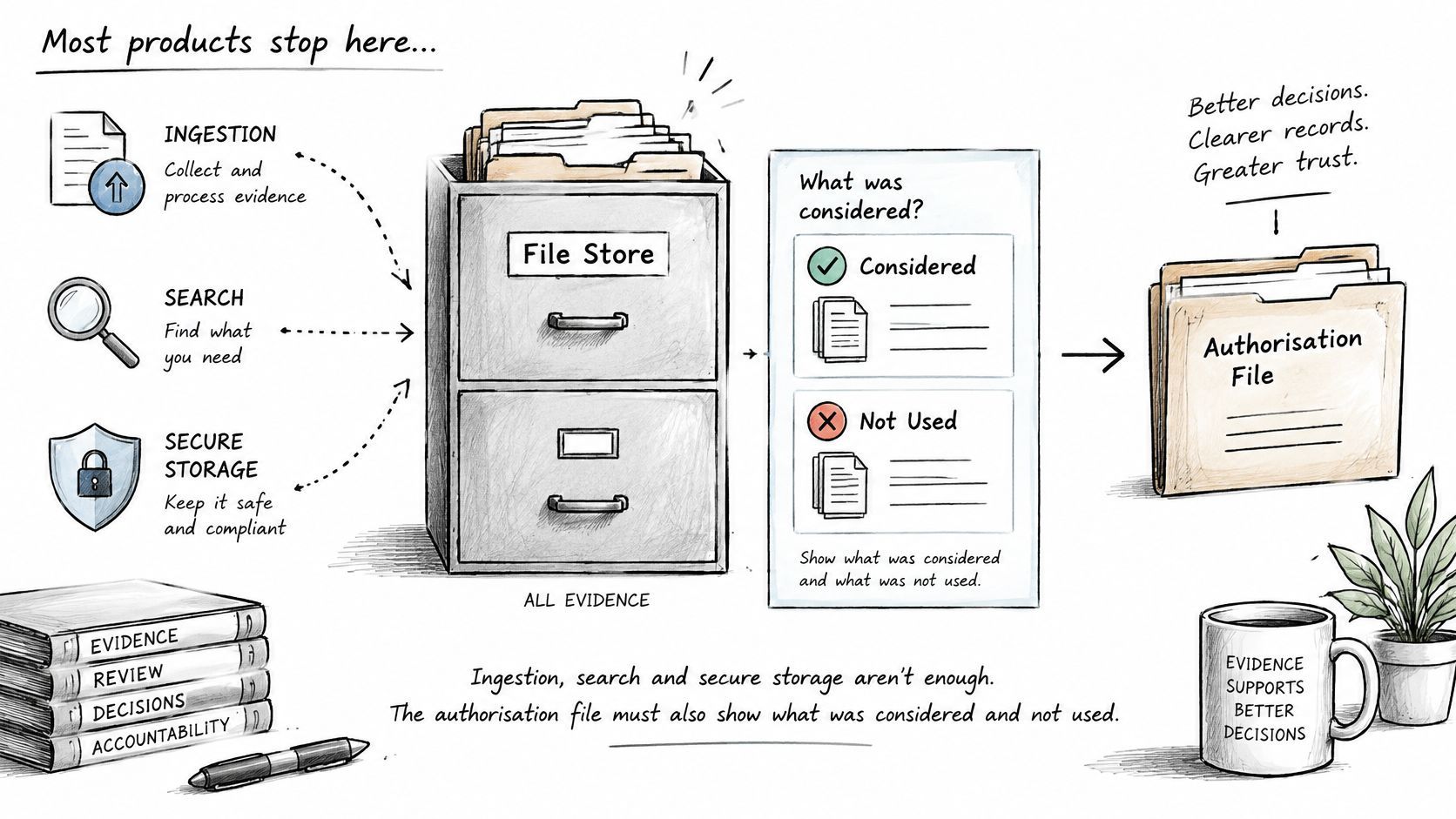
Borrow the discipline of disclosure governance without copying a policing workflow. Record material even when it wasn't fully reviewed. Store the method, result, parameters, and reason for stopping. The UK civil disclosure practice direction on electronic documents warns that metadata may not remain associated with documents when they're converted to images or paper, and says organisations using document-management systems should account for metadata stored separately. Context lost in conversion is context you can't explain later.
Three items where this bites
A financial promotion archive should record which versions were approved, which were withdrawn, and why. A wallet-screening export should show the screening parameters and thresholds, not just the wallets that passed. A set of financial projections should keep the scenarios the board rejected, with reasons.
Take one edge case. An analyst models an outlier revenue scenario, decides it's unrealistic, and deletes it. Months later, an interviewer asks how the firm stress-tested its forecast. Without the rejection note, the team can only show a tidy base case and insists the work happened. With it, they can show the scenario, the challenge, and the decision. That's the difference between asserting rigour and evidencing it, and it sits at the heart of meeting FCA compliance requirements in practice.
Link each decision to the policy, application answer, owner, approval, and submission package it affects. Automation raises the stakes. An AI summary without provenance is just fluent text, so every AI-assisted draft needs a human challenge record showing what the reviewer accepted, changed, or rejected, and against which source set.
What was excluded? Who approved that decision? Can the review state be reproduced? How was an AI summary validated or challenged?
If your system can't answer all four, you've got storage with good search. You haven't got explainability.
How to Select and Implement the System
Run five stages in order. Stop at the first failed gate, whatever the brand.
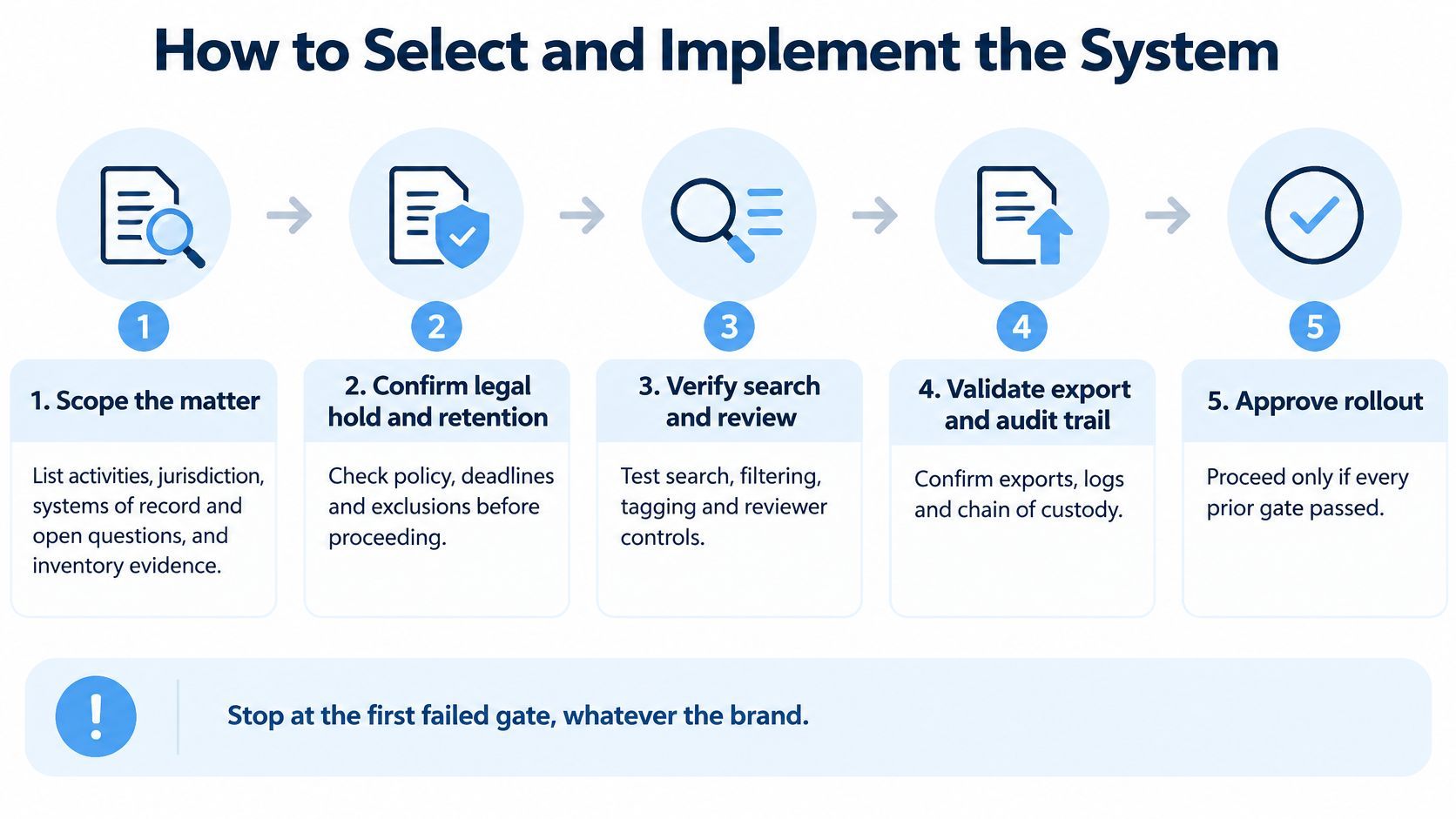
1. Scope the matter. List activities, jurisdiction, systems of record, and open questions. Inventory your evidence classes and known gaps before you look at products. At this stage, we identify the evidence still needed, the questions to be resolved, and the decisions requiring further client involvement, because a tool bought against an unknown scope gets configured twice.
2. Design the record. Lock identifiers, metadata fields, retention rules, and roles. Write a responsibility chart naming who captures, reviews, approves, and exports. If custody has no named owner, stop.
3. Pilot one package. Take one policy set or one application section. Export the hashes, custody report, and approval trail, then ask a second person to reproduce that export unaided. If they can't, the control exists only in one employee's head.
4. Connect change. Change one fact in the pilot, such as a named responsible person, and confirm the system surfaces every affected answer. Keep corrected versions. Never overwrite the master.
5. Operate. Retrieve a past supervisory question and a past incident within an agreed time, using someone other than the usual administrator.
| Stage | What you lock | Evidence produced | Stop if |
|---|---|---|---|
| 1 Scope the matter | Activities, jurisdiction and systems of record | Inventory of evidence classes and gaps | The regulatory route is still unclear |
| 2 Design the record | Identifiers, metadata, retention and roles | Control specification and responsibility chart | Custody has no named owner |
| 3 Pilot one package | One policy set or one application section | Hashes, custody export and approval trail | A second person cannot reproduce the export |
| 4 Connect change | How a fact change reaches answers and the package | Impact log and corrected versions | Editors can overwrite masters |
| 5 Operate | Retrieval time for questions and incidents | A completed retrieval that does not depend on one person | Search depends on a single employee |
Four selection questions sit alongside the gates. Can you export the full audit log if you leave the vendor? Where is personal data processed, and which safeguard covers any transfer out of the UK, such as adequacy regulations or approved contractual protections? What's forbidden use, since users must not reverse engineer, scrape, resell, or misuse the services except where law or agreement expressly permits it? Finally, who supplies accurate source data, and who reports a suspected account compromise, given users must provide accurate information, keep credentials secure, and promptly report suspected unauthorised access?
Agree the Evidence Scope Before Filing
Make one decision this week. Name the evidence scope for your intended activities and jurisdiction, and add no new policies until the gaps are listed.
Run three steps, with your own team or a specialist:
- Examine and agree. The first step of the authorisation service is to examine the client's planned activities, jurisdiction, existing material, and open questions, then agree the work, deliverables, and responsibilities.
- Build and review. The second step brings the business plan, financial information, policies, and application answers together, reviews the documents, resolves findings, and revisits affected material when facts change. A structured approach such as a business analysis process model helps keep those dependencies visible.
- Submit and keep the result. After Glentorion's internal approval and the client's sign-off, the agreed application is submitted on the client's behalf under the required mandate and access arrangements, and the filing result is recorded.
Glentorion is a regulatory authorisation consultancy for financial and crypto businesses. It combines consultants with software, systems, and AI engineers, and works across routes such as the FCA, MAS, and DFSA. Involving a specialist identifies missing evidence and unresolved decisions earlier. It doesn't replace your accountable managers, who still own the answers in interview.
If your in-house team builds the system itself, keep the nine fit tests as the acceptance sheet. A tool you built gets no easier pass than a tool you bought. Scope first, then file.
If you're preparing an authorisation and your evidence still lives in shared folders, we can help you scope what's missing, structure the record, and build a submission package your managers can defend in interview. Visit Glentorion to discuss your route, your jurisdiction, and the evidence you'll need before you file.
- digital evidence management system
- chain of custody
- regulatory authorisation
- crypto compliance
- FCA evidence