Change of Control in the UK: Thresholds and Approvals
Published
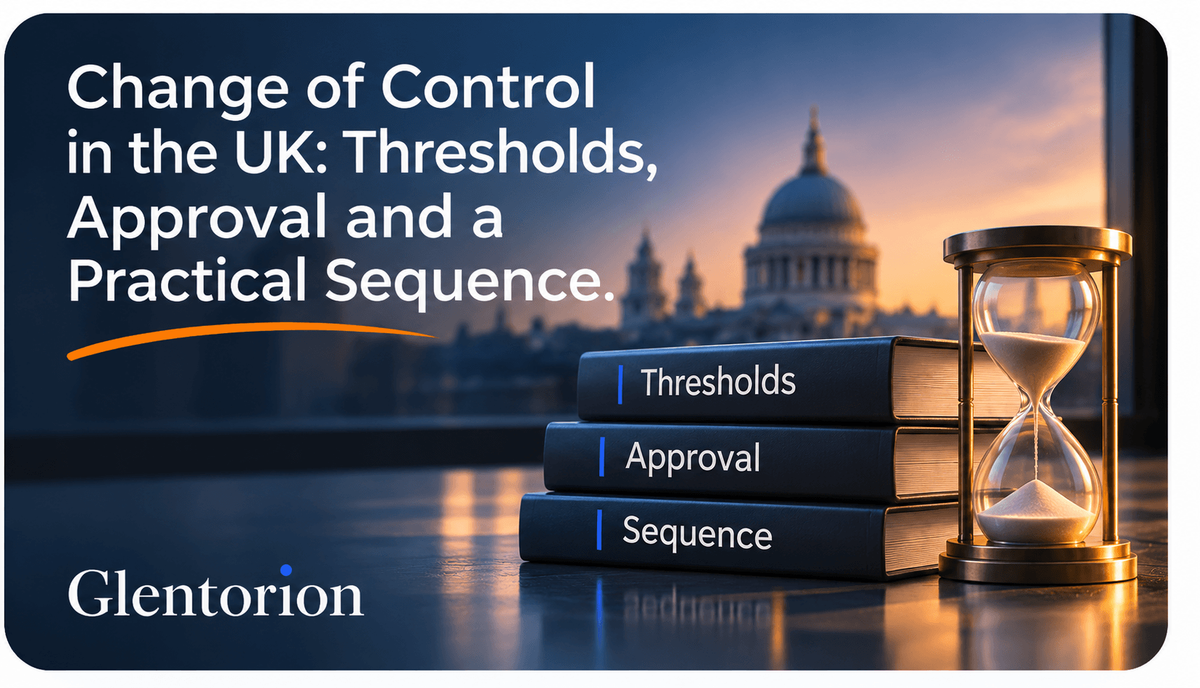
A buyer and seller can agree the price, sign the documents and still not be free to complete. In UK financial services, change of control is decided by regulatory sequence, not commercial readiness. Get the sequence wrong and completion itself becomes the problem.
That's the point deal teams miss most often. The same percentage stake can require prior approval in one authorised firm, sit below the trigger in another, and create a criminal offence if completed early in a cryptoasset firm. Start with the firm's authorisation category, map who controls it, then build your signing timetable around the regulator's clock.
Table of Contents
- Change of Control Thresholds by Firm Type
- What Counts as Control Beyond Share Ownership
- Approval Before Completion or Post-Notification
- How to Assemble a Decision-Ready Notification
- How Long FCA Approval Takes and What Drives It
- Crypto Firms and the Shifting UK Regime
- Build the Signing Timetable and Contingency Plan
Change of Control Thresholds by Firm Type
There's no single UK threshold you can apply to every target. The FCA thresholds and bands page sets 10%, 20%, 30% and 50% bands for Directive firms, a 20% or more threshold for Non-Directive firms, 33% for limited-permission consumer-credit firms, and 25% or more beneficial ownership for FCA-registered cryptoasset firms. A generic 10% rule will mislead you.
Directive firms include MiFID investment firms, credit institutions, insurers and reinsurers. Crossing into a higher band needs fresh prior approval, so approval at a lower holding doesn't cover a later increase. Non-Directive firms include non-MiFID investment firms and certain insurance and home-finance businesses, and they work to one threshold instead of four.
UK Control Thresholds by Firm Category
| Firm category | Control thresholds | What changes the outcome |
|---|---|---|
| Directive firms (MiFID investment firms, credit institutions, insurers, reinsurers) | 10%, 20%, 30% and 50% bands | Moving up a band needs fresh prior approval |
| Non-Directive firms (non-MiFID investment firms, certain insurance and home-finance businesses) | 20% or more of shares or voting power | Single threshold |
| Limited-permission consumer-credit firms | 33% | Distinct threshold |
| FCA-registered cryptoasset firms | 25% or more beneficial ownership | Additional tests under Regulations 5 and 6 of the Money Laundering Regulations 2017 |
Identify the Category Before You Price the Process
Check the firm's entry on the FCA Register, its permissions and its authorisation letter. For a cryptoasset target, confirm its MLR registration status separately, because registration isn't the same position as FSMA authorisation. Don't rely on how the seller describes the business in a teaser.
Say you're buying 25%. That holding crosses the Directive 10% and 20% bands and meets the Non-Directive 20% threshold. It also meets the cryptoasset 25% beneficial-owner threshold, but it doesn't reach the 33% consumer-credit threshold.
Practical rule: Category first, percentage second. If you reverse that order, your filing route, evidence list and completion date are all built on a guess.
That worked example is why percentage alone tells you nothing useful. Record the authorisation category in the deal file, map the proposed holding against that category's bands, and note whether the transaction creates new control or moves an existing controller higher. Do that before heads of terms harden into a completion promise.
What Counts as Control Beyond Share Ownership
A share register shows who owns the building, but control is who holds the keys. Legal share ownership is only one route. Control can also arise through voting power and through the ability to exercise significant influence over management, so an ownership-only review will miss reportable arrangements.
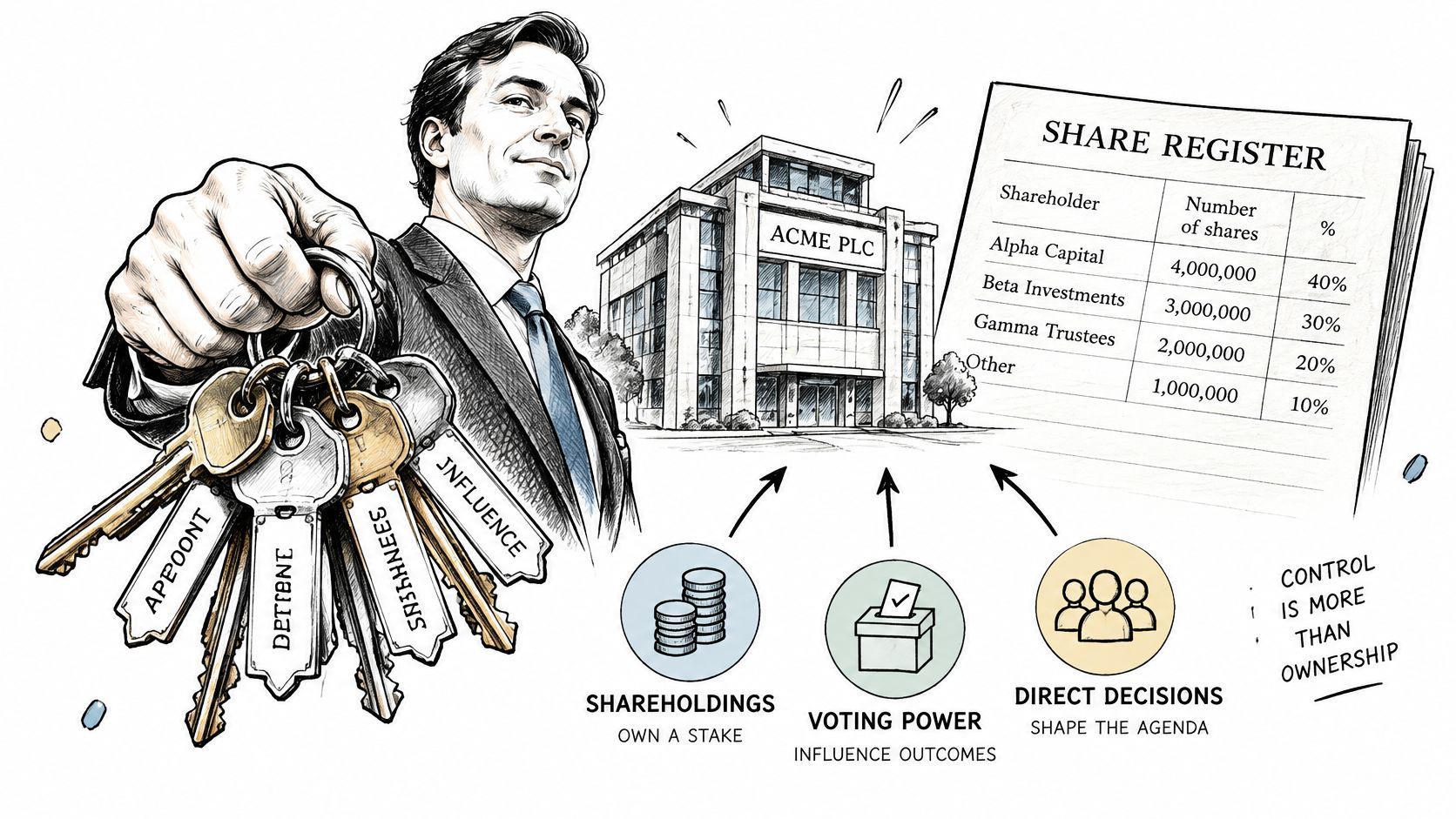
Look hard at shareholder agreements, board appointment rights, veto rights over budgets or strategy, coordinated holdings and acting-in-concert relationships. A person with a modest stake and a right to appoint the chief executive may matter more than a larger passive holder. When you're reviewing the sale documents themselves, business sale contract advice from The Owner's is useful context for separating commercial transfer terms from the regulatory control analysis.
Aggregation and Indirect Control
Fund structures create a classic trap. The FCA finalised guidance FG24/5 highlights that separate funds each holding less than 10% may still be aggregated where they share a common general partner and voting rights are attributable to that general partner, potentially making the GP an indirect controller. Each fund looks small in isolation. Together, the GP may control the vote.
The same guidance covers the involuntary case. If a person crosses a threshold without intending to, they should notify the FCA immediately upon becoming aware, even if they intend to reduce the holding again below the threshold. "We'll sell down next week" isn't a substitute for notification.
Management appointments belong in this analysis too, because post-completion leadership shows who will direct the firm. Our explainer on the FCA approved person position helps teams connect those appointments to the wider approval picture. Don't treat board changes as an HR task for after completion.
If your control map doesn't show who can hire, remove, veto and direct, it isn't a control map. It's just a share chart.
Before signing, build one map covering direct and indirect holders, voting arrangements, parent undertakings, governance rights and fund general partners. Mark who acts together, who attributes votes to whom, and which rights change on completion. That map drives the notification. Everything else is decoration.
Approval Before Completion or Post-Notification
The default is simple. The FCA change in control notification page states that a proposed acquisition or increase of control in a UK firm authorised under FSMA generally requires a Section 178 notification and FCA approval before completion. Completion follows approval. Not the other way round.
Notification Scenarios and Their Regulatory Consequence
| Scenario | Required sequence | Regulatory position |
|---|---|---|
| Planned acquisition in an FSMA-authorised firm | Notify and obtain approval before completion | Approve, approve with conditions or object |
| Involuntary threshold crossing | Notify immediately on becoming aware | Notification required even if the holding is later reduced |
| Completion without prior approval | Post-notification seeking approval retrospectively | Materially different from consent before completion |
| Cryptoasset beneficial-owner acquisition | Notify and obtain approval before completing | Completing without approval is a criminal offence |
Why Each Row Bites Differently
A planned acquisition turns on intent. You've decided to acquire or increase control, so you notify first and wait for the regulator to approve, approve with conditions or object. Your purchase agreement must leave room for all three outcomes, including conditions that alter governance, funding or structure.
An involuntary crossing turns on knowledge. You may not have planned it, perhaps because another holder exited or voting rights shifted, but once you're aware of it, notification can't wait for a convenient board cycle. A later sell-down doesn't erase the event.
Completion without prior approval turns on sequence. A post-notification asks for approval retrospectively after control has already changed hands, which is a weaker position than consent obtained beforehand. You're no longer asking permission to proceed. You're explaining why you already did.
The cryptoasset row turns on legal status. Where the acquisition makes someone a beneficial owner, completing without approval isn't just poor process, it's a criminal offence. No commercial deadline justifies that exposure.
Our guide to the FCA application process sets out how sequencing discipline works across regulatory filings more broadly. Apply the same discipline here. Make completion conditional on FCA approval in the purchase agreement, record the approval date against the completion timetable, and give the board a clear walk-away position if the regulator objects or imposes conditions the buyer can't accept.
How to Assemble a Decision-Ready Notification
A decision-ready file answers the regulator's questions before they're asked. Work through these steps in order, because each one feeds the next.
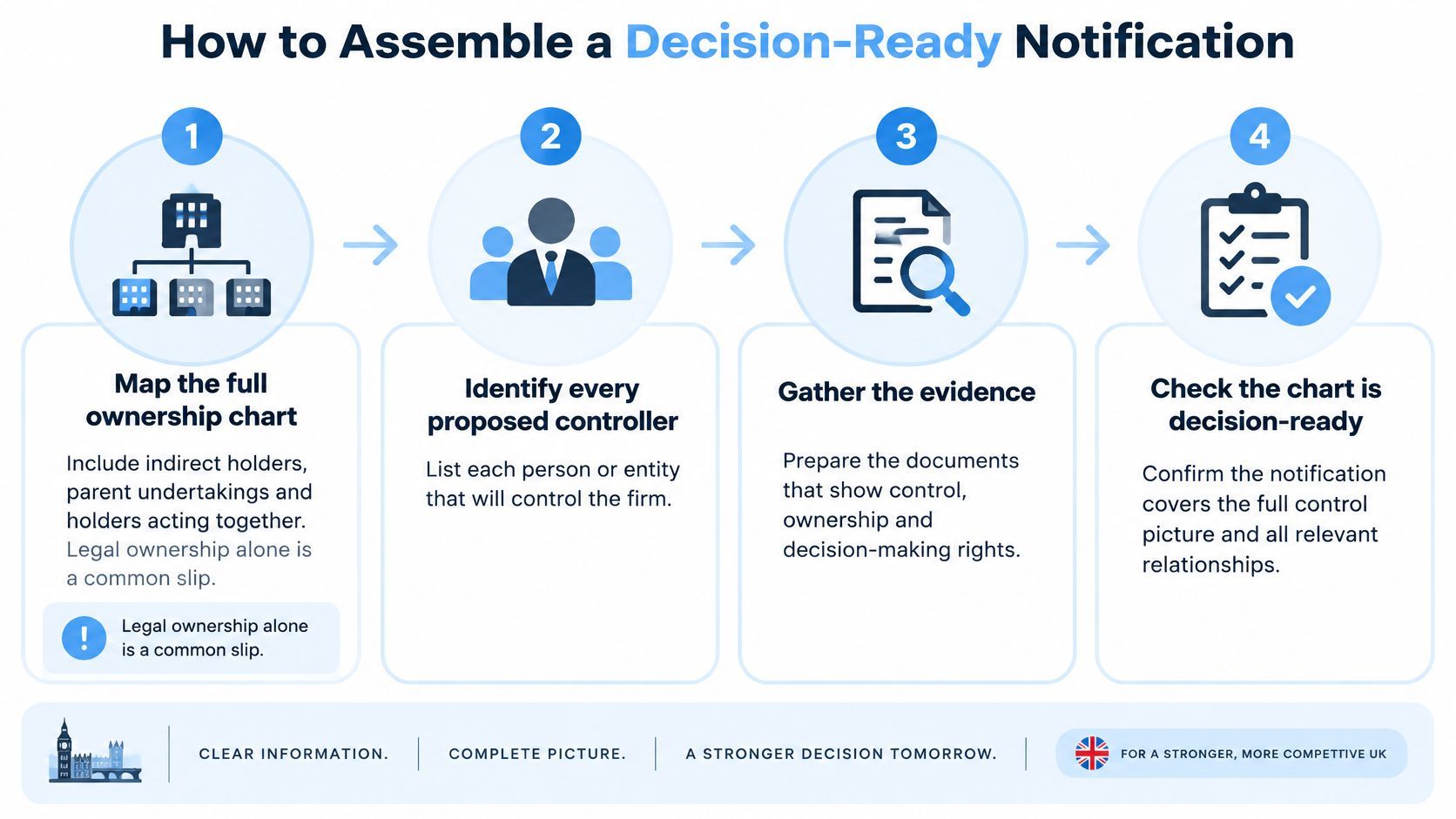
- Map the full ownership chart. Include indirect holders, parent undertakings and holders acting together. The common slip is charting legal ownership only, which hides the people who direct the votes.
- Identify every proposed controller. Gather information on each person and entity, including any fund general partner that could be an indirect controller. If you can't name them all, you're not ready to file.
- Test the post-deal holding against the bands. Record any band change for the firm's category, because moving up a band can require fresh approval. Show your workings, don't just state a conclusion.
- Set out financial resources. Explain the acquirer's resources and how the firm will keep meeting its threshold conditions after completion. Thin assertions here invite questions you could have answered upfront.
- Describe governance and responsibilities. Cover post-completion management and any Senior Management Function applications, which the target should submit at the same time as, or shortly after, the notification. Our evidence explained guide shows how to make that material usable rather than merely available.
- Explain the business rationale. State why the transaction makes sense and what it changes for continuing compliance. A regulator shouldn't have to infer your strategy from a press release.
- Gather controller due-diligence evidence. Include criminal-record checks where required and check expiry dates early. Stale or missing checks hold up otherwise ready deals.
- Cross-check the whole file. Reconcile the notification against the firm's existing registration information and policies. Inconsistencies between documents undermine confidence in everything else you've submitted.
Review the Package as One Story
Bring the business plan, financial information, policies and application answers together, review the documents, resolve findings and revisit affected material when facts change. Financial figures reviewed alongside the written account produce a more complete file than figures checked in a separate silo. We also distinguish arrangements already in place from those the business still needs to establish, and we check consistency across the application documents before the package goes for internal and client approval.
Filing test: If a fact changed tomorrow, could you find every document it touches within an hour? If not, your file isn't decision-ready yet.
How Long FCA Approval Takes and What Drives It
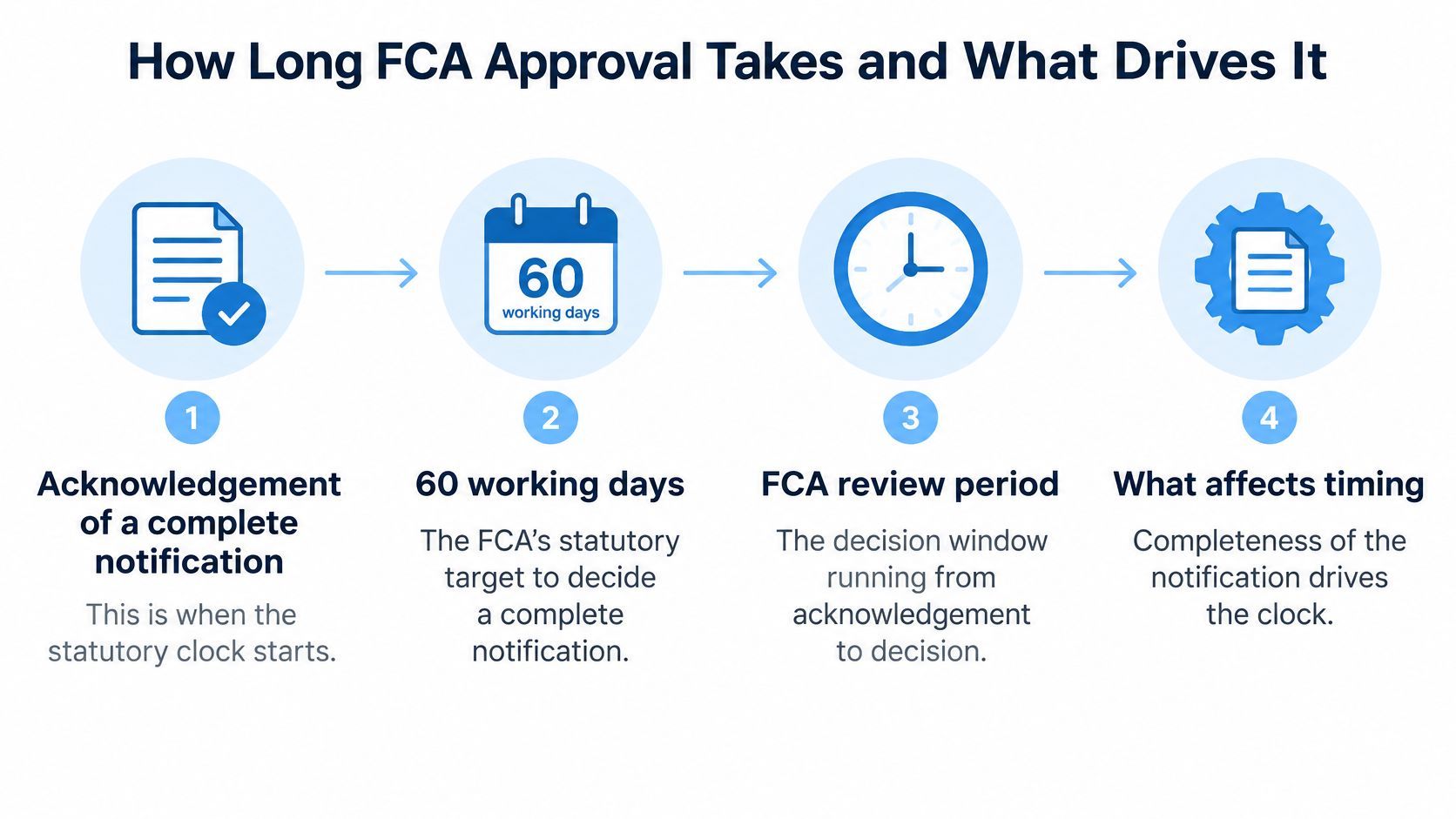
The FCA operating service metrics set a statutory target to decide a complete notification within 60 working days after acknowledging receipt, and record 1,289 pre-notifications in 2023/24 with 99.6% of decisions made within that period, meaning only 5 cases missed the target. Read that carefully. The clock runs from acknowledgement of a complete notification, not from the day you first sent an incomplete package.
It is similar to a planning-permission clock that only starts once the application is valid. Submitting something half-finished does not buy you time. It usually costs you time.
FCA Change-of-Control Processing Benchmarks
| Measure | Value | What it means for the deal |
|---|---|---|
| Statutory decision target | 60 working days after acknowledgement | Applies to a complete notification |
| Lower quartile (2024/25) | 14 calendar days | Fastest quarter of determinations |
| Median (2024/25) | 34 calendar days | Typical determination |
| Upper quartile (2024/25) | 62 calendar days | Slowest quarter of determinations |
The quartile figures in that table come from the FCA 2024/25 determination data for change of control. The spread matters more than any single number. A clean case can move quickly, but a quarter of cases took far longer than the median.
What Pushes a Case to the Slow End
Four things drive timing. The completeness of your ownership chart and evidence file, the number of proposed controllers to assess, the quality of your financial and governance evidence, and how quickly you answer FCA questions. Three of those four sit entirely within the buyer's control, which is why blaming regulator delay is usually beside the point.
Treat these benchmarks as descriptions of past outcomes, not promised dates. Regulatory decisions remain with the relevant authority, and approval and decision dates are not guaranteed. Plan from the slow end, and treat anything faster as a bonus.
Crypto Firms and the Shifting UK Regime
Completion timing for a crypto deal is a regulatory call, not a commercial preference. A buyer acquiring an AML-registered cryptoasset firm can sign under one controller test and complete under another if the target moves toward FSMA authorisation while the deal is open. Price that risk before signing or it prices you.

The Dates That Change the Answer
The FCA cryptoasset change in control page describes the application window and the planned mandatory regime date for the new UK crypto framework, alongside 2026 legislative amendments that align the cryptoasset change of control regime more closely with FSMA, including revised threshold and assessment arrangements where no defined beneficial owner sits in the controller chain.
Apply that to a live transaction. At signing, an AML-registered target sits under the beneficial owner analysis in Regulations 5 and 6 of the Money Laundering Regulations 2017, with approval required before completion. Completing without it is a criminal offence. At filing, an authorisation application may already be in train. At completion, status, permissions and the applicable controller test may have shifted. Get written advice on which test governs each stage. Do not assume the signing analysis survives to completion.
Evidence Goes Beyond Ownership
For cryptoasset firms, suitability review runs past ownership and funds. Expect scrutiny of technology reliance, outsourcing, systems ownership and continuity. Who owns custody infrastructure, who can shut it down, and what happens to customers if a vendor fails are controller questions.
Our detailed guide to UK crypto asset regulation and authorisation sets out how the perimeter is developing. For a deal in motion, record regulatory state at signing, at filing and at completion as three separate snapshots. Build contingency positions for a move from AML registration into FSMA authorisation or a variation of permission. Set who bears delay cost and walk away rights if the deal lands in a tougher approval route.
Build the Signing Timetable and Contingency Plan
Completion is a regulatory permission first and a commercial date second. Build every board date around that fact or the deal controls you.
Start from acknowledgement, not from signing. The only filing date that counts is the date you can support with a complete evidence file. A notification date without documents behind it misleads your board and wastes your long-stop.
Plan from the slow outcomes. Use the statutory outer limit and the upper-quartile result as your planning reference. Fast and median outcomes describe other applicants. They grant you nothing.
Budget explicitly for questions. The FCA will probe gaps in source of funds, controller structure and business plan consistency. Name one owner for regulator queries with authority to answer in days, not weeks. Your response speed is the one part of the clock you control.
Set the long-stop after the buffer, then make completion conditional on approval. Wider guidance on how to navigate a strategic transaction reinforces why that sequencing protects both sides. No approval, no completion. No side letter, no early transfer of voting rights, no shortcut that creates a criminal offence.
Overlay the crypto transition dates for a cryptoasset target. Record the regulatory state at signing, at filing and at completion against the authorisation window. Decide in the purchase agreement who bears cost and delay if the target moves from AML registration into FSMA authorisation mid-deal. An acquirer who prices only the current regime buys the wrong risk.
Confirm the route before signing. Where authorisation category, holding bands and transition dates interact, get specialist confirmation first. After Glentorion's internal approval and the client's sign-off, the agreed application is submitted on the client's behalf under the required mandate and access arrangements.
Authorisation decisions remain with the relevant regulator, and no date is guaranteed. Your contingency plan must state what happens if approval slips past the long-stop, who can extend, and who can walk away.
If you're planning an acquisition, stake increase or group reorganisation involving a UK authorised or cryptoasset firm, Glentorion can help you identify the correct control thresholds, assemble a decision-ready notification and build a signing timetable that respects the regulator's clock. Talk to our team before you sign, not after, and start at Glentorion.
- change of control
- FCA change in control
- UK change of control
- FSMA control thresholds
- FCA approval