Financial Services Regulation UK: The Complete Guide
Published
The UK runs a dual-regulator model under the Financial Services and Markets Act 2000, with the FCA handling conduct and the PRA handling prudential supervision. The FCA and PRA began operating on 1 April 2013, and the FCA now regulates conduct for approximately 35,500 firms, prudentially supervises around 34,000 firms, and applies prudential standards to approximately 14,000 firms, while the PRA supervises roughly 1,500 firms.
If you're trying to get authorised, or keep a regulated business on track, the hard part isn't finding the rulebook. It's proving, with clean evidence, that the business model, governance, capital, systems and senior accountability all line up in practice.
Table of Contents
- The Evolution of UK Financial Regulation
- Understanding the Two Regulatory Pillars
- Navigating Authorisation Requirements
- Building Post-Authorisation Evidence Systems
- Adapting to Data-Intensive Supervision
- The New Cryptoasset Regulatory Regime
- Transitional Arrangements Versus Authorisation
- Next Steps for Regulatory Readiness
The Evolution of UK Financial Regulation
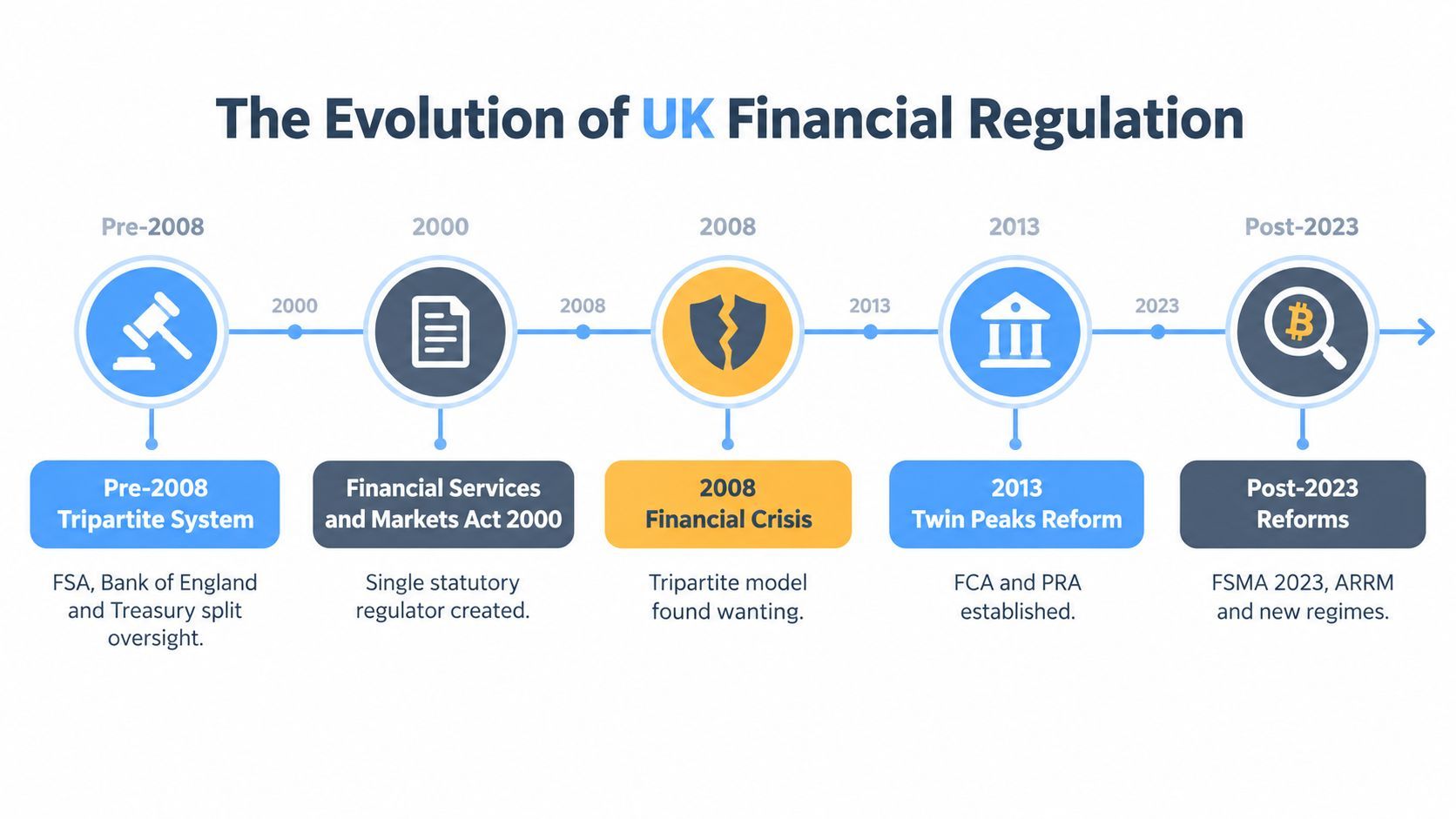
UK financial services regulation UK didn't become complex by accident. The modern framework sits on FSMA 2000, which gave the UK a structure where regulators operate independently inside a policy framework set by Parliament and government, and that architecture was later reshaped after the 2007 to 08 global financial crisis exposed the weaknesses of the old tripartite system involving HM Treasury, the Bank of England and the FSA. That history still matters because it explains why today's applications must answer both conduct and prudential questions, not just one or the other.
The old model looked tidy on paper, but responsibility was split too thinly when firms came under pressure. The FSA was abolished, and its responsibilities were divided mainly between the PRA, which supervises firms whose failure could create significant balance-sheet or financial-stability risks, and the FCA, which regulates conduct. Their split began on 1 April 2013, and the result is a system that expects firms to show who does what, who controls what, and who can be held accountable when things go wrong.
Practical rule: if your governance paper reads like a generic corporate overview, it's not ready for a UK authorisation review. The regulator needs a joined-up story about the firm's actual operating model.
For founders, the lesson is simple. A UK application has to show the business can be supervised under the current architecture, not the one that existed before the crisis. That means the evidence has to align with the regulator that owns the risk, and it has to do so in a way that's understandable to a reviewer who sees hundreds of submissions and can spot vague language quickly.
Understanding the Two Regulatory Pillars
The FCA and PRA do different jobs, but applicants often blur them together. The FCA is the conduct regulator, so it cares about customer outcomes, market behaviour, complaints, permissions and how the business treats clients. The PRA is the prudential regulator, so it cares about safety and soundness, capital, liquidity and whether the firm can survive stress without threatening financial stability.
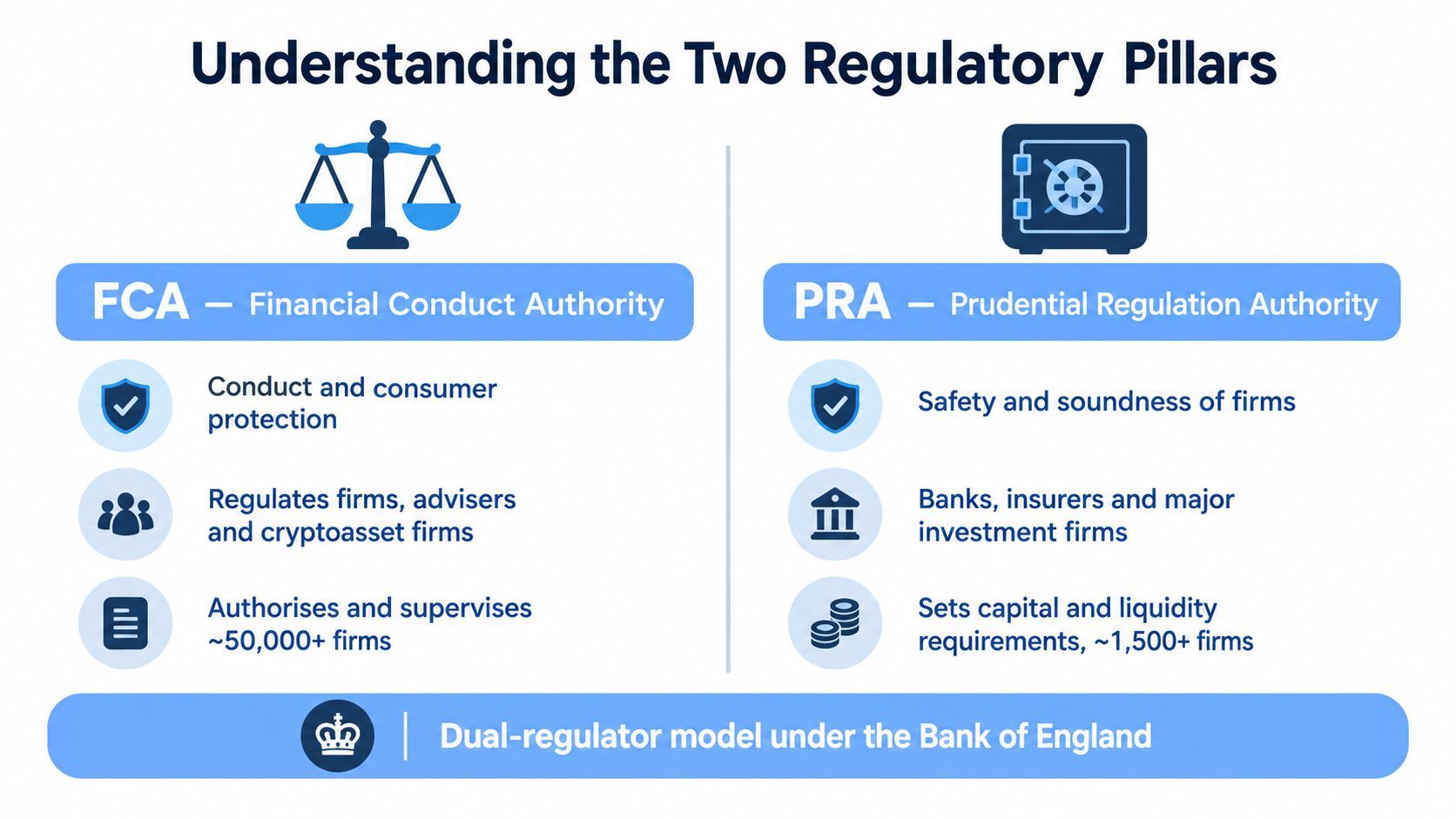
A practical way to think about the split is this, the FCA asks, “Are you treating customers and markets properly?”, while the PRA asks, “Can this firm remain safe, funded and controlled?” Some firms need both, especially where the business model touches deposits, lending, insurance or other prudentially sensitive activities.
How to spot the right regulator
Start with the activity, then test the consequences. If the firm mainly provides investment, payment, brokerage, advisory or cryptoasset services, the FCA is usually central. If the firm's failure could create balance-sheet or stability concerns, the PRA may also be involved.
A useful working habit is to map every product line to the relevant rule source before writing the application. That avoids the common mistake of drafting a polished narrative that doesn't match the actual supervisory perimeter.
| Business Type | Key Tests | Common Gaps |
|---|---|---|
| Consumer-facing financial firm | Conduct, disclosures, customer outcomes, complaints handling | Vague customer journey, weak MI |
| Prudentially sensitive firm | Capital, liquidity, governance, recovery planning | Thin forecasts, no stress analysis |
| Dual-regulated model | Both conduct and prudential evidence | Split ownership, inconsistent documents |
If you're uncertain, don't ask which regulator is “stricter”. Ask which one owns the risk, and then build the pack around that answer. That one decision saves a lot of rework later.
Navigating Authorisation Requirements
Authorisation is where weak internal alignment shows up fast. The FCA's Threshold Conditions are not a formality, they're a set of structural tests on whether the business model is suitable, supervision will be effective, resources are appropriate, and the people involved are fit and proper. For a UK-incorporated company, the location condition can also matter, because the head office, and registered office where applicable, generally needs to be in the UK for the relevant test to apply.
What the regulator is really checking
The regulator is testing whether the business can be understood, supervised and controlled. A glossy business plan won't rescue a pack if the financial forecasts, governance map, technology architecture and outsourcing model tell different stories. The same is true for senior-manager responsibilities, because accountability gaps usually surface when the reviewer traces one responsibility across several documents.
A weak application often isn't rejected because the business is bad. It struggles because the evidence doesn't hang together.
The best applicants work backwards from the decision they want. They make sure the application answers are anchored to board-approved assumptions, named owners and current operating arrangements. That means the people who sign off the filing should be able to point to the policy, the process, the control and the evidence that support each statement.
| Business Type | Key Tests | Common Gaps |
|---|---|---|
| Payment or e-money model | Governance, safeguarding, controls, customer treatment | Missing operational detail |
| Investment or brokerage model | Conduct, resources, supervision, conflicts | Weak control ownership |
| Prudentially exposed model | Capital, liquidity, governance, wind-down thinking | Optimistic forecasts |
| Cryptoasset model | Perimeter, resources, supervision, financial resilience | Misclassified activity |
A good filing reads like an operating model, not a pitch deck. If the reviewer can't follow the chain from product to risk to control to accountable person, the file needs more work.
Building Post-Authorisation Evidence Systems
The biggest mistake firms make is treating authorisation as the finish line. In practice, the hard work starts once the permission lands, because regulators expect the business to keep proving that its controls are alive, not just described on paper. The right question isn't “Do we have policies?”. It's “Can we show the policy, the control, the owner, the test result and the remediation trail in one place?”
Evidence that survives scrutiny
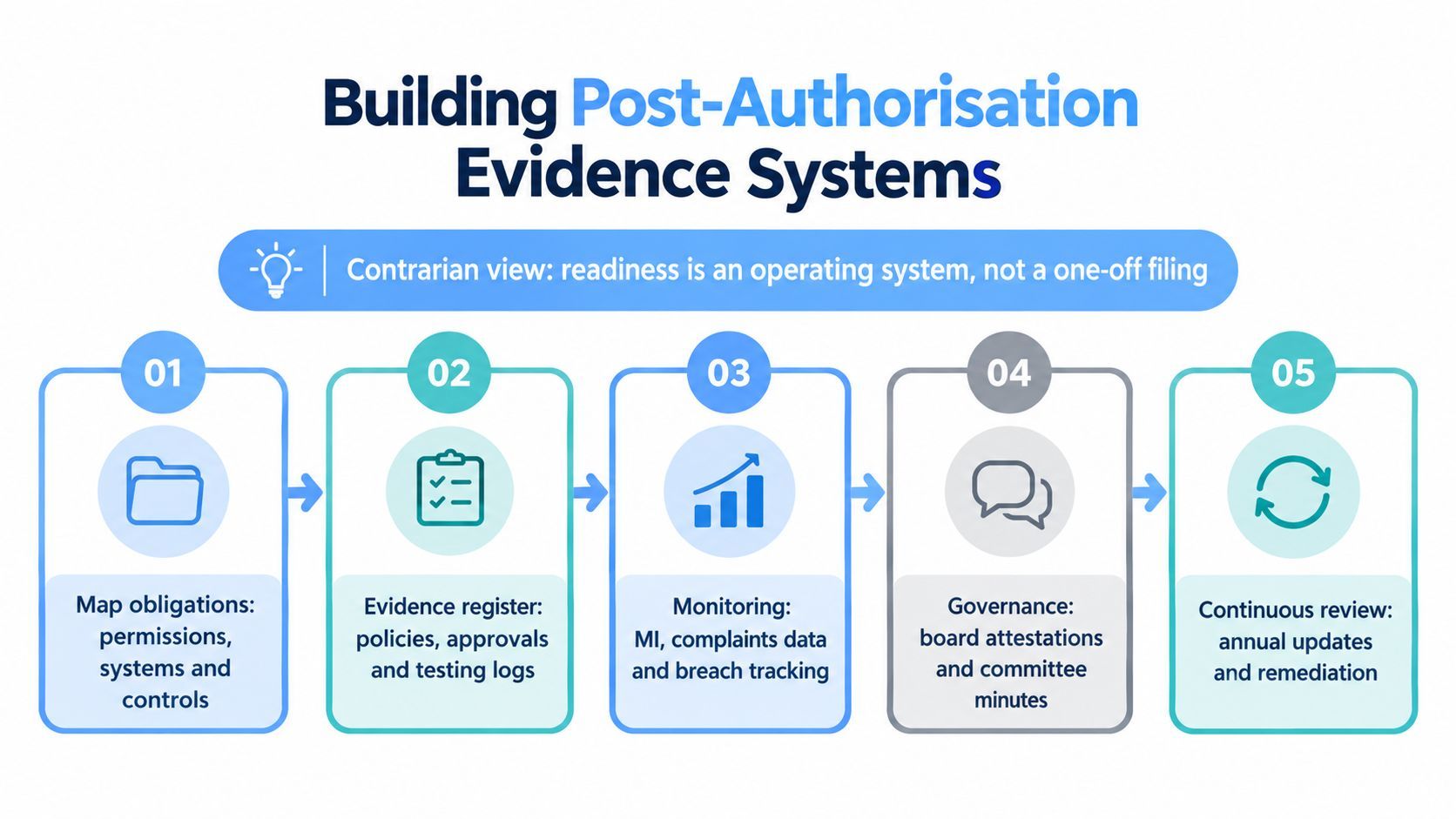
The most resilient firms build a living evidence register. That register links obligations to policies, policies to controls, controls to testing, and testing to governance decisions. It also separates current arrangements from future ones, which matters when teams are still implementing systems after authorisation.
The FCA's Consumer Duty raises the bar because firms must think about outcomes for all consumers, including vulnerable customers, while UK data-protection rules don't stop firms from processing personal data when that's necessary to deliver good outcomes. The practical challenge is to avoid false choices between compliance areas. A firm needs to show both that it identified foreseeable harm and that it handled information lawfully and proportionately.
A simple operating rhythm usually works better than a sprawling document library.
- Map obligations early: tie each permission, control and reporting duty to a named owner.
- Keep a live evidence register: store approvals, test results, breaches and remediation together.
- Use management information properly: complaints trends, incidents and exceptions should feed governance, not sit in separate folders.
- Close the loop: every issue should end with a decision, an owner and a review date.
Regulatory readiness is an operating system, not a one-off filing.
For teams that want structure, tools matter. One option is Glentorion, which prepares and reviews application packages and can help organise facts, evidence and cross-document consistency under mandate. The point isn't to create more paperwork, it's to make sure the paperwork reflects how the business runs.
Adapting to Data-Intensive Supervision
Supervision is becoming more data-heavy, and that changes what firms need to build internally. The FCA's 2026 Regulatory Initiatives Grid points to data decommissioning, common data standards, API-based collection and a future data-collection strategy, alongside work to improve firms' interactions through a single portal. Separately, the FCA reported that by the end of March 2026 all authorised and regulated firms were using My FCA, and that 81% said it was easy to use, with fewer late returns reported.
The practical message isn't that digital supervision removes effort. It shifts the effort into data ownership, reconciliations, change control and management accountability. If a firm can't trace a number from source system to board paper, it will end up rebuilding the answer by hand every time a regulator asks a question.
Build the data map before the request arrives
Firms should treat each material regulatory fact as an asset with a named owner. That fact should have a source system, a calculation method, a review date and a list of documents it affects, because one data change can alter an application answer, a regulatory return and a customer-outcome assessment at the same time.
The biggest failures I see are not technical. They're governance failures where nobody owns the number, or three teams maintain three versions of the same answer.
A practical setup looks like this:
- Assign ownership. One person owns each key metric or narrative statement.
- Document lineage. Every figure should trace back to a source and calculation method.
- Control change. If the business changes a product or outsources a function, the affected regulatory artefacts should be flagged immediately.
- Review regularly. Board packs, returns and policies need the same underlying data discipline.
That discipline matters even more for fast-moving firms. Crypto, payments and digitally enabled lenders can change quickly, and when the operating model shifts faster than the evidence base, contradictions appear everywhere.
The New Cryptoasset Regulatory Regime
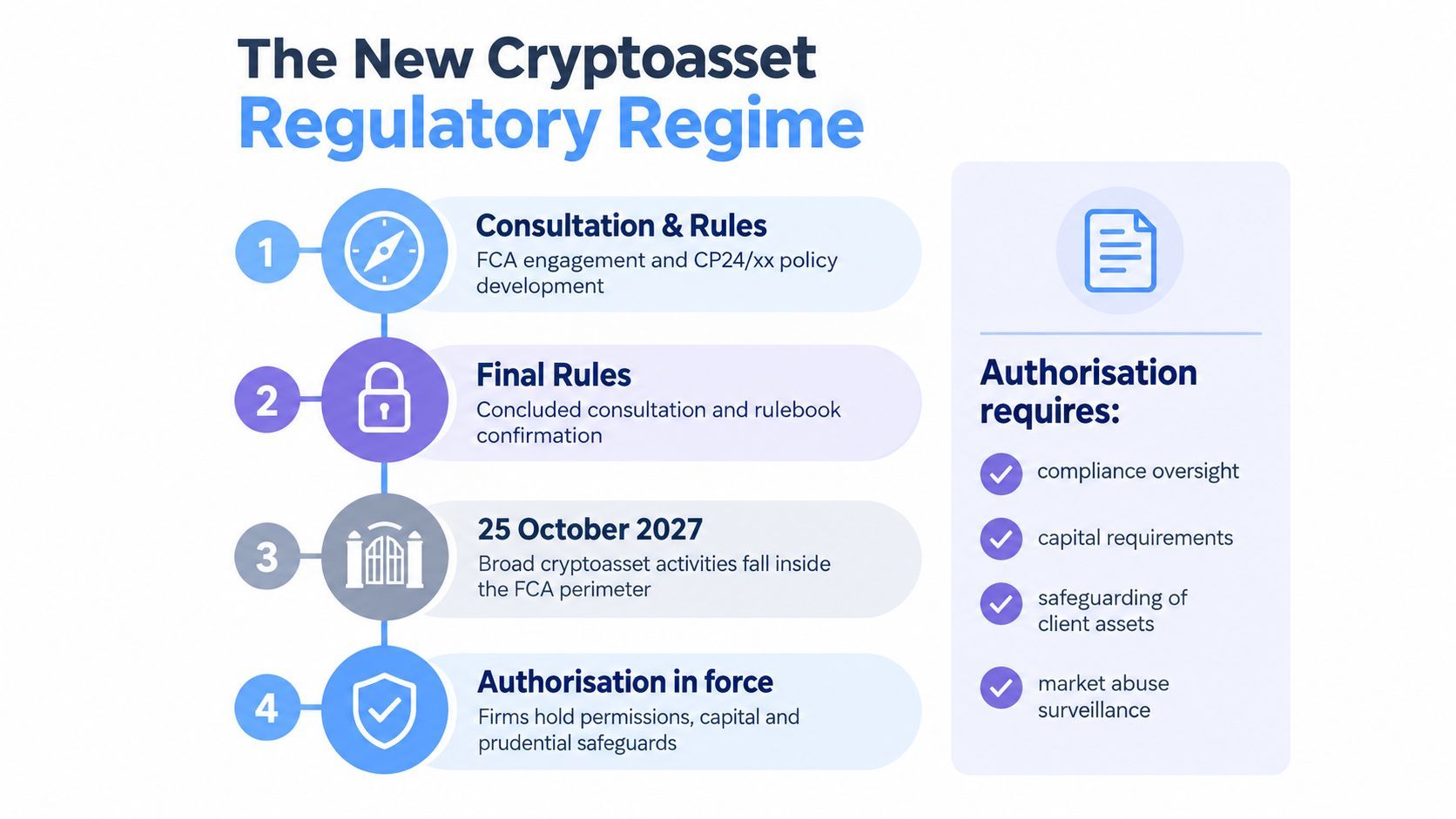
The UK's forthcoming cryptoasset regime will bring a broad range of cryptoasset activities inside the FCA perimeter from 25 October 2027. The perimeter will extend beyond anti-money-laundering registration and financial-promotion rules, and it will cover activities including qualifying stablecoin issuance, operating cryptoasset trading platforms, dealing and arranging deals, safeguarding cryptoassets and staking.
What the FCA will expect
The new regime is not just a financial-crime exercise. The FCA says applicants must satisfy the FSMA Threshold Conditions, including a suitable business model, effective supervision arrangements, appropriate financial, human and technological resources, and suitable governance and personnel. It also says firms will need to meet financial-resilience requirements, including capital and stress testing, and market-integrity rules dealing with matters such as insider trading and market manipulation.
That changes the nature of the evidence pack. A crypto firm won't get by with AML policies alone. It may need documented capital assumptions, trading-surveillance controls, disclosure processes, safeguarding arrangements and escalation procedures that match the actual product set.
Transitional timing matters
Firms intending to rely on transitional arrangements can apply from 30 September 2026, with the application window closing on 28 February 2027. Applications go through the FCA's Connect system, and existing firms that apply in time may continue providing services, including taking on new business, while the application is assessed, if the transitional conditions are met and no final decision has been made before commencement.
The safe assumption is that the regulator will look for the operating model you can prove, not the one you describe aspirationally.
For trading platforms, custodians, stablecoin issuers and staking firms, the preparation task is bigger than a form. The evidence needs to show the business can be supervised over time, not just launched.
Transitional Arrangements Versus Authorisation
Transitional permission and full authorisation solve different problems. Transitional arrangements buy time, but they don't remove the need to prove that the firm meets the standards the FCA expects for the new regime. Full authorisation gives a cleaner long-term position, but the submission bar is higher because the regulator is assessing the whole operating model rather than a temporary bridge.
| Aspect | Transitional Permission | Full Authorisation |
|---|---|---|
| Purpose | Keep services running during the switch | Secure ongoing permission under the new regime |
| Timing | Application window opens before the regime starts | Required for permanent operation |
| Evidence burden | Still substantial, focused on readiness and compliance | Broader, deeper and more durable |
| Risk profile | Time pressure and conditional continuation | Longer lead time, but stronger regulatory certainty |
The trap is assuming transitional status is easy. It isn't. Firms still need to show compliance with consumer protection, safeguarding customer assets, market integrity and financial resilience, and they need to manage the fact that the FCA can still say no.
A stronger strategy is to work backwards from the authorisation standard and use the transitional window to close gaps early. That means finalising governance decisions, control design, policy wording and management sign-off before the deadline, not after it.
Next Steps for Regulatory Readiness
A founder preparing an application should first map the business model to the right regulator, then test whether the evidence still matches the story being told. An authorised firm should tighten the link between obligations, controls, data and governance before the next supervisory request arrives. For crypto firms, the transitional window is a build phase, not a pause.
The firms that move fastest keep one source of truth for regulatory facts and update it whenever the business changes. That reduces rework, sharpens board oversight and prevents small inconsistencies from turning into filing problems.
The practical test is simple. Review the perimeter, evidence register, senior accountability map and data lineage together, not as separate workstreams. Then close the gaps that would stop a reviewer from seeing how the business is controlled.
If you need help scoping that evidence base before the next filing, see how Glentorion supports regulatory planning. For interview preparation and cross-document consistency checks, make that the final pass before submission.
- financial services regulation uk
- FCA authorisation
- PRA regulation
- cryptoasset regulation
- UK financial services