Satoshi's Dream: A Fictional Story About the Birth of Bitcoin
Published
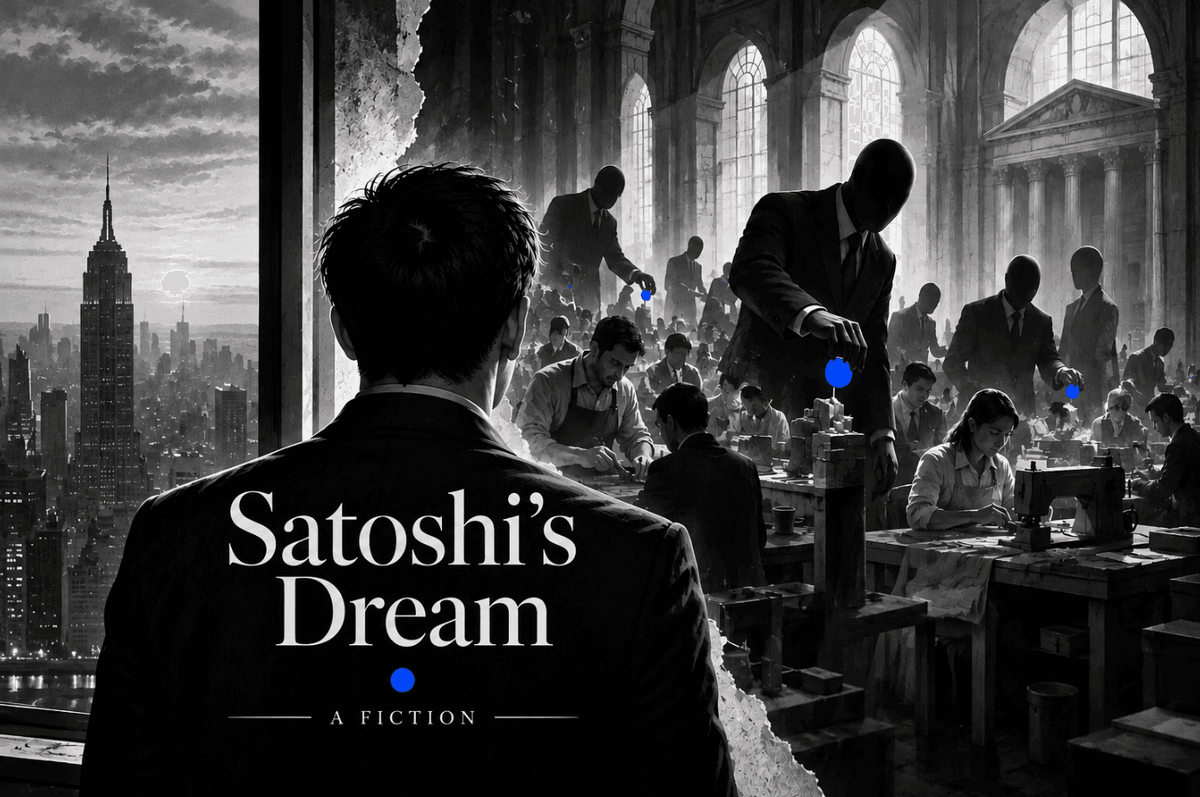
SATOSHI’S DREAM
A FICTION
I
Satoshi awoke, as he did most mornings, just a few minutes before five. He rubbed the sleep from his eyes and sighed…
He’d had the dream again.
It was always the same. There was a great hall - a vast cathedral like space and it was full of people working. There were carpenters, office workers staring at screens, farmers, executives, builders, others bent over sewing machines. And moving among them, silently, dressed in black were the faceless others. They carried nothing and made nothing. Yet each time someone finished a task, one of the dark figures would lean in and extract something from their output - a coin, a garment, a meal a percentage of something and slip it into their pocket.
Each time he had the dream those that strived seemed to diminish whilst the dark figures grew in both size and number.
What upset him each time he awoke was that no one in the hall seemed to find any of this in the least bit strange.
For a while he lay without moving and listened to the city. Forty-one floors below, Manhattan was stirring. He got up crossed the floor and stared through the full height window of his mid-town apartment. He had two others, one in London’s Holland Park and another in Minami-Azabu Tokyo. He could not have said with any conviction if any of them or anywhere else was really home. He had come to think of himself as a citizen of nowhere in particular, and therefore, in some sense, of everywhere, a man with obligations to the world rather than to any one corner of it.
II
He did not need a therapist to explain the dream to him. He had lived it.
He had been nine years old when the bank came for the house. His father had spent five years investing all the time and money he had into a substantial office development. With the building six months from completion, the bank declined to extend his line of credit. There was no appeal. The project was sold on to a consortium that took another eighteen months to complete the project but nonetheless made many millions in the process. His father, now a broken man never spoke of it again.
His mother had been an actress a very good and briefly famous one. When she signed for the film that might have made her a true star, half of her advance was paid, as was customary, to her agent. The agent took a taxi to the airport that same afternoon and was never seen again. Her return to rep. past relatively unnoticed.
And then there was his brother, a commercial airline pilot, who retired to live in Indonesia. He had bought and fully refurbished six classic DC-10 aircraft in Jakarta for luxury tours around the islands when a local politician who had befriended him shared the alarming news that the planes’ engines would in no way comply with upcoming environmental regulations. The cost of new engines was prohibitive and so he sold the planes to the politician’s brother for cargo transport in the arctic. Six weeks later he read on-line that the government had dropped the regulations. There was rarely a day after that he didn’t look up to see one of his beloved aircraft ferrying paying customers to palm fronded beaches.
A bank, an Agent, a Politician. To Satoshi they were three members of the same family; all intermediaries. Each had stood between a person and the fruit of their labour, and each had helped only themselves in the process. It was not even a conspiracy. It was it seemed to Satoshi simply the way the world had been designed to work.
III
He glanced at his phone, it was Monday the fifteenth of September 2008 he turned on the TV and learned that Lehman Brothers had filed for bankruptcy at 01.45 that morning.
It was the largest bankruptcy in American history: six hundred and thirty-nine billion dollars in assets, a hundred and fifty-eight years of existence, gone between midnight and breakfast. The cameras were outside the headquarters on Seventh Avenue, where young men and women in very good suits were carrying their careers out through the revolving doors in cardboard boxes.
‘More greedy fools!’ he shouted at the screen. It was the first time he had raised his voice in years and the sound of it startled him. He was furious. Where were the regulatory bodies? Where were the FCA complaints reporting procedures? Who was issuing bank licenses anyway?
In the days and weeks that followed, the collapse acquired a terrible momentum. On Tuesday the government took control of AIG, the largest insurer in the world, for eighty-five billion dollars. On the twenty-fifth, Washington Mutual became the biggest bank failure the country had ever known. On the twenty-ninth, the House of Representatives voted down a rescue package and the Dow fell seven hundred and seventy-seven points in a single afternoon.
The reports grew stranger and more pitiful. Families evicted from homes they had been encouraged to buy were living in tents on waste ground outside Sacramento. Wages already earned went unpaid. And each evening the same well-fed faces appeared on the news channels to explain, with small, regretful smiles, why none of it had been foreseeable, and why the institutions that had caused it must now be saved at any cost.
He began to sleep less. The dream came more and more often.
IV
On Friday the thirty-first of October, he decided he could take no more.
He dressed carefully - dark overcoat, a grey shirt with no tie. He was in London now and shortly after one o’clock he walked from his flat across the entire city to his bank. He covered the distance slowly but with great deliberation, like a man following a procession only he could see. It was Halloween. Children in scary masks were being led from shop to shop by their parents, holding out bags for sweets. One little boy, plastic fangs dripping with fake blood was dressed as a banker, in a pinstripe suit and a cardboard bowler hat. Satoshi could not look at him.
At the bank Satoshi gave a name, signed a register and was shown down a flight of marble stairs to the vault. A concierge led him past the great iron door to the long chrome wall that held his safe deposit box. He opened the small cabinet and Satoshi with no little ceremony withdrew his box and carried it to a private room. The door closed behind him with a soft pneumatic click.
He was alone.
He took the key chain from around his neck - he had worn it there, against his skin, since the 18th of August, the day on which he had registered a seemingly meaningless domain name.
He slowly pushed the small key into the lock and turned it. His hands, he noticed, were not quite steady.
The lid rose.
Inside was a laptop. It was an unremarkable machine, stripped of almost everything, capable of little more than sending an email. He lifted it out, set it on the table and raised the screen. It flickered into life. Its small fan whirred. A moment later its wireless connection made contact with the outside world.
The machine waited.
The draft was where he had left it months before. He read it through once but did not change a word.
He moved his hand forward his finger hovering above the return key.
He thought of the thousands made homeless or plunged into poverty. He thought of his father’s silence, and his mother in that empty apartment waiting for a telephone call that never came, and of his brother ever staring at the sky. And then he let himself reflect– but only for a second. iI was dangerous to ponder what might lie on the other side of what he was about to create - a world in which value could pass directly and in its entirety from one honest person to another, a world in which a thing, once made, could never be forged.
It was ten minutes past seven in the evening, ten past two in New York.
His finger descended and pressed the key.
For a moment nothing happened. Then the screen informed him, in the blandest possible language, that his message had been sent.
He locked the laptop back in its box, thanked the concierge and leaving the bank stepped out into the cool autumn air. On a corner, the boy in the bowler hat was eating a bar of chocolate.
V
It was seven thirty, and already dark.
On the fourteenth floor of an office building in Canary Wharf, a young woman was working late. Most of her colleagues had gone home. Those who remained were either drafting redundancy lists or pretending not to.
Her computer chimed announcing the arrival the of a new message.
She almost ignored it. She was tired, and her train was at seven fifty-five. However, she was curious about who might be pushing information through her firewall at this time of day and so she clicked on the mail. There were no words just an attachment.
She opened it whilst pulling on her jacket then as she read, fell back into her seat. She stared at the first few lines again…
They read….
Bitcoin
A Peer-to-Peer Electronic Cash System.
A purely peer-to-peer version of electronic cash that would allow online payments to be sent directly from one party to another without going through a financial institution.
She sat back and read on through what was clearly a compelling and detailed manifesto.
It was signed by someone called Satoshi Nakamoto
It was only a few pages and it would take the world rather longer to fully appreciate what they contained. But when it did, it would find that it would never be quite the same again.
She missed her train.
- Satoshi Nakamoto
- Bitcoin
- Bitcoin Origins
- 2008 Financial Crisis
- Historical Fiction
- Cryptocurrency
- Financial System
About the author