Electronic Money License: How to Get One Step by Step
Published

Your application is drafted, the financial model looks presentable, and your board wants a filing date. Then someone asks who reconciles customer funds when the banking partner's records disagree with your ledger, and whether that person can explain the escalation process without opening a policy. Suddenly, the unfinished work isn't the form. It's the business behind it.
Getting an electronic money license, usually called EMI authorisation in the UK, means demonstrating that the proposed institution can operate under scrutiny. The practical challenge is connecting permissions, capital, customer-money controls and management responsibilities into an operating model that people can execute.
Table of Contents
- Why the Licence Is the Easy Part
- Choosing the Right Route Before You Write a Word
- Capital and Own-Funds Planning That Holds Up
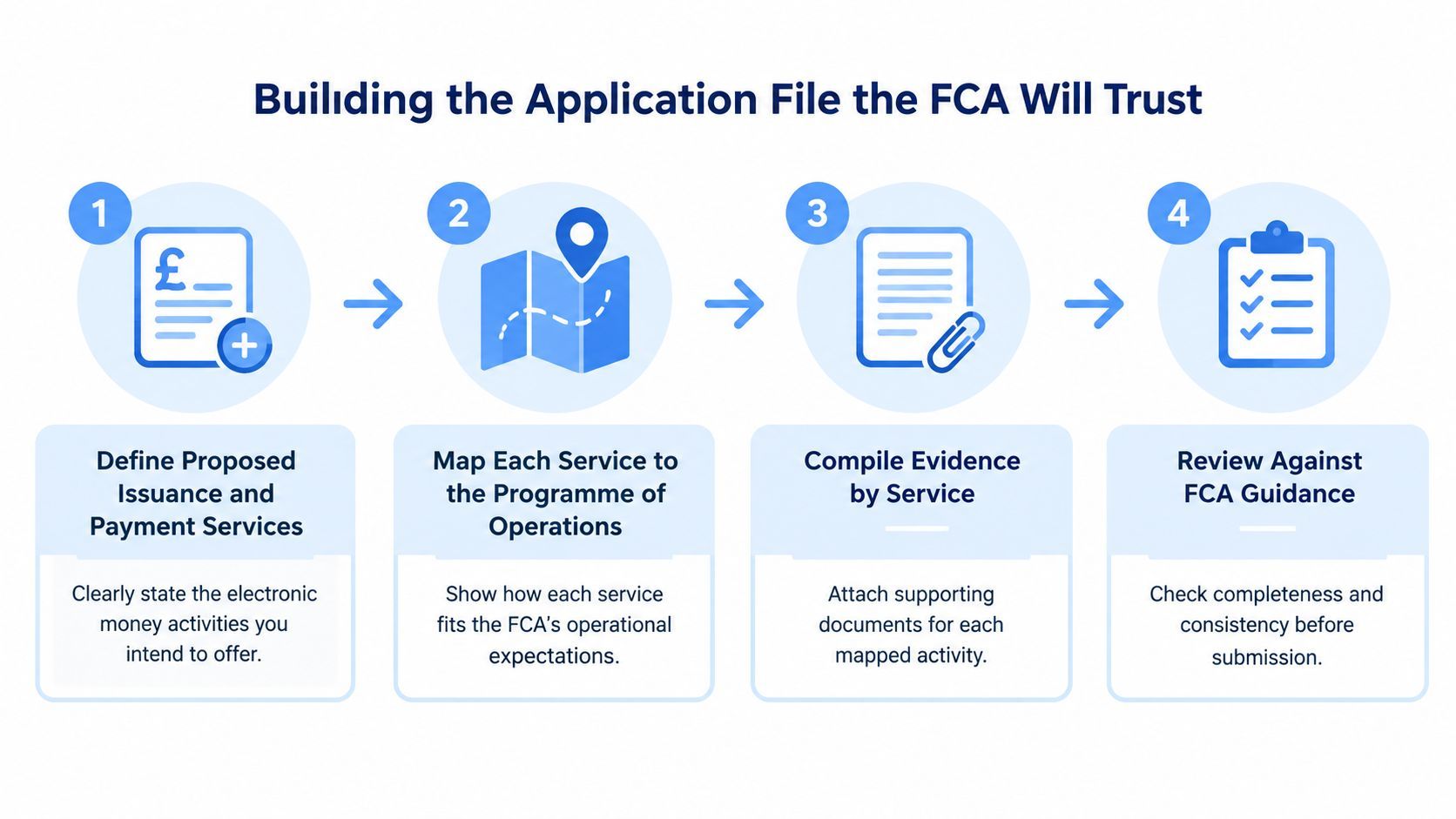
- Building the Application File the FCA Will Trust
- Safeguarding as a Daily Control System
- From Submission to FCA Interview
Why the Licence Is the Easy Part
The heading is deliberately provocative. Authorisation isn't easy, but treating it as the main deliverable encourages the wrong allocation of effort. A founder can commission a persuasive business plan while leaving reconciliation ownership, funding contingencies and supplier dependencies unresolved.
The weakness becomes visible when reviewers move from descriptions to decisions. Who authorises a correction to the ledger? What happens if an outsourced provider stops supplying transaction records? Which manager decides whether a customer-money discrepancy requires escalation?
What the application must demonstrate
The statutory authorisation test requires strong governance, defined responsibility lines, effective risk monitoring and reporting, adequate internal controls and adequate safeguarding measures. Those requirements make operational substance, not document polish, central to the assessment under the Electronic Money Regulations authorisation framework.
An EMI file must demonstrate that the people, systems and controls described in the application can support the proposed business. A convincing narrative cannot replace accountable management.
That distinction matters when deciding what to finish before filing. A policy marked approved may still depend on a bank arrangement that hasn't been agreed, a recruitment plan without funding, or a technology workflow nobody has tested. Calling those arrangements operational creates a credibility problem that careful formatting won't solve.
The FCA's EMI application outcome data puts approved or registered applications at 15% to 20% in 2023, 15% to 20% in 2024, and 40% to 45% in 2025. These figures aren't an individual applicant's probability of success, and they don't establish why outcomes changed. They're a reason to challenge the assumption that submitting sooner is better.
Permission starts the operating discipline
The safeguarding changes now in force make that distinction particularly important. Applicants should design around the obligations they'll have to perform, not around a historical application template.
A useful readiness question is whether management can demonstrate an ordinary operating day, including exceptions. If staff can explain only the happy path, the file isn't yet a defensible account of the business.
Choosing the Right Route Before You Write a Word
Choose the regulatory route from the product's legal and operational substance, not its marketing label. A wallet, payments platform or digital-money proposition needs a documented assessment of what happens when customers provide funds, hold value, make payments and request redemption.
Start with a customer-money flow diagram. Identify the contracting entity, the entity receiving funds, the balance recorded for the customer, and the parties involved in issuance or redemption. Then test the proposed services against the regulatory perimeter before deciding which application to prepare.
Establish the perimeter and eligibility
Under the Electronic Money Regulations 2011, a person generally cannot issue electronic money in the UK unless it is an authorised EMI, a small EMI or another permitted category, such as a credit institution. The framework applies where issuance or redemption takes place from an establishment maintained by the issuer or its UK agent, making establishment and activity mapping foundational issues in the UK electronic-money issuance framework.
For the route decision, AEMI authorisation falls under regulation 6, while SEMI registration falls under regulation 13. The FCA's electronic-money perimeter guidance also addresses corporate form, UK head-office conditions, safeguarding, management's good repute and appropriate knowledge and experience, and relevant financial-crime convictions among responsible individuals.
Don't reduce that assessment to a founder's preference for a cheaper launch. Management suitability and the location of decision-making need evidence, just as the proposed services do.
AEMI vs SEMI at a Glance
| Dimension | Authorised EMI (AEMI) | Small EMI (SEMI) |
|---|---|---|
| Regulatory route | Full authorisation | Separate registration route |
| Capital approach | Initial capital and ongoing own-funds requirements | Different treatment linked to the small-institution regime |
| Safeguarding | Must demonstrate adequate arrangements | Safeguarding remains required |
| Management evidence | Governance and responsibility arrangements must support the business | Good repute and appropriate knowledge and experience remain important |
| Commercial assessment | Match permissions and resources to the planned operating model | Confirm eligibility against projected activity and balances |
A SEMI's average outstanding e-money reaching €500,000 or more triggers capital treatment calculated by reference to that level, including the 2% formula, under Schedule 2 of the Electronic Money Regulations. That is a capital trigger, not a complete statement of SEMI eligibility.
Use a structured FCA authorisation assessment to connect the product roadmap, customer base, projected balances and management structure. Neither route is universally preferable. The defensible choice is the one the business qualifies for and can sustain.
Capital and Own-Funds Planning That Holds Up
Capital planning should answer two different questions: can the applicant meet the entry requirement, and can the institution maintain adequate prudential resources as it develops? Treating both as a single funding line conceals the decisions management will need to make.
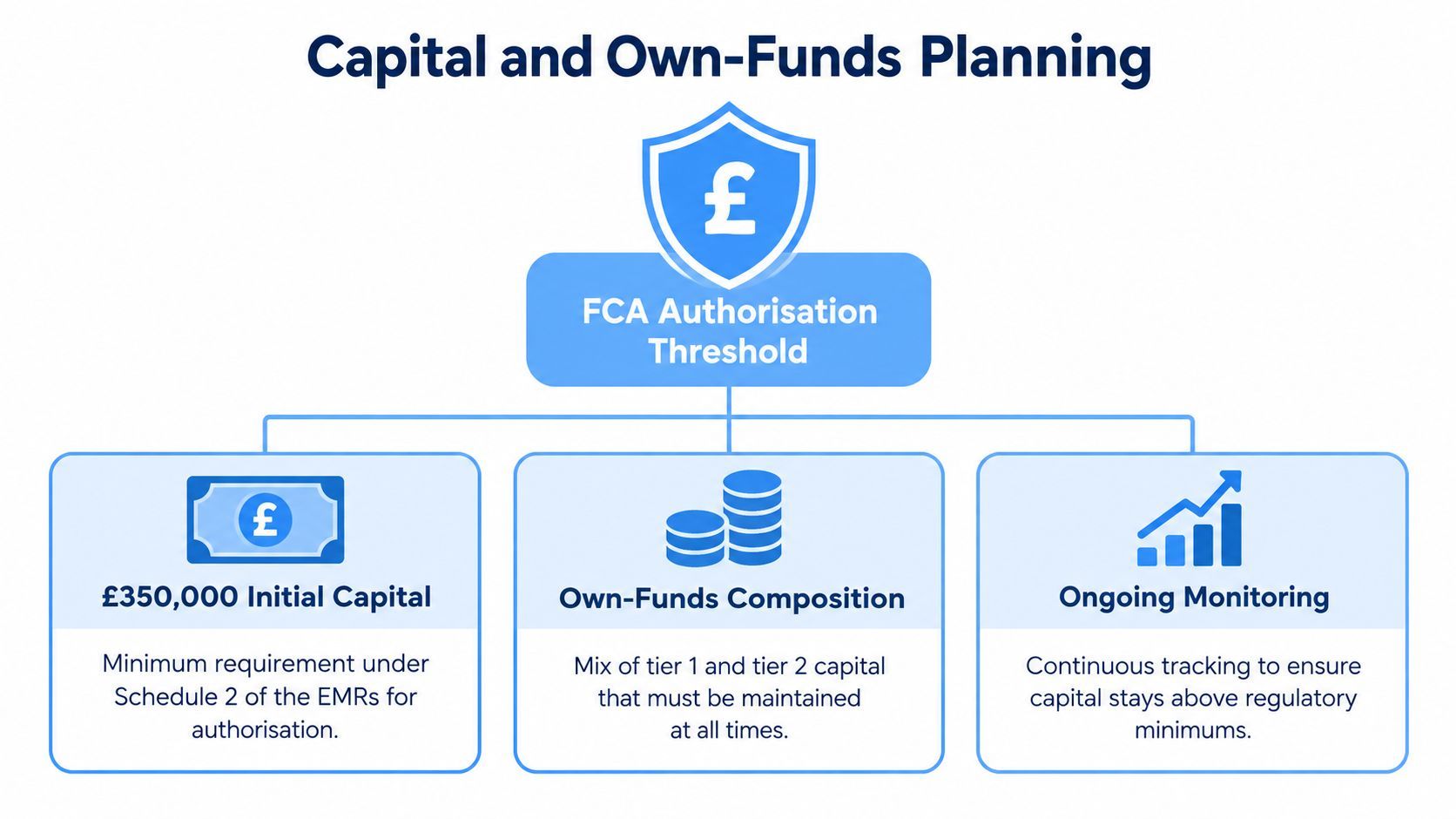
For full EMI authorisation, Schedule 2 sets €350,000 initial capital and an ongoing own-funds framework that generally links e-money issuance and directly related payment services to 2% of average outstanding electronic money. For relevant payment-service activity, the volume bands are 4% on the first €5 million, 2.5% on the next €5 million, 1% on the next €90 million, 0.5% on the next €150 million and 0.25% above that, under the Schedule 2 framework cited above.
The statutory threshold is denominated in euros, not pounds. Keep the legal denomination explicit in funding evidence and management reporting.
Separate the calculations before combining them
A mixed business needs to distinguish payment services directly related to e-money issuance from other payment-service activity. Finance staff should document that classification before applying and combining the relevant calculations. Applying a payment-volume formula indiscriminately can be as misleading as ignoring a relevant requirement.
The forecast should show the relationship between customer balances, payment activity, available own funds and operating expenditure. Customer money being safeguarded is not the institution's operating budget. Management needs to understand which resources support prudential compliance and which support payroll, suppliers and an orderly exit.
Practical rule: Every growth assumption should have a corresponding funding consequence and a named person responsible for acting before resources become inadequate.
Stress different risks separately
Rapid growth, redemption pressure and safeguarding discrepancies require different responses:
- Rapid growth: Test whether increasing outstanding balances or relevant payment volumes require additional own funds, and whether funding can arrive before it's needed.
- Redemption pressure: Examine access to funds, processing capacity and dependencies on banking partners rather than assuming capital alone resolves the problem.
- Safeguarding shortfalls: Identify how management would investigate, escalate and remediate a discrepancy, including the availability of appropriate resources.
- Operating losses: Assess whether expenditure reduces available resources while the business is still building revenue.
A credible model names the trigger, decision-maker and funding action for each sensitivity. An investor's general expression of support isn't equivalent to a documented funding arrangement that management can explain.
A financial risk assessment should connect these scenarios to board decisions and operating limits. The useful output isn't just a forecast showing compliance. It's a forecast that tells management when to intervene.
Building the Application File the FCA Will Trust
Build the file from the service model outward. Starting with a policy library encourages teams to fit the business into existing wording, even where the wording assumes different customer journeys, systems or responsibilities.
UK law requires the programme of operations, a three-year forecast budget, capital evidence, safeguarding description, governance and internal-control arrangements, security policy and AML controls, as specified in Schedule 1 application requirements. The evidence should form a connected account of the proposed institution rather than a collection of independently polished documents.
Sequence the evidence work
- Define issuance and payment services: Describe what the applicant will do, for whom, and through which entities, systems and providers. Separate launch activities from later ambitions.
- Map the programme of operations: Connect each service to customer journeys, money flows and operational responsibilities. Record where an agent, branch or outsourced provider participates.
- Build the forecast: Link the legally required planning horizon to budgets, funding, recruitment and operational assumptions. Explain dependencies rather than hiding them in spreadsheet notes.
- Evidence capital: Assemble evidence supporting the entry threshold and the continuing capital calculation. The narrative and forecast should describe the same funding position.
- Document safeguarding: Translate the money-flow design into controls, responsibilities and records that can be demonstrated.
- Reconcile the submission: Check governance, risk, accounting, AML, security, outsourcing, agent and branch arrangements against the same service map.
Use Connect as a filing channel, not a quality control
The FCA requires submission through Connect, using the relevant application form and supporting materials. Its application guidance cited earlier should govern submission preparation; the portal isn't a substitute for resolving contradictions before filing.
Prepare a document register identifying the approved version, owner and dependencies of each submission item. Keep a record of what was filed so subsequent answers refer to the actual package, not a later working draft.
A useful consistency test starts with projected transaction activity. Does the staffing plan support investigation and reconciliation workloads? Do provider arrangements support the resilience claims? Does the financial model fund the people described as responsible?
Evidence gate: Every material assumption should be traceable to an owner, a document, a control and a board-approved decision.
Use tracked findings rather than verbal reassurance. If a service changes, identify every affected form answer, forecast assumption, policy and contract. A structured review of FCA compliance requirements should distinguish current arrangements from controls still to be established, with clear ownership for closing each gap.
Safeguarding as a Daily Control System
A safeguarding-account description tells reviewers where funds might sit. It doesn't demonstrate how staff know the correct amount is protected, detect discrepancies or support the return of customer money when the firm fails.
The FCA's new safeguarding regime applies to authorised electronic money institutions, small EMIs and relevant credit unions, with the supplementary regime having come into force on 7 May 2026. The FCA describes the reform as a response to weaknesses in existing practices, intended to improve customer protection when a payments or e-money firm fails, in its EMI authorisation and safeguarding guidance.
Follow the money beyond the account
Build an evidence model connecting customer receipts, ledger entries, safeguarding arrangements, reconciliations and exception handling. The design should explain how staff distinguish funds received for issued e-money from funds received for unrelated payment services, including when classification occurs and who resolves uncertain items.
Don't assume separate product names create reliable separation. The ledger architecture needs identifiers and records that allow staff to trace the relevant obligation, receipt and movement of funds. Where flows share a banking or technology dependency, document how staff preserve that distinction.
| Control component | Evidence to prepare |
|---|---|
| Money-flow classification | Service-level diagrams and rules for identifying relevant funds |
| Internal records | Ledger specifications, transaction identifiers and correction controls |
| Third-party comparison | Reconciliation procedures using bank, custodian or provider records |
| Exceptions | Investigation records, ageing information, owners and resolution evidence |
| Escalation | Decision thresholds, accountable managers and reporting routes |
| Customer-money return | Accessible records and documented insolvency-return arrangements |
Daily reconciliation should be designed as an operating process, with the applicable regulatory requirements checked against the chosen model. Staff need to explain differences between internal and third-party records, not merely confirm that a reconciliation report exists.
Connect safeguarding to the other controls
A customer transaction should have the same treatment in safeguarding, AML, security, outsourcing and wind-down documents. If an AML hold changes how a payment is processed, the money-flow model and customer communication procedures must account for it. If a provider outage prevents access to records, the resilience and wind-down arrangements need a workable response.
The EMI should document the division of responsibilities with banking partners, custodians and technology providers. Specify who supplies records, who investigates differences, who approves corrections and what happens when a dependency fails. Outsourcing a task doesn't make unclear accountability acceptable.
A reconciliation is useful only when someone can explain the difference, establish its customer-money consequences and demonstrate how it was resolved.
Before authorisation, test representative flows and exceptions against the proposed procedures. Record limitations, assign remediation and show how management receives actionable information. That creates evidence of an operating design, rather than a paragraph suitable only for a policy.
From Submission to FCA Interview
A submitted file doesn't make management interview-ready. Senior people need to explain why they chose the operating model, where its weaknesses remain and how they'll act when assumptions stop holding.
The approval figures discussed earlier support caution about filing readiness, not a claim that interview preparation caused the improvement in outcomes. Nor should founders assume that every applicant will face an identical interview process. Prepare for substantive questioning because the application depends on management understanding the business.

Run distinct readiness reviews
An eligibility and perimeter review should challenge the route decision against the actual launch proposition. Ask what changes if a planned service, customer segment or operating arrangement differs from the assumptions used to select the route.
A control-design review should follow real customer journeys through safeguarding, reconciliation, complaints, conduct, AML, fraud, cybersecurity, outsourcing and wind-down. Use scenarios such as incomplete provider records, a disputed transaction or an unavailable banking connection. These are rehearsal scenarios, not claims about particular applications.
A consistency and interview review should require proposed managers to explain decisions, escalation thresholds, management information and residual risks in their own words. Memorising policy language produces brittle answers when a reviewer changes the facts of a scenario.
Test accountability without importing the wrong regime
Prepare managers to explain customer outcomes and conduct controls, including Consumer Duty where applicable. Check the applicability of each framework to the applicant's permissions and structure before describing it as an obligation.
Don't assume EMI status automatically imports the Senior Managers and Certification Regime applicable to other firms. Responsibility mapping is still important, but the file should use the correct legal basis and relevant individual-approval requirements. An assessment of FCA approved-person requirements can help clarify that distinction.
Before regulator questioning, management should complete a focused checklist:
- Reconcile the submitted facts: Confirm that services, staffing, funding and provider arrangements still match the filed package.
- Practise decisions: Explain who acts when a control fails, what information they need and how unresolved issues reach the board.
- Demonstrate evidence: Locate relevant records, approvals and test results without relying on an adviser to interpret them.
- Disclose unfinished work: Describe remaining gaps, interim protections, owners and completion dependencies accurately.
- Check current expectations: Make sure safeguarding preparations reflect the regime now in force, rather than superseded templates.
Readiness doesn't mean claiming the institution has no weaknesses. It means management knows which weaknesses matter, has credible responses and can distinguish established controls from planned ones. That's a stronger position than defending an immaculate document that nobody can operate.
Glentorion offers scoped EMI authorisation support, including route assessment, application preparation and review, cross-document consistency work and management interview preparation. Visit Glentorion to discuss your proposed services, starting materials and unresolved operating decisions, and agree the deliverables and responsibilities needed to prepare a defensible application.
- electronic money license
- e-money authorisation
- FCA EMI
- small EMI
- payment services